
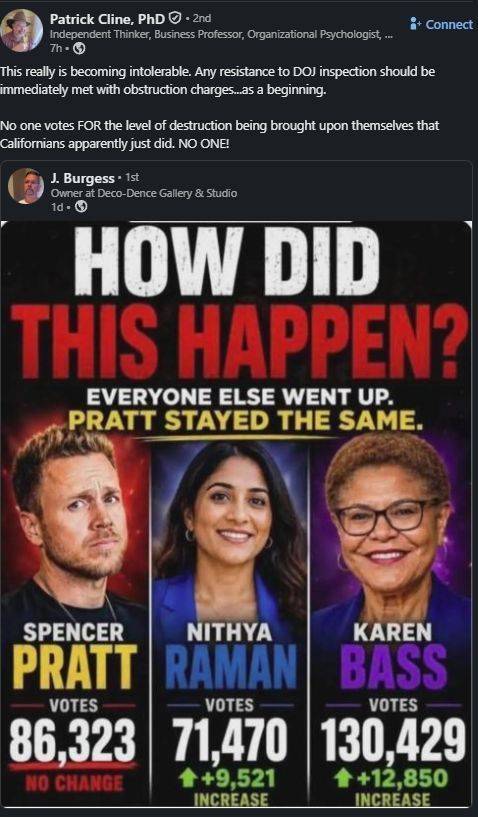
On election night, June 2, Spencer Pratt stood in front of his supporters with what looked like a clear path to the Los Angeles mayoral runoff. Early returns showed him in second place with roughly 30 percent of the vote, running 10 percentage points ahead of City Councilwoman Nithya Raman and holding a lead of approximately 40,000 votes. He was confident. His supporters were confident. Multiple outlets reported the results as showing him poised to face incumbent Mayor Karen Bass in November. Five days later, Sunday June 7, Nithya Raman overtook him. The latest update from the Los Angeles County Registrar-Recorder shows Raman at 27.1 percent and Pratt at 26.7 percent — a gap of roughly 3,100 votes — with 83 percent of the expected vote counted. With 17 percent of ballots still outstanding and the count not concluding until July 3, Pratt's situation is deteriorating. The question the rest of the country should be asking is not simply whether Pratt will survive. The question is how a 40,000-vote lead held on election night can evaporate across five days of drip-fed mail ballot dumps — and what kind of election system produces that result.
What the Numbers Show, Day by Day
The erosion of Pratt's lead has been methodical and consistent. On election night, with roughly 50 percent of the expected vote counted, Pratt led Raman by approximately 10 percentage points — a substantial margin by any normal standard. By Wednesday the gap had narrowed. By Thursday he still held a lead of roughly 6 percentage points. By Friday Raman had closed to within 3 percentage points, gaining twice as many votes as Pratt in a single batch update. By Saturday the gap was roughly 7,500 votes. By Sunday afternoon Raman had passed him.
Every single mail ballot batch released since election night has broken heavily toward Raman and away from Pratt. Not occasionally. Not randomly. Every single one. A candidate who led by 40,000 votes on election night has, through the systematic addition of mail ballots counted after election day, been reduced to a deficit of 3,000 votes. That is not a statistical fluctuation. That is a directional pattern that tells you something specific about where those ballots are coming from and who is processing them.
Election night results with roughly 50% counted: Pratt leads Raman by approximately 10 percentage points, roughly 40,000 votes. Wednesday update: gap narrowing. Thursday: Pratt still leads by 6 percentage points. Friday: Raman closes to within 3 percentage points, gaining twice as many votes as Pratt in one batch. Saturday with 78% counted: gap down to 7,500 votes. Sunday with 83% counted: Raman overtakes Pratt by 3,113 votes. Every subsequent ballot batch breaks the same direction. Every one.
What "Mail Ballot" Really Means in This Context
California mails a ballot to every registered voter automatically. The state mailed ballots starting May 4 — nearly a month before election day. Drop boxes opened May 5. Early voting began May 23. On election night, the votes counted first are the in-person votes cast on the day itself. Those votes went to Pratt at a rate that gave him a 40,000-vote advantage. The votes counted in the days after election night are the mail ballots — returned by mail, dropped off at drop boxes over the preceding weeks, processed and verified after the fact. Those votes are going to Raman at a rate that is erasing a 40,000-vote deficit vote by vote, batch by batch, afternoon by afternoon.
The question worth asking is why the mail ballot electorate and the election-day electorate are producing such radically different results. The honest answer is that they represent different populations. Election-day voters in Los Angeles skew toward people who made a deliberate choice to vote on a specific day — higher-engagement, higher-information voters who were motivated enough by a specific candidate to show up in person. Mail ballot voters include the full registered voter universe, including people who received a ballot automatically, filled it out casually over several weeks and dropped it in a mailbox without the urgency of election day. Different populations, different compositions, different results. That is not fraud. That is the predictable consequence of a system specifically designed to maximize the mail ballot universe at the expense of election-day decisiveness.
When the candidate who wins election night loses the mail ballot count by a margin large enough to flip the result, the system is not reflecting the will of the voters. It is reflecting the will of whichever segment of voters is most efficiently targeted by a month-long mail ballot operation. Those are not the same thing.
Raman's Campaign Knew What Was Coming
One of the most telling details of this story is what Raman said on election night itself. Standing before her supporters on June 2 with results showing her trailing by 10 points, she told the crowd: "Tonight may not give us the final answer on this race. Many thousands of votes will be counted in the days ahead, and we may not get an answer we like." That is not the statement of a candidate resigned to defeat. That is the statement of a campaign that knew exactly how the mail ballot count was going to go. Raman's operation understood the mail ballot universe, knew who had returned ballots before election day and had confidence in what the post-election counting process was going to produce. That is sophisticated campaign infrastructure doing its job. It is also a window into exactly how Los Angeles elections are won and lost — not at the ballot box on election day, but in the weeks of mail ballot harvesting that precede it.
The Expert Who Said It Out Loud
Political communication professor Dan Schnur said on Thursday, before Raman overtook Pratt on Sunday, that "Spencer Pratt has been losing share of the vote with every one of these new ballot dumps, and we expect that to continue. The question is, will he drop? Will Nithya Raman rise? And at some point, will there be an inflection point where Nithya Raman would take over that second spot?" That is a credentialed political analyst, on the record, predicting with confidence on Thursday that a candidate holding a multi-thousand-vote lead would be overtaken by a specific mechanism — continued mail ballot dumps breaking one direction. He was right. The inflection point arrived Sunday. The outcome was predictable to anyone who understood how the system works. That predictability is the problem.
The most unsettling aspect of what happened to Pratt is not that it was illegal. It almost certainly was not. It is that it was entirely predictable, entirely systematic and entirely invisible to a casual observer watching the election-night returns and concluding that Pratt had won second place. The system produces exactly this outcome by design: in-person votes counted first, creating a result that looks decisive; mail ballots counted over the following days and weeks, systematically shifting that result toward the candidate whose operation is best at generating mail ballot returns from the full registered voter universe. The candidate who wins election day is not necessarily the candidate who wins the election. That gap between those two things is where democracy gets quietly rearranged.
Why This Is Different From Normal Counting Delays
Every election has provisional ballots, late-arriving absentee ballots and some counting that extends past election night. That is not the issue. The issue is the scale, the duration and the predictability of the California mail ballot system's effect on results. In most states, election-night results are indicative — they may shift slightly as additional ballots are counted, but a 10-point lead with half the votes in does not routinely become a deficit a week later. In California, that outcome is so common it has a name. Political analysts call it the "blue shift" — the consistent post-election-night movement of results toward Democratic and progressive candidates as mail ballots are counted. The shift is not random noise. It is directional, consistent and structural. It reflects the deliberate design of a system optimized to maximize the participation of low-engagement voters in the mail ballot universe while minimizing the significance of the election-day result that most citizens assume is the election.
The Warning for Every Other State
What is happening to Spencer Pratt in Los Angeles right now is the end state of universal mail voting, extended ballot receipt deadlines and month-long counting windows. It is not a glitch. It is the system working exactly as designed. Every state that is being lobbied to adopt California-style universal mail voting, ballot receipt extensions, automatic registration and extended counting windows is being invited to produce this result. A system where election-night results are essentially meaningless, where a candidate who leads by 40,000 votes on election day can be overtaken a week later by systematic mail ballot processing, and where the outcome is not known for weeks is a system that cannot produce the public trust that democratic elections require. California's defenders will say the system is legal and the counting is accurate. They are probably right on both counts. That does not make it a model worth emulating. Legal and accurate is not the same as legitimate in the eyes of a public that watched one candidate lead all night and wake up five days later being told the lead is gone.
My Bottom Line
Spencer Pratt may yet survive. The count is at 83 percent with 17 percent outstanding, and the remaining ballots could break in any direction. But the damage to public confidence is already done — not because fraud occurred, but because the system produced an outcome that looks, to any reasonable observer, like the election-night result was a fiction. A candidate who led by 40,000 votes on election night, who stood before supporters confidently claiming second place, who was reported across multiple outlets as heading for the runoff, is now trailing by 3,000 votes five days later with the count still incomplete. That outcome, produced entirely within the rules of California's election system, is exactly the outcome that erodes confidence in democratic elections. The erosion is not coming from conspiracy theorists. It is coming from watching the numbers move in the same direction, every single day, until the election-night result is reversed.
You do not need fraud to undermine election confidence. You just need a system where the election-night result means nothing, where a 40,000-vote lead evaporates over five days of afternoon ballot dumps, and where the final answer comes a month after people voted. California built that system. Los Angeles is showing it to the country right now.
Why This Matters
Elections are not just about who wins. They are about whether citizens believe the result reflects what they did when they voted. A system that cannot produce a result on election night, that methodically reverses election-night outcomes through post-election counting, and that operates on a thirty-day timeline normalized by decades of one-party governance is a system that has decided the appearance of accessibility matters more than the reality of public trust. Most Americans still expect to wake up the morning after an election knowing who won. California has decided that expectation is inconvenient. The rest of the country should decide whether it agrees before California's election lawyers arrive at their state capitol with a model bill and a friendly majority to pass it.
References
- NBC Los Angeles. (2026, June 7). Nithya Raman overtakes Spencer Pratt for 2nd place in LA mayoral race, results show. nbclosangeles.com.
- KTLA. (2026, June 7). Nithya Raman overtakes Spencer Pratt in L.A. mayoral race. ktla.com.
- Fox 11 Los Angeles. (2026, June 7). LA mayor's race: Nithya Raman now leads Spencer Pratt for No. 2 spot in runoff election. foxla.com.
- CBS Los Angeles. (2026, June 7). Raman overtakes Pratt in LA mayoral race, now in lead to face Bass. cbsnews.com.
- ABC7 Los Angeles. (2026, June 7). Nithya Raman now just 1 percentage point behind Spencer Pratt in race for LA mayor. abc7.com.
- ABC7 Los Angeles. (2026, June 5). Why does California's vote counting process take so long? abc7.com.
- California Secretary of State. (2026). 2026 Primary Election — vote-by-mail and counting timeline rules. sos.ca.gov.
Disclaimer: The views expressed in this post are the personal opinions of the author and are offered for educational, commentary and public discourse purposes only. They do not represent the positions of any institution, employer, organization or affiliated entity. Nothing in this post constitutes legal, financial, medical or professional advice of any kind. This post does not allege fraud or illegal conduct. It analyzes the structure and effects of California's election system as documented by publicly available sources cited above. Commentary on political subjects reflects the author's independent analysis and is protected expression of opinion. Readers are encouraged to consult primary sources and form their own conclusions.