Let me state the thesis plainly at the outset, because everything that follows depends on understanding it precisely. The United States of America is not a Christian nation. It is a secular republic. Those two descriptions are not interchangeable, and the people who insist on blurring the distinction between them are either confused about American history or are counting on your confusion to advance a political agenda. America has been profoundly shaped by Christianity. Its moral vocabulary, its holidays, its philanthropic traditions, its reform movements and its artistic heritage are all deeply marked by two thousand years of Christian influence on Western civilization. Acknowledging that cultural reality is not the same as conceding a constitutional one. The Constitution, which is the only document that actually governs how this country works, is a secular text. It says so in its very first words. Starting from that fact, clearly and without apology, is the first step toward understanding what this republic actually is and what it was actually built to do.
Fifty-Two Words That Settle the Question
One of the most revealing passages in American history is only fifty-two words long. It is not a prayer. It is not a sermon. It is not a declaration that rights come from God. It is the Preamble to the Constitution of the United States.
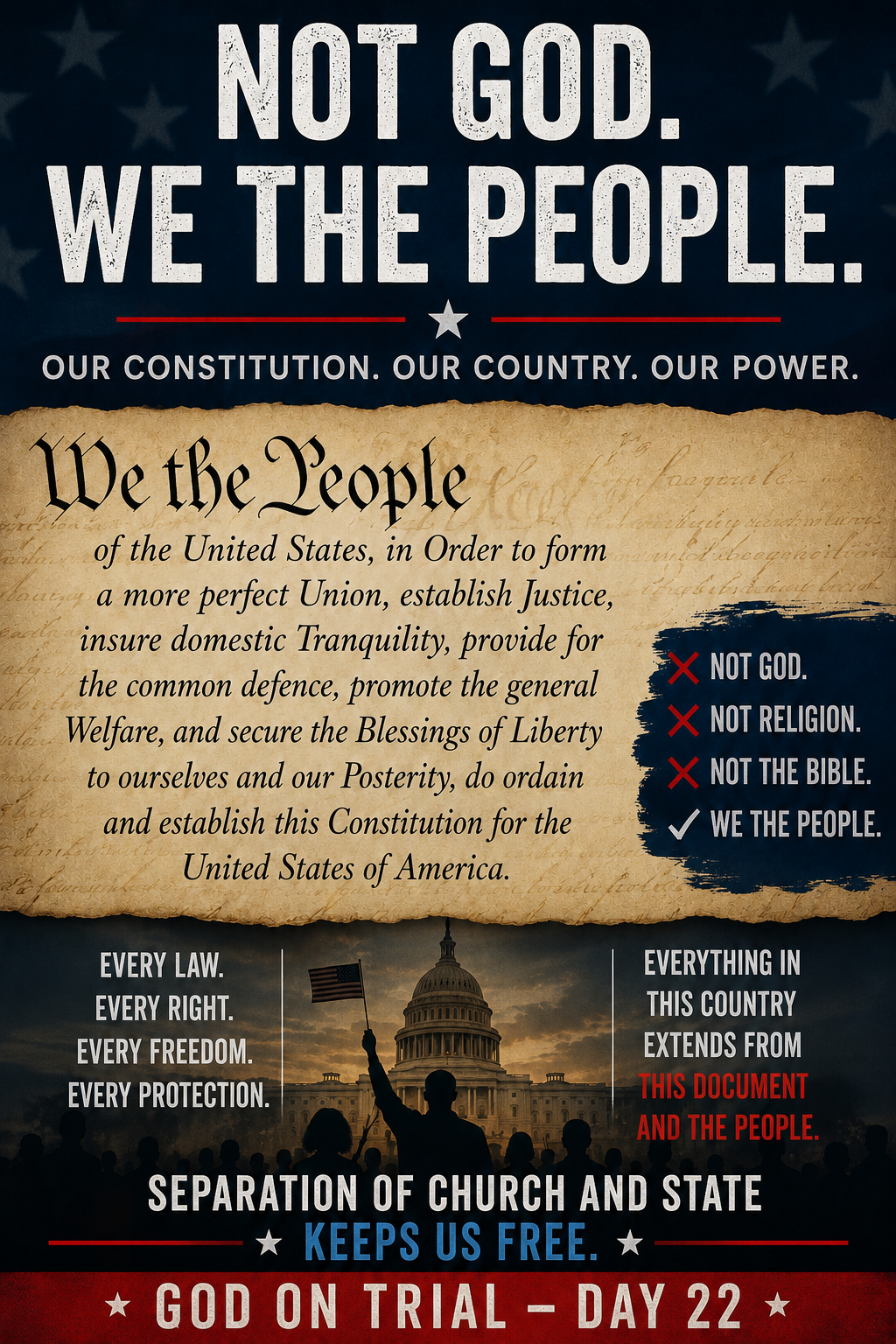
We the People of the United States, in Order to form a more perfect Union, establish Justice, insure domestic Tranquility, provide for the common defence, promote the general Welfare, and secure the Blessings of Liberty to ourselves and our Posterity, do ordain and establish this Constitution for the United States of America.
Read it carefully and ask the simplest possible question: who is acting here? Not God. Not Jesus. Not Christianity. Not the Bible. Not divine providence. The answer is explicit: We the People. That opening phrase is not accidental. It is not decorative. It establishes the source of governmental authority in the clearest possible language. The Constitution does not claim divine authorship. It does not appeal to scriptural mandate. It claims popular sovereignty. The people themselves, acting together as citizens of a new republic, create the government, define its powers and reserve the right to alter it through constitutional amendment. That is a profoundly, deliberately and intentionally secular principle, and the men who wrote it knew exactly what they were doing when they wrote it that way.
Constitutional scholar Akhil Reed Amar of Yale Law School has noted that the Preamble's "We the People" language was a deliberate departure from the Articles of Confederation, which had referenced "the states" as the source of authority. The shift to popular sovereignty was not stylistic. It was a foundational philosophical claim about where legitimate government originates. The people, not divine authority, not state governments, not hereditary aristocracy and not the church, establish the constitutional order. Every legal structure in the United States flows from that claim.
The Document Speaks Loudest Through Its Silences
The claim that America was founded as a Christian nation runs directly into the problem that the most important founding document does not say so. Not once. Not in passing. Not in its purpose, its structure, its enumerated powers or its limitations on government. The Constitution never invokes the authority of God as the source of governmental power. It never establishes Christianity as the nation's religion. It never requires belief in God as a qualification for citizenship or public office. In fact, Article VI goes in precisely the opposite direction, stating that no religious test shall ever be required as a qualification to any office or public trust under the United States. That clause was a deliberate repudiation of the religious test requirements that had existed in English law and in many colonial charters.
The absence of God from the Constitution is not a mystery. The framers were entirely capable of mentioning God when they wished. Many state constitutions of the era did exactly that. Numerous colonial charters explicitly referenced Christianity or divine authority. The delegates who gathered in Philadelphia in 1787 were literate, articulate men who had spent their careers writing legal and political documents. If they had intended to establish a Christian nation, they would have said so. Benjamin Franklin famously proposed a prayer at the beginning of the Convention's proceedings when the delegates were deadlocked in July 1787. The proposal was largely ignored and no prayer was adopted. The Convention proceeded without one. The document they produced reflects that choice.
Influenced By Christianity Is Not the Same as Founded On Christianity
This is the distinction the entire argument turns on, and it is the one that the Christian nationalist movement most aggressively refuses to make. Christianity has shaped America profoundly. The abolitionist movement drew heavily on Christian moral theology and the language of human dignity. The civil rights movement was organized through Black churches and led by a Baptist minister whose most famous speech drew on the prophetic tradition of the Hebrew Bible. American universities, hospitals and charitable organizations have Christian institutional roots stretching back to the colonial period. American culture is saturated with Christian imagery, symbolism, holidays and moral vocabulary that even secular Americans absorb without thinking about its source. None of that is in dispute.
What that history does not establish is that Christianity is the constitutional foundation of American law. A nation can be deeply shaped by a religious tradition without being constitutionally governed by it. France has been shaped by Catholicism for fifteen centuries and is nonetheless a secular republic whose constitution explicitly separates church and state. The influence of Christianity on American culture, language, charity and moral imagination is real and worth studying seriously. What that influence does not establish is that Christian doctrine has constitutional standing in American law. The first is a cultural observation. The second is a legal claim. They require different evidence, and the legal claim has none in the actual text of the Constitution.
America is a secular republic that has been profoundly influenced by Christianity. Those two descriptions are not the same. The Constitution settles the legal question in its first three words. Everything the Christian nationalist movement asks you to believe requires you to pretend those three words mean something other than what they say.
What the Founders Actually Believed About Religion and Government
The founding generation's personal religious views were remarkably diverse, far more so than Christian nationalism acknowledges. Thomas Jefferson created what is now called the Jefferson Bible by cutting the miracles out of the New Testament with a razor and keeping only the moral teachings he found philosophically defensible. He explicitly wrote that Christianity is neither part of the common law nor was it ever intended to be. James Madison, the primary architect of the Constitution, spent his career warning that mixing religion and government corrupts both. George Washington spoke publicly of providence and the Almighty but attended church irregularly, refused to take communion and almost never used specifically Christian language in his private writings. Benjamin Franklin expressed serious doubts about the divinity of Jesus in a letter to Ezra Stiles written weeks before his death.
Most decisively, John Adams signed the Treaty of Tripoli in 1797, which stated explicitly in Article 11 that the Government of the United States of America is not, in any sense, founded on the Christian religion. That treaty was ratified unanimously by a Senate still containing many men who had helped write and ratify the Constitution. It was read aloud in full before ratification. Thomas Paine, whose pamphlet Common Sense helped ignite the Revolution, wrote in The Age of Reason that his mind was his own church and that organized religion was a human institution built on hearsay. These men ranged from devout Protestant to deist to skeptic. What united them was not shared Christian doctrine. It was a shared conviction that government must rest on civic reason and popular consent rather than on theological authority.
The 1797 Treaty of Tripoli was negotiated beginning under George Washington, signed by President John Adams and ratified unanimously by a Senate still containing many men who had helped write and ratify the Constitution. Article 11 stated: "The Government of the United States of America is not, in any sense, founded on the Christian religion." This was a formal, ratified treaty included to assure a Muslim nation that American foreign policy would not be conducted on religious grounds. It was read aloud in full in the Senate before its unanimous ratification. It is the clearest single piece of documentary evidence that the founding generation itself did not believe the United States was founded as a Christian nation. Christian nationalists consistently omit it from their arguments, which tells you something about the quality of those arguments.
The First Amendment Completes What the Preamble Begins
The Constitution's opening establishes that governmental authority comes from the people. The First Amendment then ensures that government remains permanently neutral toward religion by prohibiting Congress from making any law respecting an establishment of religion, while simultaneously protecting every person's free exercise of religion. The establishment clause prevents the government from endorsing, funding or privileging any religious tradition. The free exercise clause prevents the government from interfering with any individual's or community's practice of their faith. Together they create what Jefferson called a wall of separation between church and state, protecting both institutions by keeping them out of each other's domain.
This arrangement was not hostile to religion. As Madison argued in his Memorial and Remonstrance Against Religious Assessments, it was the best possible protection religion could have, because a government that cannot establish a religion also cannot suppress one. The Baptist communities that had faced persecution from Congregationalist establishment in New England understood this immediately. Roger Williams, the founder of Rhode Island and one of the earliest American advocates for separation of church and state, was a devout Christian who argued for separation precisely to protect his faith from government corruption. The wall Jefferson described was built to protect the church from the state as much as the state from the church. Christian nationalists who attack church-state separation are attacking one of the most important protections their own faith has ever had.
What Christian Influence Actually Looks Like in a Secular Republic
Here is what Christian influence on a secular republic looks like in practice, and here is what it does not look like. Christian citizens have every right to be motivated by their faith in their political participation. A Christian voter who opposes the death penalty because of their reading of the gospels is exercising their constitutional rights. A Christian legislator who advocates for poverty relief because of their faith's teachings on charity is participating exactly as the founders intended. A Christian activist who works for criminal justice reform on theological grounds is exercising protected democratic participation. Faith can and does inform political conviction. The abolitionists who invoked scripture against slavery were right about slavery, and the scriptural argument was a real part of why they were right.
What Christian influence on a secular republic does not look like is the government mandating Christian doctrine as civil law, funding Christian religious instruction with public tax money, requiring citizens to live under legal rules derived from scriptural interpretation without their consent, or treating Christian identity as a qualification for full civic participation. The line between those two sets of examples is the First Amendment's establishment clause, and it exists to prevent the second set from occurring regardless of which religious tradition is seeking to cross it.
The Danger of Misreading the Founding
When the Christian nationalist movement convinces enough Americans that the United States was founded as a Christian nation, it creates a false historical premise from which almost any legislative conclusion can follow. If America is a Christian nation, then Christian doctrine has a special claim on American law that no other tradition can match. If Christian doctrine has that special claim, then laws derived from Christian theological positions on marriage, reproduction, education, gender, sexuality and public morality are not merely policy preferences subject to democratic debate. They are restorations of the authentic American constitutional order that secular liberalism has corrupted. That framing forecloses democratic argument before it begins, which is precisely its political function. You cannot persuade someone to reconsider a policy if they believe that policy is the recovery of a founding truth that was illegitimately taken from them.
This is why the historical argument matters so much. Not because history controls every policy question, but because the Christian nation myth is being used as the foundation for a much larger claim about who America belongs to and whose values should govern it. That claim is false as a matter of historical record, false as a matter of constitutional text and false as a matter of the founders' documented intentions. Correcting it is not an attack on Christianity. It is an attack on a specific political use of Christianity that the founders themselves, including the devout Christians among them, would have recognized as a misuse of their legacy.
My Bottom Line
The Constitution begins with We the People. Not We the Christians. Not We the Followers of the Bible. Not We the Believers in the God of Abraham. We the People, a phrase that encompasses every citizen of this republic regardless of their theological convictions or lack of them. That opening is not an accident. It is a statement of the principle on which the entire constitutional order rests: popular sovereignty, not divine mandate. Government in America derives its legitimate authority from the consent of the governed, which means it must be accountable to all the governed equally, without privileging the theological commitments of any subset of them.
America is not a Christian nation. It is a secular republic with deep Christian cultural roots, a long history of Christian moral influence on its public life and a First Amendment that protects Christian worship, Christian speech and Christian political participation with exactly the same force it extends to every other tradition. That arrangement is not an insult to Christianity. It is one of the greatest gifts any political system has ever given to a religious tradition: the freedom to thrive on its own merits, by its own persuasion, without needing or receiving the coercive power of the state to sustain it. The founders understood that. The Constitution they wrote proves it. Start here.
We the People. Not We the Christians. Three words that carry two and a half centuries of constitutional weight. The Christian nationalist movement requires you to pretend those three words mean something other than what they say. They do not. Read the document.
Why This Matters
This post is the starting point, not the conclusion. Understanding that the Constitution is a secular document built on popular sovereignty is the first step toward understanding the entire argument about church and state in America. From this foundation, the questions that follow become sharper and more answerable. Why does the Christian nationalist claim contradict the founders' own documented statements? Because the Treaty of Tripoli and the Memorial and Remonstrance and the Jefferson Bible and the absence of God from the Constitution's text are not ambiguous evidence. Why does it matter that religious influence on culture is different from religious authority over law? Because one is compatible with a free republic and one is not. The secular republic the founders built has sheltered Christianity's free practice for two and a half centuries more effectively than any established church in human history ever sheltered the faith it was supposedly protecting. Defending that secular constitution against the effort to misread it is not hostility to faith. It is fidelity to the document and to the founders who wrote it knowing exactly what they were writing and why.
References
- U.S. Constitution, Preamble. (1787).
- U.S. Constitution, Article VI, Clause 3. (1787).
- U.S. Constitution, First Amendment. (1791).
- Treaty of Tripoli, Article 11. (1797). Ratified unanimously by the U.S. Senate.
- Madison, J. (1785). Memorial and Remonstrance Against Religious Assessments.
- Jefferson, T. (1802). Letter to the Danbury Baptist Association.
- Jefferson, T. (1820). The Jefferson Bible.
- Amar, A. R. (2005). America's Constitution: A biography. Random House.
- Kruse, K. M. (2015). One nation under God. Basic Books.
- Fea, J. (2011). Was America founded as a Christian nation? Westminster John Knox Press.
- Paine, T. (1794). The Age of Reason.
Disclaimer: The views expressed in this post are the personal opinions of the author and are offered for educational, commentary and public discourse purposes only. They do not represent the positions of any institution, employer, organization or affiliated entity. Nothing in this post constitutes legal, financial, medical or professional advice of any kind. References to constitutional history and public figures are based on publicly available sources cited above. Commentary on religious, political and constitutional subjects reflects the author's independent analysis and is protected expression of opinion. Readers are encouraged to consult primary sources and form their own conclusions.