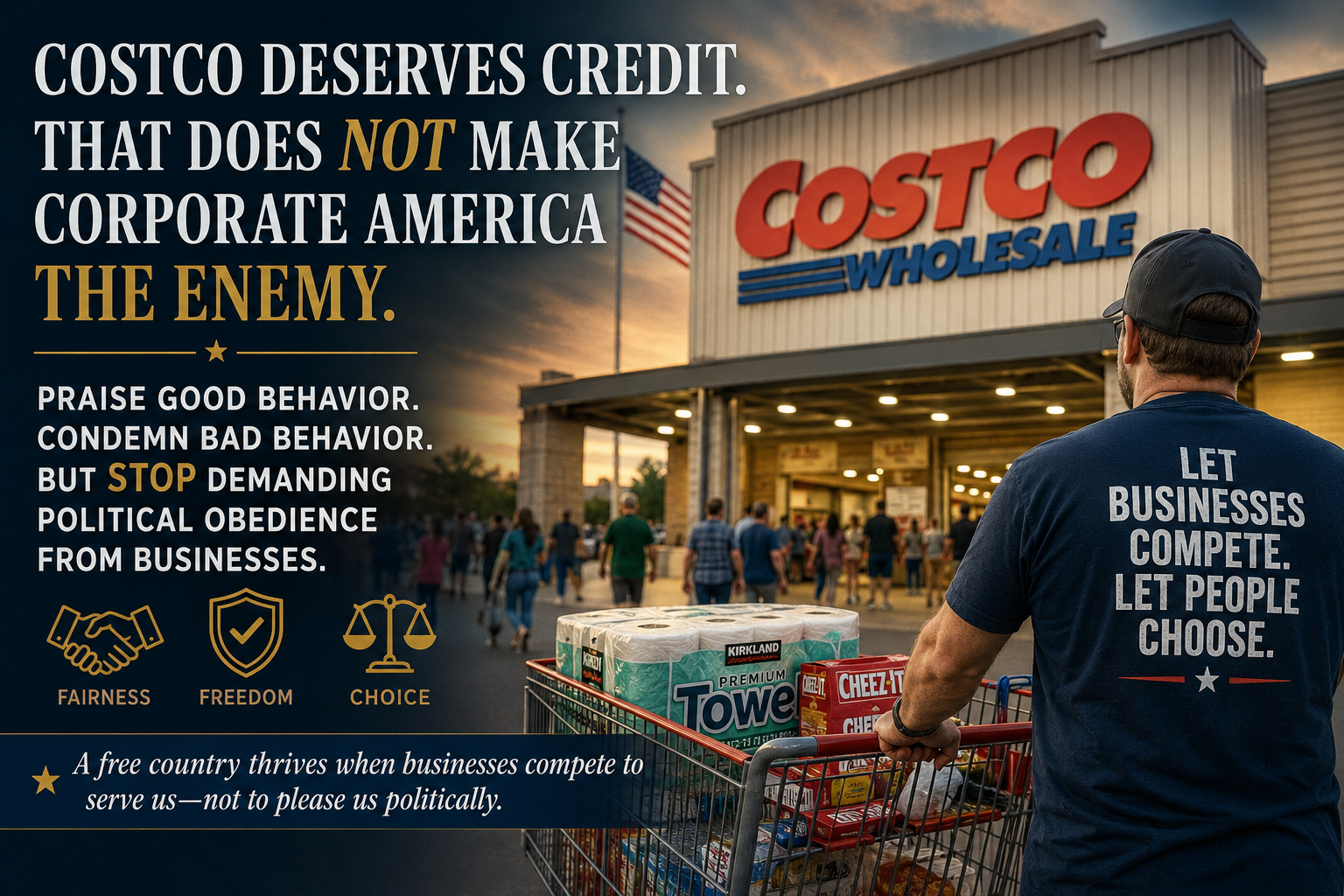
The story circulating about Costco is genuinely touching. According to the post, a Costco employee suffering from Stage 4 cancer was allowed to continue working manageable shifts so she could retain her health insurance, and after her death, Costco reportedly continued helping her family with health coverage. I have not found independent documentation confirming that individual story, so it should be treated as a personal account rather than established fact. But the larger point about Costco is fair.
Costco has a reputation for relatively strong compensation and benefits. Its own 2025 sustainability report put the average hourly wage for U.S. warehouse and distribution employees at about $30 during the fiscal year, with the rate at the end of the year approaching $32. Its careers materials advertise health insurance, retirement benefits, paid leave, disability coverage and predictable scheduling. Good. Companies that treat employees well deserve recognition.
What I reject is the ideological baggage being attached to the story: "the greed on display from major corporations today is absolutely destroying society." That conclusion simply does not follow.
Profit Is Not a Moral Failure
We have developed a strange habit in America of treating the word "profit" as though it were synonymous with "greed." It isn't. Greed is a human characteristic. Profit is an economic measurement.
A company buys materials, hires employees, rents or purchases facilities, and pays for insurance, equipment, utilities, technology, advertising, transportation, taxes, legal services, accounting and financing, among countless other expenses. It then has to sell something for more than all of those things cost. If it cannot, it eventually disappears. That is not exploitation. That is arithmetic.
There are certainly corporations that behave badly. Companies have committed fraud, abused workers, polluted communities, manipulated markets, bribed officials, lied to customers and used political connections to suppress competition. Punish them. Enforce the law. Sue them when appropriate. Fine them when appropriate. Break up monopolistic arrangements when warranted. But identify the misconduct first. Simply pointing toward a profitable company and yelling "greed" tells us almost nothing.
Costco Is Actually Evidence Against the Argument
There is an irony here. People frequently point to Costco as proof that capitalism is failing. I see almost exactly the opposite. Costco is a gigantic profit-seeking corporation operating inside a capitalist economy.
Nobody forced Costco to develop its particular compensation model, and nobody assigned Costco its business culture from Washington. The company concluded that paying employees comparatively well, offering substantial benefits, retaining experienced workers, selling goods at relatively low margins, charging membership fees and cultivating customer loyalty amounted to a successful business strategy. And it worked. That is capitalism too.
Capitalism does not require businesses to treat employees badly. It allows businesses to compete over how they treat employees. A company can pursue higher wages because it believes lower turnover improves productivity, while another emphasizes flexible schedules, bonuses or profit sharing, and still another operates on thinner margins and offers fewer benefits instead. Employees, customers and investors all make their own choices in response, and competitors adjust accordingly. That messy process is one of the reasons market economies are extraordinarily adaptable.
Nor Does Costco Owe Either Political Party Its Allegiance
This is where the conversation becomes even more important. Costco came under considerable political scrutiny in 2025 because it declined to abandon its diversity policies. At its January 2025 shareholder meeting, more than 98 percent of votes cast opposed a shareholder proposal asking the company to examine business risks associated with its DEI policies.
A 98 percent vote against the proposal does not necessarily mean 98 percent of shareholders enthusiastically endorsed every DEI policy ever conceived. They rejected that particular proposal, on those particular terms, and that is their right as owners of the company.
I have criticized DEI extensively when it substitutes racial or sexual classifications for individual merit, creates ideological litmus tests or produces discriminatory outcomes. But here is the part conservatives should understand just as clearly as progressives: Costco does not owe me obedience, and it does not owe Republicans, Democrats, activists or Trump obedience either. A private company operating lawfully should generally be allowed to decide how it wants to run its business. And then I get to decide whether I want to shop there. That is the bargain.
We Are Turning Every Purchase Into a Political Loyalty Test
This is becoming ridiculous on both sides. A company changes a logo, and somebody calls for a boycott. A company sponsors Pride, and somebody calls for a boycott. A company eliminates DEI, and somebody else calls for a boycott. A CEO mentions immigration, or advertises on the wrong network, and the same cycle starts again. A beer company hires the wrong spokesperson. A retailer sells the wrong book. A restaurant owner makes the wrong political contribution. A manufacturer refuses to take a position on Gaza, abortion, transgender issues, Trump, climate change, guns or immigration, whatever happens to dominate social media that afternoon. Suddenly buying a cheeseburger requires a political background check.
Enough. Citizens should absolutely vote with their wallets when something matters deeply to them, and consumer choice is itself part of a free economy. But a free society cannot function very well if every business is expected to publicly swear allegiance to somebody's political catechism.
Sometimes I just want the company to make a good refrigerator.
Businesses Are Not "Destroying Society"
The broader accusation is even more difficult to defend. American businesses employ roughly the entire private-sector workforce. They build our houses, move our freight, develop our medicines, manufacture our equipment, program our software, grow and distribute our food, repair our cars, build our roads, finance our mortgages, create our entertainment, design our computers, construct our hospitals and provide our telecommunications. They also stock places like Costco with an almost absurd quantity of goods that ordinary Americans can purchase at prices that would have astonished previous generations.
That does not make corporations saints. It makes them institutions created and operated by human beings. Some are excellent. Some are mediocre. Some are predatory. Most are somewhere in between. The proper response is not romanticizing corporations, nor demonizing them. It is judging their conduct.
And There Is Such a Thing as Corporate Greed
None of this means corporate misconduct should be ignored. I have no sympathy for a company that deliberately cheats employees out of wages, conspires to eliminate competition, knowingly sells dangerous products, falsifies financial information, abuses government contracts or purchases political favors that protect it from competition. That isn't a defense of capitalism. Quite often, it is an attempt to escape capitalism. A company that gets government to prevent competitors from challenging it is not triumphing in the free market. It is manipulating government to avoid the free market. That distinction matters.
There is capitalism. And there is crony capitalism. They aren't the same thing.
Treating Employees Well Is Also Good Business
Perhaps the most interesting thing about Costco is that humane treatment of workers does not necessarily require businesses to behave irrationally. Employee turnover is expensive, recruiting is expensive and training is expensive. Inexperienced workers make mistakes, while long-term employees accumulate knowledge, and satisfied employees tend to provide better service, which creates loyal customers who spend money. Suddenly the allegedly revolutionary concept of treating employees decently starts looking suspiciously like a business strategy.
Costco reported remarkably low voluntary turnover among warehouse and distribution employees in FY2025, around 10 percent. Maybe Costco isn't demonstrating the failure of capitalism. Maybe it is demonstrating one of capitalism's strengths.
My Bottom Line
I applaud Costco when it treats an employee battling cancer with compassion. I applaud companies that voluntarily pay good wages, provide good benefits and treat employees as human beings rather than interchangeable numbers on a spreadsheet. But none of that requires me to embrace the claim that major corporations are destroying society, nor does it require Costco to conform to my politics.
A company should be judged by what it actually does. Does it obey the law? Does it honor its contracts? Does it provide the product it promises? Does it deal honestly with customers? Does it compensate employees according to the agreements it makes with them? Does it compete fairly? Does it create something people voluntarily want to buy? Those questions matter considerably more to me than whether its CEO has the correct opinion about whatever Democrats or Republicans are fighting about this week.
Why This Matters
There is a dangerous temptation on both political extremes to believe that every institution in society must belong to the cause, that businesses, universities, movies, sports leagues, churches and social media companies must all agree with us. Eventually there is no neutral ground left, and that is not pluralism. A free country requires the ability to live alongside people and institutions that sometimes make decisions we dislike.
So, yes, buy the Costco membership if you admire the way Costco treats its workers. That is precisely what consumer choice is supposed to accomplish. But we don't need to condemn the rest of American enterprise to appreciate a company doing something right.
Praise good behavior. Condemn bad behavior. And stop demanding political obedience from businesses simply because we happen to disagree with them. That sounds considerably more American to me.
References
- Costco Wholesale Corporation. (2025). 2025 Annual Sustainability Report. [Average U.S. warehouse and distribution wage of approximately $30 per hour during FY2025, approaching $32 by year end; voluntary turnover around 10 percent.]
- Costco Wholesale Corporation. Why Costco: Careers. costco.com. [Employee benefits and scheduling information.]
- Reuters. (2025, January 23). Costco shareholders reject proposal seeking an assessment of risks associated with the company's diversity initiatives, with more than 98 percent of votes cast against it.
Disclaimer: This article reflects the author's personal opinions on business, capitalism and corporate accountability, offered for commentary and public discourse purposes only. The individual anecdote referenced at the start is treated as an unverified personal account, not established fact. It does not represent the positions of any institution, employer, organization or affiliated entity with which the author may be associated in any capacity. Readers are encouraged to consult primary sources and form their own conclusions.