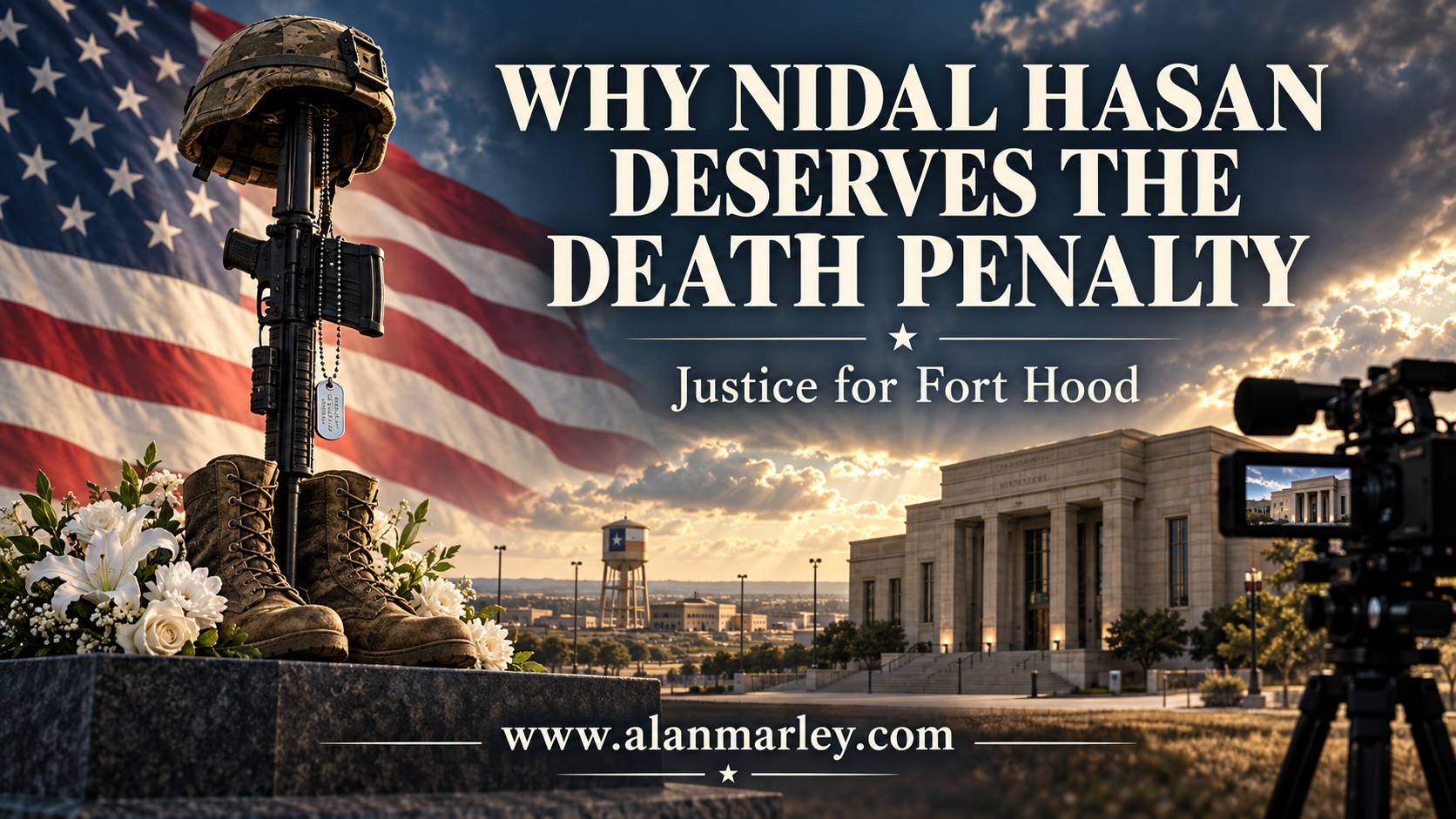
I support capital punishment for the most serious, proven murders. I believe some deliberate acts of killing warrant society’s highest lawful punishment, and I believe Nidal Hasan’s massacre at Fort Hood is one of them.
There is a factual distinction to make at the outset. Hasan has not yet been executed. As of October 10, 2026, his execution by firing squad is scheduled for December 3 at Fort Hood. A scheduled execution remains subject to legal developments. This is an argument for carrying out his sentence through the lawful process, not a report that it has already happened. [6, 1]
If that sentence is carried out, I would regard it as a victory for justice, for the people he murdered and for the country whose uniform he wore. That is my judgment. It does not presume to tell every survivor or bereaved family how to feel.
Start With What He Did
On November 5, 2009, Hasan opened fire at Fort Hood. Thirteen people were killed and 32 others were wounded. In 2013, a court-martial convicted him of 13 counts of premeditated murder and 32 counts of attempted premeditated murder. He received a death sentence on August 28, 2013. [6, 2]
The word premeditated matters. This was a deliberate attack that ended lives and imposed consequences on other people that no appeal, apology or passage of time can reverse.
Hasan was an Army officer and a psychiatrist. Those roles carried obligations of trust. His victims were entitled to expect that a fellow service member would not turn a military workplace into a killing ground. His betrayal makes the crime more appalling, not less accountable.
The case for his punishment rests on his conduct and the proven charges. His religion does not excuse his crimes. But by his own account it is part of why he committed them, and an honest account has to say so.
Why He Did It
Nobody has to guess at his motive, because Hasan stated it himself. In his opening statement on August 6, 2013, he admitted he was the gunman and said he had “switched sides,” describing himself as a mujahideen waging jihad against the United States. In documents released that August he wrote that he had to renounce oaths requiring him to defend a man-made constitution over Islamic commandments. He told others that Muslims should not be in the military because Muslims should not kill Muslims. [7]
The record before the attack points the same direction. He wrote nearly 20 emails to the radical cleric Anwar al-Awlaki between December 2008 and June 2009, and in one of them he said he could not wait to join him. Two days before the shooting he gave away his furniture and handed out Qurans. [7] The government spent years calling the attack workplace violence. In 2015, after Congress broadened Purple Heart eligibility to cover attacks inspired by a foreign terrorist organization, the Army approved the award for the Fort Hood victims. [7]
This is my reading of that record: Hasan killed in part because of the religious ideology he embraced, and he said so in open court and in his own writing. A man who names his faith as his reason owns that reason. That is a statement about one man’s stated beliefs. Muslims have served and died in the American uniform, and nobody who shares his faith is answerable for what he did.
The Epitome of Cowardice
I also want to say what kind of act this was. It was cowardice. Hasan did not face an armed enemy. He walked into a building full of fellow soldiers who were being processed for deployment, people who had no reason to suspect that an officer and a doctor among them would turn on them, and he opened fire. His victims never had a chance to see it coming. Courage is standing against someone who can fight back. Shooting the unsuspecting is the opposite.
In my opinion that is the mark of most terrorist acts, if not all of them. The terrorist does not pick a fair fight. He picks the people who are unarmed and unprepared: men, women and children going about an ordinary day. He then calls it a cause. Strip away the slogans and what is left is a person who preys on the innocent because they cannot stop him. Hasan was no exception. His own words about jihad do not change what he did, which was to murder defenseless people who trusted him.
Punishment Has a Purpose Beyond Containment
Opponents of capital punishment reasonably point out that a secure prison can incapacitate a murderer. That is true, and I do not need to pretend otherwise to defend the death penalty.
Containment, however, is only one purpose of punishment. A sentence also expresses a judgment about culpability and the gravity of an offense. Society distinguishes among crimes because different acts deserve different consequences. In my view, the most aggravated intentional murders can justify the most severe sentence.
That is the central virtue of capital punishment as I understand it: proportional accountability. It recognizes that some choices are so destructive, so deliberate and so final for their victims that permanent imprisonment does not fully answer their gravity.
Reasonable people disagree with that judgment. But calling every supporter bloodthirsty avoids the argument. I support a severe punishment following proof and lawful adjudication. I do not support private retaliation or a crowd deciding who should die.
The Victims Deserve More Than a Number
The thirteen people killed were Michael Cahill, Libardo Caraveo, Justin Decrow, John Gaffaney, Frederick Greene, Jason Hunt, Amy Krueger, Aaron Nemelka, Michael Pearson, Russell Seager, Francheska Velez, Juanita Warman and Kham Xiong. The Army’s casualty announcement identified twelve soldiers and one civilian employee. [3]
Their names belong in any discussion of Hasan’s fate. Each had a life extending beyond the place and moment of the attack. Reducing them to a number while endlessly examining the murderer’s future gets the moral emphasis wrong.
The Army’s account of the sentencing records family members welcoming the verdict and expressing relief at accountability. It also records the enduring devastation of their losses. Those two responses can coexist. Justice can matter even when it cannot repair the damage. [2]
I will not promise that an execution would deliver closure. No outsider has the right to prescribe an ending to another person’s grief. Calling it a victory for the victims means, in my argument, that the judgment against the person who murdered them is fulfilled. It does not mean their absence stops hurting.
A Victory for America Means Enforcing the Law
For America, the victory would be in holding a mass murderer accountable through institutions that gave him a trial and legal review. A country should be capable of defending the rights of an accused person and then enforcing a justified punishment after conviction.
Due process is part of the case for lawful capital punishment. It gives the state a basis for acting that a murderer never possessed. If we want the final judgment to carry moral authority, we must care about how the government reaches and carries it out.
That also means obeying any lawful stay and addressing legitimate claims of error. Supporting this sentence does not require granting the government permission to ignore its own rules. The objective is an enforceable judgment, reached and implemented fairly.
Necessary review should be thorough. Once the applicable process permits enforcement, the government should carry out the sentence.
Use Arguments That Can Withstand Scrutiny
There is no need to inflate the case with promises the evidence cannot support. I would not claim that executing Hasan will prevent the next mass shooting or that capital punishment has been conclusively shown to reduce murder more effectively than imprisonment. A National Research Council review found the existing research uninformative about the death penalty’s effect on homicide rates. [4]
My argument rests on deserved punishment, rather than a statistical guarantee about someone else’s future behavior.
Nor does execution offer a benefit that imprisonment can never provide merely because both prevent a prisoner from moving freely through society. The real disagreement is whether incarceration is a sufficient punishment for the worst intentional murders. I believe it is not always sufficient.
The possibility of wrongful conviction must also be taken seriously. An irreversible punishment demands exceptional care with evidence, competent representation and meaningful review. Hasan’s admitted role and his convictions make this case substantially different from one dependent on a disputed identification. They do not make safeguards optional. [1, 2]
I Fully Support a Public Execution
The announced plan to livestream Hasan’s execution has generated controversy. [5] My position is straightforward: I fully support a public execution, and I think it should be aired on every television station in the country.
Americans should have the opportunity to witness the lawful consequence of the mass murder committed at Fort Hood. In my view, public accountability should include seeing the sentence carried out, rather than receiving another announcement about a case that has stretched across years.
I believe a nationwide broadcast would make that accountability visible. The coverage should identify and honor the thirteen people Hasan murdered and explain the crime, the verdict and the legal process that led to the sentence. Viewers can decide whether to watch. My position is that every station should carry it.
My Bottom Line
I support the death penalty for the gravest proven murders, imposed individually through a fair legal process. Nidal Hasan’s crimes warrant that punishment. I also fully support making his execution public and airing it on every television station in the country.
Carrying out his sentence would be a victory for justice because it would enforce accountability for deliberate mass murder. It would honor the victims by affirming the seriousness of what was done to them. And it would be a victory for America in the limited but important sense that a lawful judgment had been carried through.
It would not restore thirteen lives. No sentence can. The inability to undo a crime is no reason to abandon the punishment it deserves.
Why This Matters
A justice system must protect against wrongful punishment while remaining capable of imposing deserved punishment. Those responsibilities belong together.
The Fort Hood victims deserve remembrance, and the survivors deserve continuing care and support. Neither responsibility ends when a sentence is carried out. But accountability is also part of what the country owes them.
Hasan chose to commit mass murder. I believe the lawful consequence should be the death sentence he received.
- Associated Press. (2026, October). Firing squad execution of Fort Hood shooter Nidal Hasan scheduled for December. Hasan’s admission and the potential for additional litigation. apnews.com/article/f72c1a8f1c8cf6872b518ea08ffa7035
- Fort Hood Public Affairs and ARNEWS. (2013, September 3). Fort Hood shooter Hasan sentenced to death. U.S. Army. army.mil/article/110393/fort_hood_shooter_hasan_sentenced_to_death
- III Corps & Fort Hood Public Affairs Office. (2009, November 7). Fort Hood releases names of casualties. U.S. Army. army.mil/article-amp/30037/fort_hood_releases_names_of_casualties
- National Research Council. (2012). Deterrence and the Death Penalty. National Academies Press. law.upenn.edu/live/files/1529-nagin-full-reportpdf
- Reuters. (2026, October 9). Vance says he won’t watch livestream of execution; Trump remains silent. reuters.com/world/us/trump-silent-pentagon-plan-livestream-execution-2026-10-09/
- Simkins, J. D. (2026, October 7). Army sets date, location for execution of Nidal Malik Hasan. Military Times. militarytimes.com/news/your-military/2026/10/07/army-sets-date-location-for-execution-of-nidal-malik-hasan/
- Wikipedia. 2009 Fort Hood shooting. Hasan’s statements of motive, emails to al-Awlaki, workplace violence classification, 2015 Purple Heart awards. en.wikipedia.org/wiki/2009_Fort_Hood_shooting