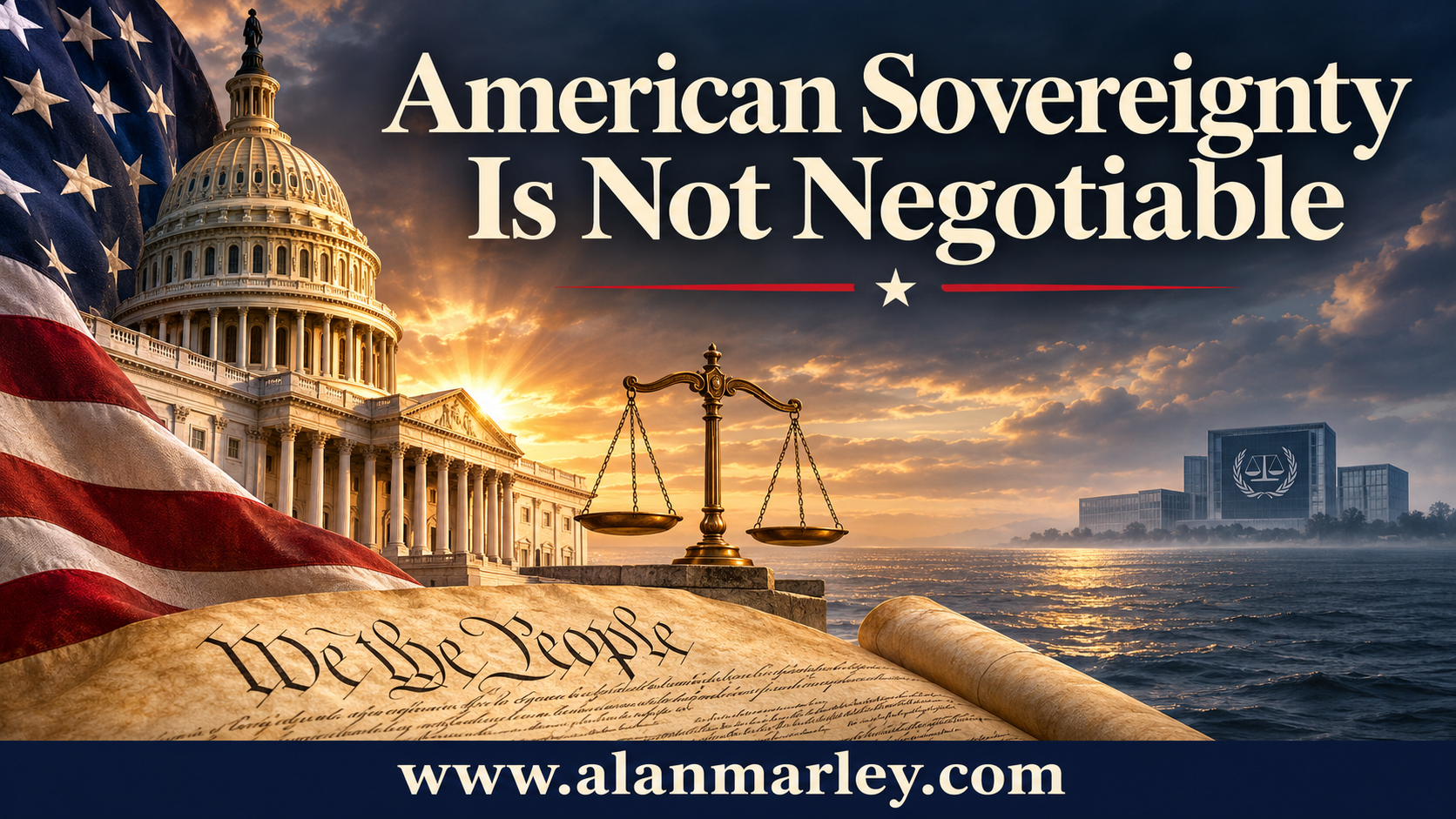
In response to The Atlantic’s criticism of Marco Rubio and Pete Hegseth, I examine a fundamental distinction that seems increasingly lost in political discourse: rejecting the authority of an international tribunal is not the same as rejecting the rule of law.
The United States never ratified the treaty establishing the International Criminal Court. Yet the ICC claims jurisdiction over Americans under certain circumstances.
Our Constitution, not an unelected international tribunal, is the foundation of American government. We can uphold the laws of war, demand accountability from our leaders, and cooperate internationally without surrendering our sovereignty.
The Line I Am Drawing
Let me say it as plainly as I can. I do not accept any international authority over the United States. Not a court, not a council, not a convention, not a committee of diplomats in a conference room. The United States is a sovereign nation. We are not a province of a global order, and we are not global citizens. We are Americans, governed by an American Constitution, answerable to American voters.
That is not a negotiating position. It is not a preference I am willing to trade for goodwill at a conference. The moment a country agrees that some outside body may judge its citizens, command its officials, or overrule its laws, it has stopped being self-governing. It has become a client.
Everything else in this piece is the argument for that line.
What Actually Happened
On Friday, November 13, 2026, Secretary of State Marco Rubio delivered the keynote at the Federalist Society’s National Lawyers Convention. He attacked what he called the weaponization of international law and aimed most of his fire at the International Criminal Court. He described a body accountable to no one that is armed with the power to investigate, prosecute, and jail American citizens under laws Americans neither consented to nor control. He warned the Court against quoting laws to men with swords. [14]
The next evening, Defense Secretary Pete Hegseth reposted a clip of the speech with a seven-word message of his own in all caps: “Stop quoting laws to MEN WITH SWORDS.” [11] Critics erupted. One journalist called the line deeply un-American and noted that the military is itself subject to law. [11]
Notice what the critics did. They took a rhetorical flourish and treated it as the whole argument. The argument itself, the one in the body of Rubio’s speech, was about consent: no court that Americans did not join gets to judge Americans. Nobody answering him has explained why that is wrong. They have only explained why the phrasing upset them.
The Rule of Law Means Our Law
The people who accuse sovereignty defenders of rejecting the rule of law are playing a trick with the word “law.” They treat the phrase as if it meant any rule written down by any body anywhere. It does not. Law is legitimate because the people it governs have a say in making it and the power to change it. A rule that comes from a body you cannot vote for, cannot lobby, and cannot remove is not law in that sense. It is a command with paperwork.
Americans already live under dense, serious law governing the use of force. The Constitution divides war powers between Congress and the president and puts both under the courts. The Uniform Code of Military Justice places every service member under criminal law, with investigations, courts-martial, and appeals. [17] Congress has made war crimes a federal offense, covering grave breaches of the Geneva Conventions whenever the offender or the victim is an American national or a member of the armed forces. [19]
We do not need a foreign court to tell us what the laws of war require. We wrote our own enforcement into our own statutes. When an American commits a war crime, the right institution to try him is an American one, under American law, in front of Americans who can be held to account for the result.
We Never Signed
The history is not complicated, and it is not partisan. The Rome Statute was adopted in 1998. At the Rome conference, the United States voted against it. [3] President Clinton signed it on December 31, 2000, the last day it was open for signature, and in the same breath declared that it contained significant flaws and that he would not submit it to the Senate for its advice and consent. [3]
That is the end of the matter under our Constitution. Treaties bind the United States only when the president negotiates them and two-thirds of the Senate consents. [16] The Senate never voted. It was never asked. A treaty that is signed but never ratified does not bind this country as law.
In May 2002, the Bush administration formally told the United Nations that the United States did not intend to become a party and recognized no obligation under the treaty. [3] In August 2002, President Bush signed the American Servicemembers’ Protection Act, restricting U.S. government cooperation with the Court. [3] The administration also negotiated well over one hundred bilateral agreements under Article 98 of the Statute to keep other countries from handing U.S. personnel to the Court without American consent. [7]
When President Biden took office, he revoked the Trump administration’s sanctions on Court personnel, but he did not join the Court either. [1] The 2002 statute stayed on the books, and I want it to stay there. Presidents of both parties, across a quarter century, have left the United States exactly where it started: outside.
A Court That Claims Power It Was Never Given
The Court was built to prosecute four categories of crime: genocide, crimes against humanity, war crimes, and aggression. [13] Those are serious crimes, and serious people take them seriously. But the Court’s reach is not limited to the countries that joined.
Article 12 of the Statute lets the Court exercise jurisdiction when a crime occurs on the territory of a member state, regardless of the accused’s nationality. [13] That is how the Court ended up claiming authority over Americans. In April 2019, a pre-trial chamber rejected the prosecutor’s request to open an investigation in Afghanistan. [9] In March 2020, the Appeals Chamber reversed and authorized it, covering alleged crimes committed in Afghanistan and on the territory of other member states, including alleged war crimes by members of the U.S. armed forces and the CIA. [1]
Washington declined to join, and the Senate never consented. Yet a panel of foreign judges concluded that American soldiers and intelligence officers could be investigated anyway, because of where the alleged conduct took place.
The Court’s answer is that member states delegated their own territorial jurisdiction to it, and that the accused are subject to it while on member territory. Fine. A member state can delegate whatever authority it holds. It cannot delegate mine. The basic rule of treaty law is that a treaty does not create obligations or rights for a third state without its consent. [18] The United States is a third state. The Statute does not bind us, and a clever theory of territorial reach does not change that.
In June 2020, the Trump administration issued Executive Order 13928, authorizing sanctions against ICC personnel involved in investigating U.S. personnel and certain allies. The Biden administration revoked it in April 2021. [1] The administrations disagreed on tactics. They did not disagree on the underlying position, which is why no president has ever submitted the treaty for ratification.
There is also a lesson in how the United States has had to protect itself. Because the Court claims reach over Americans abroad, Washington negotiated more than a hundred bilateral agreements to guard its personnel, country by country, deal by deal. [7] That is a strange way to run a foreign policy, with every host nation and base agreement carrying an extra clause because a court in The Hague asserted authority it was never given.
American independence is not an inconvenience to international governance. It is the foundation of our republic.
Complementarity Is Not a Concession
The Court’s defenders have a standard reply. Under the principle of complementarity in Article 17, the Court is supposed to act only as a last resort. A case is inadmissible if a state with jurisdiction is genuinely investigating or prosecuting it, and the Court steps in only if that state is unwilling or unable to do so. [13] In theory, they say, a country with working courts has nothing to fear.
Read that carefully. Who decides whether an American investigation is genuine? The Court does. [13] Who decides whether an American court is willing or able? The Court does. A body made up of judges that Americans did not choose, selected by an assembly of member states, would sit in judgment over whether our own institutions were adequate. [13]
I do not accept that. No foreign tribunal gets to grade American courts, American prosecutors, or American courts-martial, and it does not matter how politely the grading is described. If a foreign body can decide that our justice system was insufficient, then our justice system is subordinate to it. The word “complementary” softens the language and leaves the authority exactly where it was.
The Constitution Cannot Be Amended by Treaty
There is a constitutional principle underneath the political one, and the Supreme Court has stated it plainly. The Supremacy Clause makes treaties the supreme law of the land, but only treaties made under the authority of the United States, and that authority has limits set by the Constitution itself. [16] In Reid v. Covert in 1957, the Court, in a plurality opinion, held that no agreement with a foreign nation can confer power on Congress, or on any other branch of government, which is free from the restraints of the Constitution. [12]
That case involved American authorities, not a foreign court, so it does not decide the ICC question by itself. What it establishes is the principle that matters here: a treaty cannot be used to give away what the Constitution guarantees. The Constitution promises Americans indictment by a grand jury, a trial by a jury of their peers, confrontation of witnesses against them, and the rest of the protections of the Fifth and Sixth Amendments. [16] The ICC does not try cases to juries. Its cases are decided by judges. Other legal systems may do it that way, and that is their business. An American standing in front of that process has not received the trial his own Constitution promises him.
The founding generation understood why that matters. These rights were not decoration. They were won against a distant authority that could haul colonists away for trial far from home. Handing them to a tribunal on another continent, on the strength of a treaty the Senate never approved, would undo the thing the Revolution was fought to establish.
The Declaration of Independence made this one of its charges against the Crown, listing among the grievances the practice of transporting colonists beyond the seas to be tried for pretended offenses. [15] The Americans who wrote that sentence knew exactly what it meant to be tried by a distant authority that did not answer to them. The principle that the accused should face his own people, under his own law, is not a modern technicality. It is one of the reasons this country exists.
Accountability Is Ours
Now to the charge that sovereignty is a cover for impunity. It is the lazy accusation, and it has the equation backward.
The case for rejecting the ICC is not that Americans should escape accountability. The case is that accountability belongs to us. It is our responsibility, and our citizens are the ones who must demand it. The UCMJ, the War Crimes Act, congressional oversight, inspectors general, a free press, and the vote are the machinery. [17] [19] They are slower than a headline and messier than a verdict from a distant courtroom. They are also ours, which means that when they fail, we can fix them without anyone’s permission.
That is what it means to be self-governing. We do not outsource our conscience. When an American commits a crime in uniform, the right response is an American investigation, an American prosecution, and public pressure from American citizens until justice is done. If we fall short, the fault is ours and so is the repair. Pretending that a foreign court will do the job for us is an invitation to stop doing it ourselves.
The military is the most closely regulated institution in the country. Every service member lives under the UCMJ every day. Nobody serious claims that our forces are lawless. The claim that they must answer to a foreign tribunal to be lawful is not a claim about law at all. It is a claim about who rules.
Not Global Citizens
I want to spend a moment on the phrase “global citizen,” because it carries more weight in this debate than people admit.
Citizenship is a relationship between a person and a government. The government owes the citizen rights, protection, and a voice. The citizen owes the government loyalty and obedience to its laws. Both sides can enforce the arrangement: the citizen can vote the government out, sue it, and petition it, and the government can hold the citizen to the law.
A global citizen has none of that. There is no global government to vote out. There is no global constitution that protects him. There is no global electorate to which any global official answers. The title sounds noble and means nothing in practice.
An American, by contrast, has a Constitution that limits what the government can do to him, a vote that decides who holds office, and courts that can rule against the government on his behalf. That bundle is rare in human history. It was bought at great cost, and it exists only because the American people retained the final word. Surrendering any piece of it to a body that does not answer to them is not cooperation. It is a trade of something real for something imaginary.
We Are Not Europe
Europe has made a different choice, and it is Europe’s to make. European states have pooled a good deal of authority in common institutions. Most of them accept the European Court of Human Rights, whose judgments Article 46 of the Convention makes binding on the states concerned, and whose execution is supervised by a committee of the governments of 46 member states. [4, 5] Nations that went through what Europe went through in the twentieth century can be forgiven for wanting that kind of backstop.
But that is their history, not ours. We are not Europe. We are a continental republic with a written Constitution that has governed continuously since 1789, a tradition of self-government that predates the modern international court system, and a founding premise that the people, not an outside body, hold the final word. We do not have to imitate a model built for a different place, and we should not feel the slightest pressure to apologize for declining.
Nor are we unusual in declining. The Council on Foreign Relations notes that dozens of governments are not parties to the ICC, among them China, India, Israel, Russia, and the United States. [6] I am not holding up every one of those governments as a model. The point is narrower. Every serious nation treats the question of who may judge its citizens as a core sovereign matter. Putting the nation’s self-government first is not a peculiarity of the American right. It is the default posture of states that intend to remain states.
On sovereignty, the United States should take a nationalist stance, the same way every other country on earth does. A nation that cannot decide for itself who may judge its people is not fully a nation.
Cooperation Is Not Submission
None of this means the United States has to stand alone. We are a trading nation, an alliance leader, and a party to many treaties. We are bound by the Geneva Conventions. [8] We honor extradition treaties, arms control treaties, and defense pacts. Each of these is a commitment the United States made through its own constitutional process, with the Senate’s consent, and the United States keeps or exits them by its own decision. [16]
A treaty is a promise we make. It is not an authority that rules us. We can negotiate and cooperate with every nation on earth without conceding that any of them, or any body they create, holds power over the American people.
The Slogan Is Not the Argument
I will say a word about the line that started the uproar, because the critics have made it the center of the story. Hegseth’s post borrowed a line attributed to the Roman general Pompey, and the coverage has noted that origin. [10] It is a flourish, and critics are entitled to dislike it.
But a flourish is not an argument, and answering a flourish is not the same as answering the position. The position is that no foreign court has authority over Americans. The critics have not said why that is mistaken. They have not explained why the Senate should have been bypassed, why the Constitution’s jury guarantees should be set aside for a tribunal abroad, or why a body that decides whether American justice is adequate should be trusted with that power. They have only argued about tone.
If the best objection to the sovereignty position is that its defenders phrase it bluntly, then the position is in good shape.
What I Will Not Accept
I will not accept a foreign court judging American soldiers, officials, or citizens. I will not accept an international body deciding whether American courts are good enough. I will not accept any treaty that puts anything above the Constitution, and I will not accept the claim that a signature without the Senate’s consent binds the American people to anything.
I will accept, and defend, every constitutional means by which Americans hold their own government and military accountable. I will accept alliances and treaties that the Senate approves and that the United States can leave. I will accept cooperation with other nations on terms that preserve the final word for the American people.
That is not isolation. It is not hostility to anyone. It is the oldest idea in the American experiment: the people govern themselves, and no one else. Everything this country has built rests on it.
- American Society of International Law. (2021). Litigating U.S. policy toward the International Criminal Court (ASIL Insights, Vol. 25, No. 5). asil.org/insights/volume/25/issue/5/litigating-us-policy-toward-international-criminal-court
- Congressional Research Service. (2002, September 3). U.S. policy regarding the International Criminal Court (Report RL31495). everycrsreport.com/files/20020903_RL31495_61d0772ac5d3a7b354005cb86745a8af8fbe2410.html
- Council of Europe. (n.d.). Implementing European Court of Human Rights judgments. coe.int/en/web/portal/-/implementing-european-court-of-human-rights-judgments-13
- Council of Europe. (n.d.). The supervision process. coe.int/en/web/execution/the-supervision-process
- Council on Foreign Relations. (2026). The role of the International Criminal Court. cfr.org/backgrounders/role-icc
- Heritage Foundation. (2020). Issue Brief No. 5050. heritage.org/sites/default/files/2020-03/IB5050.pdf
- International Committee of the Red Cross. (n.d.). Geneva Conventions of 12 August 1949. IHL Databases. ihl-databases.icrc.org
- Lawyers’ Rights Watch Canada. (2021, March 29). USA: Attack on International Criminal Court. lrwc.org/usa-attack-on-international-criminal-court/
- Mitchell, R. (2026, November 15). Hegseth echoes Rubio’s ICC warning, ‘Stop quoting laws to men with swords,’ and critics cry ‘might makes right.’ Conservative Daily News. conservativedailynews.com/2026/11/hegseth-echoes-rubios-icc-warning-stop-quoting-laws-to-men-with-swords-and-critics-cry-might-makes-right/
- Raw Story. (2026, November). Hegseth’s chilling remarks set off alarm bells: ‘More frightening than usual.’ rawstory.com/pete-hegseth-2678410644/
- Reid v. Covert, 354 U.S. 1 (1957). See Constitution Annotated, Art. II, § 2, cl. 2, Effect of treaties on the Constitution. law.cornell.edu/constitution-conan/article-2/section-2/clause-2/effect-of-treaties-on-the-constitution
- Rome Statute of the International Criminal Court. (1998). International Criminal Court. icc-cpi.int/sites/default/files/Publications/Rome-Statute.pdf
- Rubio takes swipe at international law, attacks ICC. (2026, November 13). Yahoo News. yahoo.com/news/politics/articles/rubio-takes-swipe-international-law-235613594.html
- The Declaration of Independence. (1776). National Archives. archives.gov/founding-docs/declaration-transcript
- U.S. Constitution, Art. II, § 2, cl. 2; Art. VI, cl. 2; Amends. V and VI. Constitution Annotated. Library of Congress. constitution.congress.gov/constitution/
- Uniform Code of Military Justice, 10 U.S.C. §§ 801 to 946a. uscode.house.gov
- Vienna Convention on the Law of Treaties, art. 34 (1969). United Nations. legal.un.org/ilc/texts/instruments/english/conventions/1_1_1969.pdf
- War Crimes Act, 18 U.S.C. § 2441. Legal Information Institute, Cornell Law School. law.cornell.edu/uscode/text/18/2441