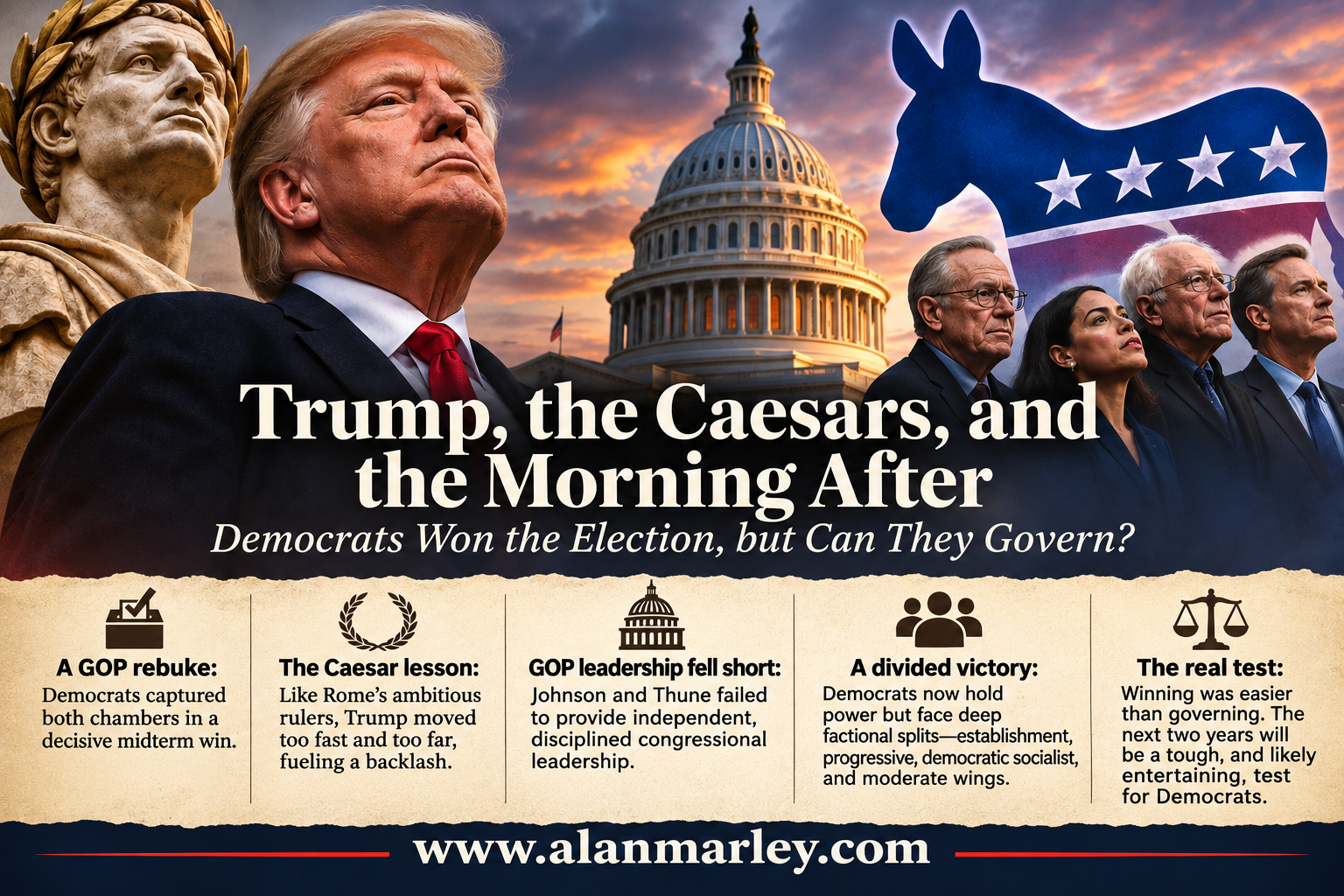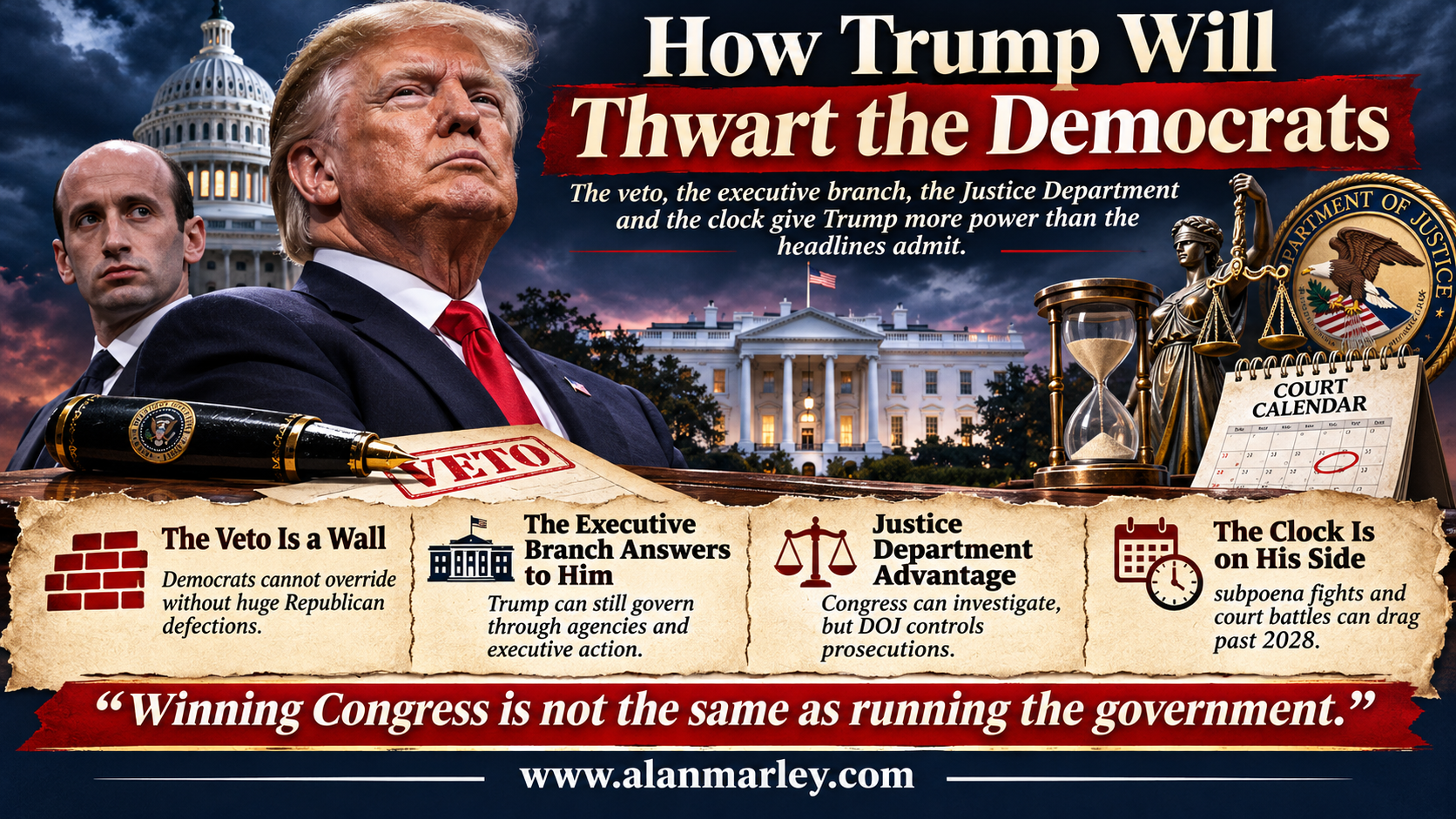
Democrats won both chambers on Tuesday, and the headlines have already decided that Donald Trump is finished as a force in Washington. He is not. The new majority holds real power, and I will lay out exactly what it is. But the president holds a veto, an executive branch that answers to him, a Justice Department that works for him, a court calendar that favors the defense and a chief of staff who was hired for a fight. Add them up and Democrats will find that winning the House and the Senate is not the same as running the government.
Trump announced Friday that Stephen Miller will take over as chief of staff on Monday. [1] A president who wanted peace with the new Congress did not make that call. This is how Trump will thwart the Democrats, why it will work more often than not and where it will not.
The Veto Is a Wall
Start with the one that matters most. Every bill Congress passes goes to the president. If he vetoes it, Congress needs two-thirds of both chambers to override. [17] That is the whole game.
House: An override needs 290 votes with full attendance. CBS News estimates Democrats will finish with between 251 and 268 seats. [4] At the high end they are 22 short. At the low end they are 39 short.
Senate: An override needs 67 votes. CBS projects Democrats will hold at least 54. [4] They are 13 short.
Impeachment: Conviction needs two-thirds of the senators present, which is 67 with full attendance. [20] The same 13 votes are missing.
Democrats do not have those numbers and cannot get them on their own. Every override depends on Republicans voting against a president who controls their primaries.
History shows how rare that is. Trump vetoed 10 bills in his first term. Congress overrode exactly one, the National Defense Authorization Act for fiscal year 2021, and it took a 322 to 87 vote in the House and 81 to 13 in the Senate. [21] That was a bipartisan defense bill that passed with huge margins, and it still needed a Republican-led Senate willing to defy him in the last days of his term. A progressive bill on healthcare, taxes, immigration or climate will not come close.
So the practical result is simple. Any bill Trump opposes is dead on arrival, and Democratic leaders know it. A Democratic Congress can pass messaging bills all day. It cannot make them law.
The Last Time Democrats Tried It
We do not have to guess how this plays out. The last time Democrats held the House against Trump, they pushed the same kinds of measures through, and the veto pen handled them.
In March 2019 Congress passed a resolution terminating Trump’s national emergency at the southern border. He vetoed it, and the House sustained the veto 248 to 181. [21] A Yemen war powers resolution passed both chambers. He vetoed it, and the Senate sustained the veto 53 to 45, with 53 senators voting to override and still falling short of two-thirds. [21] Three resolutions blocking arms sales to Saudi Arabia and the United Arab Emirates passed. He vetoed all three, and the Senate sustained them 45 to 40, 45 to 39 and 46 to 41. [21] A 2020 Iran war powers resolution fell short in the Senate, 49 to 44. [21]
Congress overrode one of his ten vetoes. Some of those measures drew real Republican votes and still never came close to the margin the Constitution demands. That is the record Democrats are running against.
Emergencies, War Powers and the Resolutions That Go Nowhere
Notice what kind of measures those were. They were joint resolutions, the tool Congress uses to check the president without writing a new law. Democrats will reach for them again, and the veto waits at the end of every one.
Under the National Emergencies Act, Congress can end an emergency the president has declared by passing a joint resolution. The president can veto it, and Congress needs two-thirds of both chambers to override. [11] The Congressional Review Act lets Congress overturn executive branch rules through the same route, and the same veto applies. [5] War powers resolutions follow the same path, and Trump vetoed two of them in his first term. [21]
So when Democrats announce that they will end an emergency declaration, cancel a rule or restrain a military action, remember the arithmetic. The tool is real, the vote will make news and the result will be a veto. Trump knows how to use that. Every failed override becomes a campaign ad that says Democrats tried and could not.
The Executive Branch Answers to Him
The bigger story is what Trump can do without Congress at all. The president can direct federal agencies by executive order within his constitutional and statutory authority. Courts can block orders that go too far, and Democrats will sue. But the Supreme Court has been tilting the field his way.
On June 29, 2026, in Trump v. Slaughter , the Court ruled 6 to 3 that the president can remove FTC commissioners at will. It overruled Humphrey’s Executor , the 1935 precedent that had protected so-called independent agencies, and called the case not a close one. The reasoning rests on Article II. Executive power belongs to the president, and officers who wield it must answer to him. [22]
Think about what that means for Democratic oversight. The agencies that Congress wants to investigate are now led by people who serve at the president’s pleasure. A committee can summon an agency head. It cannot protect a career official or a commissioner who cooperates with it from the White House.
The Court also narrowed the main weapon against executive orders. In Trump v. CASA , decided June 27, 2025, it ruled 6 to 3 that universal injunctions likely exceed the authority Congress gave federal courts, and limited relief to what each plaintiff with standing needs. [15] Class actions, state lawsuits and challenges under the Administrative Procedure Act remain open. But every challenge is now narrower, slower and more expensive, and the order stays in force for everyone else while the case moves.
A Democratic Congress can hold a hearing on an executive order. It cannot undo one without winning in court or beating a veto.
Trump’s Justice Department
Then there is the Justice Department. It belongs to the executive branch, and Trump’s attorney general oversees federal prosecutions and the government’s litigation. [18] The House has no prosecutors of its own, and that fact decides more than most people realize.
When a witness defies a House subpoena, the Speaker can certify a contempt citation to the U.S. attorney for the District of Columbia. [6] That prosecutor works for the president. The Justice Department has a long record of declining to prosecute officials who withhold documents at the president’s direction. It refused to charge Eric Holder in 2012, William Barr and Wilbur Ross in 2019 and Merrick Garland in 2024. [3, 12, 13] That record spans administrations of both parties, which is the point. It is the institutional default, and I expect Trump’s Justice Department to follow it.
Add the pardon power, which covers offenses against the United States, and a subpoena fight starts to look lopsided. [17] The White House can assert privilege, tell its people to hold the line and defend them in court. Democrats can call it obstruction. Without a prosecutor willing to act, it stays a talking point.
The Calendar Is on His Side
Democrats can sue to enforce a subpoena, and time works against them. In April 2019 the House Judiciary Committee subpoenaed former White House counsel Don McGahn. The litigation ran through a divided appeals panel and a rehearing by the full D.C. Circuit. It ended in August 2021, more than two years later, with a limited transcribed interview and a dismissal. [10]
The Supreme Court has raised the bar too. In Trump v. Mazars in 2020, the justices held that courts must weigh separation-of-powers concerns when Congress subpoenas a sitting president’s information. They set out considerations that include whether the information is necessary, whether the request is narrow and how heavy the burden on the president would be, and sent the cases back to the lower courts. [16]
Now run the clock forward. The new Congress arrives in January 2027. A subpoena issued in the first half of the year can easily still be in litigation when the 2028 campaign begins, and committee subpoenas generally lapse when a Congress ends. The side that can slow things down has the advantage, and a two-year majority is not long.
A committee can announce a subpoena in ten seconds. A fight over what the administration has to turn over can eat up months.
Trump’s lawyers understand this better than Democrats do. They do not have to win a single privilege fight. They only have to run out the clock.
The Purse Cuts Both Ways
Democrats do hold one real lever. Congress controls the money, and the Constitution says no funds leave the Treasury except through appropriations made by law. [17] A spending bill is the one thing that has to pass, so the majority has leverage in every budget fight.
But Trump holds the veto on those bills too, and a shutdown fight is costly for whoever gets the blame. And enforcing the spending laws once they pass is slower than it sounds. In August 2025 the Government Accountability Office concluded that NIH had violated the Impoundment Control Act by withholding funds Congress had appropriated. [19] A GAO finding is a legal opinion. It does not release the money. The fight over whether the administration has to spend it moves to the courts, and the courts take time.
Democrats can write the budget. Whether Trump spends it the way they wrote it is a different question, and the answer will come from a judge, not from Congress.
The Republican Wall Behind the Wall
Everything above depends on one fact. Democrats cannot reach two-thirds without Republicans, and Republicans fear Trump’s primaries more than they fear Jeffries.
That is why the 2021 defense bill override stands as the exception. It passed because Republicans in the Senate were willing to cross a lame-duck president on a bill they had written themselves. A fight over healthcare, immigration enforcement or an investigation of the president’s family will not produce that. Trump will frame every vote as loyalty, and most Republicans will vote loyalty.
He can also use Democrats’ own words against them. Rep. Robert Garcia answered the results with "Lawyer up," and Democrats have lined up subpoenas for Trump’s family businesses, crypto ventures and donors. [8] Every threat helps Trump keep Republicans united. A party that talks about prosecuting the president’s family is a gift to a president who needs his own side to stay in line.
The Playbook: Make Democrats the Story
Trump’s best move is not legal. It is political, and he has run it before. He turns the opposition into the villain.
Expect him to run against Congress. Every vetoed bill will come with a message that Democrats passed it and he stopped it. Every investigation will be called a witch hunt, which is already the White House line. [8] Every stalled budget fight will be blamed on a Congress that cannot govern. He does not need a new program to do any of this. He needs a stage and Democrats willing to supply the material.
That is where Miller comes in. Stephen Miller helped design the immigration crackdown, and Trump picked him the week he lost both chambers. [1] The choice tells us the White House plans to fight on ground it likes. Immigration enforcement is an executive function, and it is the area where Democratic tools are weakest and the party’s own positions are most divided. Democrats who spend the spring litigating enforcement are fighting on his chosen ground.
The pattern matters more than any single fight. Trump does not have to beat Democrats on every vote. He has to keep the argument about them and keep Republicans in line. For ten years that has been his reliable path, and Democrats keep walking down it.
The Senate and the Personnel Game
Balance matters here, because Democrats hold one weapon Trump cannot veto away. The Senate confirms principal executive officers and federal judges. [17] A Democratic Senate can slow nominations, force hearings and refuse to confirm the people Trump wants.
His answer is to govern with the people he already has. Acting officials can run agencies for a limited time under the Federal Vacancies Reform Act. [7] Officials can be reassigned, and Slaughter lets him fire commissioners who resist. Expect a fight in which the Senate blocks nominees and the White House fills the gaps with loyalists in acting roles, then sees which side the courts favor.
This is the one front where Democrats can force Trump to negotiate. It is also the one where he has the most ways around them.
What Democrats Can Still Do
I have spent a lot of words on Trump’s advantages, so here is what the other side holds. It is not nothing.
Democrats control the agenda in both chambers, which means Trump cannot pass anything on his own. Every bill he wants dies unless Democrats agree. The president who governed through the first two years of this term with a Republican Congress now has none, and a president without a legislative majority is a president who rules by executive action. That is a weaker position than it sounds, because executive orders can be reversed by the next president and challenged in court.
They hold the purse and the confirmation power, and they can hold hearings that put the administration’s conduct on the record. Credible allegations of corruption deserve those hearings, and Democrats are right to investigate real wrongdoing wherever it is. A hearing does not need a conviction to matter. It can change what voters believe before 2028.
They also control the public record. Subpoenas, document releases and testimony from former officials can hurt a president even when no court enforces them. Trump’s Justice Department can stall a prosecution, but it cannot stop a witness from telling the truth in a public room.
Smart Democrats will use these tools on the issues voters care about. The AP Voter Poll found about half of voters called the cost of living crucial to their vote, and about half said the same of government corruption. [2] A focused investigation of the second and a serious budget fight over the first would put the president on the defensive. A scattershot assault on every Trump business interest would not.
Where Trump Is Vulnerable
Now the other half of the balance sheet. Trump is not invincible, and the proof is recent.
On February 20, 2026, the Supreme Court ruled in Learning Resources v. Trump that the International Emergency Economic Powers Act does not authorize the president to impose tariffs. Chief Justice Roberts wrote for the Court, reasoning that tariffs belong to Congress’s taxing power. [14] That decision struck down one of the central tools of his economic agenda. Trump moved to other statutes, including Section 122, which caps a tariff at 15 percent for 150 days unless Congress extends it. [14] When a statute requires Congress to act, Congress holds a card.
The Court also drew a line around the Federal Reserve. On the day it decided Slaughter , it denied the government’s stay application in Trump v. Cook and refused to treat the Fed’s for-cause protection as effectively at will. [22] So the courts expand his power over the executive branch and still limit him on the statutes and the central bank. A president who reads every ruling as a green light will run into the ones that are red.
He is also a second-term president, and the clock runs on him. The country just handed his party a drubbing. Gallup’s September survey found 35 percent of Americans view the Republican Party favorably, against 43 percent for Democrats. [9] Republicans in swing seats know what that means for 2028, and some will start thinking about their own survival before his.
Democrats can also use his tactics against him. A president who picks a fight with every institution gives Congress material, and a chief of staff who was built for combat will produce a steady supply. Miller’s instincts are to escalate. Escalation is a strategy that works until it hands the other side a cause.
The Bottom Line
Here is where this lands. Trump cannot pass laws in a Democratic Congress, and Democrats cannot pass laws over his veto. That is a stalemate on legislation, and the stalemate favors the person who prefers the status quo of executive action. He governs through agencies he can now fire at will, a Justice Department that will not prosecute his people and a court system that moves slower than a two-year Congress.
Democrats have real tools. The purse, the Senate’s confirmation power, the committee gavels and the public record are all genuine. Used with discipline, they can cost the White House badly. Used for revenge, they play into the hands of a man who has made a career of surviving the other side’s overreach.
- Al Jazeera. (2026, November 6). Trump says he is making adviser Stephen Miller White House chief of staff. aljazeera.com/news/2026/11/6/trump-says-making-adviser-stephen-miller-white-house-chief-of-staff
- Associated Press. (2026, November). How America voted in the 2026 midterms: Early takeaways from The AP Voter Poll. apnews.com
- CBS News. (2024, June). Justice Department says it won’t prosecute Merrick Garland after House contempt vote. cbsnews.com/news/merrick-garland-contempt-justice-department
- CBS News. (2026, November 5). Where Democrats won big in the 2026 midterms: Inside the most decisive election results. cbsnews.com/news/2026-midterm-election-results-where-democrats-won/
- Congressional Review Act, 5 U.S.C. §§ 801 to 808.
- Contempt of Congress, 2 U.S.C. §§ 192 and 194.
- Federal Vacancies Reform Act of 1998, 5 U.S.C. §§ 3345 to 3349d.
- Fortune. (2026, November 3). ‘Lawyer up’: Democrats take the House, and warn Trump’s family businesses are first in line for subpoenas. fortune.com/2026/11/03/lawyer-up-democrats-win-control-house-probe-trump-family-businesses-crypto-ventures/
- Gallup. (2026, October 13). Party favorability survey, fielded September 1 to 17, 2026. gallup.com
- K&L Gates. (2021, August 2). The end of the McGahn litigation saga: House subpoena power is vindicated, for now. klgates.com
- Mayer Brown. (2025, March). President Trump’s use of the National Emergencies Act and possible congressional next steps. mayerbrown.com
- NPR. (2012, June 29). Justice will not prosecute Holder for contempt of Congress. npr.org/sections/thetwo-way/2012/06/29/156002660/justice-will-not-prosecute-holder-for-contempt-of-congress
- Scripps News. (2019, July). DOJ says it won’t prosecute Barr and Ross. scrippsnews.com/us-news/doj-says-it-won-t-prosecute-barr-and-ross
- Thomson Reuters. (2026, February 20). Supreme Court rejects IEEPA as a tariff statute ( Learning Resources, Inc. v. Trump ). thomsonreuters.com
- Trump v. CASA, Inc. , No. 24A884 (U.S. June 27, 2025). law.cornell.edu/supremecourt/text/24A884
- Trump v. Mazars USA, LLP , 591 U.S. 848 (2020). law.cornell.edu/supremecourt/text/19-715
- U.S. Constitution, art. I, § 7, cl. 2 (veto override); art. I, § 9, cl. 7 (appropriations); art. II, § 2, cl. 1 (pardons) and cl. 2 (appointments). constitution.congress.gov
- U.S. Department of Justice. Organization, mission and functions manual: Office of the Attorney General. justice.gov/doj/organization-mission-and-functions-manual-office-attorney-general
- U.S. Government Accountability Office. (2025, August 5). Department of Health and Human Services, National Institutes of Health: Application of Impoundment Control Act to availability of funds for grants (B-337203). gao.gov/products/b-337203
- U.S. Senate. Impeachment. senate.gov/about/powers-procedures/impeachment.htm
- U.S. Senate. Vetoes by President Donald J. Trump, 2017 to 2021. senate.gov/legislative/vetoes/TrumpDJ.htm
- Venable. (2026, June). Supreme Court overrules Humphrey’s Executor: Trump v. Slaughter (June 29, 2026) and Trump v. Cook. venable.com/insights/publications/2026/06/supreme-court-overrules-humphreys-executor