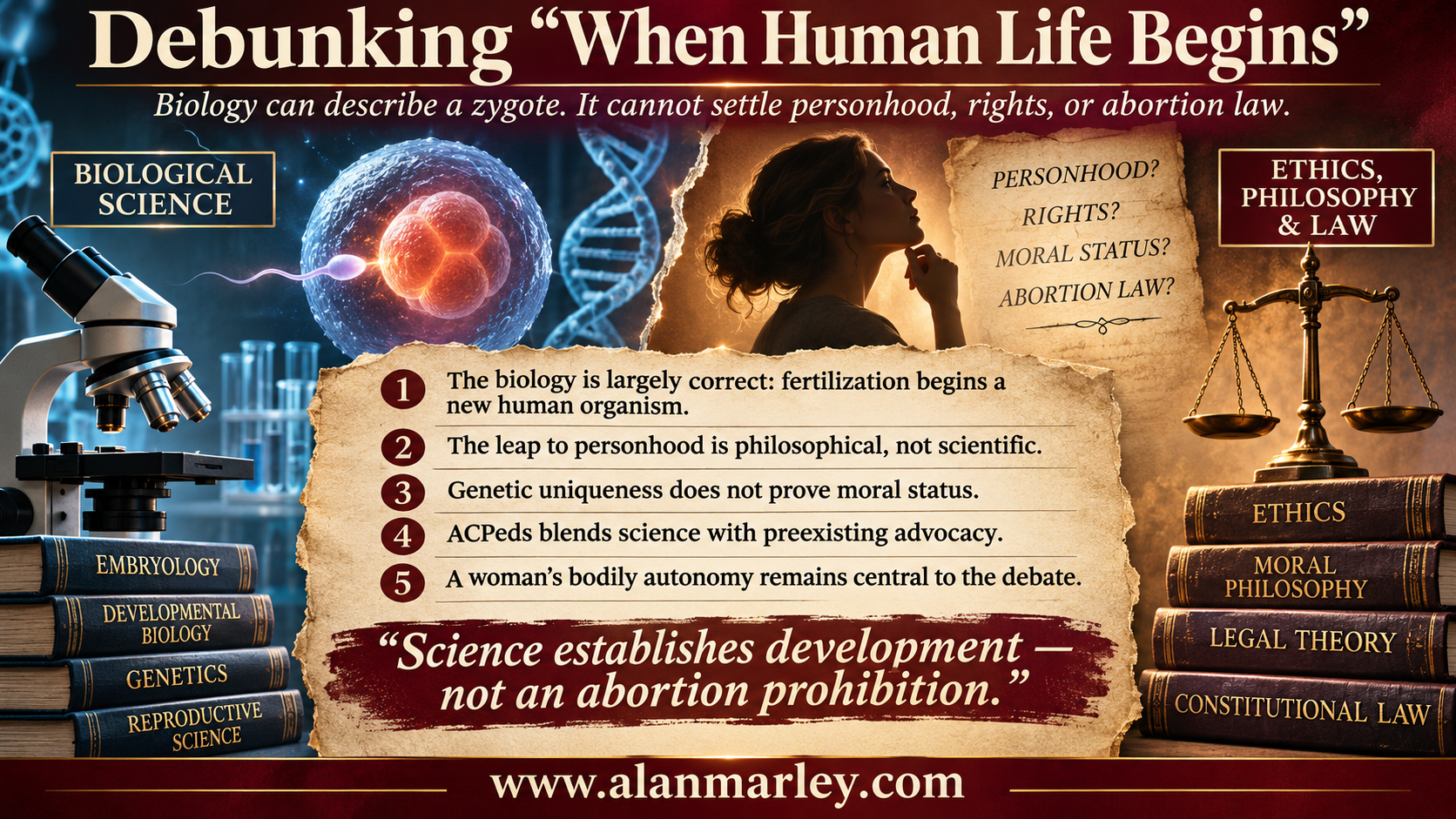
The March 2017 article "When Human Life Begins," from the American College of Pediatricians (ACPeds), makes a scientifically defensible observation and then tries to turn it into a much broader moral and political conclusion. [4]
Its central argument is that a new human organism begins developing at fertilization and therefore deserves the same moral protection as a born human being. The first proposition is broadly consistent with embryology. The second does not follow from the first. That gap is the fundamental weakness in the article.
To challenge it effectively, we have to separate what science establishes from what the authors believe science should compel society to do.
1. The Biological Argument Is Largely Correct
The article states that fertilization produces a zygote, a living organism of the human species with a new combination of genetic material. That is not a fringe religious invention. It is a standard description of early human development. Standard embryology texts describe fertilization as producing a zygote with two full sets of chromosomes, one from each parent. [7]
These propositions are broadly sound:
- Human sperm and eggs are living cells.
- Fertilization initiates the development of a new human organism.
- The resulting zygote typically carries a genetically distinct combination of parental DNA.
- Embryonic development is a continuous biological process.
Denying them would weaken, not strengthen, a serious pro-choice argument. But look at what the article has not established. It has not shown that a single-cell embryo has the consciousness, interests, moral status, legal rights or personhood of a born human being. Those are separate questions.
2. Being Biologically Human Does Not Settle Personhood
This is the article’s central logical problem. It moves from a descriptive scientific proposition to a prescriptive moral conclusion. The distinction looks like this:
| What biology can establish | What requires ethical or legal reasoning |
|---|---|
| A zygote belongs to the human species. | A zygote possesses full legal personhood. |
| Embryonic development begins at fertilization. | Moral rights begin at fertilization. |
| An embryo is biologically alive. | An embryo’s interests override bodily autonomy. |
| An embryo has human DNA. | Abortion is morally equivalent to murder. |
The distinction matters because science explains biological processes. It does not, by itself, determine the full scope of our moral obligations. A scientist could establish beyond doubt that a zygote is a living human organism and still not have shown that ending an early pregnancy is morally or legally equivalent to killing a newborn. That conclusion needs additional arguments about moral status, rights and competing obligations.
The American College of Obstetricians and Gynecologists (ACOG) opposes extending legal personhood to fertilized eggs, embryos and fetuses, citing consequences for reproductive care, IVF, pregnancy complications and patient autonomy. [1] That is itself an ethical and policy position, not an experimental discovery.
The disagreement is not about whether fertilization produces a living human organism. It is about what should follow from that fact.
3. The Authors Acknowledge the Unresolved Question
One of the most revealing passages is in the article itself. It quotes the philosopher J. T. Eberl, who says there is broad agreement that life begins when sperm and egg combine but disagreement over whether the resulting cell should be considered a human person. [4]
That is precisely the issue. The authors then suggest that distinguishing human biological life from personhood is arbitrary. Calling a distinction arbitrary is not an argument that it is invalid.
Ethical theories identify features that bear on moral status: consciousness, sentience, the capacity to suffer, interests, relationships and forms of autonomy. Reasonable people disagree about which features matter and when they become morally relevant. None of those disputes disappears because scientists have identified the start of embryonic development. The article names the central philosophical controversy and never resolves it.
4. Genetic Uniqueness Does Not Establish Moral Status
The article repeatedly stresses that fertilization creates a genetically distinct organism. But genetic uniqueness cannot by itself be the basis of personhood. Consider identical twins.
A single fertilized egg can split early in development and produce two embryos. [6] Those individuals have nearly identical genomes, yet nobody seriously disputes that they are two distinct persons. If a unique genetic code establishes an individual person at fertilization, how does one genetically distinct zygote become two people?
This does not disprove that embryonic human life begins at fertilization. It shows that genetic distinctiveness and individual personhood are not interchangeable concepts. The science of twinning complicates the claim that biological individuation is conclusively settled at the first moment of fertilization.
5. The Article Misuses the History of Medical Opinion
The authors cite an 1859 American Medical Association statement condemning abortion as historical support for their position. [4] This is another category error. A medical organization’s opposition to abortion in 1859 tells us what its physicians believed about abortion in 1859. It does not make their moral conclusions scientific discoveries.
The same applies to the article’s criticism of changing definitions of conception and pregnancy. Modern obstetrics distinguishes fertilization from implantation. ACOG describes fertilization as the first event in a sequence that leads to pregnancy, with implantation following several days later. [3] These terms name different biological or clinical milestones. They do not mean physicians deny that a zygote is alive, and defining pregnancy in relation to implantation does not establish that embryonic life lacks moral value.
The authors conflate disagreements about terminology, biological development and moral status as though they were one dispute. They are three.
6. The Organization Is Not the Medical Authority Its Name Suggests
The American College of Pediatricians is not the American Academy of Pediatrics. ACPeds is a much smaller organization founded in 2002, and its own mission statement adopts ethical principles that include the sanctity of human life from conception and the importance of traditional mother-father families. [5]
There is nothing wrong with physicians holding religious or conservative moral convictions. The difficulty comes when an organization presents its preexisting convictions as conclusions compelled by scientific observation. The authors did not begin from a morally neutral position and discover that fertilization requires opposition to abortion. Their organization’s mission had already endorsed that position.
That does not invalidate the embryological research they cite. It does make the line between scientific evidence and organizational advocacy especially important.
7. The Pregnant Woman’s Rights Are Largely Missing
The article’s most consequential omission is that it treats the biological status of the embryo as if it resolved the competing rights in a pregnancy. But pregnancy does not occur in isolation. It takes place inside the body of another living human being, who has interests, medical needs, autonomy and legal rights.
Even granting an embryo significant moral status does not establish that it has an unrestricted right to use another person’s body. That takes a separate ethical argument.
Consider ectopic pregnancy, in which an embryo implants outside the uterus. Such a pregnancy cannot develop into a viable birth and can threaten the woman’s life. ACOG explains that treatment may require medication or surgery to end the pregnancy. [2] The ACPeds article acknowledges that when the mother’s life is at risk, only her life may be saveable before viability, and it describes the embryo’s death in an ectopic pregnancy as unintended. [4]
The broader question remains. How should society balance embryonic interests against a pregnant woman’s health, bodily autonomy and other rights? The article never builds a framework for answering it. It declares an obligation to protect human life from fertilization and stops there. That is a moral position, not the result of an embryological experiment.
8. The Article Commits a Fundamental Philosophical Error
The problem comes down to the difference between what is and what ought to be. Science tells us what happens during fertilization. Ethics addresses which moral obligations we should recognize. Law determines which rights and obligations government should enforce. The three inform one another, but they are not interchangeable.
Someone can consistently believe that a zygote is a living human organism, that embryonic life deserves moral consideration and that abortion should still remain legally available because the moral claims vary with circumstances and must be balanced against a woman’s rights. Another person can accept exactly the same embryology and conclude that legal protection should begin at fertilization. Their disagreement cannot be settled by looking at a zygote under a microscope. Both positions require moral reasoning beyond the scientific facts.
Conclusion: Science Establishes Development, Not a Prohibition
ACPeds is correct about an important biological fact: fertilization initiates the development of a new human organism. It is not correct to imply that this fact, standing alone, shows that every embryo has the full moral and legal status of a born person. The article’s final opposition to abortion is an ethical conclusion supported by its authors’ values. It is not an experimentally demonstrated consequence of fertilization.
The authors cannot answer that question by repeating that life begins at conception.
- American College of Obstetricians and Gynecologists. (2022, November 9). ACOG statement on “personhood” measures. acog.org/clinical-information/policy-and-position-statements/position-statements/2022/acog-statement-on-personhood-measures
- American College of Obstetricians and Gynecologists. Ectopic pregnancy. acog.org/womens-health/faqs/ectopic-pregnancy
- American College of Obstetricians and Gynecologists. How your fetus grows during pregnancy. acog.org/womens-health/faqs/how-your-fetus-grows-during-pregnancy
- American College of Pediatricians. (2017, March). When human life begins. acpeds.org/when-human-life-begins
- American College of Pediatricians. Mission statement. acpeds.org
- MedlinePlus Genetics. Is the probability of having twins determined by genetics? National Library of Medicine. medlineplus.gov/genetics/understanding/traits/twins/
- Oliver, R., & Basit, H. (2023). Embryology, fertilization. StatPearls. National Library of Medicine. ncbi.nlm.nih.gov/sites/books/NBK542186/