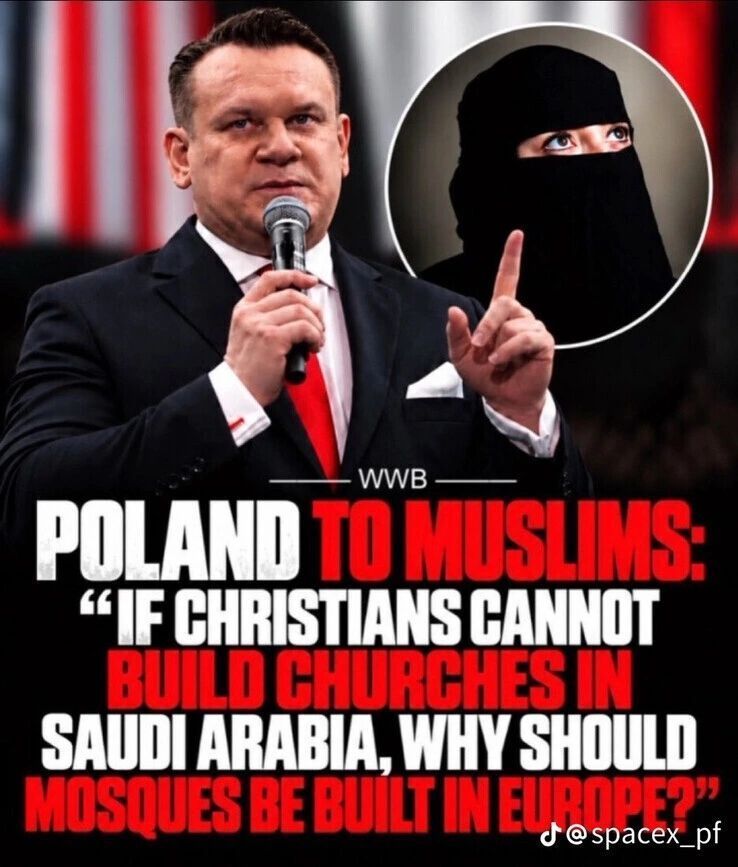
In Saudi Arabia you cannot build a church. Not a cathedral. Not a chapel. Not a rented room with a cross on the door. The U.S. Commission on International Religious Freedom has reported that no churches, synagogues, temples or other non-Muslim places of worship are permitted in the kingdom. [9] The State Department has said for years that the Saudi government prohibits the public practice of any religion other than Islam. [16]
In the United States the 2020 US Mosque Survey counted 2,769 mosques. That is a 31 percent increase in ten years, with mosques now present in every state. [2] Nobody had to ask a king for permission. They bought land. They filed plans. They built.
That is the American way and I am proud of it. But a principle that only runs in one direction is not a principle. It is a concession. It is time to say so out loud.
This Is Not a Handful of Countries
The usual response is that outright church bans exist in only a few places. Saudi Arabia. The Maldives. Afghanistan under the Taliban. That framing is designed to shrink the problem until it disappears.
Count the bans if you like. Then count the restrictions. The Pew Research Center scored government restrictions on religion in 198 countries and territories for 2023. The Middle East and North Africa had the highest average score of any region, and 17 of its 20 countries rated high or very high. [5] Saudi Arabia scored 7.4 on Pew’s scale and the Maldives 7.6, both in the very high category. [5]
In the Maldives the constitution requires citizens to be Muslim, and the law prohibits the establishment of places of worship for non-Islamic groups. [15] In 2011 an Indian Catholic worker there was jailed after police found a Bible and a rosary in his home. [1] In much of the region a church that does stand stands by permission. Permission can be revoked. Permits can be denied. Converts can be prosecuted.
A right you hold at the pleasure of the state is not a right. It is a lease.
A Door Ajar Is Not a Door Open
Defenders of the status quo will point to recent news. USCIRF reports that in 2025 Saudi authorities allowed Christians of various denominations to gather privately under strict conditions. Saudi officials say non-Muslim residents may worship in private with approval. [10]
That is a change worth noting. It is not reciprocity. The same report still cites the constitutional prohibition on public non-Muslim worship as a systematic problem, and it urges Washington to designate the kingdom a Country of Particular Concern and to stop shielding it with a waiver. [10] A worship service held in private, with a government permit, under conditions the state can change at will, is a favor. A mosque in Michigan is a right.
Think about what “private” means in practice. American Christians who work in Riyadh may worship only behind closed doors and only with official approval. No steeple. No sign. No public service open to the neighbors. In America nobody asks a mosque to hide.
The Gulf Is Not One Country
Fairness demands precision, so here is the rest of the picture. Other Gulf states treat Christians differently from Saudi Arabia. Qatar recognizes only certain Christian communities and houses all of its churches in a zoned religious complex outside Doha. Kuwait recognizes several Christian denominations although expatriate worshippers face a shortage of churches. Oman allows expatriates to worship, but only within specific compounds. The United Arab Emirates has a shortage of space for churches and Christian gatherings. [6]
That is not American-style liberty. It is still not a ban. Saudi Arabia stands apart as the state that, in the words of one survey of the region, traditionally denies non-Muslims the right of public worship. [6]
This matters because reciprocity must be measured by what a government actually does. A principle that lumps Qatar with Riyadh would be sloppy and unfair. A principle that asks which governments forbid the church on their soil and treats them accordingly is neither.
What America Gives Without Being Asked
Compare that to what happens here. The First Amendment bars the government from establishing a religion or prohibiting its free exercise. [11] Congress went further in 2000 with the Religious Land Use and Institutionalized Persons Act, which shields houses of worship from discriminatory zoning. [8]
That law has teeth and Washington uses them on behalf of mosques. When Bernards Township in New Jersey denied the Islamic Society of Basking Ridge a mosque, the Justice Department sued. The township settled in 2017 and agreed to treat all houses of worship equally. [12] In September 2019 the Justice Department sued Troy, Michigan after the city denied the Adam Community Center, a Muslim congregation, permission to worship in a building it had bought. [13] That suit was filed under the Trump administration. This is not one party’s project. It is bipartisan national policy.
Pew rates the United States low on government restrictions on religion, with a score of 2.1. [5] We do not merely tolerate mosques. Our federal government litigates to make sure they get built.
Tolerance that demands nothing in return is not a principle. It is a subsidy.
Reciprocity Is How Nations Deal With Each Other
Every serious relationship between nations runs on reciprocity. You tax our goods and we tax yours. You expel our diplomats and we expel yours. You restrict our visas and we restrict yours. Nobody calls that bigotry. They call it foreign policy.
Congress has even written reciprocity into law on matters of access. The Reciprocal Access to Tibet Act of 2018 bars entry into the United States for Chinese officials responsible for restricting the access of Americans to Tibet. [7] If American diplomats, journalists and tourists must be let in, the officials who keep them out should not expect a welcome here. Nobody called that law bigotry either.
Religious liberty is the one arena where we accept total asymmetry and call it virtue. Consider the record. The State Department first designated Saudi Arabia a Country of Particular Concern for severe religious freedom violations in 2004. USCIRF has described an indefinite waiver in place since 2006 that carries no consequences at all. [9] The State Department redesignated the kingdom on December 29, 2023, and the commission is still urging the government to lift the waiver. [10] We name the offense. Then we do nothing. Year after year.
Americans are not stupid. They can see when a rule is selectively enforced. They see mosque construction proceed freely at home with the Justice Department itself guarding the permits. They see their fellow Christians abroad worshipping in private by permission. They are told that noticing the difference makes them intolerant.
The Tools Congress Already Gave Us
Here is the part that makes the waiver so frustrating. The International Religious Freedom Act of 1998 already gives the president a menu of responses once a country is designated. They include diplomatic protests, canceled state visits and exchanges, withdrawn aid, limits on export licenses and Export-Import Bank credit and bans on federal procurement from the offending government. [4]
The same law lets the president waive those actions if the government has ceased the violations or if the national interest requires it. [4] An indefinite waiver turns the exception into the rule. The law meant to produce pressure produces a press release.
I am not claiming that every one of those measures is wise. Strategic and economic ties with Riyadh are real and they matter. But a country that has been named a severe violator of religious freedom for more than twenty years and has paid no price has learned that the designation is a formality. That is a policy failure before it is a moral one.
The Position, Stated Plainly
As long as governments that claim to speak for Islam forbid the church on their soil, the United States should close all mosques on its soil, and stop permitting new mosques on ours. The door opens when theirs opens.
I will not pretend this is easy or legal under current law. It is neither. Any town that tried it tomorrow would lose in federal court and deserve to. The First Amendment and RLUIPA make it impossible by statute or ordinance. The Supreme Court held in Church of the Lukumi Babalu Aye v. City of Hialeah that laws aimed at a particular faith’s practices must survive the strictest scrutiny, and they almost never do. [3] Getting there would take an act of Congress at minimum and almost certainly a constitutional amendment. That bar is supposed to be high.
But the height of the bar is not an argument against the principle. It is an argument for having the debate honestly instead of pretending the asymmetry does not exist.
The best objection is not about feelings. It is constitutional. The First Amendment protects American citizens, not foreign governments. A Muslim family in Dearborn has no vote in Riyadh. Barring their mosque punishes Americans for the conduct of a regime they never chose. That is collective guilt, and our law rejects it for good reason.
The second objection is precedent. The same RLUIPA the Justice Department uses for mosques it also used in 2025 against Troy, Idaho on behalf of a Christian church denied a downtown worship space. [14] A government with the power to close one faith’s doors has the power to close yours. Opponents would also point out that several Muslim-majority nations do permit churches, so treating “Islam” as a single policy actor gets the facts wrong. And they would say that copying Saudi policy makes us more like Saudi Arabia, not less.
I concede the first point has real force. The individual Muslim in Michigan did not write Saudi law. But collective consequences for state conduct are exactly what sanctions are. Sanctions hit ordinary people in the target country every time we impose them. We accept that cost because leverage requires it.
The precedent argument cuts the other way too. Unconditional tolerance has bought Christians in the Gulf nothing in twenty years of waivers. If the current approach worked, Saudi Arabia would have a public church by now. It does not.
As for the countries that do allow churches, good. Reciprocity rewards them. The pressure lands where the ban is.
What I Would Do First
Before anyone touches the Constitution there is work Washington can do tomorrow without a single new law.
End the waiver. Let the Country of Particular Concern designation mean what Congress intended when it passed the Act. Use the menu of responses the statute already provides. Make permission for public churches in Saudi Arabia a stated condition of the relationship, not a footnote in an annual report.
If that fails, then the question of how far reciprocity should go is no longer hypothetical. It becomes the question of what a free country owes governments that give its citizens nothing in return. That is the debate I am asking us to have.
The Line
Freedom of religion is the first freedom in our Bill of Rights. I would not trade it for anything. That is exactly why I refuse to watch it be treated as a one-way street.
America extends every faith a seat at the table. We ask nothing in return. Some of the governments sitting at that table would not let our faith through their front door.
Respect that only flows one direction is not respect. It is surrender with good manners.
- AsiaNews. (2011, October 7). Indian Catholic jailed in the Maldives over a Bible and a rosary. asianews.it
- Bagby, I. (2021). The American mosque 2020: Growing and evolving. Institute for Social Policy and Understanding. ispu.org
- Church of the Lukumi Babalu Aye, Inc. v. City of Hialeah , 508 U.S. 520 (1993).
- International Religious Freedom Act of 1998, Pub. L. No. 105-292, 22 U.S.C. §§ 6401 et seq. (presidential actions, § 405; waiver, § 407).
- Pew Research Center. (2024). Government restrictions on religion around the world in 2023. pewresearch.org
- Providence: A Journal of Christianity & American Foreign Policy. (2019, October). Arab Persian Gulf states and religious liberty. providencemag.com
- Reciprocal Access to Tibet Act of 2018, Pub. L. No. 115-330.
- Religious Land Use and Institutionalized Persons Act of 2000, 42 U.S.C. § 2000cc et seq.
- U.S. Commission on International Religious Freedom. (2011). Annual report 2011: Saudi Arabia. uscirf.gov
- U.S. Commission on International Religious Freedom. (2026). USCIRF 2026 annual report: Saudi Arabia. uscirf.gov
- U.S. Constitution, amend. I.
- U.S. Department of Justice. (2017). Justice Department and Bernards Township (NJ) settle lawsuit over alleged RLUIPA violations. justice.gov
- U.S. Department of Justice. (2019, September 19). Justice Department files lawsuit against the City of Troy, Michigan, for restrictions on Muslim place of worship. justice.gov
- U.S. Department of Justice. (2025, May 20). Justice Department files religious liberty lawsuit against Troy, Idaho, for discriminating against church. justice.gov
- U.S. Department of State. (2019). 2019 report on international religious freedom: Maldives. state.gov
- U.S. Department of State, Bureau of Democracy, Human Rights, and Labor. (2010, November 17). International religious freedom report 2010: Saudi Arabia. state.gov