I have a friend who is convinced that the world is heading toward an apocalyptic conclusion. He is hardly alone. Between sensationalized news coverage, social media, religious prophecy, political polarization and the seemingly endless parade of international crises, there is no shortage of people willing to tell us that civilization is coming apart at the seams.
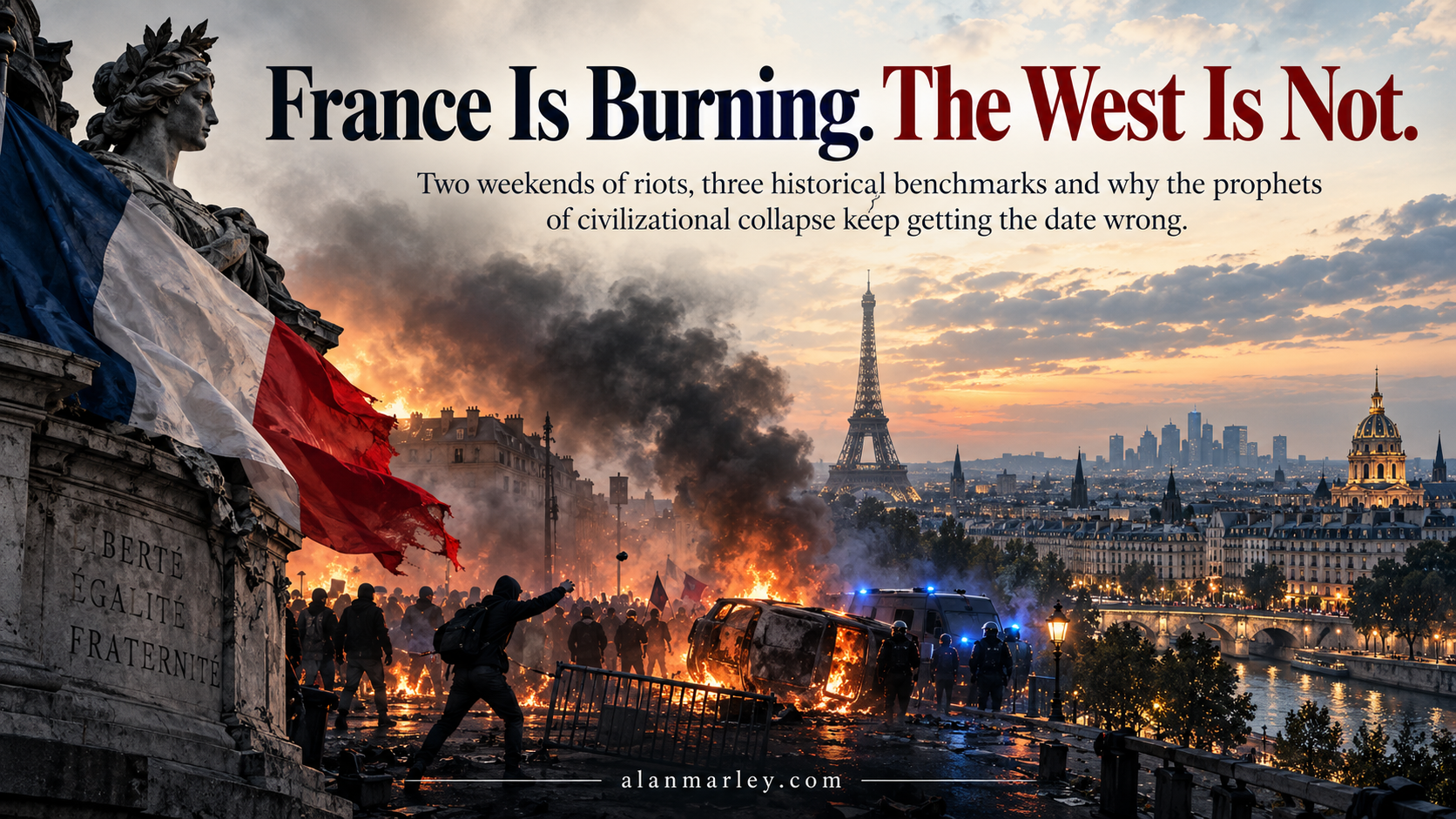
France is rioting. Illegal immigration is straining Europe and changing its cultural landscape. Christianity is losing influence. Governments are struggling with debt, inflation and political instability. Wars continue, social values are changing and the institutions we once considered permanent seem increasingly vulnerable.
Therefore, according to some, the world is on an irreversible trajectory toward destruction.
I disagree.
Not because these problems are imaginary or unimportant. Many are serious, and some demand immediate attention. I disagree because identifying a collection of troubling events is not the same as establishing that those events constitute an inevitable progression toward the end of civilization.
Generalizations can be useful. They help us identify patterns, describe broad social developments and formulate questions worth investigating. But generalizations are not proof.
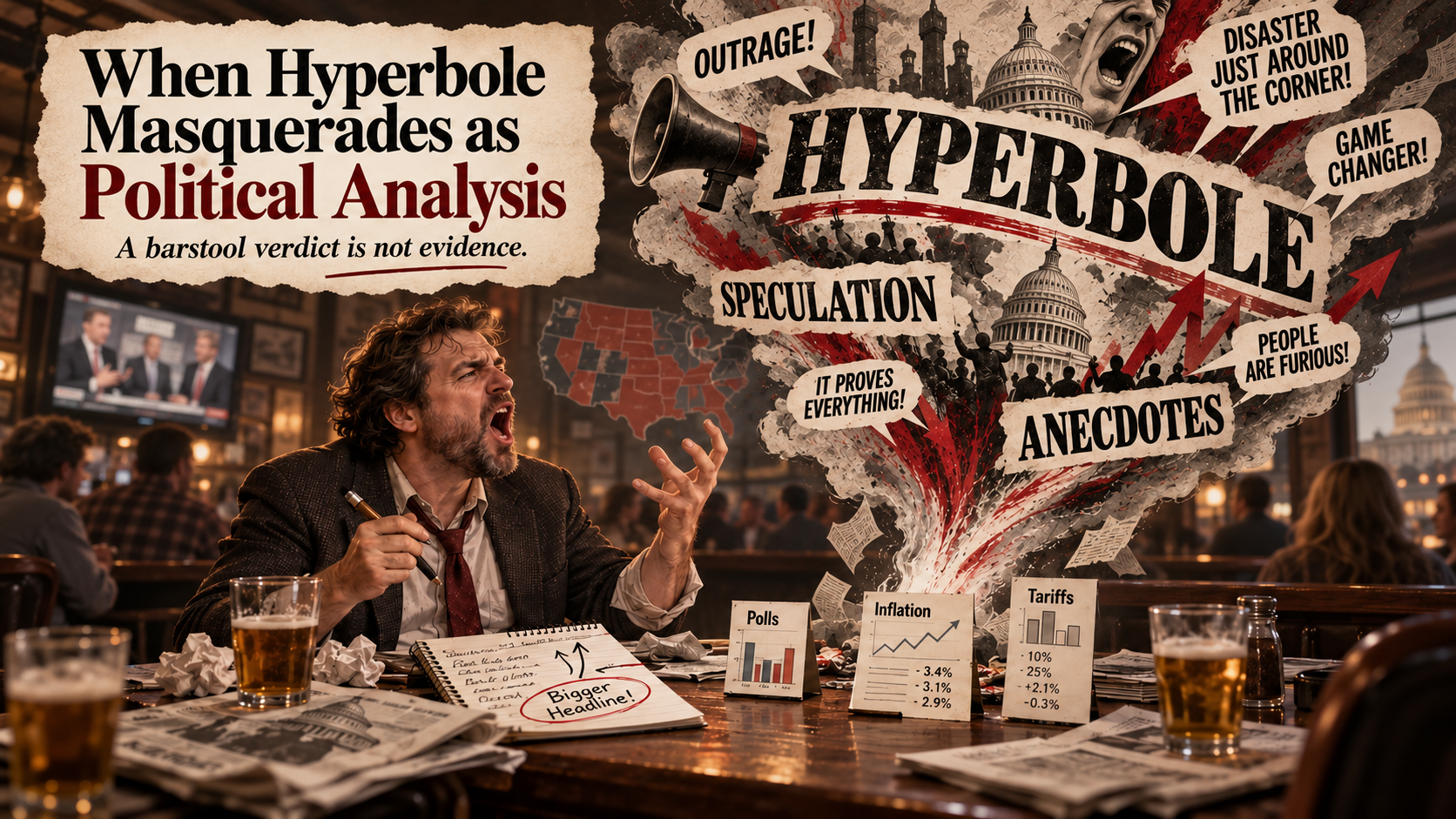
When someone claims that contemporary events demonstrate an approaching apocalypse, it is perfectly reasonable to ask for something considerably more substantial than ominous headlines and subjective interpretations.
Show me the evidence. Show me the measurements. Show me the trajectory.
Otherwise, we are not discussing an established conclusion. We are discussing a belief.
This Time Is Different. Or Is It?
Whenever I challenge my friend’s predictions, the response is remarkably consistent. Yes, humanity has experienced wars, pandemics, political upheavals, religious conflicts and societal transformations before. But this time is different. This time the problems are worse, more widespread, more interconnected and more consequential. And, apparently, all moving in the same direction.
It sounds persuasive until we examine the historical record.
Consider the period between 1914 and 1945. In just 31 years, humanity experienced two world wars, a devastating influenza pandemic, the Great Depression, the rise of fascism and totalitarianism, the Holocaust, the destruction of entire cities and the introduction of nuclear weapons. Millions upon millions died. Governments collapsed. Empires disappeared. Economies disintegrated. Entire populations were displaced.
Imagine living in Europe during those decades. Would anyone seriously suggest that the upheavals facing contemporary France are inherently more catastrophic than the destruction Europe experienced in the first half of the twentieth century?
That does not mean today’s problems should be dismissed. Nor does it mean that the past guarantees humanity will overcome every future challenge. It simply demonstrates that declaring the present uniquely disastrous requires considerably more historical perspective than a few alarming headlines.
There is another problem with the assertion that this time is different. Every historical period is different. That observation, by itself, proves absolutely nothing about how the period will end.
France Is Not the End of Western Civilization
France provides an excellent example of how legitimate social problems can be transformed into exaggerated conclusions. The country has experienced protests, strikes, political unrest, disputes over immigration, economic pressures and growing dissatisfaction with government. These are meaningful developments.
But France also has a long tradition of mass demonstrations and political confrontation. The French Revolution, the upheavals of 1848, the Paris Commune and the demonstrations of May 1968 remind us that political turmoil is hardly new in French society. France has experienced significant periods of instability before. Some transformed its political system. Others produced reforms or eventually subsided.
Does contemporary unrest demonstrate serious dissatisfaction? Certainly. Does it establish that the French Republic is approaching destruction? Not without considerably more evidence.
There is a difference between a government experiencing difficulty and a nation losing the capacity to govern itself. There is a difference between an economic slowdown and economic collapse. There is a difference between civil unrest and civilizational disintegration. Those distinctions matter because words have meanings, and the scale of a conclusion should correspond to the strength of the supporting evidence.
France may face difficult years ahead. Its immigration policies, fiscal challenges, political divisions and economic performance deserve serious examination. But the existence of serious problems does not establish the inevitability of national destruction.
Illegal Immigration: A Legitimate Concern Is Not an Apocalyptic Prediction
Illegal immigration is frequently presented as one of the principal indicators that Western civilization is approaching its demise. It is a genuine problem, and I find the apocalyptic argument built on it revealing because it often begins with legitimate concerns and ends with extraordinary predictions.
Illegal immigration can place pressure on housing, schools, healthcare systems, infrastructure and public budgets, and it undermines the rule of law. Rapid demographic change can create tensions over national identity, cultural integration, employment and competing social expectations. Those concerns deserve serious discussion.
Lawful immigration, by contrast, can provide labor, entrepreneurship, tax revenue, economic activity and demographic renewal. The consequences of any migration depend on numerous factors, including its scale and pace, employment opportunities, public policy, enforcement and the success or failure of integration. In other words, illegal immigration is a serious economic, political and social problem that demands enforcement and sound policy. It is not an automatic mechanism of civilizational destruction.
When someone argues that illegal immigration is destroying France, Britain, Germany or the United States, I want to know precisely what they mean. Are they claiming that economic productivity is declining? That crime is increasing? That government services are becoming unsustainable? That democratic institutions are failing?
If so, which measurements support those conclusions? Over what period? Compared with what baseline? And what evidence establishes illegal immigration as the cause rather than merely an accompanying development?
These are reasonable questions. The statement that illegal immigration is changing Western civilization is a broad observation that can be investigated. The declaration that illegal immigration is inevitably destroying Western civilization is a causal prediction requiring substantially more proof.
One is a subject for examination. The other is a conclusion that has yet to be established.
Has the World Turned Its Back on God?
Another frequent argument is that civilization is collapsing because society has abandoned God. Religious affiliation and participation have declined in many Western countries. That is a measurable development.
But what exactly does turning one’s back on God mean? Declining church attendance? Increasing secularism? Changing attitudes toward marriage and sexuality? Religious pluralism? The separation of religious doctrine from civil government? These are not interchangeable concepts.
Even if we agree that religious participation has declined, how does that establish that civilization is moving toward destruction? History provides plenty of examples of deeply religious societies experiencing corruption, warfare, poverty, persecution and political collapse. It also provides examples of relatively secular societies maintaining stable institutions, productive economies and high standards of living.
Religion can encourage charity, social responsibility, community involvement and moral reflection. These are meaningful contributions. But those qualities are not exclusive to religious societies, nor does religious identification guarantee them.
More important, correlation is not causation. If religious participation declines while political unrest increases, that does not automatically mean the former caused the latter. And attributing unrest, war or natural disasters to divine punishment is a theological interpretation, not a conclusion established through historical or scientific measurement.
People are certainly entitled to their religious convictions. But there is a distinction between believing that humanity faces divine judgment and claiming that contemporary events objectively prove its arrival.
Faith may not require empirical confirmation. A public claim about the measurable condition and future of civilization does.
The World Is Getting Worse. By What Measure?
This is where the apocalyptic argument becomes particularly vulnerable. My friend insists that humanity is moving along a trajectory of continuous deterioration. Fine. Then that trajectory should be measurable.
Are people living shorter lives? Has global literacy collapsed? Are more children dying before adulthood? Has extreme poverty returned to its historical levels? Have medical advances stopped improving human survival?
Across several important measures, humanity has made extraordinary progress over the past two centuries. Global life expectancy has more than doubled since 1900, from about 32 years to about 73. [3] Child mortality has fallen dramatically. Literacy has expanded. Medical science has eliminated or substantially reduced many diseases that once killed millions. Large portions of humanity enjoy material conditions that previous generations could scarcely imagine.
None of this suggests that the world is free of serious problems. Nuclear weapons, geopolitical conflict, authoritarianism, illegal immigration, economic inequality, technological disruption and institutional instability present genuine risks. Some indicators have deteriorated in recent years, and progress in other areas has slowed or reversed.
But that is precisely the point. The evidence is mixed, complicated and dependent upon what we are measuring. It does not support a simplistic assertion that everything is progressively getting worse.
Selecting only those measurements that reinforce a predetermined conclusion is not objective analysis. It is confirmation bias. If we are going to argue that civilization is deteriorating, we should establish the criteria, examine the available evidence and acknowledge findings that contradict our assumptions. That is how a credible argument is constructed.
Generalizations Are Fine. They Are Not Proof.
I have no problem with generalizations. We use them constantly. Europe is experiencing demographic change. Western societies are becoming more secular. Political polarization is creating challenges for democratic governance. Illegal immigration is placing pressure on certain communities. Economic uncertainty is contributing to public frustration.
These statements can provide useful starting points for investigation. But none, standing alone, proves that civilization is approaching an irreversible collapse.
A generalization describes an apparent pattern. A hypothesis proposes an explanation. Evidence tests that explanation. A conclusion follows only when the evidence reasonably supports it.
My concern is that apocalyptic arguments frequently skip the middle two steps. They begin with a generalization and proceed directly to a conclusion.
Illegal immigration is increasing; therefore, Western civilization is dying. Religious participation is declining; therefore, God is withdrawing his protection. There are riots in France; therefore, Europe is collapsing. Wars are occurring; therefore, the end times have arrived.
These assertions may be emotionally compelling, particularly when reinforced by religious conviction or political ideology. But emotional conviction is not a substitute for demonstration.
The more extraordinary the conclusion, the more substantial the evidence should be.
What Would an Actual Trajectory Toward Doom Look Like?
If someone claims that humanity is moving toward an inevitable catastrophe, the claim should contain identifiable conditions that can be evaluated. At a minimum, I would expect answers to several questions.
First, what precisely constitutes civilization’s destruction? Are we discussing the collapse of a particular government, the disappearance of Western cultural traditions, a worldwide economic breakdown, the extinction of humanity or a supernatural event? These are profoundly different outcomes.
Second, which indicators demonstrate movement toward that outcome? Institutional failure, food insecurity, mortality, economic collapse, political violence or some combination of measurable developments?
Third, what evidence establishes that these developments are worsening consistently rather than fluctuating through ordinary historical cycles?
Fourth, why should we conclude that the process is irreversible? History contains numerous examples of societies recovering from devastating crises.
Finally, and perhaps most important, what evidence would disprove the prediction?
If there is no answer to that last question, we have a problem. A prediction that cannot be challenged by any conceivable evidence is not an ordinary empirical prediction. It is an unfalsifiable belief. And there is nothing particularly scientific about declaring that every event, regardless of its outcome, confirms a predetermined prophecy.
The Apocalypse That Never Quite Arrives
There is something remarkable about the staying power of apocalyptic predictions. For centuries, people have interpreted wars, plagues, earthquakes, famines, political upheavals and changing social values as signs that the end was imminent. When the anticipated destruction failed to materialize, the predictions were frequently revised, reinterpreted or postponed. The underlying conviction survived.
That raises an uncomfortable question. What happens when a person has constructed an explanation of the world in which every possible development confirms the same conclusion?
Violence increases. The apocalypse is approaching. Violence declines. The calm is temporary, and the apocalypse is still approaching. The economy deteriorates. The apocalypse is approaching. The economy improves. Material prosperity is distracting humanity from its spiritual decline. Religious participation falls. Civilization is abandoning God. Religious participation rises. People are responding to the signs of the approaching end.
Notice the difficulty. There is no outcome that genuinely challenges the prediction. The conclusion remains fixed regardless of what actually happens.
At that point, we are no longer evaluating the evidence. We are arranging the evidence around a conclusion we have already decided must be true. I would argue that this approach tells us considerably more about the observer’s worldview than it does about the actual trajectory of civilization.
Civilization Is Not Static
Human civilization has never been a finished product. Societies evolve. Economies change. Religious institutions gain and lose influence. Governments rise and fall. Populations migrate. Technologies disrupt established ways of living.
Some changes produce genuine progress. Others produce hardship, instability and unintended consequences. Occasionally, institutions and entire political systems do collapse. None of this should be minimized. But civilization’s capacity for adaptation is itself an important historical fact.
Consider how dramatically the world has changed over the past 200 years. Monarchies have given way to republics. Slavery has been legally abolished across much of the world. Women have gained political and economic rights previously denied to them. Medical advances have transformed human survival. Technology has fundamentally changed how we communicate, work and acquire knowledge.
Not every transformation has been universally beneficial, and progress has often been uneven. But the notion that civilization must remain culturally, politically or religiously unchanged to survive is difficult to reconcile with history. Much of what we now consider civilization emerged through the transformation of earlier institutions and traditions.
Change is not synonymous with decline, and decline is not necessarily synonymous with destruction.
Perhaps We Are Confusing Discomfort With Catastrophe
There is another possibility worth considering. What if some apocalyptic predictions reflect discomfort with cultural transformation more than objective evidence of civilizational collapse?
A society becoming less religious may seem deeply troubling to someone whose worldview depends upon religious institutions retaining their traditional influence. A country becoming more ethnically and culturally diverse may feel destabilizing to someone accustomed to a relatively homogeneous national identity. Changing political attitudes, family structures or social conventions may create a sense that familiar institutions are disappearing.
These reactions can be sincere, and the underlying changes may involve legitimate costs and tradeoffs. But personal discomfort with change does not establish that the change represents the destruction of civilization. Nor does the loss of a particular institution’s traditional influence necessarily mean that society itself is failing.
We must be careful not to confuse the disappearance of the world as we remember it with the disappearance of the world itself. Those are two very different things.
Keep Religion in Its Lane
There is a practical lesson in all of this, and it extends well beyond my friend. The unshakeable belief and constant doomsaying of extremists, Christian fundamentalists and nationalists is one of a long list of reasons to keep religion, all religions, in their lanes and distinctly separate from the secular and from government.
I say that as someone who respects the right to believe. The First Amendment protects the free exercise of religion, and it also forbids Congress from establishing one. [4] The Constitution bars any religious test for public office. [4] Jefferson described the result as a wall of separation between church and state, and the Supreme Court adopted that image in Everson v. Board of Education. [1, 2]
The reasons for that wall are not complicated. A government must justify its decisions with arguments open to every citizen, whatever his faith or lack of one. A claim that the end is near because God is displeased cannot be tested, challenged or voted out of office. Policy built on a prophecy that no evidence can disprove is policy no one can correct.
The same logic applies to every faith. A Christian nationalist who wants Scripture written into law, a fundamentalist who reads current events as end-times signs and a religious movement of any other tradition that seeks the power of the state for its doctrines all make the same mistake. They ask the government to enforce a belief instead of protecting the believer.
That is also why separation protects religion. When the state picks a favorite, every other believer becomes a second-class citizen, and the favored faith gets tied to the failures of whoever holds office. Europe’s history of religious wars is a reminder of what happens when doctrine and power fuse.
Believers remain free to vote their consciences, build congregations and argue in public. What they cannot do is demand that everyone else live under their prophecy. Faith may rest on conviction. Government must rest on evidence.
The Burden of Proof Belongs to the Person Predicting Doom
I do not claim that civilization cannot collapse. History demonstrates otherwise. Nor do I claim that humanity will inevitably overcome every challenge. There are genuine existential risks, and some deserve considerably more attention than they receive.
But acknowledging the possibility of catastrophe is different from declaring its inevitability. If someone insists that the current political, economic, cultural and religious environment demonstrates an unavoidable march toward destruction, that person bears the burden of establishing the claim. And the evidence should be proportionate to its seriousness.
What is the predicted outcome?
What measurable developments point toward it?
What establishes the causal relationships?
What demonstrates that recovery or adaptation is no longer possible?
What observations would challenge the prediction?
Without reasonably clear answers, the argument remains speculative. It may be a sincere religious conviction. It may be a strongly held political interpretation. It may be an understandable reaction to frightening developments. But it is not proof.
Conclusion: The World Has Problems. That Is Not a Prophecy.
I have no objection to someone expressing concern about illegal immigration, secularism, political unrest, government spending, economic instability or the direction of modern society. These are legitimate subjects of discussion, and thoughtful people can reasonably disagree about their causes, consequences and solutions.
What I object to is the intellectual leap from recognizing those problems to declaring that civilization is inevitably approaching its destruction.
France has problems. Europe has problems. The United States has problems. Every civilization in recorded history has confronted problems, some considerably more devastating than those we face today. Some societies survived. Some transformed. Others failed. The existence of serious challenges is therefore not sufficient to establish an approaching apocalypse. And the claim that this time is somehow fundamentally different must be supported by more than the insistence that it is.
Generalizations are fine. They can help us recognize patterns and begin meaningful investigations. But they are not proof.
If we are going to argue that the world is following an inevitable trajectory toward destruction, then that trajectory should be reasonably defined, supported by measurable evidence and open to challenge. It should not remain so vague, subjective or obtuse that every headline can be interpreted as another sign of the approaching end. Otherwise, we have abandoned analysis in favor of interpretation, and evidence in favor of expectation.
My friend may ultimately be correct that humanity faces dangers greater than those we fully appreciate. I certainly cannot prove otherwise. But neither can he establish an inevitable apocalypse simply by pointing to every troubling development and declaring it another step toward doom.
Until that proof is forthcoming, I see no compelling reason to interpret the ordinary, albeit sometimes painful, struggles of modern civilization as evidence that humanity is approaching its final chapter.
The world is changing. The world has problems. The world has always had problems. Perhaps the most sensible response is not to spend our lives anticipating its destruction, but to concentrate on addressing the challenges that actually exist.
After all, declaring the end of civilization is considerably easier than doing the difficult work necessary to improve it.
- Everson v. Board of Education , 330 U.S. 1 (1947).
- Jefferson, T. (1802). Letter to the Danbury Baptist Association, January 1, 1802.
- Our World in Data. Life expectancy (Riley 2005; Zijdeman et al. 2015; UN World Population Prospects 2024). ourworldindata.org
- U.S. Constitution, amend. I; art. VI, cl. 3.