I recently came across a letter to the editor titled “Thanks, Mr. President,” written by Doug Whitley of Northport. [1] It is quite a piece of work.
The author begins by announcing that Donald Trump asked him to vote as though Trump were on the ballot. His response? “Gladly.”
What follows is a laundry list of everything supposedly wrong with America, the world and perhaps the Earth’s rotational axis.
War, inflation, tariffs, immigration, science, democracy, Canada, NATO, the Justice Department, national parks and the Kennedy Center. Nothing escapes the presidential wrecking ball.
By the time I finished reading, I was surprised Trump hadn’t also been blamed for the extinction of the dinosaurs, the price of movie popcorn and the disappearance of matching socks from the dryer.
Apparently, one man has managed to destroy civilization between rounds of golf.
Impressive, really.
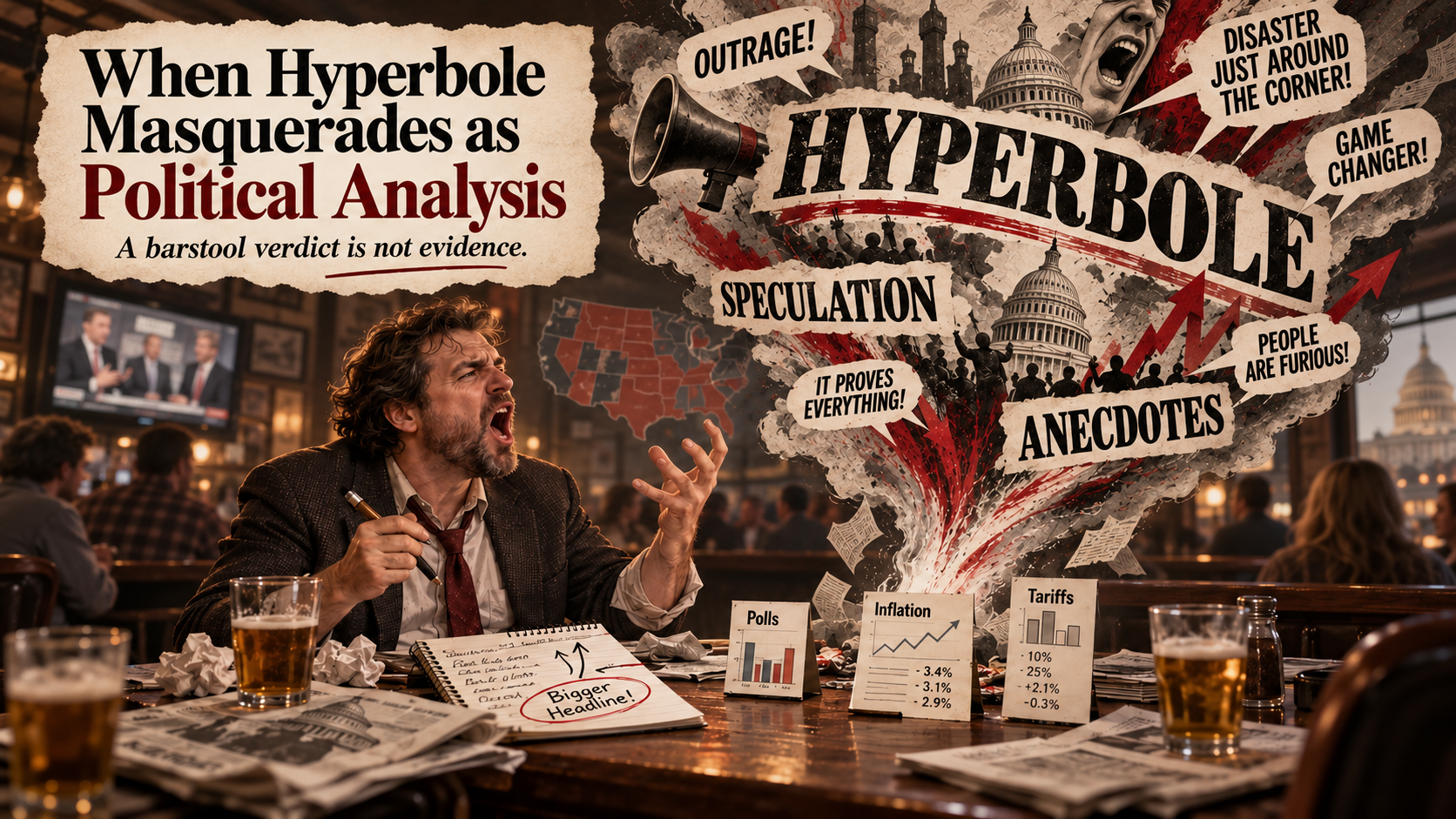
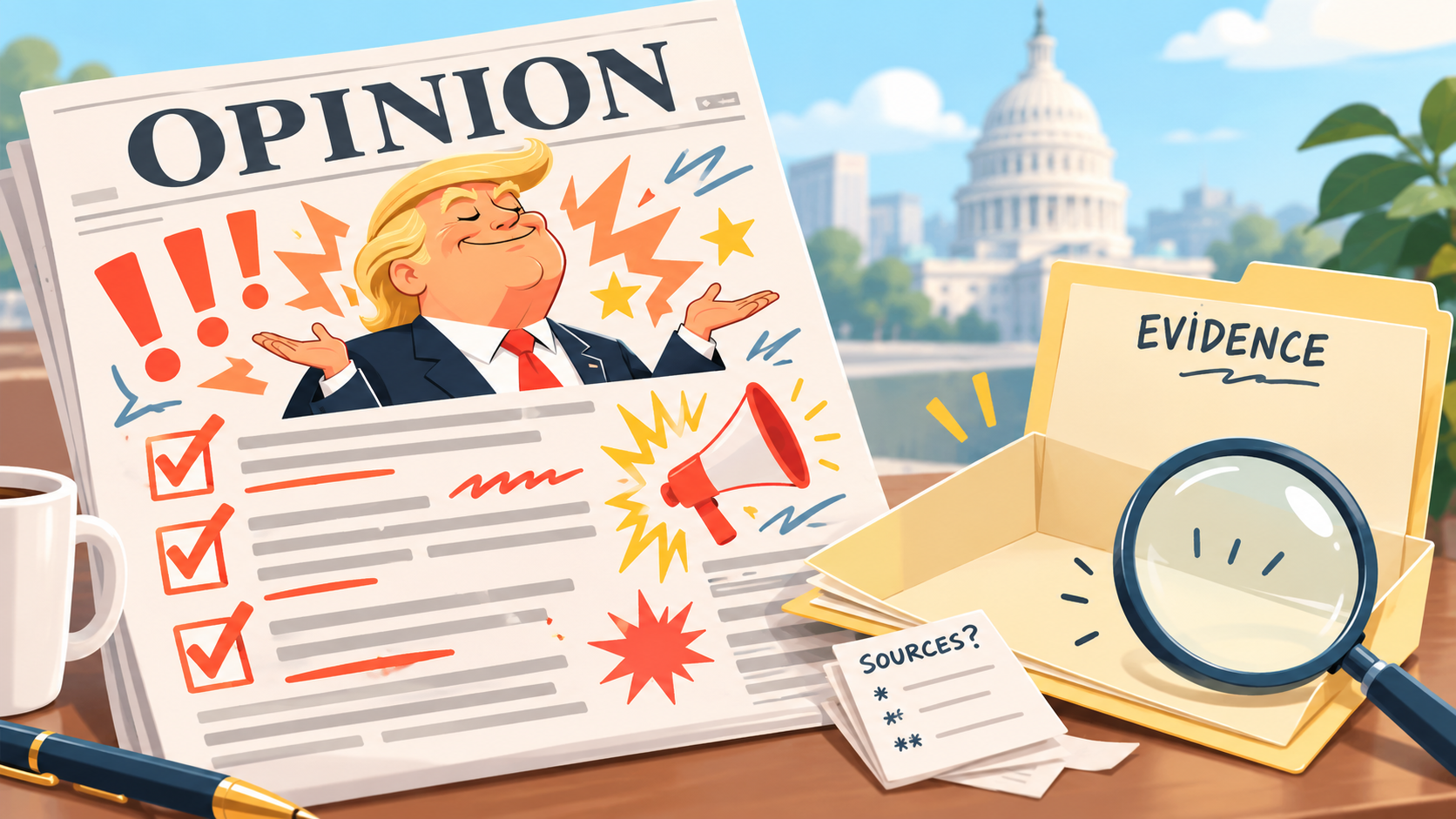
But here’s the problem with this little masterpiece of political outrage: the author offers an impressive collection of accusations without providing a single source, citation or meaningful explanation to support them. Some may be legitimate criticisms, others exaggerations and still others questionable interpretations. But apparently, evidence is optional when indignation is running at full throttle.
And that’s the point of this blog. I’m not defending Trump. I’m questioning the growing belief that making an accusation loudly enough somehow relieves the accuser of the responsibility to prove it.
If sarcasm were evidence, this letter would qualify as a doctoral dissertation.
Everything Is Trump’s Fault. Everything.
The author thanks Trump for disrupting global economics, increasing the cost of living and raising the deficit by $11 trillion.
Eleven trillion dollars!
That’s an impressive number, particularly when the writer doesn’t bother telling us the period covered, where the figure came from or how much of it can actually be attributed to Trump.
Perhaps numbers are more persuasive when they aren’t burdened by explanations.
Now, tariffs can increase consumer prices. Deficits are legitimate concerns. And military intervention deserves serious scrutiny.
But these are subjects requiring evidence, context and analysis.
Instead, we’re treated to an economic evaluation that could fit neatly on a bumper sticker:
Somewhere, an economist just retired early.
Canada, NATO and the End of Western Civilization
Next, we learn that Trump has apparently destroyed decades of international trust, undermined NATO, alienated Canada and generally reduced America’s standing to something resembling an unpopular relative at Thanksgiving dinner.
I won’t pretend Trump’s diplomatic style is particularly graceful. The man can turn a routine meeting into a wrestling promotion without removing his necktie.
But international relations are a little more complicated than whether European leaders enjoy being photographed with the American president.
Canada has its own political interests. NATO members have their own defense obligations. European governments disagree with Washington under presidents of both parties.
Disagreement is not necessarily destruction.
And criticizing an alliance’s financial arrangements doesn’t automatically mean someone wants to dismantle Western civilization.
Although, judging by this letter, civilization apparently survives only when everyone agrees with Doug.
The Department of Everything Is Ruined
The letter then charges through an impressive collection of federal institutions.
The State Department. DHS. CDC. EPA. National Parks. Smithsonian. Kennedy Center. Justice Department.
It’s practically a federal government directory with an obituary attached.
Some of these agencies have undergone significant policy changes, funding disputes or leadership upheavals. Those are fair subjects for criticism.
But describing every institutional change as an existential catastrophe requires something more than indignation and a functioning keyboard.
Which programs were eliminated? What were the measurable consequences? Which decisions were unlawful, ineffective or demonstrably harmful?
Those would be interesting questions.
Unfortunately, asking them might interfere with the rhythm of the letter.
And once you’ve committed to thanking Trump for destroying America, there’s precious little room for nuance.
The January 6 Problem
The author also condemns Trump’s pardons of January 6 defendants.
Here, at least, we have a concrete action that can be identified and debated.
The pardons are real. They are controversial. Their wisdom and consequences deserve examination.
But rather than distinguish between conduct, individual cases, punishment and presidential clemency authority, the letter simply moves along to the next outrage.
That’s the trouble with trying to squeeze the apocalypse into a few newspaper columns.
You eventually run out of space for reasoning.
Democracy Is in Peril. Please Remain Calm.
The grand finale warns that America’s 250-year-old democracy is being undermined by authoritarianism, misinformation and the destruction of public trust.
These are serious issues. Democratic institutions depend on constitutional limits, the rule of law, accountability and an informed electorate.
But I find it peculiar that every administration’s critics seem convinced they are witnessing the final chapter of the American experiment.
We’ve survived a civil war, presidential assassinations, two world wars, the Great Depression, Watergate, economic crises, riots, terrorist attacks and some truly dreadful congressional decisions.
Yet apparently the republic is now hanging by a thread because Donald Trump has spent another afternoon irritating everyone on social media.
Could democratic institutions be damaged by presidential misconduct? Certainly.
Does that mean every controversial appointment, executive order, diplomatic argument or budget decision constitutes the death of democracy?
Hardly.
The American constitutional system was designed precisely because the founders understood that political leaders would often be ambitious, self-interested and occasionally spectacularly foolish.
They didn’t expect angels to occupy the White House.
The Missing Ingredient: Evidence
My real objection to this letter isn’t that its author dislikes Trump.
That’s his prerogative. There are plenty of legitimate reasons to criticize Trump’s decisions, temperament and policies.
My objection is the substitution of emotional certainty for evidence.
The letter contains allegations, interpretations and dramatic conclusions, but precious little effort to establish the relationship between cause and effect.
It never seriously considers alternative explanations, competing evidence or even the possibility that some presidential decisions might produce mixed results.
And therein lies the problem with much of contemporary political commentary.
A claim becomes a fact because it sounds plausible to people who already agree with it.
An opinion becomes an argument because it’s delivered with sufficient indignation.
And sarcasm becomes analysis because nobody bothered to bring a calculator.
To be fair, sarcasm has its place.
I’m rather fond of it myself.
But I generally prefer mine accompanied by something that can survive a fact-check.
My Bottom Line
Doug Whitley’s letter is entertaining, at least if you enjoy political catastrophism served in bite-sized portions.
But it tells us considerably more about the author’s opinion of Donald Trump than it does about the actual condition of the United States.
The president is responsible for his decisions. Criticize them. Examine their consequences. Demand accountability.
Just don’t expect the rest of us to accept a sweeping indictment of American government, economics, foreign policy and democracy because someone managed to fit a dozen grievances beneath a clever headline.
The remarkable thing about American democracy is that it gives Mr. Whitley the freedom to publish his assessment of the president, however exaggerated it may be.
He can criticize the administration, call it authoritarian, predict the collapse of democracy and encourage readers to vote against it.
And the newspaper can print the whole thing.
That’s not proof democracy is perfectly healthy, of course.
Perhaps the next letter could include a few numbers, sources and explanations.
Although that might ruin the entertainment.
Why This Matters
Political hyperbole isn’t exclusive to Democrats, Republicans, liberals, conservatives or the perpetually outraged.
Both sides have developed a remarkable talent for portraying every election as civilization’s final opportunity to save itself.
The problem is that when everything is called a catastrophe, genuine catastrophes become harder to recognize.
A functioning democracy requires more than passion. It requires intellectual discipline, skepticism and a willingness to distinguish facts from opinions.
- Whitley, D. Thanks, Mr. President [Letter to the editor]. Northport.