Apparently, the world is coming apart at the seams. At least that’s what some people would have us believe.
Turn on the television, open social media or listen to certain religious fundamentalists, and you’d think humanity was experiencing something never before witnessed in civilization. France is rioting, Americans are fighting over politics, governments are unpopular and people are angry.
What else is new?
We’ve been fighting wars, overthrowing governments, rioting in the streets, arguing about religion and struggling with economic problems for thousands of years. Yet every generation seems convinced that its particular problems are somehow different, more dangerous and possibly a sign that the end is near.
I don’t buy it.
I’m not suggesting that the world doesn’t have serious problems. Of course it does. What I question is the assumption that today’s unrest represents some extraordinary breakdown of civilization.
And I especially question the religious nonsense that takes these events and turns them into evidence of an approaching apocalypse.
A Little Historical Perspective Wouldn’t Hurt
Consider what genuine national upheaval has looked like throughout history.
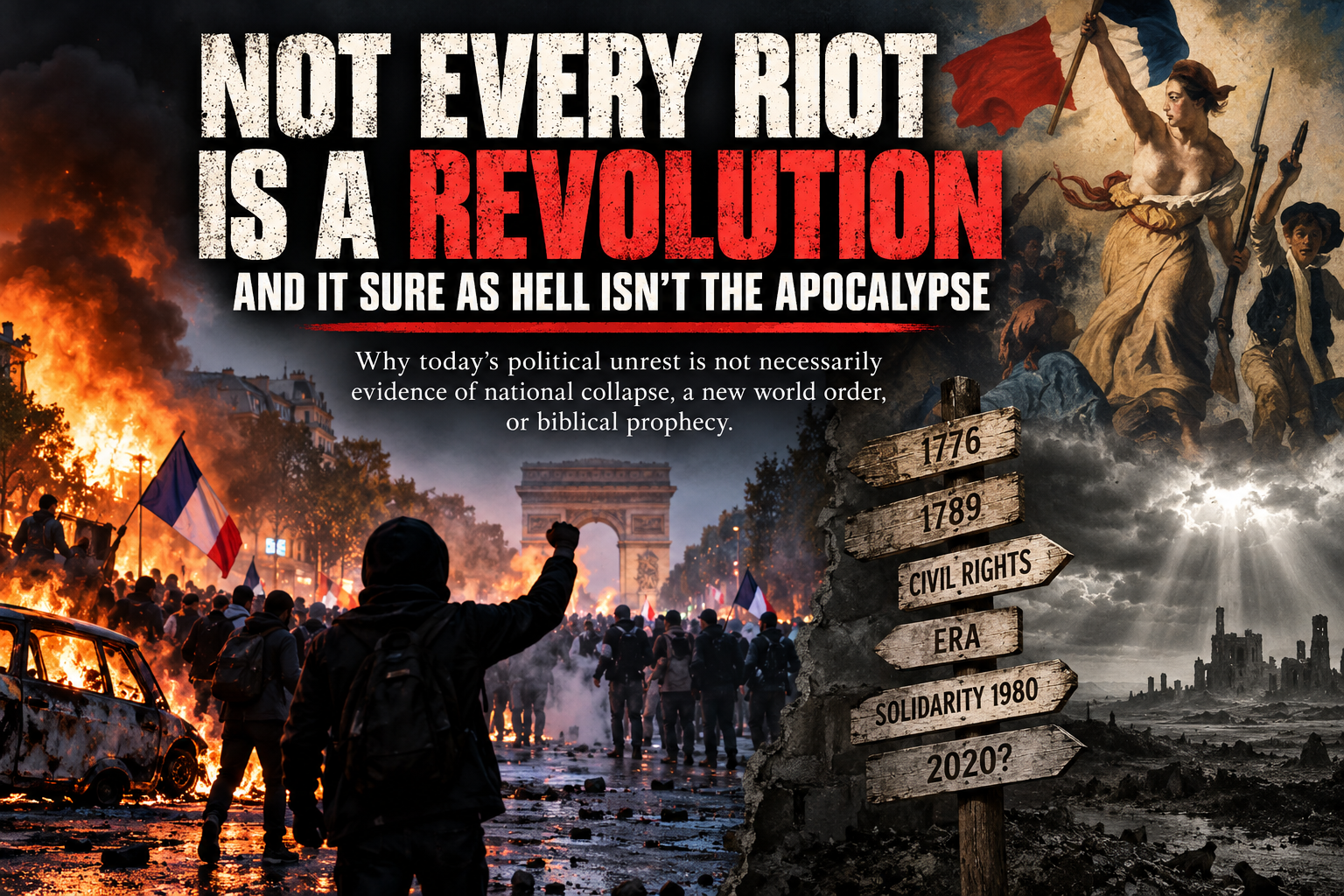
The American Revolution in 1776 wasn’t simply a collection of unhappy colonists demonstrating against unpopular policies. It was a sustained political struggle that ended in independence and the creation of a new nation.
The French Revolution in 1789 fundamentally overturned France’s monarchy and political structure. It involved years of violence, institutional collapse, executions and eventually the rise of Napoleon.
The American Civil Rights Movement challenged generations of legalized racial discrimination. It involved sustained demonstrations, boycotts, litigation, political organization and demands for fundamental changes in American law.
The Equal Rights Amendment movement reflected a decades-long struggle over women’s legal equality and constitutional rights.
And in Poland in 1980, Lech Wałęsa and the Solidarity movement challenged communist authority. That movement eventually helped bring about the end of communist rule in Poland. [5]
These were not simply episodes of people getting angry and breaking windows.
They involved deeply rooted grievances, sustained public involvement, identifiable objectives and profound struggles over political and social institutions.
Not everyone supported these movements, of course. Revolutions and social movements rarely enjoy unanimous public support.
But their impact was substantial, their objectives were clear and their historical consequences were enormous.
Now compare those events with what we’re witnessing today.
Are we really experiencing anything comparable across the United States, France or the world as a whole?
I haven’t seen convincing evidence of it.
France Is Rioting. That Doesn’t Mean France Is Having Another Revolution.
France is experiencing serious unrest in October 2026. Students, labor organizations and other groups have demonstrated over education, public services and government spending. [3, 6, 7]
Some demonstrations have turned violent. Cars have burned, businesses have been looted and public buildings have been attacked. [4]
None of that is acceptable.
But let’s distinguish between a country experiencing serious political unrest and a country whose population is prepared to overthrow its entire political system.
Those are two very different things.
On October 6, authorities counted about 250,000 demonstrators nationwide, and organizers claimed about 500,000. [3] That’s significant. It demonstrates substantial dissatisfaction.
But France has roughly 69 million residents. We cannot look at a few hundred thousand demonstrators, or the smaller number engaging in violence, and automatically conclude that the entire country has reached some revolutionary breaking point.
Nor can we assume that every demonstrator supports the destruction.
There are genuine grievances in France. There are also political organizations, ideological activists and opportunists who may attempt to exploit those grievances.
Both things can be true.
But before someone declares that France is approaching another 1789, I’d like to see some evidence beyond burning cars and dramatic television footage.
What About America in 2020?
The same distinction applies to the United States in 2020.
George Floyd’s killing triggered genuine anger over policing and racial injustice. I don’t deny that, nor do I question that many Americans sincerely believed changes were necessary.
And the protests spread nationwide. The Armed Conflict Location & Event Data Project (ACLED) documented more than 10,600 demonstrations between May 24 and August 22, 2020. Nearly 95 percent involved peaceful protesters. [1, 2]
But the destructive unrest did not reflect some broader national desire to dismantle the American political system.
There were widespread grievances, but that doesn’t mean Americans collectively wanted to overturn their institutions.
Protest movements also require organization. They need money, transportation, communication, legal assistance and people willing to coordinate their activities.
That’s nothing new. The Civil Rights Movement had financial supporters. So did Solidarity in Poland. Funding does not make a movement fake, and it does not make a movement a revolution.
One thing is clear: the intensity of the unrest declined. That doesn’t prove the underlying grievances disappeared.
The Zeitgeist Is Different
This is where historical comparisons become particularly important.
The zeitgeist is simply the prevailing spirit, attitude or mood of a particular period.
And I don’t see convincing evidence that today’s zeitgeist is comparable to that of the great revolutionary movements.
In 1776, American independence became the central objective of a sustained revolutionary struggle.
In 1789, France experienced an upheaval that transformed its entire political and social order.
During the Civil Rights Movement, millions of Americans were confronting an entrenched system of discrimination and fighting for fundamental legal changes.
Poland’s Solidarity movement challenged a communist state and helped change the political direction of Eastern Europe.
Those movements weren’t defined simply by how many demonstrations appeared on television.
They were defined by the depth of their objectives, the persistence of their supporters and the institutional changes they sought.
Today’s unrest may produce important changes. History hasn’t finished writing that chapter.
But I don’t see evidence that every country experiencing demonstrations is facing a comparable revolutionary transformation.
And I certainly don’t see a worldwide revolutionary movement proving that civilization is approaching its end.
The News Media Make Everything Look Like a Catastrophe
Here’s another problem.
The news media sensationalize practically everything.
A burning police car is news. A smashed storefront is news. A confrontation involving tear gas, screaming protesters and police officers makes dramatic television.
You know what doesn’t make particularly interesting television?
Millions of people getting up in the morning, going to work, taking their kids to school, paying their bills and carrying on with their lives.
But that’s what most people are doing.
The result is a distorted impression of society.
Watch enough news coverage, and you might conclude that every major city is burning and every government is about to collapse.
That’s not an assessment of the country. That’s an assessment of what television networks choose to show you.
I’m not arguing that journalists should ignore riots or political violence. Of course they should cover them.
But the coverage needs perspective.
How many people are participating? What percentage of the population do they represent? How many support peaceful reform versus violence? What changes are they actually demanding? Is the movement growing, declining or simply receiving more attention?
A burning building tells us something happened.
Not Everything Is a Biblical Prophecy
And now we get to the religious interpretation of all this.
I’ve heard the argument repeatedly: Look at the wars. Look at the earthquakes. Look at the political unrest. Look at the moral decline. Surely we’re living in the end times.
Really?
People have been making those claims for centuries.
The Black Death killed an enormous portion of Europe’s population. Europe endured the Thirty Years’ War. The French Revolution overturned a monarchy. Two world wars killed tens of millions of people. The Holocaust demonstrated just how far human cruelty could go.
And throughout history, religious believers have repeatedly interpreted the catastrophes of their own times as evidence of an approaching divine judgment.
Yet here we are.
I find it remarkable that someone can examine today’s political disagreements and conclude that they are somehow more apocalyptic than what people endured during the Black Death or the Second World War.
By what standard?
What measurable evidence establishes that today’s unrest is uniquely significant?
And how does any of it establish the existence of a supernatural being, much less that biblical predictions are being fulfilled?
It doesn’t.
If someone wants to argue that today’s conflicts fulfill biblical prophecy, then demonstrate it. Identify a specific prediction, establish what the original text meant to its original audience and show that the event could not reasonably be explained through ordinary historical processes.
Otherwise, we’re simply taking events that have occurred throughout human history and pretending they’re suddenly supernatural because they’re happening during our lifetimes.
That’s not historical analysis.
That’s religious interpretation.
My Bottom Line
I don’t see convincing evidence that the United States or the world collectively is experiencing some unprecedented, civilization-ending social upheaval.
That doesn’t mean individual countries aren’t suffering terrible wars, humanitarian catastrophes or genuine political crises. They are.
Nor does it mean serious unrest cannot develop into something much larger. Of course it can.
But we need to distinguish between what is actually happening and what people imagine might happen.
France is experiencing serious unrest. That doesn’t automatically make it another French Revolution.
America experienced enormous demonstrations in 2020. That doesn’t establish that Americans collectively wanted to overthrow their government.
And the fact that people are angry about politics, economics, social issues or religion doesn’t mean humanity has reached some extraordinary turning point.
Human beings have always fought, protested, disagreed and struggled to improve their circumstances.
Sometimes those struggles have changed history.
Sometimes they’ve accomplished little.
And sometimes they’ve produced nothing but destruction.
What I reject is the automatic assumption that today’s events must be different simply because we’re the generation experiencing them.
We’ve seen genuine national revolutions. We’ve seen world wars. We’ve seen governments collapse and political systems disappear.
The modern world certainly has serious problems, but the claim that today’s unrest is unprecedented requires evidence, not dramatic headlines.
And it certainly doesn’t establish that the apocalypse is upon us.
Why This Matters
Historical perspective matters because fear is a lousy substitute for evidence.
When people become convinced that their country is collapsing or that the world is approaching some supernatural conclusion, they can begin interpreting every new event as confirmation of what they already believe.
Another riot? More proof.
Another war? More proof.
Another economic crisis? More proof.
The problem is that the conclusion was already decided before the evidence was examined.
That’s exactly backward.
We should evaluate the evidence first and reach conclusions afterward.
And if the evidence doesn’t establish that civilization is ending, then we shouldn’t pretend otherwise.
Humanity has serious problems to solve. It always has.
- Armed Conflict Location & Event Data Project. (2020). Demonstrations and political violence in America: New data for summer 2020. acleddata.com.
- Armed Conflict Location & Event Data Project. (2021). A year of racial justice protests: Key trends in demonstrations supporting the BLM movement. acleddata.com.
- Al Jazeera. (2026, October 6). France suspends high school classes as protesters clash with police. aljazeera.com.
- Associated Press. (2026). How France’s worst rioting in years erupted and how the government responded. apnews.com.
- Encyclopaedia Britannica. American Revolution; French Revolution; American civil rights movement; Solidarity (Polish trade union). britannica.com.
- Reuters. (2026, October 17). Mass protests in France spiral into worst riots in years. reuters.com.
- Reuters. (2026, October 20). Curfews help calm France but more protests planned. reuters.com.