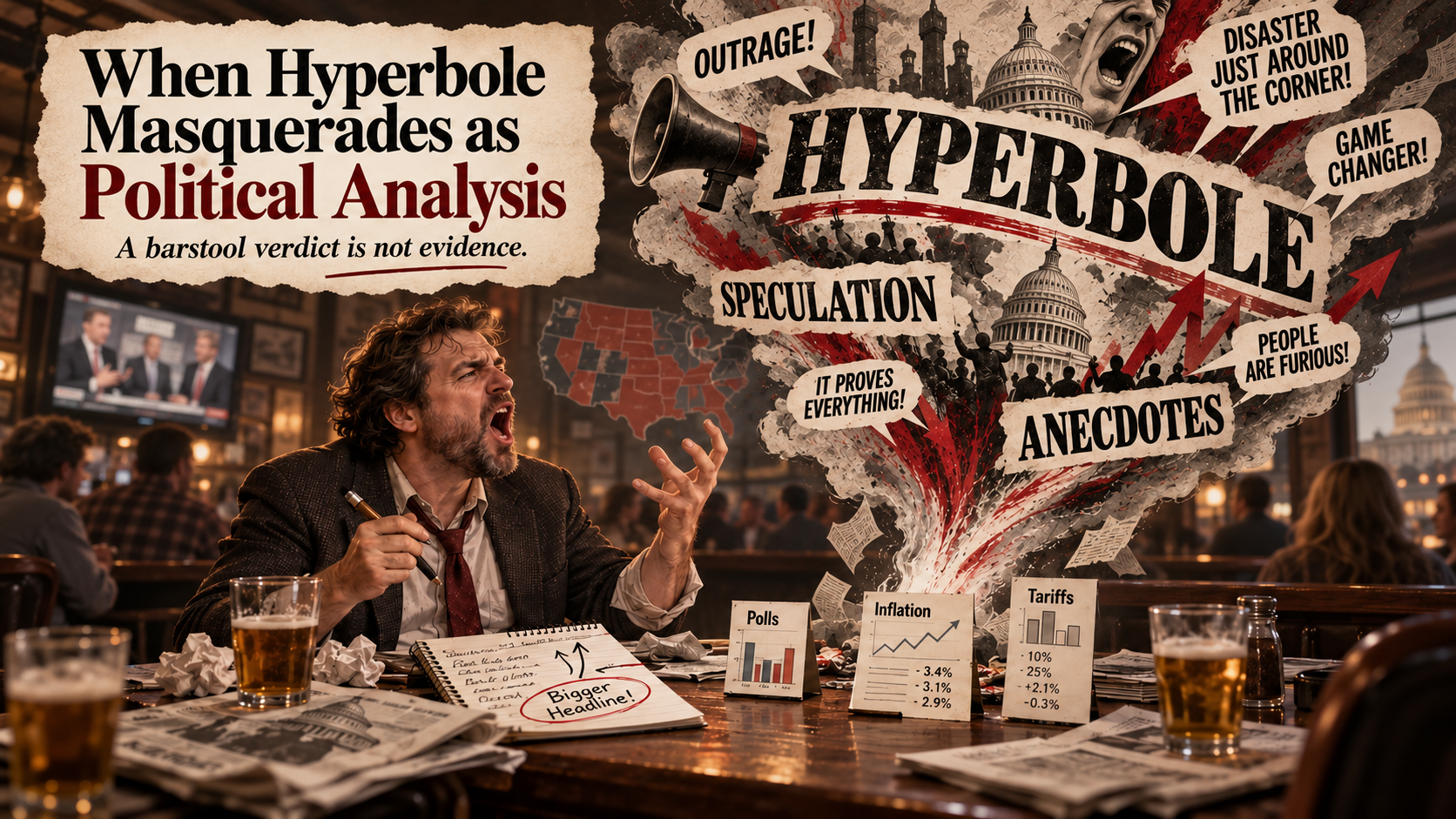
Richard Littlejohn has apparently decided that Donald Trump is finished, Trumpism has run its course, Republicans are heading for an electoral bloodbath and the remaining two years of Trump’s presidency will amount to little more than impeachment threats and increasingly bizarre executive orders. [1]
Quite a conclusion.
And what is the evidence supporting this political obituary?
A few opinion polls, an expensive steak in Florida, some dissatisfied acquaintances in Michigan and conversations with Republican drinking buddies at a bar called Bobby’s.
I’m not making that up.
Littlejohn’s October 22, 2026, Daily Mail column reads less like political analysis and more like an extended conversation between a few retired fellows who have spent the afternoon discussing everything wrong with America.
There’s nothing wrong with that. I’ve participated in a few such conversations myself.
But I wouldn’t confuse them with research.
The problem isn’t that Littlejohn criticizes Trump. There’s plenty to criticize about virtually any president. The problem is that he takes a handful of observations, mixes them with speculation and ridicule, and somehow produces a sweeping conclusion about the political future of the United States.
The result is entertaining, occasionally factual and overwhelmingly hyperbolic.
The Great Florida Steak Indicator
Littlejohn describes standing in a Florida discount warehouse, contemplating a ribeye priced around $25 per pound. An elderly woman remembers when steak was eight dollars a pound.
Apparently, this encounter contributes to his conclusion that Trumpism has reached its expiration date.
Well, that’s certainly one way to conduct economic research.
Find an expensive steak, locate a dissatisfied shopper and extrapolate the future of American politics.
Inflation is real. Food prices have increased. Gasoline prices have placed additional pressure on household budgets. None of those observations is particularly controversial.
But the existence of expensive groceries doesn’t establish which political party voters will support in November.
An economic observation is not an electoral forecast.
If it were, predicting elections would be remarkably easy. Economists could abandon statistical models and simply visit the meat counter at Costco.
A Political Earthquake According to Roger at Bobby’s
Perhaps the most revealing feature of Littlejohn’s argument is his reliance on personal acquaintances.
He mentions Republican regulars at his favorite Florida bar, including Roger, who supposedly considers Littlejohn a dangerous liberal and is stocking up on ammunition.
He mentions his sister in Michigan, whose younger coworkers once supported Trump enthusiastically but have apparently cooled considerably.
Then there’s a Republican businessman in Georgia who predicts an electoral bloodbath.
And we’re told this fellow is rarely wrong.
Well, there you have it.
Cancel the polling. Fire the political scientists. Shut down the election forecasting models.
Roger, Littlejohn’s sister and a businessman from Georgia have apparently settled the question.
This is what researchers call anecdotal evidence. And while anecdotes can illustrate an argument, they cannot establish how millions of voters think.
There’s no representative sample, no systematic selection of respondents, no controls and no meaningful way to determine whether these individuals reflect broader public opinion.
It’s particularly amusing that Littlejohn announces he doesn’t trust polls while treating conversations with his friends as reliable indicators of national sentiment.
Think about that for a moment.
Scientific polling, however imperfect, attempts to measure public attitudes systematically.
Littlejohn apparently prefers whoever happens to be sitting on the next barstool.
The Polling Problem: Facts Without Context
To his credit, Littlejohn does introduce an actual political statistic.
He observes that Trump’s endorsed candidate for Florida governor is only two percentage points ahead of the Democrat.
That’s a legitimate observation about one poll.
But it’s hardly the whole picture.
As of October 22, RealClearPolling’s Florida gubernatorial average showed Republican Byron Donalds leading Democrat David Jolly by approximately 5.6 percentage points. Individual surveys ranged from a tie to an eleven-point Republican advantage. [2]
The distinction matters.
A single poll showing a close race may suggest competitiveness. It doesn’t establish that a political movement has collapsed.
Michigan provides another example. The Senate contest between Democrat Abdul El-Sayed and Republican Mike Rogers is competitive, with the RealClearPolling average showing El-Sayed ahead by approximately two points. [3]
Again, that’s a close election, not evidence that the Republican Party is approaching extinction.
And Littlejohn manages an additional mistake by suggesting that Michigan’s Senate race could determine control of the House.
It cannot.
The Senate and House are separate legislative chambers, and elections to one do not determine control of the other.
That’s not a subtle disagreement about political philosophy. It’s basic American government.
These factual details matter because Littlejohn is asking readers to accept a sweeping political conclusion while demonstrating remarkably little interest in the precision needed to support it.
The Facts Are There. They’re Just Buried Under the Rhetoric.
To be fair, Littlejohn raises a few legitimate issues.
The economic consequences of the Iran conflict, higher energy prices, tensions involving Canada and the possible effects of tariffs on Michigan’s automotive industry are all reasonable subjects for criticism.
A September 2026 inflation report placed annual inflation at 3.7%, while gasoline prices had increased substantially. [4]
These aren’t imaginary economic pressures.
The disagreement isn’t over whether such problems exist.
It’s over what they establish.
Higher energy prices do not automatically translate into Republican electoral defeat. Tariff-related economic disruption does not establish that the president’s political coalition has disintegrated. Dissatisfaction with foreign policy does not demonstrate that an entire political movement is finished.
These propositions require evidence beyond the original economic observations.
Yet Littlejohn repeatedly moves from a legitimate concern to a dramatically larger conclusion without demonstrating the connection.
That’s the recurring problem throughout his column.
A fact appears, followed by an opinion, followed by an unsupported prediction.
By the time the reader reaches the end, the prediction has somehow assumed the status of an established fact.
When Insults Substitute for Arguments
Littlejohn’s descriptions of political figures are certainly colorful.
Politicians he dislikes become headbangers, spivs, virtual communists and various other creatures apparently inhabiting the British political imagination.
Trump himself becomes an increasingly ridiculous character headed toward political oblivion.
Putin gets his share of the abuse. So do Gavin Newsom, Abdul El-Sayed and assorted European leaders.
Some readers will undoubtedly find the language entertaining.
But what does it establish?
Nothing.
Calling a politician a communist doesn’t demonstrate that his economic proposals constitute communism. Calling someone a headbanger doesn’t address his policy positions. Suggesting that Trump has become increasingly irrational doesn’t prove that his remaining political influence has disappeared.
This is rhetoric substituting for analysis.
And it works because ridicule is emotionally satisfying.
Readers already inclined to agree with the author enjoy watching their political opponents get verbally dismantled.
But agreement and amusement aren’t evidence.
The Political Fortune Teller
Littlejohn moves beyond current political dissatisfaction to predict what amounts to the unraveling of the Trump presidency.
Republicans are supposedly facing a bloodbath.
Trump will become a powerless lame duck.
Impeachment battles will dominate his remaining term.
His executive orders will become increasingly outrageous.
Even Vice President JD Vance is supposedly being abandoned, with speculation extending to what Vance’s wife may think about the political situation.
That’s quite a collection of predictions.
But where’s the evidence that establishes this sequence of events?
An election hasn’t yet occurred. Control of Congress hasn’t yet changed. Impeachment proceedings aren’t an inevitable consequence of political dissatisfaction.
Even a president facing an opposition-controlled Congress retains substantial constitutional authority.
Littlejohn treats possible events as though they form an unavoidable chain.
They don’t.
Political forecasts are inherently uncertain. One can identify conditions that might produce a particular outcome without pretending that outcome has already occurred.
That’s an important distinction for anyone claiming to analyze politics rather than merely entertain readers.
The Most Revealing Admission in the Entire Column
Perhaps the most interesting moment arrives when Littlejohn explains why he came to admire Trump.
He invokes the familiar idea that the enemy of his enemy is his friend.
Trump, he admits, irritated the people Littlejohn disliked.
There it is.
Not a systematic assessment of economic performance. Not a carefully developed argument about constitutional government, foreign policy or legislative achievements.
He admired Trump partly because Trump aggravated the right people.
Now that Littlejohn has become disillusioned, the pendulum has swung in the opposite direction.
But the analytical method hasn’t improved.
He once found Trump’s provocations entertaining. Now he finds Trump’s behavior embarrassing.
That’s a change in personal sentiment.
It isn’t necessarily evidence of a comparable change among the American electorate.
And that distinction matters enormously.
Personal political disappointment is not the same thing as a measurable national political transformation.
My Bottom Line
Richard Littlejohn is an experienced columnist, and he knows how to write an entertaining piece.
His descriptions are colorful, his insults imaginative and his personal anecdotes occasionally amusing.
But entertainment shouldn’t be confused with evidence.
His argument consists largely of hyperbole surrounding a handful of legitimate observations.
He identifies real economic problems and political controversies, then leaps to the conclusion that Trumpism is finished and Republicans are approaching electoral catastrophe.
He relies heavily on personal conversations while expressing skepticism toward systematic polling.
He selectively emphasizes statistics favorable to his narrative, makes at least one elementary mistake about congressional elections and treats speculative predictions as though they were logical consequences of current events.
None of this proves that Trump or the Republicans will enjoy electoral success, either. That would be committing precisely the same error in the opposite direction.
The political difficulties he identifies may be meaningful.
The political obituary he writes is premature as an evidentiary conclusion.
And there’s an enormous difference between the two.
Why This Matters
The larger problem isn’t Richard Littlejohn or Donald Trump.
It’s the increasing tendency to confuse colorful political commentary with reliable political analysis.
We see it constantly.
A columnist talks to a handful of people, discovers a poll supporting his preferred narrative, quotes a few economic statistics and produces a sweeping declaration about the direction of an entire country.
Social media amplifies the conclusion. Other commentators repeat it. Eventually, repetition gives the original speculation an appearance of credibility.
But the underlying reasoning hasn’t improved.
Political analysis ought to begin with a clearly defined question, reliable evidence, appropriate comparisons and some recognition of uncertainty.
It should not begin with a conclusion and then go hunting for anecdotes that make the conclusion sound plausible.
Littlejohn is certainly entitled to his opinions.
He’s entitled to dislike Trump, question his policies and predict Republican defeat.
But an opinion doesn’t become research simply because its author mentions a few statistics along the way.
If I wanted to know what Roger thinks about Donald Trump, I’d buy him a beer.
If I wanted to know what American voters think, I’d examine the evidence.
There’s a difference.
- Littlejohn, R. (2026, October 22). Opinion column on Trump and American voters. Daily Mail. dailymail.com/debate/article-16231299/RICHARD-LITTLEJOHN-Trump-toast-voters-bars-US.html
- RealClearPolling. (2026, October). 2026 Florida Governor: Donalds vs. Jolly. https://www.realclearpolling.com/elections/governor/2026/florida
- RealClearPolling. (2026, October). 2026 Michigan Senate: Rogers vs. El-Sayed. https://www.realclearpolling.com/polls/senate/general/2026/michigan/rogers-vs-el-sayed
- U.S. Bureau of Labor Statistics. (2026, October). Consumer Price Index: September 2026. https://www.bls.gov/cpi/