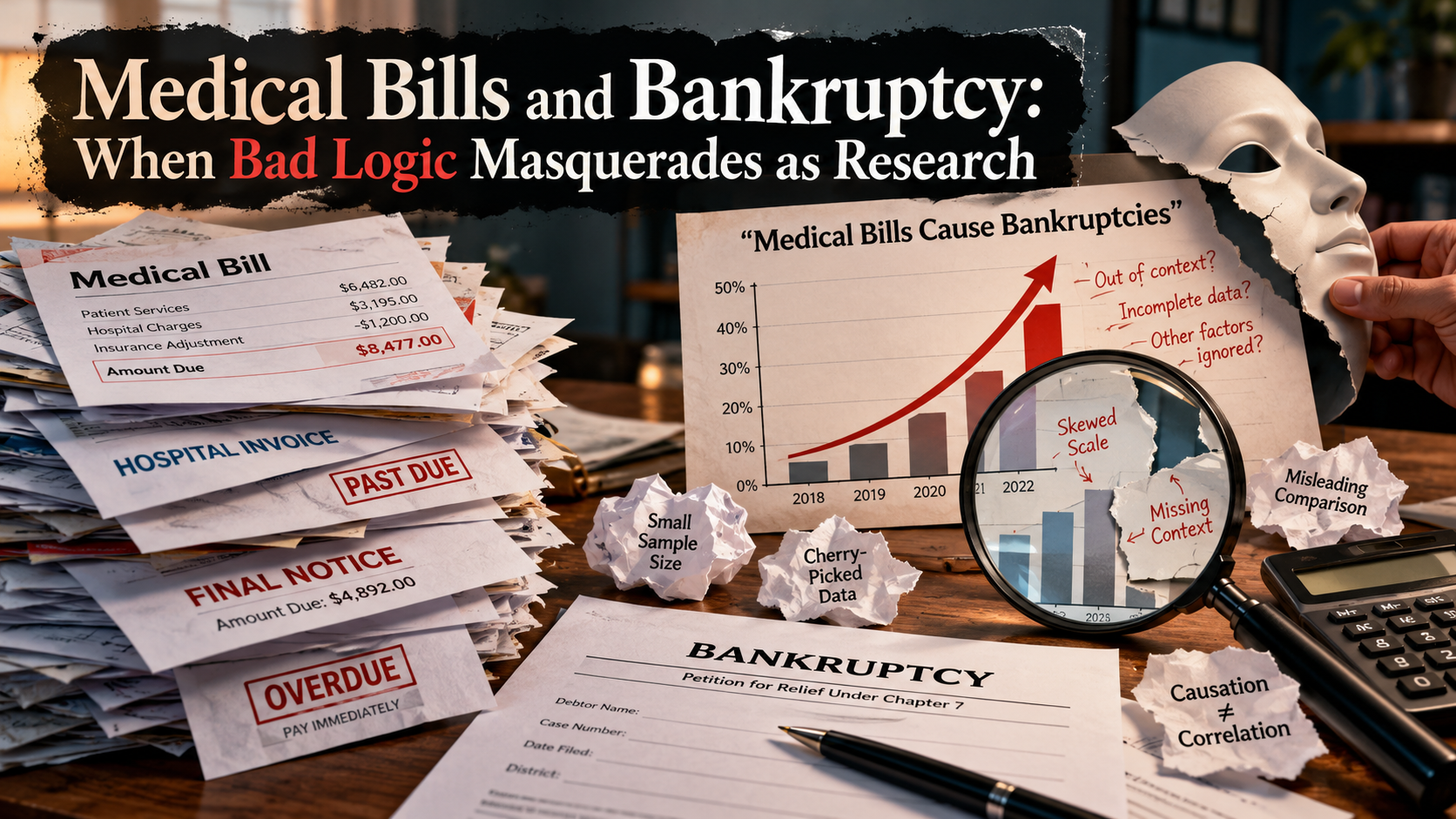
The American Bankruptcy Institute (ABI) published a piece titled Health Care Costs Number One Cause of Bankruptcy for American Families. [1]
That’s quite a declaration. Not a cause of bankruptcy. Not a contributing factor. The number-one cause.
There’s just one problem: making that declaration and proving it are two entirely different things.
I have no doubt that medical bills create financial hardship. Serious illnesses can devastate families financially, particularly when someone loses the ability to work. I’m not disputing that. What I question is the intellectual leap from identifying medical expenses among someone’s debts to concluding that those expenses caused the bankruptcy.
And that distinction isn’t some technicality. It’s fundamental to credible research.
The ABI page itself restricted direct access when I examined it, so this critique concerns its headline and the published studies commonly used to support that claim, rather than an unverifiable line-by-line reading of the article.
The Research Behind the Claim
In 2009, researchers David Himmelstein, Deborah Thorne, Elizabeth Warren and Steffie Woolhandler published a study in the American Journal of Medicine titled Medical Bankruptcy in the United States, 2007: Results of a National Study. [4]
The researchers surveyed 2,314 bankruptcy filers and conducted 1,032 interviews. They concluded that 62.1% of bankruptcies qualified as medically related.
That percentage is impressive. It’s also misleading when presented without explaining how the researchers arrived at it.
A bankruptcy could qualify as medical if the individual reported illness-related financial difficulties, experienced significant income loss due to illness or had qualifying medical expenses.
The original study included people with medical bills exceeding $5,000 or 10% of household income, among other criteria.
In other words, these weren’t necessarily people whose medical bills were the primary reason they filed bankruptcy.
The research identified medical involvement. That’s not identical to establishing medical causation.
And therein lies the problem.
Bad Logic No. 1: Confusing Correlation With Causation
This is Research Methodology 101.
Two things occurring together do not establish that one caused the other.
Suppose someone files bankruptcy with the following financial obligations:
- Mortgage arrears: $35,000
- Credit card debt: $48,000
- Auto loans: $27,000
- Medical bills: $6,000
Total financial obligations: $116,000.
The person has also been struggling financially for years.
Can the medical bills be a contributing factor? Certainly.
But can we conclude that the $6,000 medical obligation caused the bankruptcy?
Of course not. Not without examining the person’s income, assets, payment history, existing debt and financial condition before the medical expenses appeared.
Yet a broad classification system could identify that person as having a medical bankruptcy.
The first is an observation. The second requires a causal argument supported by evidence.
Calling both the same thing doesn’t make them the same thing.
Bad Logic No. 2: Changing the Definition Halfway Through the Argument
Another problem is the way medical bankruptcy is defined.
Most people hearing that medical bills cause the majority of bankruptcies reasonably imagine families overwhelmed by hospital bills, doctors’ bills and other direct medical expenses.
But some studies include something quite different: lost income resulting from illness.
Consider a self-employed contractor who undergoes surgery and cannot work for six months.
His business revenue collapses. He falls behind on his mortgage, equipment payments and credit cards. Eventually, he files bankruptcy.
Was his bankruptcy related to a medical problem? Absolutely.
Was it caused by medical bills? Not necessarily.
His medical bills might have been covered by insurance. The real financial problem could have been six months without income.
Those are two distinct economic mechanisms: increased expenses and reduced earnings.
Both deserve consideration, but combining them under the popular claim that medical bills cause bankruptcy changes what the public is being told.
That’s a form of equivocation, using a broad definition during the research and a narrower, more dramatic interpretation when presenting the conclusion.
It may sell a headline, but it doesn’t improve the methodology.
Bad Logic No. 3: Treating Survey Responses as Proof of Causation
In 2019, researchers published another study in the American Journal of Public Health , examining 910 bankruptcy filers from 2013 through 2016. [5]
They reported that 66.5% identified medical expenses or illness-related work loss as contributing factors.
But look at the actual responses:
| Reported contributing factor | Percentage |
|---|---|
| Medical expenses | 58.5% |
| Medical problems causing lost work | 44.3% |
| Either medical factor | 66.5% |
| Income loss, including medically related | 77.8% |
| Unaffordable mortgage or foreclosure | 45.0% |
| Spending beyond one’s means | 44.4% |
| Student loans | 25.4% |
| Divorce or separation | 24.4% |
Notice something?
The percentages overlap because respondents could identify multiple contributing factors.
In fact, 77.8% identified income loss as a contributor, a figure higher than the medical category.
Does that automatically establish that lost income was the primary cause of 77.8% of bankruptcies?
No.
And that’s precisely my point.
These surveys tell us what financial problems bankrupt individuals experienced and what they believed contributed to their difficulties.
That is useful information.
But a person’s explanation of their financial collapse is not necessarily an objective determination of its primary cause.
People are quite capable of identifying a recent or particularly painful expense while overlooking years of financial decisions that made them vulnerable in the first place.
This is why researchers distinguish self-reported explanations from independently established causal relationships.
It’s not a matter of disbelieving the respondents. It’s a matter of understanding what a survey can and cannot prove.
Bad Logic No. 4: Ignoring Research That Challenges the Conclusion
In 2018, economists Carlos Dobkin, Amy Finkelstein, Raymond Kluender and Matthew Notowidigdo published The Economic Consequences of Hospital Admissions in the American Economic Review. [2]
Their approach differed substantially from the bankruptcy surveys.
Instead of relying solely on retrospective explanations from people who had already declared bankruptcy, they examined hospital admissions alongside financial records and subsequent economic outcomes.
They found that hospitalizations increased financial hardship, reduced earnings, increased unpaid medical bills and raised bankruptcy risk in certain populations.
So yes, medical events demonstrably cause financial damage.
But their analysis also found that hospital admissions accounted for only about 4% of bankruptcies among nonelderly adults in their sample.
That’s an enormous difference from the widely repeated 62% or 66.5% figures.
Now, intellectual honesty requires acknowledging an important limitation.
The 2018 research examined hospital admissions among California adults under 65. It did not capture every chronic illness, outpatient medical expense, disability or medical event that might contribute to bankruptcy.
Therefore, it would be just as wrong to declare that only 4% of American bankruptcies have medical causes.
Nevertheless, the study provides substantial evidence that the widely advertised medical-bankruptcy percentages cannot simply be accepted as established causal findings.
The same researchers also addressed the issue in the New England Journal of Medicine , explaining that medical expenses do cause bankruptcies, but potentially far fewer than previous estimates suggested. [3]
This is what makes the question interesting.
We have different studies using different methodologies, producing different estimates because they are measuring different things.
That’s not a reason to pick whichever percentage best supports your politics.
It’s a reason to examine the methodology.
Bad Logic No. 5: Confusing an Authority With Proof
The American Bankruptcy Institute is a recognized professional organization.
Fine.
But the fact that an article appears on the ABI website does not establish that the headline is correct.
This is where the appeal to authority becomes a problem.
An authoritative source can provide reliable information. Its reputation is relevant when evaluating credibility. But credibility is not a substitute for examining the underlying evidence.
A professional organization repeating a statistic does not transform that statistic into a demonstrated causal relationship.
I would apply precisely the same standard to an article published by a conservative think tank, a liberal advocacy organization, a prestigious university or a government agency.
Show me the data. Explain your definitions. Identify your variables. Demonstrate how you reached the conclusion.
And explain the limitations.
That’s how research works.
What Would Actually Establish the Claim?
If we’re going to declare medical costs the number-one cause of American bankruptcy, we need a research design capable of testing that proposition.
At minimum, I would want to know:
First: What was the individual’s financial condition before the medical event?
Second: How much debt existed before the medical expenses occurred?
Third: Did medical expenses materially change the individual’s probability of filing bankruptcy?
Fourth: What would likely have happened without the medical expense or illness?
Fifth: How does the estimated causal effect compare with unemployment, divorce, unaffordable housing, excessive debt and other financial shocks?
That fourth question is especially important.
It’s called the counterfactual : What would have happened if the alleged cause had not occurred?
We cannot observe both versions of the same person’s life. But appropriately designed statistical studies can estimate causal effects by comparing comparable individuals and examining changes over time.
Without that analysis, we’re largely left with association, classification and self-reporting.
Those things have value. But they cannot always answer a question about primary causation.
The Difference Between a Real Problem and an Exaggerated Claim
None of this means American health care is inexpensive.
It isn’t.
None of this means medical debt never causes bankruptcy.
It does.
And none of it establishes that insurance protects every family from medical-related financial hardship.
It clearly doesn’t.
But why should acknowledging those realities require accepting a claim that hasn’t been adequately demonstrated?
We can recognize the burden of medical expenses without exaggerating what the bankruptcy research establishes.
In fact, exaggeration can undermine a perfectly legitimate argument.
When advocates describe every bankruptcy with a medical component as a medical bankruptcy, they risk obscuring the broader causes of household insolvency.
Job loss, insufficient savings, excessive debt, unaffordable housing and illness can interact. Sometimes a medical problem is the decisive shock. Other times it is one of several pressures on a household already headed toward financial failure.
Good research should attempt to separate those possibilities.
Bad logic treats them as interchangeable.
My Bottom Line
The American Bankruptcy Institute headline, Health Care Costs Number One Cause of Bankruptcy for American Families , is a stronger claim than the commonly cited evidence can conclusively support.
The underlying research is not worthless. Quite the contrary. It provides evidence that medical expenses and illness contribute substantially to financial distress.
But identifying a contributing factor is not the same as establishing a primary cause.
That’s the central mistake.
Correlation is not causation. Self-reported contributing factors are not definitive causal findings. Broad classifications are not necessarily proof of the dominant reason someone went bankrupt.
And an organization’s reputation doesn’t excuse weak reasoning.
I’ve spent enough time studying research design and evaluating evidence to recognize the difference between a finding and an interpretation of that finding.
The appropriate conclusion isn’t that medical bankruptcies are imaginary. Nor is it that they account for only 4% of all filings.
The appropriate conclusion is that the claim that medical bills are America’s number-one cause of bankruptcy has not been conclusively established by the frequently cited studies.
If someone wants to make that argument, fine. Produce research that isolates medical expenses as the primary causal factor and demonstrates that they exceed competing causes.
Until then, let’s stop presenting a disputed interpretation as though it were a settled fact.
And putting it on a respected organization’s website doesn’t make the logic any better.
Why This Matters
This issue is bigger than bankruptcy.
The same errors appear constantly in political arguments, economics, public health, education and social science.
Someone discovers a statistical association, assigns it a causal explanation, and suddenly the explanation becomes a fact repeated across news articles, social media and political debates.
The public remembers the headline. Almost nobody examines the methodology.
That’s precisely backward.
Whether we’re discussing medical debt, crime, education, poverty or economic policy, the standard should be the same.
- American Bankruptcy Institute. Health care costs number one cause of bankruptcy for American families. abi.org/feed-item/health-care-costs-number-one-cause-of-bankruptcy-for-american-families.
- Dobkin, C., Finkelstein, A., Kluender, R., & Notowidigdo, M. J. (2018a). The economic consequences of hospital admissions. American Economic Review, 108 (2), 308-352. https://doi.org/10.1257/aer.20161038
- Dobkin, C., Finkelstein, A., Kluender, R., & Notowidigdo, M. J. (2018b). Myth and measurement: The case of medical bankruptcies. New England Journal of Medicine, 378 , 1076-1078. https://doi.org/10.1056/NEJMp1716604
- Himmelstein, D. U., Thorne, D., Warren, E., & Woolhandler, S. (2009). Medical bankruptcy in the United States, 2007: Results of a national study. American Journal of Medicine, 122 (8), 741-746. https://doi.org/10.1016/j.amjmed.2009.04.012
- Himmelstein, D. U., et al. (2019). Medical bankruptcy: Still common despite the Affordable Care Act. American Journal of Public Health, 109 (3), 431-433. https://pmc.ncbi.nlm.nih.gov/articles/PMC6366487/