Some arguments never end. They only change messengers.
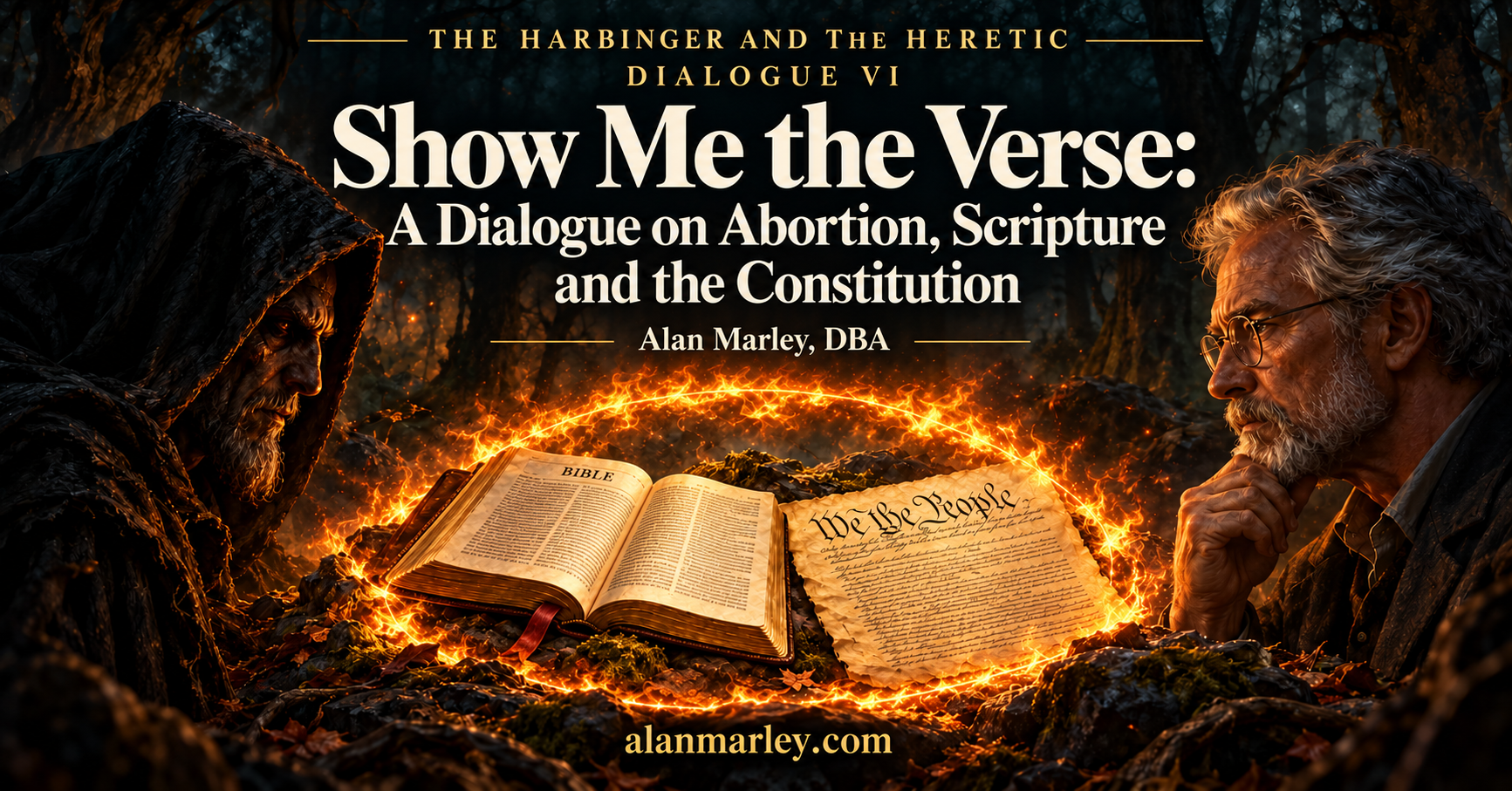
This one began with a friend, a fundamentalist who is certain that the Bible and the Constitution stand on his side of the abortion question. I asked him to show me where. I asked for the words, not the interpretation.
What follows is how that went. The Harbinger’s messages appear exactly as he wrote them. The Heretic’s appear in full.
The Harbinger"Typical Dr Matley, if someone doesn't agree with uou, uou write them off, look down on them and put yourself above them. There are MANY MANY people every bit as learned and read as thr great Dr. Marley. On abortion, Christianty, and the Constitution there are MANY " REAL" SCIENTISTS, SCHOLARS AND THE LIJE WHO BELIEVE AD CHARLIE AND AND COULD DEBATE YOU UP ONE SIDE SND FOWN THE OTHER. Oh you know the fact you want, and the facts that support the beliefs YOU WANT TO BELIEVE."
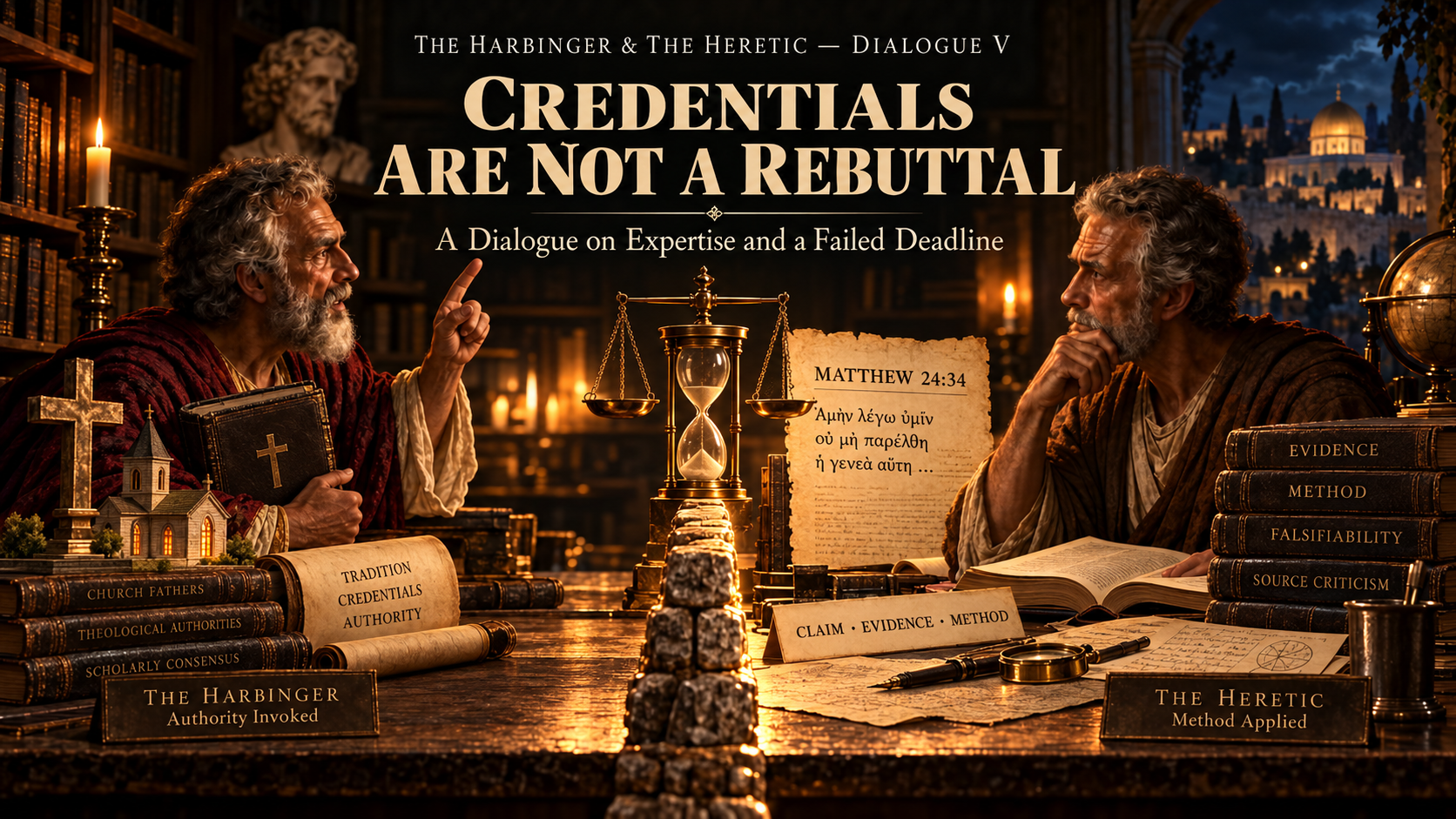
The HereticYou seem far more interested in attacking my education and character than addressing the actual argument. I have never suggested that intelligent, educated people cannot disagree with me. Of course they can. But their credentials, religious convictions, and personal beliefs do not magically transform opinions into facts.
Let’s make this remarkably simple.
The United States Constitution does not mention abortion. Not once. It neither explicitly prohibits nor guarantees it. Even the Supreme Court acknowledged the absence of any express reference in Dobbs v. Jackson Women’s Health Organization (2022).
The Bible contains no explicit commandment prohibiting abortion. Not one. There is no passage in which Jesus condemns abortion, nor any direct biblical prohibition identifying abortion as murder.
And before you start reaching for Jeremiah, Psalms, Exodus, or some other passage, remember the distinction: Allusions, interpretations, theological extrapolations, and personal convictions are not explicit statements of fact. You can certainly interpret those passages to support your beliefs, but that does not mean the authors actually said what you claim. If you have a legitimate verse that clearly states abortion is a sin and murder, by all means provide it.
As for Charlie Kirk and the supposedly countless scholars who could debate me into submission, wonderful! Then produce their evidence. Name-dropping isn’t an argument. Neither is announcing how many people agree with you. Millions of people believing something does not establish its truth.
And please stop confusing disagreement with intellectual arrogance. I don’t dismiss people because they disagree with me. I challenge assertions that are presented as established facts without the evidence necessary to support them.
If you believe the Bible explicitly prohibits abortion, cite the passage. If you believe the Constitution explicitly addresses abortion, cite the article or amendment.
No interpretations. No theological gymnastics. No appeals to authority. No ad hoc excuses for why you have to offer an interpretation because the bible is not clear.
Just the actual words.
That really shouldn’t be an unreasonable request.
The HarbingerKnowing what you call facts doesn't make you right....
The HereticAnd disagreeing with facts doesn’t make them disappear.
Facts aren’t determined by what I call them, what you believe, or how many people agree with you. They are established by evidence.
The Constitution either explicitly mentions abortion or it doesn’t. The Bible either explicitly prohibits abortion or it doesn’t. Those are verifiable questions, not matters of personal preference.
You seem to be confusing the existence of a fact with your willingness to accept it.
If I’m wrong, produce the evidence. Otherwise, you’re not rebutting my argument. You’re simply announcing that you don’t like it.
And that, my friend, is not a counterargument. It’s an admission that you haven’t produced one.
The HarbingerCharlie debated scholars, professors abd the like at prestigious universities around the country and even Cambridge....Once again, l havent see you doing that. Were YOU invited to debate at Oxford, has Victor Davis Hanson invited you on his show? In fact, has ANYBODY invited you on their shows?
The HereticAnd there it is again. Another appeal to authority wrapped in a personal attack, with absolutely nothing addressing the argument.
Charlie Kirk debated people at universities. Wonderful. He appeared on television and podcasts. Good for him. But since when did receiving an invitation to Oxford, Cambridge, or Victor Davis Hanson’s show become a measure of whether someone’s assertions are factually correct?
By that standard, a television celebrity with a large audience is more credible than an anonymous scientist conducting groundbreaking research. That’s an interesting definition of intellectual achievement.
Kirk’s debating schedule has absolutely no bearing on whether his claims were accurate. Debate is a performance. Evidence is what establishes whether the arguments presented are sound. You can win applause, embarrass an opponent, and still be demonstrably wrong.
I don’t need an invitation to Oxford to read the Constitution. I don’t need Victor Davis Hanson’s approval to examine the Bible. And I certainly don’t need a YouTube audience to distinguish evidence from opinion.
You keep telling me who Kirk debated, where he appeared, and how many educated people agreed with him.
What you haven’t done is produce a single piece of evidence refuting my original argument.
So I’ll ask again: Where does the Constitution explicitly mention abortion? Where does the Bible explicitly prohibit it?
Names, credentials, audiences, and television appearances are not substitutes for answers.
You’ve spent considerably more time discussing my résumé than defending your position. Perhaps that’s because one is easier than the other.
The HarbingerDude you think too highly of yourself.
The HereticAnd apparently, you think too little of evidence.
You’ve questioned my education, my credentials, my debating experience, and now my opinion of myself. Yet you still haven’t addressed a single point of the original argument.
My self-esteem isn’t the subject. The Constitution and the Bible are.
When you run out of arguments and resort to personal insults, you’re not demonstrating that I’m wrong. You’re demonstrating that you have nothing left to offer.
Still waiting for that evidence, dude.
The HarbingerAnd YOU ARE WRONG ON ABORTION AND CHRISTIANITY, AND THERE ARE MORE PEOPLE IN HIGH PLACES, WITH HIGH DEGREES, EXPERIENCE AND SO ON, WHO HAVE RESEARCHED " FACTS" , "EVIDENCE " AND THEY COILD TEAR YOU A NEW ONE BROTHER
The HereticWell, there’s a compelling argument. More capital letters, more unnamed experts, more impressive degrees, and another promise that somebody, somewhere, could intellectually demolish me.
Yet, curiously, not a shred of evidence.
You keep telling me how many brilliant people disagree with me. Wonderful. Brilliant people have disagreed about virtually everything throughout human history. Their credentials don’t establish the truth of their conclusions.
And let’s address something you seem determined to avoid: I never claimed that Christianity opposes abortion only if the Bible explicitly says so. Christians are perfectly free to develop theological positions based on interpretations of scripture. But those interpretations are not the same thing as explicit biblical prohibitions.
The Bible does not explicitly prohibit abortion. The Constitution does not explicitly mention abortion. Those are statements about what the texts actually contain, not what someone wishes to read into them.
You can disagree with my conclusions. You can parade a thousand professors across the stage. You can even find someone from Oxford to tear me a new one.
But not one of them can manufacture words that aren’t in the text.
So here’s a novel suggestion: Rather than repeatedly telling me about all these brilliant people who could prove me wrong, why don’t you borrow one of their arguments and actually present it?
Because so far, your entire rebuttal amounts to “You’re wrong because important people agree with me.”
That’s not research. That’s not evidence. And it certainly isn’t an argument.
It’s an appeal to authority, accompanied by a temper tantrum.
The HarbingerBut YOU DO NOT WANT FACTS, YOU DO NOT WANT EVIDENCE, YOU WANT TO ARGUE , BECAUSE YOU THINK YOU KNOW IT ALL.
The HereticThat’s a fascinating accusation coming from someone who has spent this entire exchange offering personal insults, hypothetical experts, and promises of my intellectual destruction without producing a single piece of evidence.
I’ve repeatedly asked you for facts. You’ve repeatedly responded with opinions about me.
You claim I don’t want evidence? Then produce some. Cite the constitutional language. Cite the explicit biblical prohibition. Give me something we can actually examine instead of another lecture about my supposed arrogance.
I don’t claim to know everything. In fact, I’m perfectly willing to change my conclusions when presented with credible evidence. That’s how rational inquiry works.
But here’s what you apparently find so objectionable: I don’t consider your confidence in your beliefs evidence that they’re true.
You keep accusing me of wanting an argument while doing everything imaginable to avoid having one.
And shouting “YOU DON’T WANT FACTS” is a particularly amusing substitute for actually providing any.
Less shouting. More evidence. It’s really that simple.
The HarbingerYou get invited to speak at Cambridge, or ANYWHERE, and l will watch and listen. But your books fo nit qualify you to be on the BIG STAGE brother.
The HereticAnd there you go again, confusing celebrity with credibility and an invitation to speak with evidence of intellectual merit.
Apparently, in your world, an argument doesn’t become valid until someone delivers it from a prestigious stage, preferably with television cameras rolling.
I hate to disappoint you, brother, but facts don’t require an invitation to Cambridge, a book deal, or a million YouTube followers.
Einstein’s equations don’t become more accurate because he speaks at Oxford, and Charlie Kirk’s assertions don’t become facts because he debates college students in front of an audience.
My books, degrees, and speaking engagements are irrelevant to the question at hand. So are Kirk’s.
You keep demanding that I prove my qualifications when I’ve been asking you to prove your assertions.
That’s the difference between us in this exchange. I’m asking for evidence. You’re asking for celebrity credentials.
And after all these exchanges, you still haven’t produced a single explicit biblical prohibition of abortion or a constitutional provision expressly addressing it.
You don’t need to get me on the big stage, brother. You just need to get yourself back to the original argument.
And apparently, that’s proving considerably more difficult.
The HarbingerHeck, even little old me knows more about God, and has experience Him in my that dwarfs anything you know about Him. Just because He fient bow to YOUR DEMANDS , doesn't mean He isn't real, and there's a lot of people as intelligent, and as educated as you, even MORE SO, who DISAGREE WITH YOU.
The HereticAnd once again, you’ve managed to avoid the argument entirely.
You claim to have experienced God. Fine. I don’t dispute that you’ve had experiences you attribute to God. What I dispute is your ability to establish that God actually caused them. Those are two entirely different propositions.
Your personal conviction is evidence of what you believe, not necessarily evidence that the object of your belief exists.
And what’s this nonsense about God not bowing to my demands? I’m not demanding anything of God. I’m asking the people who claim he exists to provide evidence supporting that claim. That’s a fairly elementary distinction.
As for all those brilliant, highly educated people who disagree with me, we’ve already covered that ground. Intelligence doesn’t guarantee correctness. Neither do degrees, religious devotion, or invitations to prestigious universities.
There are equally educated people who reject your conclusions. That’s precisely why we examine evidence instead of counting diplomas.
And here’s the really amusing part: We started with abortion, the Constitution, and Christianity. You’ve now taken us through Charlie Kirk’s debating career, Cambridge University, my books, my qualifications, my supposed arrogance, and your personal relationship with God.
Everything, apparently, except the original question.
So I’ll ask again: Where does the Bible explicitly prohibit abortion, and where does the Constitution explicitly address it?
You keep insisting that you know more than I do. Perhaps you do.
Then demonstrate it. Because repeatedly announcing your superior knowledge is a remarkably poor substitute for actually displaying some.
The HarbingerSo you have NOTHING, but your OWN FAITH AND BELIEF SYSTEM, nothing more.
The HereticNo, brother, you’ve got it exactly backward.
Faith is accepting a proposition without sufficient evidence. Skepticism is withholding acceptance until sufficient evidence is presented. Those are not the same thing, no matter how desperately you want to equate them.
I don’t need faith to examine the Constitution, read the Bible, or evaluate claims about supernatural beings. I need evidence, logic, and a willingness to change my conclusions when the evidence warrants it.
You assert that God exists. I ask how you know. You tell me you’ve experienced him. I ask how you’ve established that your experience was supernatural. Instead of answering, you accuse me of having a belief system.
Asking you to demonstrate your claim is not a competing article of faith. It’s how rational inquiry works.
And after all this blustering, you’ve still produced no explicit biblical prohibition of abortion, no constitutional passage mentioning it, and no independently verifiable evidence of your supernatural claims.
What you have produced is an impressive collection of capital letters, personal insults, appeals to authority, and repeated declarations that I’m wrong.
Here’s the distinction you keep missing: I don’t have to prove your beliefs false to recognize that you haven’t established they’re true.
And until you understand that elementary principle, you’re not debating evidence. You’re simply defending your convictions against the inconvenience of having to substantiate them.
And so…once again…you have done nothing
The Heretic, In The EndJonathan, let me summarize your entire argument because, frankly, it’s ridiculous.
You think I’m arrogant, that I believe I know everything, and that because Charlie Kirk debated people at Cambridge and appeared on television, his arguments somehow carry more weight than mine. You’ve repeatedly reminded me that plenty of highly educated people disagree with me, as though counting degrees and television appearances establishes whether something is true.
You keep asking whether I’ve been invited to Oxford, Cambridge, or Victor Davis Hanson’s show. What the hell does that have to do with anything? Since when did popularity, celebrity, or an invitation to speak determine whether an argument is factually correct?
Then there’s your personal experience with God. You tell me you’ve experienced him and know more about him than I ever will. Fine. I don’t dispute that you’ve had experiences you attribute to God. What I question is how you determined that God caused those experiences. That’s a legitimate question, Jonathan, not an attack on your intelligence or your faith.
And then you accuse me of having my own faith-based belief system because I expect evidence before accepting extraordinary claims. That’s nonsense. Not accepting a claim without sufficient evidence is not the same as believing the opposite on faith.
But here’s what really gets me.
My point is painfully made about you, Charlie, and all fundamentalists and Christian nationals on abortion (and so much more), Christianity, and the Constitution and the separation of church and state. I made two straightforward observations: The Constitution does not explicitly mention abortion, and the Bible contains no explicit prohibition against it.
I didn’t ask for someone’s interpretation of Jeremiah, Psalms, or Exodus. I didn’t ask what a theologian thinks the Bible implies. And I certainly didn’t ask for a list of famous people who agree with you.
I asked for the actual language.
Instead, you’ve spent this entire exchange discussing my education, my books, my qualifications, my supposed arrogance, and all the brilliant people who could supposedly tear me a new one.
Well, Jonathan, where the hell are their arguments?
You haven’t provided a single explicit biblical prohibition of abortion or a constitutional provision expressly addressing it.
You keep telling me I’m wrong, but you never explain precisely where I’m wrong. You just announce that other people, apparently smarter and more important than I am, disagree.
So what? Intelligent people disagree about all sorts of things. That’s why we examine the evidence instead of taking a vote among people with impressive résumés.
And this notion that I think I know everything is particularly silly. I’ve never claimed anything of the sort. I have no problem admitting I’m wrong when someone demonstrates it. But there’s a considerable difference between demonstrating that I’m wrong and repeatedly announcing that I am.
You haven’t refuted my argument, Jonathan. You’ve spent the entire exchange (over 30 years) attacking the person making it.
And here’s the irony: You accuse me of arrogance while repeatedly informing me that you know more about God, that your intellectual heroes could destroy me in a debate, and that my accomplishments don’t qualify me to speak on the subject.
That’s quite a performance for someone lecturing me about humility.
My position hasn’t changed. If you believe something is true, provide the evidence. If you think I’ve made a factual error, identify it and demonstrate why it’s wrong.
But enough with the name-dropping and the promises that somebody somewhere could intellectually demolish me.
Stop telling me how wrong I am and start showing me.
Because, so far, you’ve demonstrated considerably more enthusiasm for attacking my credibility than for defending your own assertions.
And brother, that’s not a debate. That’s just a lot of noise.
Credentials Are Not an Argument
Notice what the Harbinger offered. Degrees. Stages. Cambridge. A television audience. Not one verse and not one clause.
An invitation to speak tells you who booked the room. It tells you nothing about whether the speaker is right.
Debate rewards the quick, the confident and the loud. Evidence rewards none of them.
So I kept asking for the same thing. Show me the words. Everything else was a way of not showing them.
The Constitution. The majority opinion in Dobbs v. Jackson Women’s Health Organization (2022) states: “The Constitution makes no express reference to a right to obtain an abortion.” [1] The word abortion does not appear anywhere in the document.
What the Constitution does say about religion. Article VI bars any religious test for public office, and the First Amendment bars an establishment of religion. [2]
Experience Is Not Evidence
The Harbinger says he has experienced God and that his experience dwarfs anything I know. I do not dispute that he had the experience.
I dispute the step after it. A feeling establishes that you felt something. It does not establish what caused it.
That is not an attack on his faith. It is the question every claim has to answer, and the Harbinger never did.
Faith and Skepticism Are Not the Same Thing
When the arguments ran out, I was told I had nothing but my own faith and belief system.
Faith accepts a claim without sufficient evidence. Skepticism withholds acceptance until the evidence arrives. One is a commitment. The other is a waiting room.
I do not have to prove his beliefs false to notice that he has not shown them true.
Why This Matters
This was one friend and one thread. But the pattern is everywhere.
A conviction is announced. A list of important people is produced. The person who asks for the text is told he is arrogant.
Private belief is protected, and it should be. But the moment a belief asks the rest of the country to live under it, belief is no longer enough. It needs a text, a clause and a reason that does not depend on who agrees.
- Dobbs v. Jackson Women’s Health Organization , 597 U.S. 215 (2022). law.cornell.edu/supremecourt/text/19-1392
- U.S. Constitution, art. VI, cl. 3 and amend. I. constitution.congress.gov