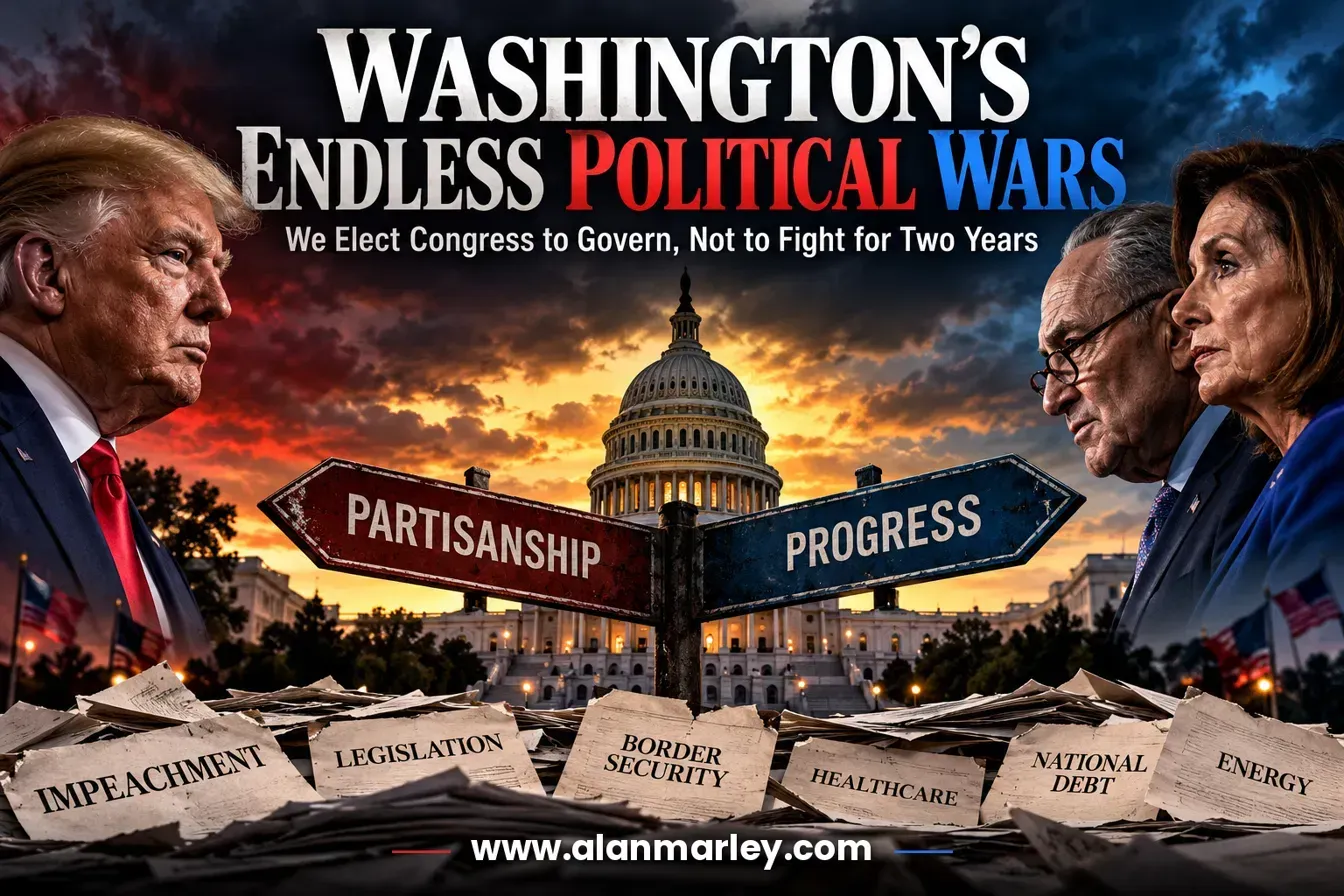
There is something profoundly frustrating about American politics, and it has very little to do with whether Republicans or Democrats control Washington.
It is the increasingly familiar spectacle of politicians spending enormous amounts of money, making extraordinary promises, winning elections and then accomplishing remarkably little of what they promised.
Every election is supposedly the most consequential election of our lifetime. Every congressional majority is presented as an opportunity to save the country. Every defeated political party warns that civilization itself may be in jeopardy.
And yet, after the speeches, celebrations, accusations, investigations, congressional hearings and endless television appearances, Americans are frequently left wondering what actually changed.
As we approach the November 3, 2026, midterm elections, that question deserves considerably more attention than it is receiving.
Democrats are polling well nationally. Republican control of the House is under serious pressure, and control of the Senate is also being contested. Political analysts have outlined scenarios in which Democrats could emerge with majorities in both chambers of Congress.
That possibility brings us to an uncomfortable question.
If Democrats take back Congress, are we about to experience two more years of Washington concentrating on Donald Trump instead of concentrating on the country?
It is a legitimate question, particularly given what Americans witnessed during Trump’s first administration.
But before anyone gets too comfortable blaming Democrats for political dysfunction, Republicans should examine their own record. They have controlled Congress and the presidency at various times and have also struggled to deliver on important promises.
Perhaps the problem is larger than either political party.
Perhaps the American political system has developed a culture in which gaining power is more important than using power responsibly.
And perhaps we, the voters, have become far too accepting of it.
1. The 2026 Midterms: Democrats Have an Opportunity, but Nothing Is Guaranteed
Let’s begin with the current political landscape.
As of October 30, 2026, the nonpartisan Cook Political Report has moved another twelve House races toward Democrats. Its closing analysis describes a potential Democratic gain of 12 to 25 House seats, enough to produce a Democratic majority reaching as high as 240 seats.
The Senate is more complicated. Cook identifies seven important races within polling margins of error and describes Democrats as slight favorites while acknowledging that both parties have paths to control.
These are forecasts and assessments, not election results. The voters have not finished speaking. [3]
For purposes of this discussion, consider one possible outcome:
Democrats win the House, 237 to 198.
Democrats win the Senate, 52 to 48.
Donald Trump remains president through January 2029.
On paper, that sounds like an impressive Democratic victory.
In practice, it could produce one of the most contentious periods of divided government in recent American history.
Democrats would control the House committees, congressional oversight machinery and the Senate confirmation process. They would have the ability to investigate the Trump administration, conduct hearings, issue subpoenas and prevent many of the president’s preferred policies from becoming law.
But they would not control the presidency.
And that matters enormously.
A congressional majority is not a license to implement whatever policies the majority party wants. It is one component of a constitutional system deliberately designed to divide governmental authority.
The president retains the power to veto legislation. The Senate retains procedural rules that can prevent measures from advancing. Courts can resolve certain disputes over executive and congressional authority.
Even with 52 Democratic senators, most ordinary legislation would remain subject to the Senate’s 60-vote cloture threshold.
In other words, winning both chambers would not mean Democrats could simply impose their agenda on Donald Trump.
It would mean they could obstruct much of his agenda while attempting to advance their own.
There is a difference.
And it is a difference that political commentators frequently overlook when celebrating election results.
2. Impeachment: A Powerful Constitutional Remedy or Another Political Spectacle?
One of the first questions that comes to mind when considering a Democratic takeover is impeachment.
Will we have another two years of congressional investigations designed to produce articles of impeachment against Donald Trump?
Possibly.
But there is an important distinction between what Democrats could do and what they would actually be capable of accomplishing.
The Constitution gives the House of Representatives the sole power to impeach federal officials. A simple majority is sufficient to approve articles of impeachment.
With 237 seats, Democrats would possess more than enough votes to impeach Trump without the assistance of a single Republican, assuming they could maintain their own party’s support.
But impeachment is not removal from office.
That distinction is frequently lost in political discussions.
The Senate conducts the impeachment trial, and conviction requires a two-thirds vote of senators present. [8]
If all 100 senators participate, that means 67 votes.
Now consider the hypothetical 52 to 48 Senate.
Even if every Democrat voted to convict Trump, Democrats would still need fifteen Republican senators to join them.
Fifteen.
That is not an insignificant number.
During Trump’s second impeachment trial in 2021, seven Republican senators joined Democrats in voting to convict him. The final vote was 57 to 43, short of the constitutional threshold. [6]
So a future Democratic majority of 52 senators would need more than twice the Republican support obtained during that earlier trial, assuming all senators voted and all Democrats supported conviction.
Could that happen?
Certainly, depending on the nature and seriousness of the evidence.
But historical experience gives us little reason to assume such bipartisan support would materialize merely because Democrats regained congressional control.
And here is where the distinction between accountability and political theater becomes important.
If credible evidence establishes that a president committed serious misconduct, Congress has a constitutional responsibility to investigate.
That responsibility applies whether the president is a Republican or a Democrat.
I have no objection to legitimate oversight.
The Constitution does not provide presidents with immunity from congressional accountability simply because investigations might be politically inconvenient.
But I do object to the idea that impeachment should become a recurring political strategy whenever the opposition party gains control of the House.
Impeachment was not designed to be an ordinary substitute for elections, political disagreement or legislative opposition.
It was designed to address serious abuses of public office.
When politicians treat impeachment as another campaign instrument, they risk diminishing the extraordinary constitutional significance of the process.
And when Congress spends months pursuing an outcome that has little realistic prospect of obtaining the required Senate votes, Americans are entitled to ask whether that effort is proportional to the evidence and whether Congress is fulfilling its other responsibilities.
That does not mean impeachment should be abandoned because conviction appears difficult.
It means the decision should rest on evidence and constitutional responsibility rather than partisan enthusiasm.
There is a difference between holding someone accountable and simply wanting to get someone.
Our political system would benefit enormously from remembering it.
3. Remember Trump’s First Term? We Have Seen This Before
Americans do not have to imagine what congressional confrontation with Donald Trump looks like.
We have already experienced it.
During Trump’s first two years, from January 2017 through January 2019, Republicans controlled the House, Senate and presidency.
That was unified Republican government.
During the next two years, Democrats controlled the House while Republicans retained the Senate.
And the atmosphere changed dramatically.
The Democratic-controlled House devoted substantial attention to investigations involving Trump, his administration and the circumstances surrounding his presidency.
In December 2019, the House approved two articles of impeachment. The Republican-controlled Senate subsequently acquitted Trump in February 2020.
There were legitimate constitutional questions at issue, and reasonable people disagreed about the evidence and appropriate consequences.
But what should not be disputed is that impeachment and congressional confrontation became major features of Washington’s political life.
How much did that political environment contribute to legislative gridlock?
That question deserves examination.
The 115th Congress, covering 2017 to 2018, enacted 442 public laws.
The 116th Congress, covering 2019 to 2020, enacted 344. [1]
Those numbers show a decline in the number of laws enacted, but they do not establish that impeachment caused the decline.
Counting laws is also an imperfect measure of governmental effectiveness. A Congress that passes one consequential piece of legislation may have a greater effect on the country than one that passes dozens of minor measures.
The 2019 to 2020 period also included the COVID-19 pandemic, extraordinary emergency spending and significant disagreements between the Republican Senate and Democratic House.
Nevertheless, the broader concern remains.
When political parties focus intensely on defeating one another, legislation can become secondary to confrontation.
And that is particularly frustrating when Americans are dealing with healthcare expenses, housing costs, immigration problems, federal debt, infrastructure needs and the ordinary challenges of earning a living.
I am not suggesting those issues went entirely unaddressed during Trump’s first term.
They did not.
But I am suggesting that Americans have every reason to question a political culture that often celebrates investigations and political victories with greater enthusiasm than measurable improvements in governance.
After all, members of Congress are not elected merely to express outrage.
They are elected to represent the public and perform the legislative responsibilities of their offices.
4. Republicans Are Hardly Innocent
Before Republicans begin congratulating themselves for recognizing Democratic dysfunction, they should take a serious look in the mirror.
When Republicans controlled the presidency and both chambers of Congress in 2017, they had an opportunity to pursue their agenda through unified government.
They passed the Tax Cuts and Jobs Act, a substantial legislative accomplishment with major economic consequences.
But they also failed to fulfill one of their most prominent campaign promises: repealing and replacing the Affordable Care Act.
After years of campaigning against Obamacare, Republicans could not agree on a comprehensive alternative that would obtain the necessary Senate votes.
That failure cannot be blamed on a Democratic House majority because Republicans controlled the House.
It was largely a problem of disagreement within their own governing coalition, combined with the difficulties of designing a politically acceptable replacement.
And it illustrates something Americans should remember whenever politicians promise sweeping change.
Winning an election does not mean your party suddenly agrees on what governing should look like.
Republicans include fiscal conservatives, social conservatives, populists, libertarians, national-security conservatives and members whose priorities depend heavily on their constituents.
Democrats likewise contain competing ideological and regional factions.
Those differences do not disappear when one party obtains a majority.
The same problem emerged under President Biden, although unified Democratic government did produce significant legislation.
During the 117th Congress, lawmakers enacted the American Rescue Plan, the bipartisan Infrastructure Investment and Jobs Act, the CHIPS and Science Act and the Inflation Reduction Act.
Those laws had substantial consequences, whether one supports or opposes their provisions.
They also demonstrate that Congress can produce major legislation under a narrow majority. [5]
One can disagree with the wisdom of particular laws without pretending that nothing was accomplished.
That distinction is important.
My criticism is not that government must produce more legislation simply for the sake of producing legislation.
Sometimes refusing to enact a bad law is responsible governance.
My criticism is that both parties frequently confuse political control with political competence.
Winning elections is one skill.
Governing is another.
And neither political party has demonstrated a monopoly on either.
5. A Democratic Congress Could Stop Trump, but Could It Govern?
Now return to the hypothetical 2027 Congress.
Democrats control the House and Senate.
Trump controls the White House.
What happens when Democrats pass legislation that Trump opposes?
He can veto it.
To override a presidential veto, Congress needs a two-thirds majority in both chambers.
A 237-seat Democratic House and 52-seat Democratic Senate would fall well short of those thresholds without substantial Republican support.
And because Democrats would hold only 52 Senate seats, much of their legislation could encounter procedural obstacles before reaching the president.
Consider the practical consequences.
Democrats might propose changes to immigration enforcement, healthcare policy, taxation, environmental regulation or federal spending.
Trump could refuse to sign the legislation.
Congress could attempt to override the veto and fail.
The administration could continue exercising its lawful executive authority, while congressional Democrats could use appropriations, oversight and other powers to challenge that authority.
The result could be two years of prolonged negotiation and political conflict.
But there is another complication.
Trump’s administration could contest certain congressional subpoenas and assertions of investigative authority in court.
Executive privilege, separation of powers, statutory limitations and the scope of congressional inquiries can all become subjects of litigation.
That does not mean Trump could simply file a lawsuit and automatically invalidate Congress’s authority.
Courts would have to examine the relevant legal arguments.
Nor does the president have unlimited authority to disregard lawful congressional demands.
Still, litigation can consume time.
And time matters when a Congress has only two years before the next election.
Imagine months spent debating whether a congressional committee can obtain particular documents, compel testimony or challenge an executive decision.
Imagine subpoenas, appeals, hearings, press conferences and competing accusations of constitutional misconduct.
Some of those disputes may involve important constitutional principles.
Others may produce far more political publicity than meaningful governmental action.
Meanwhile, Americans continue paying their bills.
That is where my patience with Washington begins to wear thin.
6. The Senate Filibuster: Another Obstacle Nobody Wants to Discuss
There is another reason congressional majorities frequently disappoint their supporters.
The Senate is not designed to operate like the House.
In the House, the majority party can generally exercise considerable control over the legislative process.
The Senate operates differently.
Most ordinary legislation is subject to rules that typically require 60 votes to end debate.
The result is that a party can control 52 Senate seats and still be unable to advance major legislation without support from the opposition. [7]
There are exceptions, including certain budget reconciliation measures, but those procedures have limitations.
And let’s be clear: the filibuster is not a constitutional requirement.
It is a Senate procedural institution that has developed and changed over time.
Supporters argue that it encourages compromise and prevents narrow majorities from making sweeping legislative changes.
Critics contend that it allows a minority to obstruct legislation even when a majority of senators supports it.
Both arguments deserve consideration.
The deeper issue is whether lawmakers use procedural rules to encourage legitimate deliberation or to avoid difficult decisions.
A system that requires cooperation can function effectively when politicians are willing to cooperate.
The same system can become frustratingly unproductive when cooperation is treated as political betrayal.
And that raises a larger concern.
Perhaps Washington’s problem is not simply that the Constitution divides power.
Perhaps it is that our political culture increasingly treats compromise as weakness.
That is not a problem that can be solved by electing another congressional majority.
It requires a different attitude toward governing.
7. The Texas Senate Race: A Lesson in the Difference Between Ideology and Candidate Quality
The Texas Senate race provides an especially interesting example of how elections are often misunderstood.
I grew up in Texas.
And while Texas has changed considerably over the decades, there remains a cultural identity associated with its politics, religion, business environment and traditional conservatism.
That identity matters, even if it does not describe every Texan.
Which brings us to the contest between Republican Ken Paxton and Democrat James Talarico.
Talarico is an interesting political figure.
He is a state representative and Presbyterian seminarian whose public presentation of Christianity differs substantially from the conservative evangelical traditions familiar to many Texans.
He emphasizes social justice, inclusion, concern for marginalized people and a progressive interpretation of Christian responsibilities.
For some voters, that approach is appealing.
For others, particularly those accustomed to more conventional evangelical teaching, his theological positions and public remarks can seem unusual, unpersuasive or inconsistent with their religious beliefs.
The Texas Tribune has reported extensively on the contrasting religious messages offered by Talarico and Paxton.
Texas remains a deeply religious state, with approximately two-thirds of adults identifying as Christian. [4]
Now, conversations with family and friends are not scientific polling.
But they can provide an interesting window into how political candidates are perceived.
Among some lifelong Republicans I know in Texas, Talarico’s presentation does not resonate.
They find him peculiar, overly theatrical or simply out of step with their understanding of Texas political and religious culture.
Interestingly, I have also heard skepticism from younger people who strongly dislike Trump.
That does not establish a statewide trend.
But it raises an important question.
Can voters reject Donald Trump while also rejecting the personality and political message of a particular Democratic candidate?
Of course they can.
Americans do not come in only two political varieties.
Someone can dislike Trump without embracing progressive theology.
Someone can be dissatisfied with Republicans without accepting Democratic economic policies.
And someone can identify as conservative while refusing to support a particular Republican nominee.
Which brings us to Ken Paxton.
Paxton has his own political and personal controversies, including his impeachment by the Republican-controlled Texas House in 2023 and subsequent acquittal by the Texas Senate.
These controversies have become part of the political discussion surrounding his candidacy.
Therefore, a Democratic victory in Texas would require thoughtful interpretation.
Would it demonstrate that Texans had embraced progressive policies?
Would it reflect dissatisfaction with Paxton?
Would it be driven by voters who opposed Trump?
Would turnout among younger voters and racial or ethnic minorities make the difference?
Or would some combination of those factors explain the outcome?
Those questions are not interchangeable.
As of October 30, RealClearPolling’s average shows Talarico ahead of Paxton, 48.8% to 46.8%, while individual surveys range from ties and small Paxton leads to larger Talarico leads. [2]
That is a competitive election.
It is not, by itself, proof of a statewide ideological transformation.
Sometimes an election is not a referendum on a political philosophy. Sometimes voters simply dislike the candidate a party nominated.
That possibility should never be overlooked.
And it applies equally to both parties.
8. Younger Voters and Minorities: Demographics Are Important, but They Are Not Destiny
Political commentators frequently speak of younger voters and minority voters as though these groups constitute predictable, uniform voting blocs.
They do not.
Younger Americans disagree about economics, religion, immigration, education and the proper role of government.
Black and Hispanic voters are likewise diverse in their political views, economic interests, religious commitments and cultural values.
It is entirely reasonable to examine voting patterns across demographic groups.
It is unreasonable to assume that those patterns eliminate individual political judgment.
In the Texas Senate race, polling has documented important differences in candidate support across demographic categories.
But percentages alone do not explain why individuals make their choices.
A young voter might support Talarico because of his economic policies.
Another might support him because of his positions on abortion or civil liberties.
Another might simply oppose Paxton.
A Hispanic voter might prioritize immigration policy, education, business opportunities, religious values or any number of other issues.
The same applies to Republican voters.
What matters ultimately is not the demographic label assigned to a voter but the decision that person makes.
And turnout complicates everything.
A candidate can enjoy substantial support among younger voters but still lose if those voters do not participate in sufficient numbers.
A candidate can be unpopular among some traditional supporters and still win because those voters ultimately prioritize party loyalty or policy preferences.
That is why I resist sweeping conclusions about what a single election means.
A close Senate race in Texas may reveal important political changes.
It may also reveal temporary dissatisfaction with particular candidates.
The responsible conclusion depends on evidence, not the narrative political commentators prefer.
9. Winning Congress Does Not Mean Americans Have Endorsed Every Party Position
One of the more irritating habits of modern politicians is their tendency to interpret electoral victory as universal public approval of their agenda.
A party gains a handful of congressional seats and immediately announces that the American people have delivered an unmistakable mandate.
A mandate for what, exactly?
Voters have many reasons for supporting political candidates.
Some vote primarily on inflation.
Others care about immigration, abortion, education, taxes, national security, healthcare or the federal debt.
Some vote for a candidate.
Some vote against the opponent.
Some cast their ballots because they dislike the president.
Others support a party out of habit, tradition or confidence in its general political direction.
An election aggregates millions of individual decisions.
It does not automatically reveal a single, coherent national instruction.
Suppose Democrats gain control of Congress this November.
Does that necessarily mean Americans want another impeachment of Donald Trump?
No.
Does it necessarily mean they want higher taxes, more regulation or a particular immigration policy?
No.
It might mean that some voters oppose Trump’s policies.
It might mean that others are dissatisfied with economic conditions.
It might reflect candidate quality, local issues, turnout or a desire for greater checks on presidential authority.
Those explanations may overlap.
The important thing is that election results should not be interpreted more broadly than the evidence supports.
Political parties have an obligation to determine what voters actually want rather than simply claiming that election victories validate every item in their platforms.
That requires listening.
And listening is something Washington could stand to do considerably more often.
10. Is Political Gridlock Always a Bad Thing?
Before condemning legislative gridlock altogether, we should consider why the American system was designed to make governing difficult.
The Constitution divides power among the legislative, executive and judicial branches.
It also divides legislative authority between two chambers with different structures and responsibilities.
That was deliberate.
The founders did not want a simple congressional majority to exercise unlimited authority over the country.
They were concerned about the concentration of political power.
They understood that governments could threaten liberty when temporary political majorities gained too much authority.
Consequently, our constitutional system includes competing institutions that must frequently cooperate before significant governmental action can occur.
That arrangement can frustrate political parties.
But frustration is not necessarily evidence of constitutional failure.
Sometimes preventing a bad law is a public benefit.
Sometimes requiring negotiation protects minority interests.
And sometimes political gridlock reflects genuine disagreements among Americans that cannot responsibly be resolved through partisan force.
I am not suggesting that government should accomplish nothing.
I am suggesting that the number of laws enacted is not the only measure of effective governance.
A government that protects constitutional rights, maintains basic services, exercises responsible fiscal oversight, enforces existing laws and avoids unnecessary interference in private life may be performing valuable work even when it passes relatively few major laws.
The real problem emerges when gridlock results not from principled disagreement but from deliberate political obstruction.
There is a difference between rejecting legislation because it is unwise and rejecting legislation simply because the other political party proposed it.
There is also a difference between conducting oversight to protect constitutional government and conducting investigations primarily to embarrass political opponents.
These distinctions matter.
And neither party has demonstrated immunity from confusing them.
11. The Federal Debt: A Perfect Example of the Problem
Perhaps no issue illustrates Washington’s governing failures more clearly than the national debt.
Republicans routinely describe themselves as champions of fiscal responsibility.
Democrats frequently argue that public investments and social programs are essential to economic stability and opportunity.
Both arguments have legitimate elements.
But neither party has consistently demonstrated a willingness to make all the difficult choices necessary to bring federal finances onto a sustainable trajectory.
Reducing deficits requires confronting the relationship between revenue and spending.
That means examining taxes, entitlement programs, defense spending, discretionary expenditures and long-term demographic pressures.
None of those subjects is politically comfortable.
Politicians prefer promising benefits without explaining their full costs.
They also prefer promising tax reductions without explaining how lost revenue will be offset.
The result is a political system in which both parties can criticize the national debt while contributing to the conditions that sustain it.
And when divided government arrives, fiscal responsibility frequently becomes another partisan weapon.
One side accuses the other of reckless spending.
The other side responds with accusations of protecting wealthy taxpayers or neglecting public needs.
Meanwhile, the underlying fiscal challenges remain.
Now imagine Democrats controlling Congress in 2027 while Trump remains president.
Would that create an opportunity for serious bipartisan negotiations over federal finances?
Potentially.
Would those negotiations be politically difficult?
Absolutely.
But that is precisely the sort of work elected officials are supposed to undertake.
It is not glamorous.
It may not generate the television ratings of another congressional investigation.
It may require elected officials to disappoint some of their own supporters.
Nevertheless, it is governing.
And governing is supposed to be the job.
12. Immigration, Healthcare and Energy: Problems That Will Not Disappear During Political Warfare
The country has substantial policy challenges that cannot simply be set aside while Congress and the president fight.
Immigration is one example.
Americans disagree about border enforcement, deportation policy, asylum procedures, employment verification and the treatment of people already living in the country unlawfully.
Those disagreements are serious.
But immigration law exists, and the federal government has a responsibility to administer and enforce it within constitutional limits.
Congress also has the power to revise that law when existing policies fail to address the country’s needs.
Doing so requires legislation.
And legislation frequently requires compromise.
Healthcare presents another challenge.
Americans continue debating the cost of insurance, prescription drugs, hospital services, Medicaid, Medicare and the appropriate balance between government programs and private markets.
Neither political party has resolved those disagreements to the satisfaction of the entire country.
Energy policy raises similarly complicated questions.
The United States has substantial oil and natural gas resources, growing electricity demands, renewable-energy technologies, infrastructure constraints and environmental responsibilities.
These are not simple problems.
They involve economic tradeoffs and competing public priorities.
But they are precisely the issues that deserve serious legislative consideration.
Instead, Americans frequently watch Congress reduce complex policy questions to slogans.
Republicans blame Democrats.
Democrats blame Republicans.
Candidates promise solutions.
Television commentators assign responsibility.
And then another election arrives.
At some point, we should stop confusing political activity with meaningful progress.
A congressional committee can conduct hundreds of hearings without producing a useful policy outcome.
A president can issue dozens of executive orders without establishing durable legislative solutions.
A political party can dominate news coverage without materially improving the lives of the people it represents.
Activity is not the same thing as accomplishment.
And publicity is not a substitute for results.
13. The Media Has Become Part of the Political Incentive Structure
There is another participant in Washington’s perpetual political conflict that deserves examination.
The news media.
I am not suggesting that journalists should avoid investigating elected officials.
An independent press is essential to constitutional government.
And investigative reporting has exposed serious wrongdoing by officials from both political parties.
But modern political coverage often rewards confrontation more readily than substance.
A dramatic congressional hearing may dominate headlines for days.
A technical legislative compromise involving healthcare reimbursement or transportation funding may receive comparatively little attention.
An insulting statement from a politician can generate enormous engagement.
A thoughtful explanation of budget policy may struggle to attract an audience.
That is not necessarily because journalists are deliberately attempting to undermine government.
It reflects the economic and cultural incentives of the modern information environment.
Conflict attracts attention.
Attention attracts audiences.
Audiences attract revenue.
Politicians understand this.
And many have become extraordinarily skilled at converting political confrontation into publicity.
The result can resemble a continuous campaign in which governing becomes only one part of an elected official’s professional responsibilities.
Consider how frequently political discussion revolves around who embarrassed whom, who delivered the sharpest criticism, who dominated a hearing or which party supposedly won the day’s political confrontation.
Now compare that attention with the discussion devoted to the actual substance of proposed legislation.
There is a noticeable imbalance.
Americans have become accustomed to consuming government as political entertainment.
And political entertainment is not always compatible with effective public administration.
Perhaps one of the most useful changes we could make would be to evaluate public officials less by the intensity of their rhetoric and more by the quality of their work.
That would require more effort from voters, journalists and politicians alike.
But it would be a worthwhile investment.
14. What Should Americans Expect From a Democratic Congress in 2027?
Suppose Democrats obtain both congressional majorities.
What would constitute responsible governance?
First, legitimate oversight.
Congress should investigate credible allegations of wrongdoing, misuse of federal funds, abuse of authority and violations of law.
That responsibility does not disappear because the administration belongs to the opposition party.
Nor should investigations automatically be dismissed as political persecution merely because they involve a president whose supporters dislike the investigators.
Evidence should matter.
Second, serious legislative priorities.
A Democratic Congress should identify the problems it intends to address and offer specific, workable proposals.
The same obligation applies to Republicans.
Public officials should explain the expected benefits, costs and limitations of their proposals.
Third, meaningful negotiations.
Divided government requires compromise on matters that cannot be resolved through unilateral authority.
Compromise does not mean surrendering every principle.
It means recognizing that public policy often requires cooperation among people who disagree.
Fourth, constitutional restraint.
Congress should respect the limits of its authority.
The president should respect the limits of executive power.
Courts should resolve genuine legal disputes rather than being treated as instruments of partisan convenience.
Finally, measurable accountability.
The American people should be able to evaluate what Congress actually accomplished.
Not how many angry speeches were delivered.
Not how many times a member appeared on television.
Not how frequently one political party accused another of destroying democracy.
Actual accomplishments.
What laws were enacted?
What problems were addressed?
What spending decisions were made?
What constitutional responsibilities were fulfilled?
What measurable results followed?
Those are the questions that deserve answers.
15. The Danger of Turning the Next Two Years Into a Campaign Against Trump
One particularly important complication deserves attention.
Trump is constitutionally barred from being elected president again after his current term.
His second administration is scheduled to conclude in January 2029.
That means the 2027 to 2028 Congress would be operating during the final two years of his presidency.
Democrats might determine that aggressive opposition to Trump is politically advantageous.
Republicans might determine that resisting congressional Democrats is equally advantageous.
Both parties would then enter the 2028 presidential campaign with incentives to blame the other for Washington’s failures.
That scenario could produce a familiar political cycle.
Democrats investigate.
Trump challenges.
Republicans accuse Democrats of obstruction.
Democrats accuse Trump of abusing executive authority.
Federal courts consider legal disputes.
Congress struggles over spending.
Political commentators declare each new confrontation extraordinary.
Meanwhile, the clock keeps running.
By November 2028, another presidential election arrives.
And Americans are once again promised that everything will improve if they simply give one party another victory.
Is that really the best we can expect from representative government?
I don’t think the question should be whether Democrats can make Trump’s remaining years politically uncomfortable.
They certainly possess constitutional tools to challenge an administration.
Nor should the question be whether Trump can make Democratic legislative ambitions difficult to achieve.
He possesses substantial constitutional authority of his own.
The more important question is whether the institutions of government can function productively despite those political disagreements.
That is the test.
And it applies equally to both sides.
16. A Better Standard: Judge Politicians by Results, Not Political Victories
I have watched both political parties celebrate electoral victories as though winning control of Congress automatically meant that meaningful change was about to occur.
Sometimes they deliver substantial legislation.
Sometimes they don’t.
Sometimes they encounter legitimate constitutional or political obstacles.
Other times they simply discover that making promises is considerably easier than governing.
This is not a reason to abandon political parties or dismiss elections as meaningless.
Elections are fundamental to representative government.
They determine who exercises authority, establishes priorities and represents public interests.
But elections should be the beginning of accountability, not the end.
A congressional majority should be judged by what it does with its authority.
And a president should be judged by more than whether he successfully frustrates the opposition.
There is nothing inherently admirable about obstructing legislation simply because it comes from the other party.
There is also nothing inherently admirable about passing legislation simply to claim a political victory.
The question should always be whether the action serves a legitimate public purpose and whether its benefits justify its costs.
That standard is more demanding than partisan loyalty.
It requires Republicans to criticize Republican failures.
It requires Democrats to criticize Democratic failures.
And it requires voters to resist the temptation to excuse poor governance simply because the politicians responsible belong to their preferred party.
That is difficult in an increasingly polarized political environment.
But democratic accountability becomes meaningless when every failure is blamed on the opposition and every questionable action by one’s own party is automatically defended.
A functioning republic depends on citizens who are willing to demand more.
17. November 2026 May Change Congress. Will It Change Washington?
The coming election could change the balance of power in Washington considerably.
Democrats may take the House.
They may also take the Senate.
Republicans may retain enough congressional seats to preserve control of one or both chambers.
The voters will determine that.
What interests me more is what happens afterward.
If Democrats obtain both congressional majorities, they will have an opportunity to demonstrate what they believe responsible congressional leadership should look like during a Republican presidency.
They can conduct legitimate investigations.
They can propose legislation.
They can challenge executive decisions they believe violate the law.
They can negotiate with the White House.
And they can demonstrate whether they are prepared to govern under conditions that require compromise.
Trump, meanwhile, would face his own responsibilities.
He could reject legislation he considers harmful.
He could defend the constitutional powers of the executive branch.
He could also negotiate with congressional Democrats when doing so serves national interests.
None of those choices would require either side to abandon its principles.
But they would require both sides to recognize that the federal government exists for something larger than their ongoing political rivalry.
That is the point Washington seems increasingly determined to forget.
The American people are not merely an audience for congressional theater. They are the citizens whose government these officials have been elected to operate.
We deserve serious public policy.
We deserve fiscal accountability.
We deserve lawful administration of government.
We deserve meaningful constitutional oversight.
And we deserve elected officials who understand that representing the country requires more than defeating their political opponents.
Conclusion: Stop Campaigning and Start Governing
The 2026 midterms may produce a Democratic Congress facing a Republican president.
If that happens, we could experience two years of investigations, subpoenas, vetoes, legal disputes, political accusations and congressional confrontation.
Some of those disputes may be necessary.
Others may be avoidable.
And some may have considerably more to do with political advantage than public necessity.
But nothing about divided government makes legislative paralysis inevitable.
The Constitution provides mechanisms for negotiation, oversight, compromise and accountability.
The problem is that politicians must be willing to use those mechanisms responsibly.
Republicans have had opportunities to govern and have sometimes failed to fulfill major promises.
Democrats have had opportunities to govern and have sometimes devoted substantial attention to political confrontation.
Both parties have enacted meaningful legislation.
Both have also contributed to the public’s frustration with Washington.
The lesson should not be that one party is uniquely incapable of governing.
It should be that political victory and governmental effectiveness are not the same thing.
Nor should we assume that every congressional investigation is illegitimate or that every legislative stalemate represents failure.
Those conclusions are too simplistic.
Instead, Americans should demand evidence, proportionality, competence and results.
If Donald Trump commits conduct warranting impeachment, Congress should examine the evidence and fulfill its constitutional responsibilities.
If Democrats possess legitimate policy proposals, they should present them and attempt to build the coalitions necessary to enact them.
If Republicans believe those proposals are harmful, they should explain why and offer alternatives.
And if both parties disagree, they should remember that negotiation is part of governing.
What they should not do is spend two years treating the federal government as a taxpayer-funded campaign operation.
We have seen enough of that.
The real challenge facing Washington after November 3 will not simply be determining who controls Congress.
It will be determining whether anyone intends to use that control constructively.
Because Americans do not send politicians to Washington simply to fight.
And after decades of political promises, partisan accusations and recurring legislative disappointment, perhaps it is time we started insisting that they actually do it.
- National Archives. Previous sessions of Congress: Public law numbers. archives.gov/federal-register/laws/past
- RealClearPolling. (2026, October). Texas Senate election: James Talarico vs. Ken Paxton. realclearpolling.com
- The Cook Political Report. (2026, October 30). Two Senate and a dozen House moves in Democrats’ direction. thecookpoliticalreport.substack.com
- The Texas Tribune. (2026, August 13). Paxton, Talarico tap contrary versions of God and Christianity in appeal to Texas voters. texastribune.org
- U.S. House of Representatives, History, Art & Archives. Congressional profile: 117th Congress. history.house.gov
- U.S. Senate. (2021, February 13). Roll call vote 59: Article of impeachment against Donald John Trump. senate.gov
- U.S. Senate. About filibusters and cloture. senate.gov
- U.S. Senate. About impeachment. senate.gov