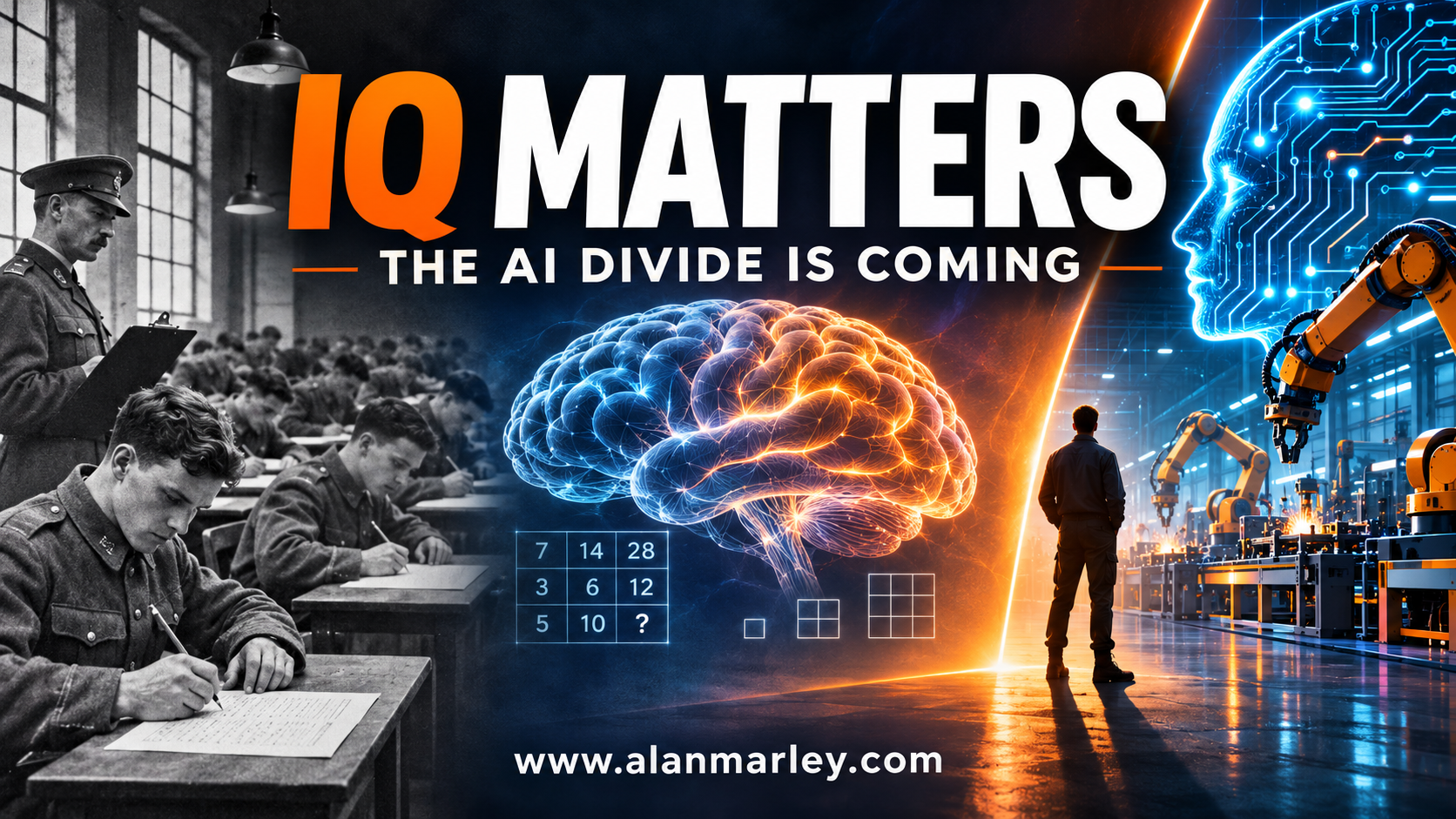
There is an uncomfortable truth that American society has spent decades trying to talk around: intelligence matters.
Not a little. Not occasionally. Not merely when someone is applying to Harvard or attempting to become a nuclear physicist.
It matters in education, employment, technical training, problem-solving, adaptability, and the ability to navigate an increasingly complicated world.
And as artificial intelligence transforms the economy, I suspect it will matter even more.
Yet discussions of intelligence, particularly IQ, routinely deteriorate into ideological arguments. Instead of examining what cognitive testing actually predicts, critics often turn the conversation toward questions of fairness, social circumstances, or the historical misuse of intelligence research.
Those debates have their own place. But they do not answer the central empirical question.
Does measured cognitive ability predict meaningful differences in people’s capacity to learn, perform complex tasks, and succeed in demanding occupations?
The answer, supported by decades of psychometric and occupational research, is yes.
We have an especially compelling institution to examine: the United States military.
For more than a century, the American military has used cognitive and aptitude testing to evaluate recruits and help determine which occupations they are qualified to enter.
These decisions are not theoretical exercises. They affect training expenditures, technical proficiency, military readiness, and ultimately lives.
The military cannot afford to pretend that everyone possesses identical cognitive capabilities. It must determine who can learn what, how effectively, and under which circumstances.
And it has accumulated an extraordinary body of evidence in the process.
Rather than treating that experience as politically inconvenient, we should be studying it.
Because the technological revolution now unfolding may make understanding human cognitive differences more important than at any previous point in our economic history.
The Bell Curve: The Argument That Never Really Went Away
In 1994, Richard Herrnstein and Charles Murray published The Bell Curve: Intelligence and Class Structure in American Life. [2]
The book generated enormous controversy, particularly because of its discussion of racial differences in measured intelligence and the authors’ interpretation of possible causes.
But the controversy frequently overshadowed its broader argument.
Herrnstein and Murray contended that general cognitive ability was becoming an increasingly important determinant of economic and social outcomes in the United States.
They argued that modern society was developing a cognitive elite: individuals whose abilities allowed them to succeed in increasingly complex academic, professional, and technical environments.
As the economy moved away from routine industrial labor toward information-intensive occupations, the advantages associated with higher cognitive ability would become more pronounced.
Their argument was not simply that intelligent people tend to earn more money.
It was that the structure of the economy was changing in ways that increasingly rewarded abstract reasoning, rapid learning, analytical thinking, and the ability to process complicated information.
Those predictions deserve serious reconsideration today.
We are now entering an economy in which artificial intelligence can write software, analyze contracts, generate technical designs, evaluate financial information, and automate portions of work once reserved for highly educated professionals.
The implications for human labor are extraordinary.
But before discussing AI, consider something that existed long before The Bell Curve was published.
The United States military was already putting cognitive measurement into practice.
The Military Has Been Testing Cognitive Ability for More Than 100 Years
During World War I, the United States Army introduced the Army Alpha and Army Beta tests.
These early assessments were designed to evaluate recruits’ mental capabilities and assist with military classification.
The system evolved through the Army General Classification Test during World War II, the Armed Forces Qualification Test introduced in 1950, and eventually the Armed Services Vocational Aptitude Battery, or ASVAB. [7]
The ASVAB was introduced in 1968 and subsequently adopted across the military services.
Its purpose was straightforward: measure relevant abilities and use those measurements to improve personnel selection and occupational assignment.
Today, the military uses the Armed Forces Qualification Test, derived from four ASVAB subtests, to help determine enlistment eligibility.
Other ASVAB composite scores help establish qualifications for particular military occupations.
These assessments evaluate verbal, mathematical, technical, and other relevant aptitudes.
They are not interchangeable with a conventional full-scale IQ test. However, their cognitive components are closely related to the general mental abilities examined in intelligence research.
That distinction is important, but it does not weaken the larger argument.
The military has spent generations examining whether measurable cognitive abilities predict training and occupational performance.
And the research indicates that they do.
A Department of Defense research review found substantial correlations between ASVAB-based aptitude composites and military technical-school performance. Corrected correlations for final school grades were generally in the range of .55 to .60, while average correlations with combined job-performance criteria ranged from approximately .35 to .47. [6]
A 2024 meta-analysis examining hands-on military job proficiency likewise reported operational validity coefficients in the .40s and .50s. [1]
Those are meaningful predictive relationships.
They do not mean that a test determines someone’s destiny. They mean that knowing an individual’s measured cognitive abilities provides useful information about probable performance.
In personnel selection, that is precisely the point.
The military does not require perfect prediction. It requires prediction substantially better than guesswork.
And that is what these assessments provide.
I Was One of Those Recruits
My interest in this subject is not exclusively academic.
I served in the United States Marine Corps.
Like countless other recruits, I went through the military’s testing and occupational classification process.
My test results helped determine which occupational specialty I qualified for.
I experienced firsthand a system designed to match individuals with occupations according to measured abilities.
That experience stayed with me.
I also came from circumstances that hardly resembled the stereotypical pathway to academic or professional success.
I grew up poor, surrounded by roughly 600 hillbilly relatives, where, to my knowledge, nobody had attended college or owned a business.
There was no established professional network waiting to usher me into higher education or entrepreneurship.
Yet I eventually pursued advanced education, became a business owner, and entered university teaching.
It was not a straight line. I also grew up in a seriously abusive and dysfunctional family, and it stunted my high school work. My transcript from those years says almost nothing about what I could do. The Marine Corps changed that. I learned discipline, went through military schools, and eventually settled down enough to take academics seriously. The ability was there all along. The stability to use it came later.
I mention this for a particular reason.
My background does not prove that intelligence is the only ingredient in success. Nor does my personal experience establish the statistical relationship between IQ and achievement.
What it does demonstrate is why I reject the idea that people’s backgrounds tell us everything we need to know about their potential.
We should be interested in what individuals can actually learn and accomplish.
Objective aptitude assessment, properly validated, can help answer that question.
It can identify capabilities that otherwise might go unnoticed.
It can also identify situations in which an individual may face substantial difficulty mastering a particular technical discipline.
Both findings have practical value.
Pretending that measurable differences do not exist does not make them disappear.
The Evidence Is Not Merely Historical
One could reasonably ask whether military aptitude testing has continued simply because bureaucracies are reluctant to abandon longstanding practices.
That would be a legitimate criticism if the military had never attempted to validate its testing system.
But it has.
The Joint-Service Job Performance Measurement Project and the Army’s Project A research program investigated the relationship between aptitude scores and subsequent military performance.
Researchers examined technical knowledge, hands-on proficiency, training outcomes, and other measures of occupational effectiveness.
The military’s own ASVAB research program reports that aptitude composites predicted later technical proficiency, including a reported correlation of .69 with core technical proficiency among soldiers in their second tour of duty. [6]
The National Academies has also examined the military’s personnel assessment system and recognized the substantial evidence supporting its predictive validity. [3]
The significance should not be understated.
We are discussing one of the largest, longest-running applied personnel-assessment efforts in American history.
Millions of people have passed through military recruitment and training systems over successive generations.
Different occupational specialties impose different cognitive demands.
Different recruits demonstrate different patterns of aptitude.
And the military has had strong institutional incentives to understand which assessments predict successful training and performance.
That body of research deserves far more attention in civilian education, workforce planning, and the development of future employment policy.
Why would we disregard an evidence-based system simply because its findings might challenge the comforting assumption that everyone can master every occupation equally well?
Intelligence Is Not the Same as Human Worth
A recurring problem in discussions of IQ is the tendency to confuse a measurable capability with a judgment about someone’s value as a human being.
They are not the same question.
A person with exceptional mathematical reasoning may be poorly suited to supervising a construction crew.
A skilled carpenter may possess remarkable spatial reasoning and practical problem-solving abilities without being particularly proficient in advanced calculus.
An excellent salesperson may outperform someone with much higher measured general intelligence because of interpersonal skills, persistence, and commercial judgment.
None of this disproves the importance of cognitive ability.
It demonstrates why occupational aptitude assessment should measure the abilities relevant to actual job requirements.
The military understands this distinction.
It does not assign every recruit to the same occupation and then act surprised when their performance differs.
It establishes qualifications.
It measures relevant aptitudes.
It trains people for specific responsibilities.
And it evaluates performance.
Civilian society should be willing to learn from that approach.
The purpose of assessment should not be to declare winners and losers.
It should be to improve the match between individual capabilities and occupational demands.
That is a question of efficiency, competence, and effective human-resource development.
The Coming Collision Between Human Intelligence and Artificial Intelligence
Now consider what happens when artificial intelligence begins transforming occupations across the economy.
Historically, technological progress has eliminated some jobs while creating others.
Agricultural mechanization displaced enormous amounts of manual labor.
Industrial automation transformed manufacturing.
Computers eliminated many clerical tasks while generating new technical and professional occupations.
Each transition changed the abilities employers valued.
AI is likely to accelerate that process, but with an important difference.
It is increasingly capable of performing cognitive tasks, not merely physical or repetitive ones.
Software development, accounting, legal research, customer service, logistics, financial analysis, and engineering are already experiencing significant changes.
The Organisation for Economic Co-operation and Development has documented how AI is reshaping occupational skill requirements and how workers in routine occupations face displacement risks. [4]
Its 2026 research also identifies shortages of relevant skills as a significant obstacle to AI adoption. [5]
Here is the question we should be asking:
What happens to people whose cognitive abilities make it difficult to learn, supervise, or adapt to increasingly complex technological systems?
That question is not an insult.
It is a workforce-planning problem.
Suppose an occupation that once required following a relatively straightforward sequence of procedures now requires operating an integrated digital system, interpreting automated recommendations, troubleshooting exceptions, and understanding the consequences of erroneous machine output.
The occupation has changed.
The cognitive demands may have changed with it.
Some employees will adapt quickly.
Others will require more extensive training.
Still others may struggle to meet the new requirements.
These differences are not imaginary simply because discussing them makes people uncomfortable.
And employers will have to confront them whether politicians, educators, and commentators approve or not.
There is, however, an important uncertainty.
AI may also reduce cognitive demands in some occupations by simplifying complicated tasks, supplying instructions, and allowing workers to perform activities that previously required more specialized knowledge.
That possibility deserves serious study as well.
The essential point is not that AI will automatically disadvantage every person with a lower IQ.
It is that the interaction between human cognitive ability and increasingly sophisticated technology will become a central economic question.
We should be investigating where AI amplifies cognitive differences, where it reduces them, and which workers are most likely to benefit from each outcome.
That is a much more useful undertaking than pretending cognitive differences are irrelevant.
The Great Educational Mismatch
For decades, American education has increasingly treated college preparation as the default pathway to economic opportunity.
Students are encouraged to pursue academic credentials even when their interests and demonstrated aptitudes may be better suited to technical or vocational occupations.
This approach deserves reconsideration.
Not everyone needs a four-year degree.
Not every occupation requires the same cognitive profile.
And not every student benefits from an educational system that measures success primarily through academic progression.
I would favor introducing comprehensive aptitude assessment by approximately eighth grade, followed by meaningful educational and career guidance.
Not a single test that permanently determines a child’s future.
Not an irreversible classification system.
But a serious, evidence-based assessment process that identifies cognitive strengths, technical aptitudes, academic readiness, and occupational interests.
Students demonstrating strong mathematical and analytical abilities could receive more advanced academic opportunities.
Students demonstrating mechanical, spatial, or technical aptitudes could be introduced to demanding vocational and applied-technology pathways.
Students with varied abilities could explore occupations aligned with their particular strengths.
And pathways should remain open as individuals develop new skills and demonstrate additional capabilities.
The objective would be to replace educational guesswork with better information.
We should also stop treating skilled trades as consolation prizes for people who supposedly cannot succeed academically.
Modern construction, electrical work, advanced manufacturing, and mechanical systems require substantial knowledge, judgment, and problem-solving.
The issue is not whether a person is intelligent enough for college.
It is whether our educational institutions are identifying the right combinations of abilities for different forms of productive work.
Test Them, Sort Them, Give Them a Skill
Here is the position, stated without padding. We should test young people early, measure what they can do, and steer them toward whatever path gives them a marketable skill. College for some. Trades for others. Technical certification, apprenticeship, military service, or applied training for the rest. The destination matters less than the result: every graduate leaves the system able to do something an employer will pay for.
The current approach does the opposite. It assumes every student is headed to a four-year campus, treats any other path as a fallback, and measures the school system’s success by how many students enroll. Enrollment is not a skill. A credential that never converts into a paycheck is a cost, not an asset, and a student who drops out with debt and no trade has been failed by the process, not protected by it.
Feelings are not a workforce plan. Telling a sixteen-year-old that every door is open, regardless of aptitude, preparation, or interest, does not open any of them. It delays the moment when someone tells him the truth, and that moment arrives at a much higher price at twenty-two. Good counseling uses data. It looks at test results, demonstrated ability, and labor-market demand, then gives a student a direct answer about where he is likely to succeed.
The military does this every day. A recruit takes the ASVAB, the scores qualify him for specific jobs, and he is trained for one of them. Nobody calls that cruel. It works because it is honest about ability and honest about what the job requires. A school system can do the same thing with a different goal: not to rank children, but to place them.
A test score at fourteen measures a fourteen-year-old in his circumstances. Abuse, chaos at home, and plain immaturity can all depress results, and a lot of people sort themselves out later. I am one of them. That is why retesting and movable pathways are built into the design, and why this is not an argument for pigeonholing anyone. But it is also not a reason to skip the sorting. A late bloomer’s timeline does not feed him. Learning to earn a living and becoming a contributing citizen cannot wait on someone eventually settling down, so the trade and technical pathway runs alongside the academic one from the start, and the door to college stays open for anyone who later earns his way through it.
The program is not complicated:
Test every student by eighth grade with a validated aptitude battery, and test again in high school.
Give families the results in plain language, with the occupations those results line up with.
Build real vocational and technical tracks that carry the same status, funding, and counselor attention as the college track.
Tie every pathway to a credential or license that employers actually recognize.
Keep the doors movable. A student who tests into a trade can still move to college, and a student who struggles in college can move into a trade.
None of this is a ban on college. Students who test strongly in math, reading, and analytical reasoning should be pushed toward demanding academic programs, and they should be pushed hard. But a system that sends everyone down the same road and calls it opportunity is not serving anyone. The goal is a skill that pays, and the quickest way to get there is to find out what each person can do before years and thousands of dollars are spent guessing.
What Civilian Employers Could Learn
The same logic applies to hiring.
An employer recruiting a software engineer needs different competencies from one hiring a roofing supervisor, an accountant, or a heavy-equipment operator.
Resumes, interviews, and educational credentials provide useful information, but they are imperfect measures of actual occupational competence.
Validated aptitude assessments can add another source of evidence.
Employers should be able to examine job-relevant cognitive and technical abilities when those assessments have demonstrated predictive value and comply with applicable employment law.
A standardized test should not replace practical demonstrations, experience, or other relevant qualifications.
But refusing to examine cognitive aptitude because the subject is controversial is hardly a rational alternative.
Imagine a construction company selecting a project estimator.
The job requires mathematical reasoning, spatial visualization, attention to detail, understanding of construction systems, and the ability to interpret complicated specifications.
Would it be unreasonable to assess those abilities?
Of course not.
Indeed, selecting someone without considering the abilities essential to the occupation could be far more consequential than administering a properly designed assessment.
The same principle applies to cybersecurity, aviation maintenance, industrial automation, logistics, and countless other technical occupations.
The question is not whether aptitude testing makes people uncomfortable.
The question is whether it improves our ability to predict successful performance.
We Need Better Data, Not More Ideological Arguments
If the military’s experience teaches us anything, it is that the usefulness of cognitive assessment can be evaluated empirically.
We can ask whether particular test scores predict training completion.
We can measure occupational proficiency.
We can examine how long different individuals require to master specific skills.
We can compare alternative assessment methods.
We can determine whether additional training improves outcomes.
And we can evaluate how these relationships change as technology transforms job requirements.
This is where the research should now expand.
I would like to see a major longitudinal research initiative examining cognitive aptitude, occupational complexity, technological adaptation, and employment outcomes.
The study should draw on the military’s extensive personnel-assessment experience while developing civilian measures suited to different industries.
It should examine whether measured cognitive ability predicts the speed with which workers learn AI-assisted systems.
It should identify occupations in which AI reduces the amount of specialized knowledge required.
It should investigate occupations in which AI creates new demands for judgment, abstraction, and error detection.
And it should examine which training strategies are most effective for workers with different cognitive profiles.
This is not an argument for abandoning people who struggle with technological change.
It is an argument for understanding the problem well enough to develop solutions that actually work.
A society cannot intelligently prepare its workforce for technological disruption while refusing to examine one of the variables that may influence adaptation.
The Hardest Question: What Happens to Those Who Cannot Keep Up?
Here is where the discussion becomes particularly uncomfortable.
Suppose technological progress increasingly rewards people who can rapidly acquire new knowledge, manage complicated systems, and exercise independent judgment.
Suppose, at the same time, machines become capable of performing more of the routine work that previously provided employment to people across a wide range of cognitive abilities.
What happens to workers who cannot readily transition into the remaining occupations?
We cannot answer that question by declaring that everyone has unlimited potential.
Potential is not the same as demonstrated capability.
We cannot answer it by insisting that every displaced worker simply learn computer programming, engineering, or advanced data analysis.
Some will.
Others will not.
Nor can we assume that every new job created by technological progress will be accessible to everyone displaced by automation.
That has never been guaranteed.
The economic danger is a widening mismatch between the capabilities required by available jobs and the capabilities possessed by portions of the workforce.
Such a mismatch could produce prolonged unemployment, lower earnings, underemployment, and growing dependence on public assistance.
It could also intensify the social stratification Herrnstein and Murray warned about more than three decades ago.
These are possibilities, not predetermined outcomes.
But they are serious enough to warrant investigation before technological displacement becomes more widespread.
And if cognitive aptitude helps predict which workers are most likely to encounter difficulties, refusing to examine that relationship would be an extraordinary failure of public policy.
Stop Confusing Uncomfortable Findings With Bad Science
The controversy surrounding The Bell Curve demonstrated how quickly intelligence research can become entangled in ideological conflict.
Some of the book’s arguments, particularly its claims about racial differences and their possible causes, remain disputed.
Those claims should be evaluated on their own evidence rather than treated as established simply because the book also discusses well-supported relationships between cognitive ability and performance.
But the controversy does not erase decades of research showing that cognitive assessments have predictive value.
Nor does it invalidate the military’s extensive experience using aptitude testing.
The correct response to disputed research is more rigorous research.
It is not to dismiss every uncomfortable finding by association.
We should be capable of distinguishing between a statistical relationship, an explanation for that relationship, and a policy recommendation based upon it.
Those are three different things.
Evidence that cognitive ability predicts occupational performance does not automatically establish why individuals differ in cognitive ability.
And demonstrating predictive validity does not dictate one particular educational or employment policy.
But it does establish that cognitive measurement deserves serious consideration.
A society that claims to value science should be willing to follow the evidence even when the conclusions challenge fashionable assumptions.
The Next Great Economic Divide May Be Cognitive
The industrial economy rewarded physical labor, mechanical aptitude, discipline, and technical skill.
The information economy increasingly rewarded education, analytical reasoning, and specialized knowledge.
The AI economy may create an even more complicated relationship between human abilities and economic opportunity.
Some workers will use AI to become dramatically more productive.
Some will find that AI makes previously difficult tasks easier.
Others may discover that the tasks they once performed are no longer economically valuable.
The outcomes will vary by occupation, technology, training, and individual capabilities.
But it would be remarkable if cognitive ability played no meaningful role in determining how workers navigate those changes.
We already have substantial evidence that measured cognitive abilities predict training and job performance.
We have a military personnel-assessment system with more than a century of institutional history.
We have contemporary research confirming that cognitive aptitude measures remain useful predictors of occupational proficiency.
And we have a technological revolution that is rapidly changing the requirements of human work.
What we lack is sufficient willingness to connect these subjects in a serious national discussion.
The question should no longer be whether intelligence matters.
It does.
The question is how much it matters, in which occupations, under which technological conditions, and what we intend to do with that knowledge.
We should stop treating the subject as something too controversial to investigate.
Because artificial intelligence will not wait for us to become comfortable discussing human intelligence.
The civilian economy would be wise to examine that lesson.
Not because a test can tell us everything about a person.
But because refusing to measure something important does not make it unimportant.
And the coming decades may make that distinction impossible to ignore.
- Cucina, J. M., Burtnick, S. K., De la Flor Musso, M. E., Walmsley, P. T., & Wilson, K. J. (2024). Meta-analytic validity of cognitive ability for hands-on military job proficiency. Intelligence, 104 , 101818. doi.org/10.1016/j.intell.2024.101818
- Herrnstein, R. J., & Murray, C. (1994). The Bell Curve: Intelligence and Class Structure in American Life. Free Press.
- National Research Council. (2015). Measuring Human Capabilities: An Agenda for Basic Research on the Assessment of Individual and Group Performance Potential for Military Accession. National Academies Press. nationalacademies.org/read/19017/chapter/2
- Organisation for Economic Co-operation and Development. (2024). How is AI changing the way workers perform their jobs and the skills they require? OECD Publishing. oecd.org/content/dam/oecd/en/publications/reports/2024/11/how-is-ai-changing-the-way-workers-perform-their-jobs-and-the-skills-they-require_842aa075/8dc62c72-en.pdf
- Organisation for Economic Co-operation and Development. (2026). Skills in the AI age. OECD Publishing. oecd.org/en/publications/skills-in-the-ai-age_972bd15e-en.html
- U.S. Department of Defense, ASVAB Research Program. (n.d.). Validity Information. officialasvab.com/researchers/validity-information/
- U.S. Department of Defense, Defense Testing and Assessment Center. (2026). Appropriate Use of ASVAB Scores. officialasvab.com/wp-content/uploads/2026/02/20260128_DTAC_ExecutiveNote_TO52-4.4.7-AppropriateUseofASVABScores.pdf