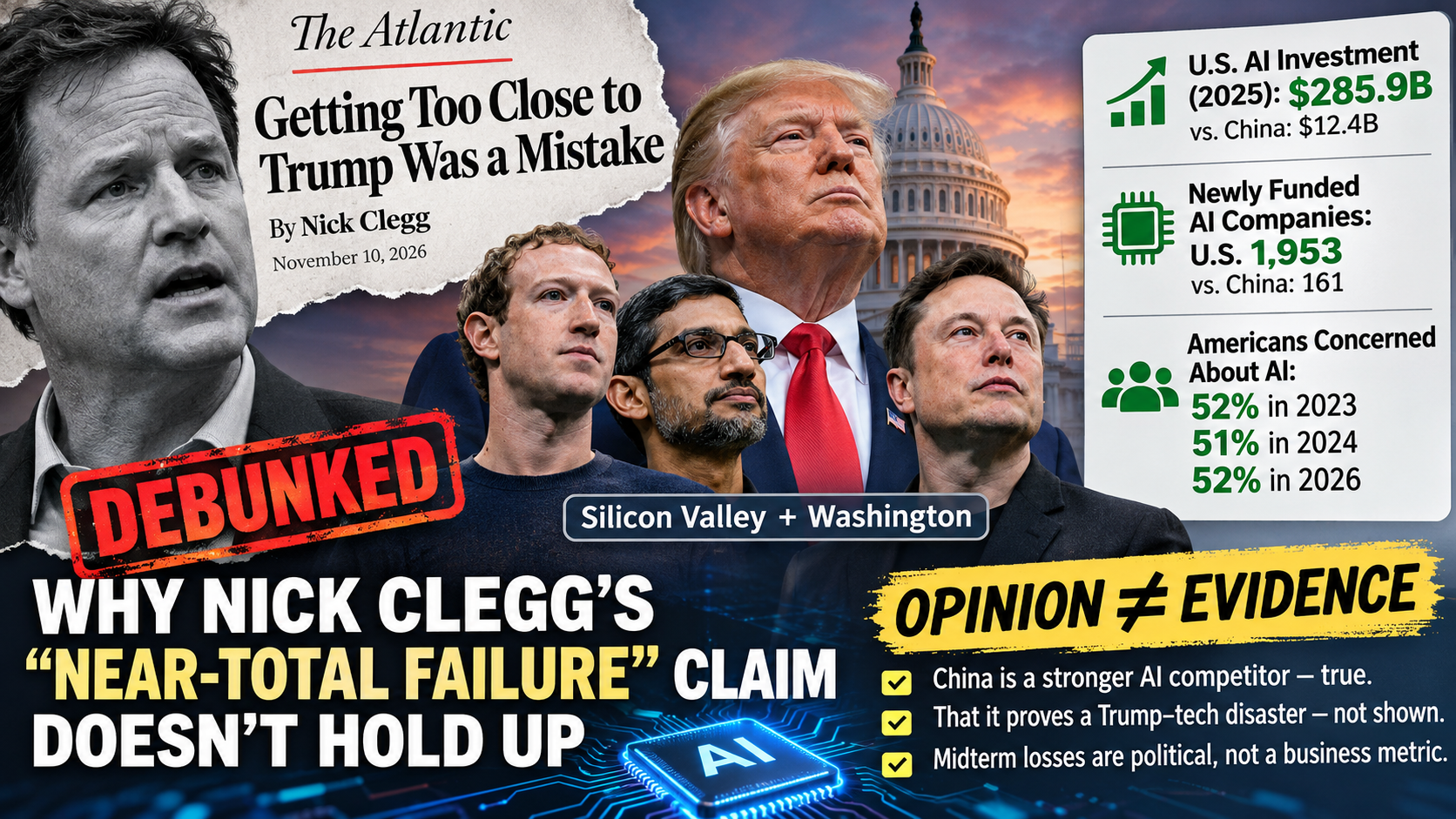
Nick Clegg’s argument is a remarkable exercise in confusing political disappointment with business failure. In his November 2026 piece for The Atlantic , “Getting Too Close to Trump Was a Mistake,” the former Meta executive argues that Silicon Valley made a disastrous misjudgment by aligning with Donald Trump after the 2024 election, and that by the industry’s own standards the relationship has been a “near-total failure.” [7]
That is where his argument begins to fall apart.
There are legitimate questions about whether corporate executives should align themselves so closely with any administration. There are also legitimate concerns about China’s advances in artificial intelligence, public skepticism toward technology, and government interference in competitive markets. But the argument blurs three fundamentally different questions.
First: did Republicans lose the 2026 midterms? Yes, decisively. Democrats won both chambers of Congress. [5]
Second: has China become a more formidable AI competitor? Absolutely.
Third: does either development prove that Silicon Valley’s relationship with Trump was a business failure? No.
The third proposition requires evidence that a political narrative, by itself, does not supply. The strongest rebuttal is not that everything Trump has done is wonderful. It is that Clegg confuses political outcomes, technological competition and corporate strategy, and treats correlation as causation.
The Biggest Omission: America’s AI Investment Advantage
| Measure | United States | China |
|---|---|---|
| Private AI investment | $285.9 billion | $12.4 billion |
| Newly funded AI companies | 1,953 | 161 |
Stanford’s 2026 AI Index puts U.S. private AI investment in 2025 at about $285.9 billion, compared with $12.4 billion in China, roughly 23 times as much. It also counts 1,953 newly funded AI companies in America against 161 in China. [8]
There is an important qualification. China’s government-directed funding makes private investment an imperfect comparison, and Stanford itself says these figures likely understate Chinese spending. Nevertheless, these are hardly the numbers one would expect from an industry suffering a near-total strategic collapse.
Clegg could reasonably argue that American investment is inefficient, or that China is achieving more with less. But that is a different argument, and it requires comparing results against the resources invested. American AI investment remains extraordinarily strong. That does not establish that Trump’s policies caused the surge, but it undermines the notion of broad industry failure.
China Catching Up Is Real. Blaming Trump’s Silicon Valley Alliance Is Another Matter
This is where I would challenge the argument most aggressively.
Chinese AI models have substantially closed the performance gap with American models. Reporting on Stanford’s index says that by March 2026 the leading American model’s lead had shrunk to just 2.7 percent. [1] The competitive threat is real.
But what precisely is the causal argument? China has spent years investing in artificial intelligence, domestic chip production, research universities, industrial automation and energy infrastructure. Why would anyone expect that progress to stop because American technology executives established a working relationship with a Republican president?
Competition between American and Chinese companies is also not a zero-sum test of presidential policy. China can improve dramatically while American companies improve dramatically too. And the Trump administration did not sit idle. It released its AI Action Plan in July 2025 alongside an executive order to speed federal permitting of data center infrastructure and ease environmental review. [4] Whether those policies succeed remains open to evaluation, but they are evidence of an active industrial strategy, not an absence of one.
Public Worry About AI Predates the Trump Alliance
Americans really are concerned about AI, especially jobs, privacy, safety and the consequences of increasingly capable technology. But anyone who blames that worry on tech executives associating with Trump has a problem with Pew’s polling.
| Year | Share of U.S. adults |
|---|---|
| 2023 (Biden) | 52% |
| 2024 (Biden) | 51% |
| 2025 | 50% |
| 2026 | 52% |
In 2021 it was 37%. [2] It reached 52% in 2023, during Biden’s presidency, and stood at 52% again in 2026. [6] The broad national measure barely moved between 2023 and 2026. There are meaningful demographic and political shifts beneath those figures, but public anxiety cannot simply be pinned on executives who worked with Trump. The public has plenty of reasons to worry about AI that have nothing to do with political affiliation.
The European Regulatory Argument Cuts Both Ways
The argument that closer ties with Washington have not protected American technology companies from foreign regulators has some truth in it. The European Commission fined Apple €500 million and Meta €200 million under the Digital Markets Act in April 2025. [3]
But why would European penalties prove that American executives made a mistake by engaging with their own government? European regulators have independent authority, and Washington cannot erase European competition law. The meaningful business question is whether American diplomatic pressure reduced regulatory costs, helped companies negotiate terms or improved their positions relative to what would otherwise have occurred. Without that counterfactual, calling the relationship a failure is premature.
The Midterms Are Not a Corporate Performance Review
There is no point pretending the election went well for Republicans. They have substantial reasons to examine their failures, particularly affordability, economic confidence, candidate quality and the administration’s political messaging.
But voters rejecting a party in a midterm election does not establish that executives who worked with the president made poor business decisions. Corporate leaders must work with administrations whose policies directly affect their companies. They negotiate with regulators, advocate for their industries, and seek policies that protect shareholders, employees and customers. That is not an endorsement of every presidential policy. It is called doing business, not pledging political allegiance.
The genuine risk is that executives turn business relationships into theatrical partisan loyalty. On that narrow point, Clegg has a legitimate concern. Corporate leaders should not assume a party will stay in power indefinitely, should avoid turning their companies into political organizations, and should be ready to engage constructively with the next administration. That is sound governance. There is a major difference between a professional relationship with government and surrendering corporate independence to a politician, and Clegg’s article would be stronger if it drew that line.
The Verdict
| Claim | Assessment |
|---|---|
| China is closing the AI gap | Supported |
| Silicon Valley's Trump relationship caused that outcome | Not established |
| Americans are increasingly skeptical of AI | Supported |
| Trump's alliance caused the public backlash | Not established |
| U.S. technology companies remain exposed to foreign regulation | Supported |
| The alliance was a near-total business failure | Not demonstrated |
| Excessive corporate partisanship creates future risks | Reasonable concern |
My central objection is simple. Clegg treats evidence of political disappointment as evidence of economic and strategic failure. They are not interchangeable.
A real assessment would examine earnings, investment returns, innovation, market share, regulatory costs, energy access and the long-term competitive position of individual companies. It would also separate Trump’s actual policy effects from developments already underway before he returned to office.
The fact that Republicans lost the midterms, that China keeps improving its AI capabilities and that Americans remain worried about technology does not establish that Silicon Valley’s relationship with Trump was a mistake. Neither does America’s investment lead establish that Trump’s entire strategy has succeeded. Both conclusions need considerably more evidence than a broad political narrative supplies.
- Business Today. (2026, April 16). China narrows AI gap with US to near zero, Stanford report shows. businesstoday.in/technology/story/china-narrows-ai-gap-with-us-to-near-zero-stanford-report-shows-525911-2026-04-16
- Campus Technology. (2023, September 20). Pew Research: Americans feel more concerned than excited about AI [Reporting Pew Research Center survey, August 2023]. campustechnology.com/articles/2023/09/20/pew-research-americans-feel-more-concerned-than-excited-about-ai.aspx
- European Commission. (2025, April 23). Commission finds Apple and Meta in breach of the Digital Markets Act. digital-markets-act.ec.europa.eu/commission-finds-apple-and-meta-breach-digital-markets-act-2025-04-23_en
- Jones Day. (2025, August). White House issues executive orders on AI Action Plan [AI Action Plan, July 23, 2025; Executive Order 14318]. jonesday.com/en/insights/2025/08/white-house-issues-executive-orders-on-ai-action-plan
- NPR. (2026, November 4). Democrats win full control of Congress, ushering in a new era of divided government [Based on Associated Press race calls]. kut.org/politics/2026-11-03/democrats-win-full-control-of-congress-ushering-in-a-new-era-of-divided-government
- Pew Research Center. (2026, August 18). Young adults in the US are increasingly wary of AI, concerned it will take jobs. pewresearch.org/short-reads/2026/08/18/young-adults-in-the-us-are-increasingly-wary-of-ai-concerned-it-will-take-jobs
- Political Wire. (2026, November 10). Getting too close to Trump was a mistake [Excerpting Clegg, N., The Atlantic , November 2026]. politicalwire.com/2026/11/10/getting-too-close-to-trump-was-a-mistake/
- Stanford Institute for Human-Centered Artificial Intelligence. (2026). Artificial Intelligence Index report 2026 , chapter 4: Economy. hai.stanford.edu/assets/files/ai_index_report_2026_chapter_4_economy.pdf