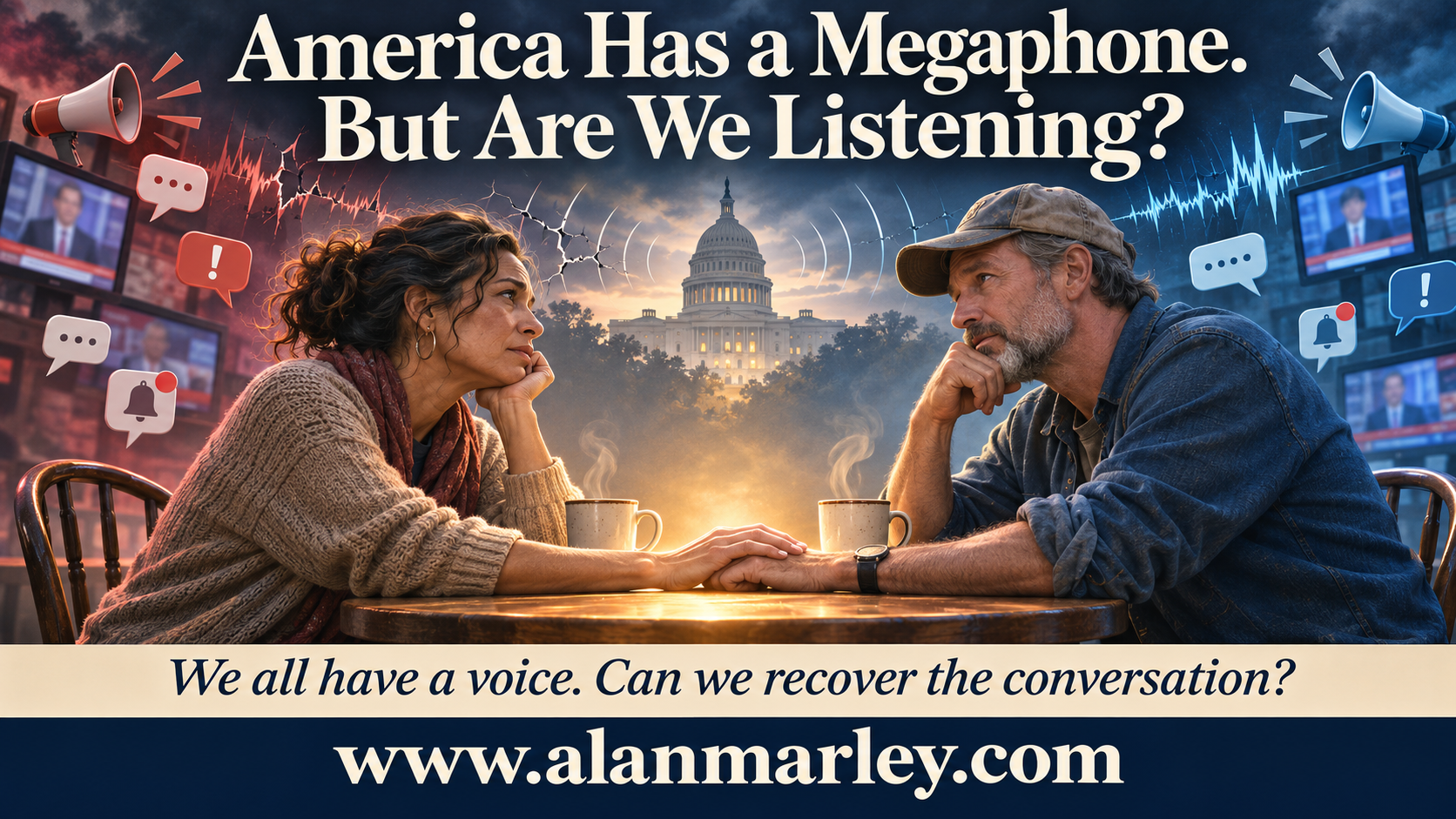
There are days when I wonder whether Americans can have a political disagreement anymore without turning it into a referendum on one another’s intelligence, character, or patriotism. Every headline seems to demand an immediate verdict. Every controversy arrives already packaged with villains and heroes. Every argument has a ready-made slogan, and an astonishing number of people seem prepared to repeat it with absolute certainty. We talk constantly. We pronounce judgment confidently. We insist that everyone else is misinformed. Yet I increasingly wonder whether we are listening to one another at all.
I am not writing this as an innocent bystander. I write articles. I post opinions. I challenge claims that strike me as foolish, dishonest, or unsupported. I sometimes enjoy a well-placed rebuttal more than I probably should. I have my own convictions, frustrations, and rhetorical habits. If the internet has given everyone with an ax to grind a megaphone, it has given one to me, too.
That admission matters. It would be easy to write another essay explaining how those people are ruining civil discourse. We have enough of those essays. What interests me more is whether our collective behavior has created a political culture in which nobody is permitted to be uncertain, almost nobody is rewarded for reconsidering an opinion, and concession is treated as weakness. Perhaps the problem is not merely that politicians and media companies have made anger profitable. Perhaps we have become willing customers.
My concern is not that Americans disagree. Disagreement is inevitable in a free society. My concern is that disagreement is increasingly experienced as hostility, and hostility as a form of civic participation. Somewhere along the way, we began mistaking the energy of our arguments for the quality of our reasoning.
A nation exhausted by its own conversation
Political fatigue is more than an impression. A 2023 Pew Research Center survey found that 65 percent of American adults said politics always or often left them feeling exhausted, while 55 percent reported feeling angry. Just 10 percent frequently felt hopeful and 4 percent frequently felt excited about politics [6]. Those numbers describe a public conversation experienced less as a shared civic enterprise than as a source of emotional depletion.
Pew also found that 61 percent considered political conversations with people who disagreed with them stressful and frustrating. Only 36 percent generally found those conversations interesting and informative [7]. That is a revealing reversal of what democratic conversation ought to offer. An encounter with a different viewpoint should at least create the possibility of learning something. Instead, many of us enter the exchange expecting an aggravation and emerge convinced that the other person is beyond reach.
One cannot attribute all of this to technology or to the latest election. Americans have endured bitter divisions before. We have fought over slavery, reconstruction, immigration, labor, war, civil rights, religion, and the boundaries of government power. The notion of a lost golden age in which everyone politely disagreed is historical fantasy. Our past includes political violence, inflammatory newspapers, vicious personal attacks, and profound injustices. Civility was not universally extended to everyone, and an apparent consensus sometimes depended on excluding people who lacked the power to challenge it.
Still, modern political life has distinctive characteristics. The argument no longer waits for a newspaper delivery or an evening broadcast. It follows us to breakfast, the workplace, the checkout line, and bed. There is always a new controversy and always someone insisting that our failure to react instantly demonstrates moral indifference. We carry an endless political argument in our pockets. And because outrage is infinitely renewable, resolution is rarely the point.
Perhaps that is why even those who love politics sometimes seem to hate discussing it. We are exposed to a constant stream of conflict without the satisfaction of solving much of anything. The emotional cost is immediate; the civic benefit can feel remote.
The 24-hour outrage economy
The development of round-the-clock news created an enormous demand for content. But there are only so many consequential public events on any given day. The hours still must be filled, the audience retained, and the advertisements sold. Analysis, speculation, argument, reaction, and reaction to the reaction become programming. A statement that might once have occupied two paragraphs in a newspaper can now sustain an afternoon of furious commentary.
I do not believe journalists are uniformly cynical, nor do I think reporting is interchangeable with punditry. Serious investigative journalism remains indispensable. Without reporters scrutinizing official claims, obtaining documents, interviewing witnesses, and uncovering misconduct, citizens would be less equipped to hold power accountable. The problem arises when the obligation to inform gets crowded out by the commercial incentive to provoke.
The basic mechanics are straightforward. Outrage captures attention. Attention can increase audience engagement. Engagement can produce revenue, influence, subscriptions, or donations. None of this requires an elaborate conspiracy. A series of ordinary business decisions, each apparently rational on its own, can produce a public conversation saturated with anxiety and indignation.
Cable television perfected a recognizable formula: identify a controversy, assemble familiar advocates, assign opposing roles, compress a complicated matter into a confrontation, and send viewers to the next segment with their loyalties intact. The format is entertaining because conflict is entertaining. But it can leave the audience with the impression that almost every subject has exactly two positions and that the only appropriate response to the other position is contempt.
The same distortion extends beyond television. News alerts emphasize what is urgent, not necessarily what is important. Headlines compete in a crowded attention market. Commentary often arrives faster than verified facts. Corrections rarely generate the excitement of the original accusation. In a world of constant updates, thoughtful hesitation can look like ignorance while unwarranted confidence looks like leadership.
None of this means we should stop following the news. It means we should distinguish being informed from being continuously stimulated. Reading a carefully reported account of a legislative proposal is not the same experience as consuming six hours of people shouting about it. Both may be labeled political engagement, but they cultivate different habits of mind.
Social media gave us all a microphone
Then came social media, and the gatekeepers lost much of their control over public speech. In many ways, that is a remarkable achievement. Ordinary people can expose wrongdoing, organize assistance, challenge powerful institutions, publish independent research, and communicate without asking permission from a newspaper editor or television producer. The capacity to speak publicly is no longer reserved for those with money, institutional status, or professional media access.
But democratizing speech has not necessarily democratized judgment. We now have millions of amateur editorial boards, each operating at remarkable speed, often with little obligation to verify what they publish. A screenshot becomes evidence. A clipped video becomes a complete account. A sarcastic post becomes a declaration of ideology. A rumor is repeated so often that its familiarity begins to substitute for proof.
Researchers Soroush Vosoughi, Deb Roy, and Sinan Aral examined the spread of verified true and false stories on Twitter between 2006 and 2017. Their study, published in Science, found that false stories spread farther, faster, more deeply, and more broadly than true ones in the dataset; the difference was especially pronounced for political falsehoods [9]. That finding does not establish that everything popular online is false. It does suggest that novelty and emotional appeal can give inaccurate information a powerful competitive advantage.
The uncomfortable observation in that study is that human behavior mattered. It is tempting to imagine the entire information crisis as a machine-driven problem, but people choose what to share, repeat, and celebrate. We are not merely passive victims of an algorithm. We are contributors to the environment that algorithms measure and optimize.
We should not oversimplify the science, either. A large experiment involving Facebook and Instagram during the 2020 election found that switching participants from algorithmically ranked feeds to chronological feeds changed what they encountered and how much time they spent on the platforms. Yet it did not significantly change their measured political polarization over the three-month study [2]. Another experiment found that temporary Facebook and Instagram deactivation had little measurable effect on several polarization outcomes during that election period [1]. These studies do not absolve platforms of responsibility. They remind us that our divisions have deeper roots than any single recommendation system.
Nevertheless, the architecture of social media changes the way we behave. A face-to-face disagreement involves expressions, pauses, relationships, and the possibility that tomorrow we must work beside the person we challenged. Online, the audience may be vast, anonymous, and transient. We can deliver a cutting insult, collect approving reactions, and move on without seeing its effect on another human being.
The result is a strange inversion: our opportunities to communicate have expanded dramatically, while the ordinary disciplines of conversation (patience, context, restraint, and curiosity) have often contracted.
The nation of pontificators
I use the word pontificators deliberately, and I include myself. A pontificator speaks as though possessing authority, frequently at greater length and with greater certainty than the evidence warrants. In the old world, one might find such people at the end of a bar, around a dinner table, or behind a lectern. In the new world, the lectern is everywhere.
One need not read a court opinion to explain what the Supreme Court supposedly ruled. One need not understand an economic indicator to announce what caused it. One need not study immigration law to declare that a particular policy is obviously constitutional or unconstitutional. An arrest, a viral encounter, a proposed regulation, or a controversial speech can prompt thousands of instant experts before essential facts are established.
The problem is not that ordinary citizens lack a right to comment. They have every right, and their participation is vital. Expertise is not a prerequisite for citizenship. But the right to express a view should not be confused with having earned confidence in that view. There is dignity in saying, “I do not know enough about this yet.” There is intelligence in asking for a primary source. There is integrity in admitting that a familiar claim did not survive scrutiny.
Unfortunately, those responses do not make particularly exciting social-media performances. Certainty plays better. A colorful insult plays better still. The confident pontificator can win applause without answering a single serious objection.
I understand the temptation. I enjoy an argument. I like exposing weak reasoning. And when someone posts something that seems spectacularly uninformed, I may feel the urge to respond with the verbal equivalent of a hammer. Sometimes the argument deserves to be dismantled. Yet I must ask whether a public humiliation will encourage anyone to reconsider a position, or simply reassure people already on my side that we are cleverer than our opponents.
There is a difference between proving a proposition wrong and making a person feel small. The first can advance public understanding. The second often produces another committed adversary.
That distinction should not require politeness at any price. Dishonesty, cruelty, corruption, and abuses of power deserve direct criticism. Some claims are demonstrably false, and we do no service to truth by pretending otherwise. But harsh scrutiny of an idea need not become wholesale contempt for everyone who accepts it.
From disagreement to identity
Why do ordinary policy disagreements become so personal? Part of the answer is that political affiliation has grown into a broader social identity. We increasingly infer someone’s character, education, values, neighborhood, religion, and even humanity from a political label. The label becomes a shortcut in place of knowing the person.
Pew Research Center has documented increasingly unfavorable attitudes toward the opposing party over decades. In its 2022 work, negative sentiment toward the other party was an important component of partisan identity, and intensely negative attitudes had become far more widespread than in earlier years [5]. That pattern is commonly discussed as affective polarization: the tendency to dislike or distrust people associated with the other political camp, beyond disagreement over policy details.
This is particularly corrosive because it makes every debate feel existential. A disagreement over tax rates becomes evidence that someone lacks compassion. A dispute over public safety becomes proof that someone despises freedom. A question about religious liberty becomes a complete judgment about a neighbor’s morality. The person disappears behind the category.
And because categories are easier to attack than human beings, caricature replaces description. We select the most outrageous representative of a group and treat that person as typical. We interpret ambiguous remarks from allies generously and those from opponents suspiciously. We share the worst behavior of the other camp and quietly ignore equivalent conduct in our own.
Most of us can recognize this process when others do it. The harder task is recognizing it when we do.
One useful test is to imagine the identical action committed by a politician we dislike and one we support. Would our judgment change? Would the same executive maneuver suddenly become tyranny instead of decisive leadership? Would a refusal to compromise transform from principle into obstruction? Would inflammatory rhetoric become intolerable from one mouth and understandable from another?
If the standard moves with the partisan label, it is not really a standard. It is allegiance dressed as reasoning.
Our opinions are more complicated than our political uniforms
Another casualty of permanent partisan conflict is the independent mind. Real people often hold beliefs that do not conform to a party platform. Someone may favor low taxes and reproductive autonomy, strong border enforcement and humane treatment of migrants, broad free-speech protections and robust civil rights, religious liberty and a firm separation of government from religious authority. These combinations are not necessarily incoherent. They arise because people weigh principles and tradeoffs differently.
Yet our political conversation frequently asks us to select a uniform and defend everything associated with it. Once we identify with a camp, a disagreement with its leadership can feel like disloyalty. An honest admission that an opponent has made a good point may draw more criticism from supposed friends than from adversaries.
This is a poor environment for thought. In business, an entrepreneur who refuses to examine contrary evidence can lose money, customers, and eventually the enterprise. In science, a hypothesis must remain open to testing. In education, we say we value critical thinking, an ability to assess arguments rather than memorize preferred conclusions. Why should politics, the field that determines the legitimate use of government power, be exempt from those disciplines?
There is an especially troubling asymmetry between the seriousness of political authority and the casualness with which it is sometimes discussed. A government can tax, regulate, prosecute, imprison, and use force. Its legal powers matter immensely. Yet constitutional claims often circulate as slogans stripped of the relevant text, statutes, precedent, and institutional context.
We need not all become attorneys or political scientists. But citizens should know enough to distinguish what they want the government to do from what the government is authorized to do. And we should be humble about interpretations that responsible experts can reasonably dispute.
A constitutional republic was built for disagreement
The United States was not designed on the assumption that Americans would agree about everything. The constitutional system acknowledges competing interests, separated institutions, and the need to limit concentrated power. Legislative, executive, and judicial authority are distributed among branches, and the federal system divides authority between national and state governments. Checks and balances are not obstacles accidentally left in the machinery; they are an essential part of the machinery [4].
James Madison confronted the problem of faction in Federalist No. 10. He understood that free people would develop different interests, passions, and opinions. Attempting to remove those differences by suppressing liberty would, in his analysis, sacrifice the very thing republican government exists to protect. The challenge was to control the harmful effects of factions while preserving freedom [3].
That insight remains strikingly relevant. Our republic does not require uniformity of belief. It requires procedures, restraints, and a basic willingness to recognize that citizens who disagree retain legitimate standing within the constitutional community.
The Constitution does not guarantee that public policy will always be wise or that voters will always choose wisely. It provides a structure for deciding who may act, through what process, and within what limits. Those limits are particularly important when a preferred political outcome tempts us to overlook them.
Consider how casually we sometimes discuss impeachment. A demand that an officeholder be removed may express understandable anger, but constitutional removal is not accomplished by a television segment or a social-media petition. For federal civil officers, the House may impeach, and conviction in the Senate requires a two-thirds vote of senators present. The procedure is deliberately different from ordinary political disapproval. Likewise, an executive order is not a magic substitute for legislation: presidential directives must operate within the authority conferred by the Constitution and applicable law.
Citizens can reasonably debate particular applications. What troubles me is the tendency to skip the analysis entirely. We leap from a political preference to a demand for action without asking which institution possesses the authority, what protections the law requires, or whether we would tolerate the same maneuver by an administration we oppose.
The constitutional republic is not a partisan accessory to be displayed when convenient. Its restraints have meaning only if they apply when they frustrate our ambitions.
Compromise is not surrender
Somewhere in our political vocabulary, compromise began to sound like a defect of character. We celebrate the leader who never backs down, never admits error, never concedes a point, and never allows an opponent to claim a success. That posture may perform well in a campaign advertisement. It is a questionable model for governing a diverse nation.
Compromise is not always possible, desirable, or morally acceptable. There are fundamental rights that should not be traded away for convenience. A proposal can be unjust even when many people support it. A constitutional violation does not become permissible because negotiators split the difference. Civility should never be a demand that victims of injustice accept their treatment quietly.
But many policy disputes involve legitimate competing objectives and imperfect tradeoffs. Government budgets require choices among public needs and private burdens. Immigration policy must address lawful entry, enforcement, labor demands, humanitarian claims, and administrative capacity. Environmental policy must consider ecological risks, costs, innovation, and distributional effects. No slogan can settle all the competing considerations.
The ability to negotiate does not indicate an absence of principle. Often it indicates that a public official understands the difference between a campaign promise and a law that can survive the legislative process. A workable agreement may accomplish less than one side desires but more than either could achieve through perpetual stalemate.
Yet the incentive to compromise weakens when political careers depend on maintaining fear of the other side. Solving a problem can reduce its usefulness as a fundraising appeal or campaign issue. A dramatic confrontation attracts far more attention than a committee quietly correcting an administrative problem. We should be careful about attributing cynical motives to every individual politician, but we should also recognize that political institutions respond to incentives.
In a functioning republic, negotiation should be a tool of responsible government. It should not automatically be regarded as evidence that someone has betrayed the voters.
What civility is, and what it is not
The word civility can sound quaint, as though the solution to political division is simply to speak more softly. That is not my argument. Civility does not mean abandoning strong opinions. It does not require treating established facts as interchangeable with unsupported assertions. It certainly does not obligate citizens to be deferential toward people exercising public power.
Civility is a discipline of disagreement. It means dealing with the proposition a person actually makes instead of the grotesque version most easily refuted. It means allowing evidence to matter. It means distinguishing motives we can establish from motives we merely suspect. It means treating a correction as an opportunity to improve our understanding rather than as an attack on our identity.
It also requires proportionality. Not every insensitive remark demonstrates a national moral collapse. Not every policy disagreement threatens the survival of civilization. Not every offensive joke deserves a week of public condemnation. Some events genuinely are grave; assigning maximum outrage to everything makes it harder to recognize the things that are.
At the same time, there is a danger in a superficial appeal to “both sides.” A commitment to civility should not erase meaningful differences in conduct or evidence. Two claims do not become equally credible merely because they come from different political camps. Nor should a demand for balance prevent criticism of a particular abuse. Being nonpartisan in one’s standards is not the same thing as refusing to draw conclusions.
That is the standard I would favor: evaluate conduct by consistent principles, evaluate factual claims by reliable evidence, and judge proposed remedies by their legal authority and likely consequences. Let the conclusions fall where they may.
We also ought to give people room to change their minds. A culture that treats an earlier mistake as permanent proof of bad character discourages the very intellectual growth it claims to seek. If admitting error is punished more severely than stubbornly repeating it, stubbornness is what we will get.
Why the loudest voices can seem like everybody
It is tempting to look at a hostile comment section and conclude that the entire nation has gone mad. But an online crowd is not a scientific sample of the public. People who are highly motivated to comment, fight, or share provocative content may be more visible than those who are content to live their lives without publicly litigating every controversy.
Research offers a useful corrective to the impression that Americans talk about nothing but politics. In a 2024 Pew survey, just 18 percent said they talked a lot about political issues with family and close friends. By contrast, 69 percent said they frequently discussed what was happening in their loved ones’ lives, and 46 percent talked frequently about work or school [8]. Real life contains more than the political performances filling our feeds.
I find that reassuring. The neighbor who disagrees with us on an election may still help when our car fails. The coworker who votes differently may still be generous, dependable, and thoughtful. The person whose political posts irritate us may be remarkably kind to a family member in distress. Human beings rarely fit the tidy portraits drawn by partisan propaganda.
The problem is that public political conversation makes the disagreement unusually visible while leaving the ordinary virtues less conspicuous. Online, we encounter the inflammatory sentence without the decades of friendship, work, hardship, and generosity that might make us interpret it more charitably.
I am not suggesting that the quiet majority automatically shares a single reasonable middle position. People who avoid political discussion can disagree just as profoundly as those who participate. Silence does not equal moderation. But we should resist assuming that the angriest public voices represent the full country.
The noisy fraction of the nation may be shaping our impression of the whole. When we mistake visibility for representativeness, we begin behaving as though virtually everyone around us is an adversary.
The seductive pleasure of being right
There is another reason the machinery of outrage works: outrage can be enjoyable. This may be the least flattering admission in the entire discussion, but anyone who has ever composed a sharp rebuttal knows the feeling. We find a contradiction, expose a double standard, assemble the devastating paragraph, and press publish. When others applaud, the satisfaction is immediate.
That satisfaction does not establish that the argument is wrong. Sometimes an effective rebuttal is entirely justified. The problem occurs when we begin optimizing our writing for the pleasurable moment of victory rather than the more demanding work of understanding. A sarcastic line can receive hundreds of approving reactions while doing almost nothing to persuade a skeptical reader.
The audience matters. Are we writing to the people who already agree with us, or to those who might reasonably disagree? Are we trying to clarify a disputed issue, or to produce an applause line? Are we exposing a factual error, or enjoying a stranger’s embarrassment? These questions cannot be answered by counting reactions.
I am not above the temptation to score a point. Indeed, it would be hypocritical to claim otherwise. I have strong opinions about religion, constitutional limits, government authority, and public policy. I have challenged people sharply and undoubtedly sometimes with more heat than necessary. I may be right about a particular conclusion and still be wrong in the way I communicate it.
Recognizing that is not self-censorship. It is self-examination. The First Amendment protects the opportunity to speak; it does not relieve us of responsibility for the quality of our speech.
I would like to think that a well-constructed argument can be forceful without being needlessly cruel. It can expose a falsehood without inventing motives. It can insist on accountability without surrendering to personal hatred. And it can acknowledge a legitimate concern in an opposing argument without abandoning its own conclusion.
That kind of writing is harder. It is also more likely to leave an opening for an actual conversation.
Constitutional literacy begins with intellectual humility
One of my recurring frustrations is how confidently people announce constitutional conclusions without examining the Constitution or the law. We have a republic organized around defined governmental powers, but public discussions often begin and end with whether the proposed action benefits a favored cause.
Yet I must apply the same scrutiny to myself. Being familiar with constitutional structures is not the same thing as being incapable of error. The Constitution is a text with a history, a body of interpretations, and genuine disputes about meaning and application. Constitutional scholars and judges can disagree after years of serious study. That fact should inspire diligence, not paralysis or false equivalence.
Perhaps a practical habit would help: whenever someone asserts that a politician “can,” “must,” or “cannot” do something, ask for the legal basis. Which constitutional provision applies? Is there a statute? Has a court interpreted it? What factual assumptions does the claim require? Which institution has authority to make the decision? What is the strongest counterargument?
These questions are not attempts to win on a technicality. They are the civic equivalent of checking the measurements before cutting material or reviewing the financial assumptions before investing in a business. We would not consider a contractor competent merely because he was passionate about construction. We should be equally skeptical of constitutional certainty unsupported by analysis.
The goal is not to manufacture millions of constitutional lawyers. It is to cultivate citizens who know when they are offering an opinion, when they are asserting a fact, and when they are interpreting a rule that may be more complicated than a headline implies.
And perhaps the most important question remains: would I apply this principle consistently if the people holding power changed tomorrow? If not, I should reconsider whether I have a constitutional argument or a partisan preference.
Can we rebuild the habits of conversation?
I doubt there is one grand solution to political incivility. Government cannot legislate Americans into respecting one another, and I would be wary of any proposal that gave officials broad authority to decide which political expressions were sufficiently civil. The cure could quickly become more dangerous than the disease. Free speech includes speech we dislike, speech that is irritating, and speech that is harshly critical of those in power.
But we are not powerless. We can change the practices we reward and the habits we bring to discussions. The first step may be learning to slow down. A story that triggers instant fury is often precisely the story that deserves verification before amplification. We can read beyond the headline, locate the complete quotation, distinguish a first-hand document from somebody’s interpretation, and wait when the facts are still emerging.
Second, we can use questions as genuine inquiries rather than traps. “What evidence led you to that conclusion?” is more promising than “How could anyone be stupid enough to believe that?” The former gives the other person an opportunity to explain. The latter announces that explanation will be futile.
Third, we can make room for partial agreement. An opponent may accurately identify a problem while proposing a remedy we reject. We can acknowledge the first without endorsing the second. Indeed, accurately describing the part of another person’s argument that has merit often makes our criticism more credible.
Fourth, we should distinguish the severity of an error from the worth of the individual making it. A person can be badly mistaken about policy while still deserving the ordinary respect owed to a fellow citizen. Conversely, respect for a person’s dignity does not require leaving a dangerous or dishonest claim unanswered.
Fifth, we can decline the invitation to participate in every manufactured emergency. Not every viral dispute deserves our immediate opinion. Sometimes the most constructive contribution to civic life is to step away, spend time with people, build something useful, teach, volunteer, or solve a tangible problem in the community.
Finally, those of us who write publicly can deliberately change our standard of success. Instead of asking whether a post will make allies cheer, we can ask whether a reasonable critic would recognize their position in our description of it. Would we stand behind the factual claims after the excitement fades? Have we made it easier for an undecided reader to understand the issue? Have we given ourselves permission to revise the piece if better evidence emerges?
No single individual can repair a national political culture. But political culture is the accumulation of individual choices, institutional incentives, and shared expectations. Each of us contributes something to it, for better or worse.
The danger of treating neighbors as enemies
One of the most consequential shifts in public life occurs when political rivals stop being regarded as legitimate opponents and begin being described as enemies who must be destroyed. Ordinary competition then takes on the atmosphere of a permanent emergency. Every defeat seems intolerable. Every institutional restraint appears suspicious if it obstructs victory. The temptation to excuse abuses of power grows stronger because, we tell ourselves, the other side is worse.
This is a dangerous bargain. Constitutional safeguards matter precisely because political fortunes change. Speech rights protect unpopular speakers. Due process constrains government when accusations are emotionally compelling. Elections transfer authority without requiring citizens to agree with the result. Checks and balances frustrate officeholders who would otherwise act with too little oversight.
These principles protect us from one another’s certainty. They presume that no party, leader, or movement possesses an exclusive claim to wisdom. They also presume that political adversaries remain members of the same constitutional community, entitled to the same basic legal protections.
It is possible to oppose an agenda strongly while rejecting the dehumanization of its supporters. It is possible to criticize a public official relentlessly while recognizing that threats and political violence are unacceptable. It is possible to believe that a policy would cause serious damage without imagining that every person who favors it is malicious.
None of that requires complacency. A democratic society must confront misconduct and defend its institutions. But it should do so through evidence, accountable processes, and the rule of law rather than through reflexive tribal vengeance.
The country will always have winners and losers in its elections. The more important question is whether we can preserve a political community in which losing an election does not mean losing our citizenship, dignity, or rights.
Perhaps the mirror is more useful than another megaphone
It is easy to blame cable news, social-media platforms, elected officials, wealthy donors, and partisan operatives. There are good reasons to scrutinize all of them. They shape the environment in which arguments circulate. But blaming them exclusively lets the rest of us escape examination.
The uncomfortable truth is that outrage would be less profitable if fewer of us rewarded it. Manufactured controversy would be less influential if fewer of us spread it. Politicians would have less incentive to demonize opponents if their supporters consistently demanded evidence, restraint, and results.
That does not mean the responsibility is equally distributed in every controversy. People with institutional power and large audiences can inflict far greater harm than an ordinary citizen arguing online. Public officials and professional communicators should be held to especially demanding standards. Yet personal responsibility does not disappear merely because someone else has more influence.
I return to my own part in all this. I will continue to write, question, criticize, and defend conclusions I believe are supported by evidence. I have no intention of pretending that every argument deserves equal respect or that every political decision is a matter of taste. There are principles worth defending and falsehoods worth exposing.
But I would like to become more attentive to the distinction between being persuasive and being performative. I would like to ask more often whether my response adds information or merely adds heat. I would like to resist the cheap pleasure of humiliating someone when a more disciplined argument could do more good.
Most of all, I would like to remember that the person on the other end of a disagreement may be more than the worst sentence they have written.
I suspect I am not alone in this aspiration. Many Americans seem tired of the constant conflict, even as we continue participating in it. We want a less hostile political culture, but we are tempted every day to contribute another small piece of hostility. We complain about the shouting while reaching for our own microphones.
That contradiction is not a reason for despair. It is a place to begin.
Conclusion: The republic needs citizens, not just commentators
We do not need a country in which everyone agrees. We could not create one without sacrificing the liberty that makes a constitutional republic worth preserving. We need a country in which disagreement can occur without destroying respect, in which political authority is constrained by law, in which facts still matter, and in which citizens can recognize the humanity of people whose conclusions they reject.
Our technology has made speaking extraordinarily easy. It has not made listening automatic. We have access to more claims, more opinions, more outrage, and more opportunities to pronounce judgment than any generation before us. Yet the essential civic virtues remain old-fashioned: patience, curiosity, humility, honesty, courage, and restraint.
The solution is not silence. It is better speech and more thoughtful listening. It is the willingness to challenge our own camp, to verify a claim before sharing it, to understand a constitutional limit even when it frustrates us, and to make room for the possibility that we have misunderstood someone.
I do not expect our political arguments to become gentle. Nor should they always be. Freedom produces friction. But a free society cannot afford to confuse friction with hatred, certainty with knowledge, or contempt with strength.
We have all been handed megaphones, myself included. The question is whether we will use them to deepen the national quarrel or to recover the possibility of a national conversation.
- Allcott, H., et al. (2024). The effects of Facebook and Instagram on the 2020 election: A deactivation experiment. Proceedings of the National Academy of Sciences. doi.org/10.1073/pnas.2321584121
- Guess, A. M., et al. (2023). How do social media feed algorithms affect attitudes and behavior in an election campaign? Science, 381 (6656), 398–404. doi.org/10.1126/science.abp9364
- Madison, J. (1787). Federalist No. 10. National Constitution Center. constitutioncenter.org/the-constitution/historic-document-library/detail/james-madison-federalist-10-1788
- National Archives. (n.d.). The Constitution: What does it say? archives.gov/founding-docs/constitution/what-does-it-say
- Pew Research Center. (2022, August 9). As partisan hostility grows, signs of frustration with the two-party system. pewresearch.org/politics/2022/08/09/as-partisan-hostility-grows-signs-of-frustration-with-the-two-party-system/
- Pew Research Center. (2023a, September 19). Americans' dismal views of the nation's politics. pewresearch.org/politics/2023/09/19/americans-dismal-views-of-the-nations-politics/
- Pew Research Center. (2023b, September 19). Americans' feelings about politics, polarization and the tone of political discourse. pewresearch.org/politics/2023/09/19/americans-feelings-about-politics-polarization-and-the-tone-of-political-discourse/
- Pew Research Center. (2024, July 2). What Americans talk about with family and friends. pewresearch.org/short-reads/2024/07/02/whats-new-with-you-what-americans-talk-about-with-family-and-friends/
- Vosoughi, S., Roy, D., & Aral, S. (2018). The spread of true and false news online. Science, 359 (6380), 1146–1151. doi.org/10.1126/science.aap9559