There is a peculiar misunderstanding of American government that seems to surface after every midterm election. One political party wins control of Congress, its supporters celebrate, and suddenly everyone behaves as though the president has been reduced to a spectator in his own administration.
That is not how our constitutional republic works.
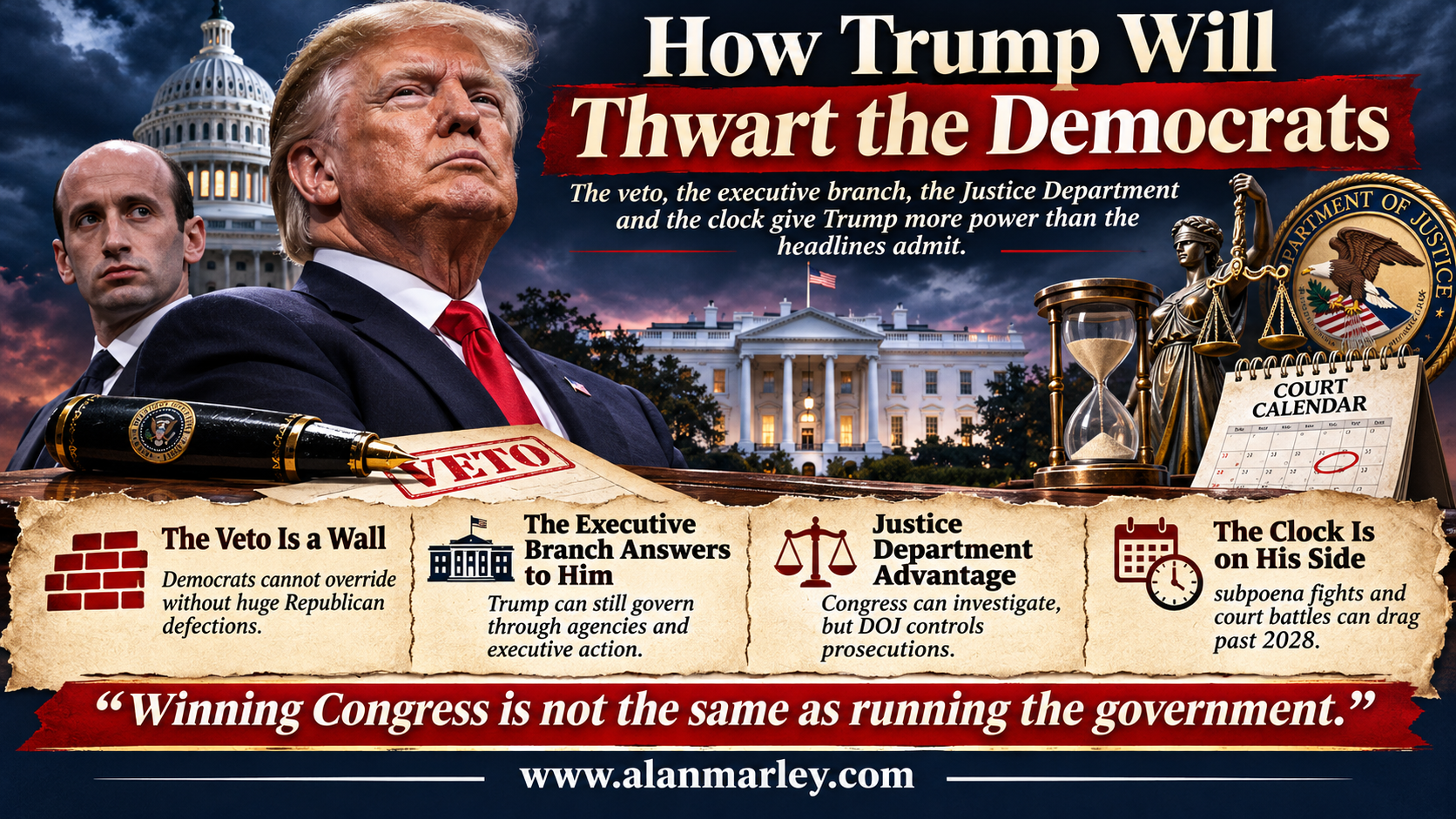
A president does not surrender the executive branch because voters elect an opposition Congress. He does not lose the presidential veto, his authority over executive agencies, or his ability to exercise powers granted by the Constitution and federal law.
And he certainly does not become an employee of the House speaker or Senate majority leader.
The Constitution deliberately distributes political power among competing institutions. Sometimes those institutions cooperate. Sometimes they negotiate. And sometimes they spend years preventing one another from accomplishing much of anything.
The latter is known as gridlock.
Depending on one’s political preferences, gridlock can look like democratic dysfunction or a welcome defense against government overreach.
But here is what history makes unmistakably clear: a determined president can frustrate a congressional majority for years, particularly when that majority lacks the two-thirds votes required to override his vetoes.
The Democrats’ 2026 congressional victory presents another opportunity to observe that constitutional arrangement.
Donald Trump may have lost his congressional allies’ majorities, but he has not lost the presidency.
And that distinction matters enormously.
The Constitution Gives the President a Powerful Defensive Weapon
Begin with Article I, Section 7 of the Constitution.
A bill ordinarily must pass both the House of Representatives and the Senate before reaching the president.
The president can sign it into law.
Or he can veto it.
Congress may override that veto, but doing so requires two-thirds of the members voting in each chamber, provided a quorum is present.
With all members voting, that means 290 representatives and 67 senators.
Consider the practical consequences.
A political party can control both chambers, pass legislation with comfortable majorities, and still accomplish absolutely nothing legislatively if the president refuses to sign its bills and Congress cannot muster sufficient votes to override him.
This is not a loophole.
It is a constitutional check.
The Framers understood that legislative majorities could become excessive, impulsive, or politically opportunistic. They gave the president a means of resisting legislation he considered objectionable.
The presidential veto does not allow a president to write whatever laws he pleases.
It does something almost as important.
It allows him to prevent legislation from becoming law.
A president does not need a congressional majority to stop a bill. He needs only enough congressional support to sustain his veto.
That is why the minority party can remain remarkably influential even after losing control of Congress.
And it is why Democratic leaders promising sweeping legislation should begin by examining the arithmetic.
Andrew Johnson: When Congress Had Enough Votes to Fight Back
The aftermath of the Civil War provides one of the most consequential confrontations between Congress and the presidency.
President Andrew Johnson clashed repeatedly with congressional Republicans over Reconstruction.
Johnson favored an approach that congressional Republicans considered insufficient to protect the rights of formerly enslaved Americans and reshape the defeated Southern states.
Congress responded with major legislation.
Johnson vetoed important Reconstruction measures.
But there was a crucial difference between Johnson’s political circumstances and those facing many later presidents.
Congress possessed the necessary votes to override him.
In 1867, congressional Republicans enacted Reconstruction legislation over Johnson’s objections. Congress also passed the Tenure of Office Act over his veto, attempting to restrict his ability to remove certain federal officials.
The conflict eventually contributed to Johnson’s impeachment.
He survived removal by a single Senate vote.
The significance is difficult to overstate.
Johnson was stubborn, confrontational, and determined to resist Congress. But presidential determination could not overcome a congressional coalition large enough to override his vetoes.
That is the constitutional lesson.
A president can obstruct ordinary majorities.
He cannot necessarily obstruct a genuine supermajority.
The veto is formidable, but it is not absolute.
Richard Nixon: Congress Overrules a President on War Powers
Richard Nixon provides another revealing example.
By 1973, controversy over the Vietnam War and presidential military authority had produced substantial congressional resistance.
Congress passed the War Powers Resolution to establish procedures and limitations concerning the introduction of American forces into hostilities.
Nixon vetoed the measure on October 24, 1973.
Congress overrode him in November.
The measure became law despite his objections.
That confrontation demonstrates that Congress can reassert its constitutional authority when sufficiently broad bipartisan support exists.
It also illustrates the importance of distinguishing between winning a legislative battle and resolving a constitutional disagreement.
Presidents of both parties have subsequently challenged or interpreted aspects of the War Powers Resolution in ways that preserve executive flexibility.
The institutional struggle did not disappear simply because Congress won that particular vote.
A law can settle a legislative dispute without eliminating disagreements over constitutional authority.
Nevertheless, Nixon’s experience reinforces the central point: congressional numbers matter.
When Congress can assemble two-thirds majorities, the president’s veto becomes a temporary obstacle.
When it cannot, the veto can end the legislative effort.
Bill Clinton and Newt Gingrich: The Shutdown That Became a Political Reckoning
Perhaps the clearest modern example of divided government occurred after Republicans captured both chambers of Congress in the 1994 midterm elections.
President Bill Clinton remained in the White House.
Republican House Speaker Newt Gingrich entered the confrontation with an ambitious agenda and considerable confidence.
Republicans believed their electoral victory provided a mandate to reshape federal spending and domestic policy.
Clinton had other ideas.
The confrontation centered on budget priorities, federal spending, Medicare, and the terms under which government operations would continue.
In November 1995, Clinton vetoed a continuing resolution containing provisions he opposed.
The federal government entered a partial shutdown.
Another shutdown followed in December and continued into January 1996.
The political struggle became a contest of institutional power and public opinion.
Republicans could refuse to approve spending on terms Clinton found acceptable.
Clinton could refuse to sign legislation he opposed.
Neither side could simply command the other to surrender.
Eventually, the parties negotiated arrangements that reopened the government.
The episode is remembered partly because Clinton emerged politically strengthened, while Gingrich and congressional Republicans faced substantial criticism.
But the larger lesson is constitutional, not partisan.
Republicans controlled Congress.
They did not control the president.
Clinton used his veto and negotiating position to resist important elements of their agenda.
The party that wins Congress does not automatically win the budget confrontation. Both sides must account for the other’s constitutional leverage.
And sometimes the political winner is the institution that succeeds in convincing voters that the other side caused the stalemate.
George W. Bush: A Democratic Congress Could Pass Bills He Would Not Sign
The 2006 midterm elections gave Democrats control of both chambers during George W. Bush’s presidency.
The Iraq War dominated the political atmosphere, and Democratic leaders sought to change its direction.
Congress approved a 2007 supplemental appropriations measure containing provisions concerning the withdrawal of American forces from Iraq.
Bush vetoed it on May 1.
The House attempted an override the following day.
It failed.
The administration continued pursuing its military strategy, while Congress confronted the difficult question of whether to withhold funding, negotiate alternative legislation, or continue opposing the president politically.
Bush also vetoed legislation expanding the State Children’s Health Insurance Program.
Congress failed to override those vetoes as well.
The lesson should be familiar.
Democrats controlled the legislative branch.
Bush controlled the executive branch and held the veto.
Congress could debate, investigate, criticize, and pass legislation.
But its ordinary majority could not compel the president to accept its preferred policies.
Bush was not invulnerable. Congress overrode his veto of the Water Resources Development Act in November 2007.
That exception matters because it demonstrates that sufficiently broad coalitions can prevail.
Nevertheless, the major confrontations of 2007 illustrate the substantial defensive power of an opposition president.
Barack Obama: Republicans Controlled Congress, but Not the White House
The pattern repeated under President Barack Obama.
Republicans gained control of the House following the 2010 midterms and later took the Senate following the 2014 elections.
By January 2015, Republicans controlled both chambers.
They wanted to advance legislation Obama opposed.
One prominent example was the Keystone XL Pipeline Approval Act.
Congress passed the bill.
Obama vetoed it on February 24, 2015.
The Senate attempted to override him.
The vote was 62 to 37.
That was a substantial majority in favor of overriding the veto.
It was not two-thirds.
The override failed.
The bill did not become law.
This is an especially instructive example because it illustrates how misleading ordinary majority arithmetic can be.
Sixty-two senators supported overriding Obama’s veto.
In most political conversations, sixty-two votes in the Senate would sound overwhelming.
But the Constitution required more.
Obama prevailed.
Not because his party controlled Congress.
It did not.
He prevailed because the Constitution provided a defensive threshold his opponents could not reach.
Obama also exercised executive authority in immigration and other areas, though his actions faced legal challenges and limits.
The point is not whether one approves of his decisions.
The point is that a president with sufficient political determination can remain consequential even when Congress is hostile.
Obama demonstrated that an opposition Congress could pass legislation, generate headlines, and claim popular support while still being unable to overcome the president’s veto.
The same constitutional principle applies regardless of which political party occupies the White House.
Donald Trump: The 2019 Border Emergency Confrontation
Donald Trump’s first administration provides an unusually direct example.
In February 2019, Trump declared a national emergency concerning the southern border.
Congress challenged the declaration.
Both chambers approved a joint resolution intended to terminate the emergency.
Trump vetoed it.
The House attempted to override his veto on March 26, 2019.
The vote was 248 to 181.
The override failed.
The resolution did not terminate the emergency.
This episode is particularly relevant because Congress was not simply trying to enact an unrelated domestic policy.
It was attempting to check a presidential emergency declaration.
Yet the mechanism Congress used required presentation to the president.
Trump therefore exercised the same veto authority he held over ordinary legislation.
Congress had enough votes to register its objection.
It did not have enough votes to impose that objection over the president’s resistance.
The result was a significant demonstration of presidential defensive power.
During Trump’s first term, he vetoed ten measures.
Congress successfully overrode only one: the National Defense Authorization Act for fiscal year 2021.
That override required extraordinary bipartisan support: 322 to 87 in the House and 81 to 13 in the Senate.
The historical record illustrates two complementary truths.
First, a president can repeatedly frustrate Congress when his opponents lack overwhelming support.
Second, when both parties assemble an exceptionally broad coalition, Congress can defeat the president’s objections.
Presidential power is substantial.
It is not unlimited.
The Department of Justice: Congress Does Not Control Federal Prosecutions
The presidential veto is only one part of the equation.
The Department of Justice is a federal executive-branch department.
The attorney general is appointed by the president with Senate confirmation and serves as the department’s leader.
Federal prosecutors operate within the executive branch.
Congress may investigate government misconduct, hold hearings, request documents, and issue subpoenas.
It does not ordinarily direct federal criminal prosecutions.
That creates an important institutional distinction.
A congressional committee can conclude that an executive official improperly refused to cooperate.
Congress can pursue contempt procedures.
But a criminal contempt referral does not automatically produce a federal prosecution.
The Justice Department makes prosecutorial decisions subject to applicable law and professional obligations.
This institutional problem has appeared under administrations of both parties.
The Obama Justice Department declined to prosecute Attorney General Eric Holder following a congressional contempt referral in 2012.
The Trump Justice Department declined prosecutions of William Barr and Wilbur Ross after contempt referrals in 2019.
The Biden Justice Department declined to prosecute Attorney General Merrick Garland following a congressional contempt referral in 2024.
The pattern demonstrates a persistent institutional conflict.
Congress wants information.
Executive officials sometimes resist.
And the department ordinarily responsible for federal prosecutions belongs to the executive branch.
That does not make the DOJ a president’s private legal firm.
It does not authorize the president to obstruct justice, disregard statutes, or direct unlawful prosecutions.
The department has legal obligations, and Congress possesses civil enforcement and oversight tools.
Nevertheless, a president who is determined to resist congressional investigations possesses institutional advantages that legislators should not underestimate.
A subpoena is not a criminal conviction.
A contempt vote is not an automatic prosecution.
And congressional outrage is not a substitute for the judicial process.
Executive Orders: Governing Within Existing Authority
Presidents also possess significant authority to direct the executive branch.
Executive orders can guide federal agencies, establish administrative priorities, and implement existing laws within constitutional and statutory limits.
A president does not generally need congressional approval every time he directs a federal agency to exercise authority already delegated by law.
That makes executive action especially attractive during divided government.
When Congress refuses to enact a preferred program, the president may examine what existing statutes permit.
He may reorganize administrative priorities, change enforcement policies where discretion exists, direct regulatory review, or pursue other lawful measures.
But executive orders are not legislation.
They cannot create authority the Constitution and statutes do not provide.
They can be challenged in federal court.
And a future president may reverse many of them.
The Supreme Court’s 2023 decision in Biden v. Nebraska provides a powerful reminder.
The Biden administration attempted broad student-loan cancellation under authority it claimed from existing federal law.
The Supreme Court concluded that the asserted statute did not authorize the program.
The administration could not accomplish through executive interpretation what the law did not permit.
That is the other half of the constitutional balance.
Presidents can act without passing new legislation when existing law authorizes their actions.
They cannot simply declare a preferred policy lawful because Congress refuses to cooperate.
A determined president can use executive authority aggressively.
But determination does not erase legal limits.
The Clock Can Be a Political Weapon
Another advantage available to an administration resisting congressional oversight is time.
Congress operates in two-year terms.
Investigations require document requests, witness interviews, legal analysis, hearings, and sometimes litigation.
Executive privilege disputes can produce prolonged judicial proceedings.
The investigation involving former White House counsel Don McGahn illustrates the problem.
The House Judiciary Committee subpoenaed McGahn in April 2019.
The resulting litigation continued through multiple judicial proceedings and political developments.
A negotiated interview eventually occurred in 2021.
More than two years had passed.
That timeline matters.
A congressional majority seeking information before an election may discover that the legal process moves considerably more slowly than the political calendar.
An administration may challenge a subpoena on legitimate legal grounds.
It may also benefit politically from the resulting delay.
Congressional committees cannot assume that issuing a subpoena guarantees prompt testimony or disclosure.
And when a Congress ends, unresolved investigative demands may require renewed action.
The calendar does not belong to the president.
But litigation delays can favor an executive branch defending information it already possesses.
There is an old political observation worth remembering.
Sometimes an administration does not need to win every legal battle.
It needs to remain standing long enough for political circumstances to change.
Impeachment Is Not Removal
This distinction is perhaps the most frequently misunderstood constitutional issue.
The House of Representatives possesses the sole power of impeachment.
A simple majority can approve articles of impeachment.
But impeachment is not removal from office.
The Senate conducts the trial, and conviction requires the concurrence of two-thirds of the senators present.
With all 100 senators present, that requires 67 votes.
A congressional majority can therefore impeach a president or other impeachable federal official without possessing anything close to the votes required for conviction.
Impeachment can have political consequences.
It can expose evidence, establish a public record, and influence voters.
But it cannot be honestly presented as equivalent to removing someone from office.
Andrew Johnson survived his Senate trial.
Bill Clinton was acquitted.
Donald Trump was acquitted in both of his first two Senate impeachment trials.
The constitutional process was designed to make removal difficult.
And that difficulty remains regardless of how angry a congressional majority becomes.
A party that does not possess the necessary Senate votes should be candid with voters about what impeachment can realistically accomplish.
The President Cannot Govern Alone, Either
At this point, an important qualification is necessary.
A president’s ability to block Congress is not the same as an unlimited ability to govern without it.
Congress retains substantial constitutional powers.
It controls federal appropriations.
It determines the contents of legislation sent to the president.
The Senate exercises advice and consent over appointments covered by the Constitution.
Congressional committees conduct oversight.
And Congress can amend or repeal statutory authority when it can enact the necessary legislation.
An opposition Congress can therefore frustrate a president just as a president can frustrate Congress.
It can refuse to pass new legislation.
It can reject nominees.
It can demand negotiations over federal spending.
It can investigate executive conduct and expose information to the public.
Presidents must also comply with valid appropriations statutes. The Impoundment Control Act restricts their ability to withhold spending that Congress has lawfully authorized.
The president cannot simply seize the Treasury or rewrite spending statutes.
That is why divided government so often produces stalemate rather than decisive victory for either branch.
The president can prevent new laws.
Congress can prevent new presidential legislative initiatives.
Neither side can ordinarily impose a comprehensive agenda over the determined resistance of the other without sufficient constitutional authority or political support.
This is frustrating when one believes a particular policy is urgently needed.
It is also one reason our constitutional system resists sudden concentration of political power.
What the 2026 Congressional Elections Mean for Trump
Now consider the current political situation.
Democrats have won control of Congress, but Donald Trump remains president.
The White House therefore retains its constitutional powers.
Democrats can control legislative priorities.
They can investigate the administration.
They can demand testimony and documents.
They can use Senate confirmations to constrain presidential appointments.
They can negotiate federal spending and refuse legislation they oppose.
Those are substantial powers.
But Democrats do not possess the two-thirds majorities necessary to override Trump’s vetoes on their own.
Nor can they independently secure Senate convictions in impeachment trials without significant Republican support.
Trump retains the executive branch, including the authority to supervise federal agencies and appoint executive leadership subject to applicable law.
The Justice Department remains an executive department.
And where existing statutes permit executive action, Trump can continue directing his administration without first obtaining a new act of Congress.
In practical terms, he can resist legislation he opposes, negotiate over appropriations, defend executive privilege claims, challenge congressional demands in court, and continue pursuing policies supported by existing legal authority.
None of this guarantees success.
Federal courts can reject unlawful executive actions.
Congress can block nominations and legislation.
Republicans may occasionally join Democrats in challenging the president.
Public opinion can shift.
An administration that mistakes constitutional authority for political invulnerability can damage itself severely.
Nevertheless, the institutional advantages are undeniable.
A Democratic congressional victory changes Trump’s political circumstances.
It does not terminate his constitutional powers.
The Real Danger: Mistaking Gridlock for Victory
There is a broader concern here.
Political parties frequently celebrate the acquisition of institutional power without honestly explaining the limitations that accompany it.
A congressional majority promises sweeping legislation.
A president promises executive action.
Activists demand investigations, prosecutions, impeachment, and immediate results.
Then the constitutional machinery begins operating.
Bills die.
Vetoes survive.
Nominations stall.
Subpoenas enter litigation.
Budget negotiations collapse.
And voters understandably wonder why the people they elected cannot accomplish what they promised.
Some of this frustration reflects genuine political dysfunction.
But some reflects a misunderstanding of how the American system was designed.
The Constitution does not guarantee that winning an election gives one political faction the authority to impose its entire agenda.
It divides power precisely because temporary majorities and ambitious executives are both capable of making serious mistakes.
Gridlock can prevent harmful legislation.
It can also prevent necessary reform.
Its value depends partly on what is being blocked and whether the institutions involved are acting responsibly.
We should not romanticize obstruction as a virtue in itself.
Nor should we condemn every constitutional restraint merely because it frustrates a preferred political outcome.
The same standards should apply under Republican and Democratic presidents.
Conclusion: Winning Congress Is Not Winning the Government
American history offers abundant evidence that a strong-willed president can frustrate Congress.
Andrew Johnson tried, but congressional supermajorities repeatedly defeated him.
Richard Nixon vetoed the War Powers Resolution, and Congress overrode him.
Bill Clinton faced Republican congressional majorities and resisted their budget demands.
George W. Bush used the veto to block major Democratic initiatives involving Iraq and children’s health insurance.
Barack Obama stopped Republican-backed legislation despite his opponents controlling both chambers.
Donald Trump used the same constitutional tool to preserve his border emergency declaration against congressional opposition.
The pattern is unmistakable.
Presidents remain powerful during divided government.
But their ability to prevail depends on constitutional authority, political coalitions, public opinion, and the willingness of other institutions to resist.
The presidential veto is particularly important because it changes the arithmetic of lawmaking.
A party can win a majority and still lack the votes to legislate over presidential opposition.
That is neither a Republican advantage nor a Democratic advantage.
It is an advantage of the presidency.
And it exists regardless of which party occupies the White House.
As the new Congress prepares to confront Trump, Democratic leaders would be wise to remember that an investigation is not a prosecution, impeachment is not removal, a congressional majority is not a veto-proof majority, and an election victory does not transfer executive authority to the legislative branch.
They can obstruct Trump.
Trump can obstruct them.
Both can make political theater out of the confrontation.
But governing a constitutional republic requires more than issuing threats, holding hearings, and promising that one’s opponents are finished.
It requires understanding the limits of power, and finding ways to accomplish something within them.
- U.S. Constitution, Article I, Section 7; Article II. U.S. Senate, Constitution of the United States.
- National Archives. The Presidential Veto and Congressional Veto Override Process.
- U.S. Senate. Impeachment Trial of President Andrew Johnson, 1868.
- U.S. House of Representatives, History, Art & Archives. Power Struggle Over a New America.
- National Park Service. Congressional Reconstruction.
- U.S. House of Representatives, History, Art & Archives. The War Powers Resolution.
- Congressional Research Service. Past Government Shutdowns: Key Resources.
- U.S. Senate. Vetoes by President George W. Bush.
- U.S. Senate. Vetoes by President Barack Obama.
- Obama White House Archives. (2015, February 24). Veto Message to the Senate: S. 1, Keystone XL Pipeline Approval Act.
- U.S. Senate. Vetoes by President Donald J. Trump.
- Congressional Research Service. National Emergencies Act: Expedited Procedures in the House and Senate.
- U.S. Supreme Court. (2023). Biden v. Nebraska , 600 U.S. 477.
- U.S. Government Accountability Office. Impoundment Control Act.
- U.S. Senate. (2021, January 1). Roll Call Vote 292, Override of the FY2021 National Defense Authorization Act Veto.
- U.S. Senate. About Voting.