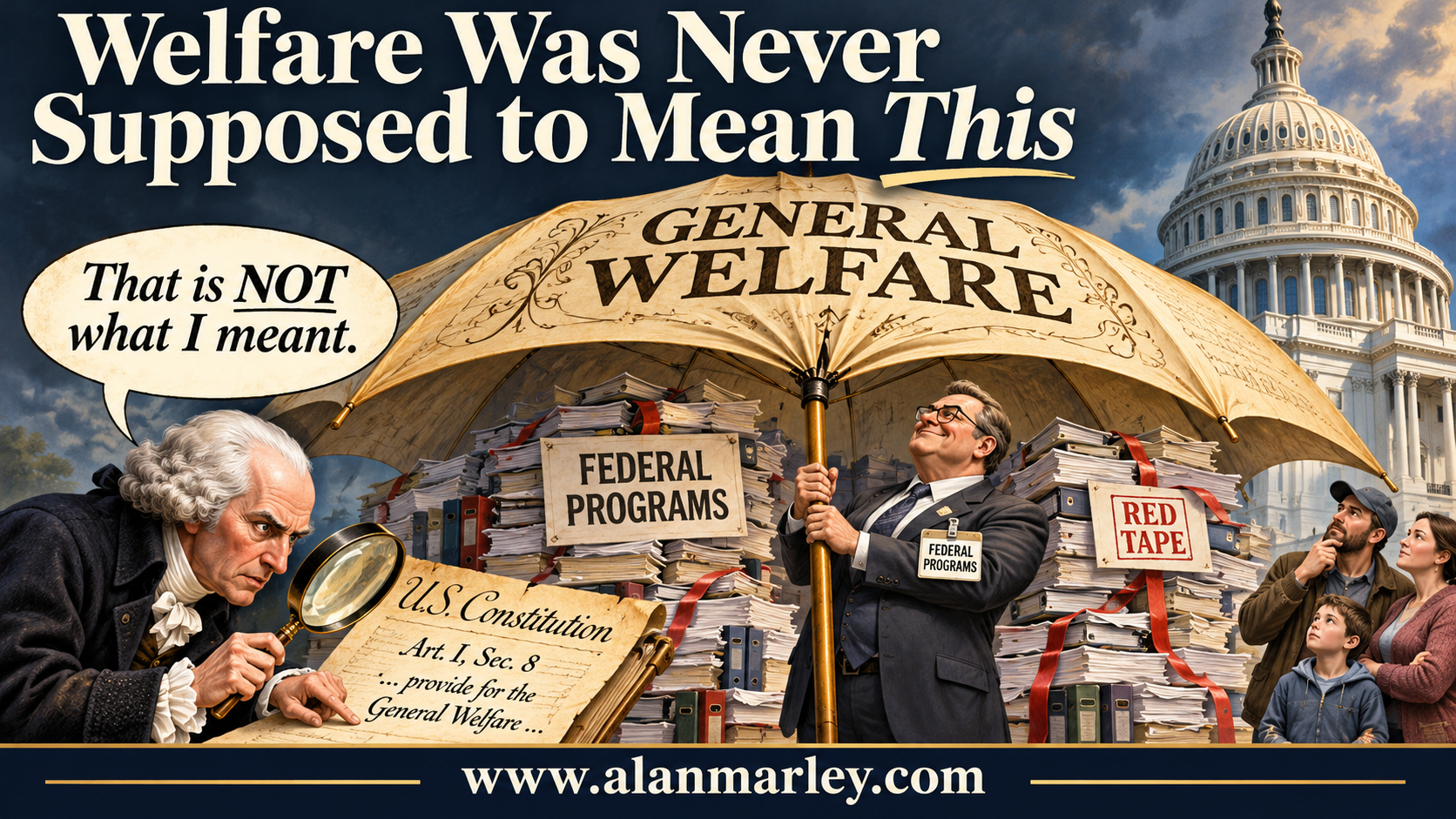
Somewhere along the way, Americans stopped asking a simple question: where does the federal government get the authority to hand out benefits to individuals? Not whether it is kind. Not whether it is popular. Where is the authority? The Founders argued about it from the first Congress forward, and the side that lost the argument in 1788 won it in the courts in 1936. I think that is where we went wrong, and I am not going to apologize for saying so. A country can care about its poor and still insist that the power to help them has a source, a limit, and a purpose.
If “general welfare” means whatever Congress says it means, then the Constitution does not limit spending at all. It only describes it.
What the Clause Actually Says
Article I, Section 8 opens by giving Congress the power “to lay and collect Taxes, Duties, Imposts and Excises, to pay the Debts and provide for the common Defence and general Welfare of the United States.” Seventeen more clauses follow, listing specific powers: borrow money, regulate commerce, coin money, raise armies, and so on. The whole fight is over how the first clause relates to the rest.
Is “general welfare” a separate grant of power, a blank check Congress can write for anything it judges good for the country? Or is it a statement of purpose that tells you why Congress taxes, with the list that follows telling you what Congress may actually do? Two founders, both brilliant, answered differently, and the answer you pick decides almost everything about the size of the federal government.
Madison: A Caption, Not a Blank Check
James Madison took the narrow view. In Federalist 41, he answered critics who warned that the clause handed Congress power over everything. [11] His reply was a question: “For what purpose could the enumeration of particular powers be inserted,” if the opening phrase already covered all of them? [10] If “general welfare” were a free-standing power, the seventeen clauses after it would be meaningless filler. Madison read the phrase as a general heading over the powers that follow it, a statement of the ends that taxing serves, not an additional authority to do anything Congress thinks wise. [1]
The logic is hard to dodge. Why would a Constitution that carefully lists federal powers also contain a power to do whatever the list leaves out?
Hamilton: A Power of Its Own
Alexander Hamilton disagreed, and he said so in his 1791 Report on Manufactures. He argued that the clause gave Congress a power to tax and spend for the general welfare in its own right, reaching beyond the specific powers listed elsewhere. [5] The limits, in his reading, were few: duties had to be uniform, direct taxes apportioned by population, and the spending had to serve the general welfare of the nation, not some local or particular interest. [4] Justice Joseph Story endorsed the Hamiltonian view in his 1833 Commentaries on the Constitution. [8]
| Question | Madison | Hamilton |
|---|---|---|
| What is "general welfare"? | A purpose that frames the listed powers | A separate power to tax and spend |
| Can Congress spend beyond the listed powers? | No | Yes, if the spending serves the nation as a whole |
| Who decides the limit? | The enumeration itself | Congress, within the word "general" |
| Where does it lead? | Limited, specific federal authority | A broad spending power with soft edges |
Notice what even Hamilton required. The spending had to be for the general welfare, meaning the nation as a whole, not particular people or places. That word, “general,” is where the modern welfare state quietly cheats.
The Presidents Who Said No
For most of the first century and a half, American presidents treated the narrow reading as the working rule. James Madison himself vetoed a bill to fund internal improvements on March 3, 1817, one of his last acts as president. [9]
In 1854, Franklin Pierce vetoed a bill that would have granted federal land to the states to build asylums for the indigent insane. The cause was Dorothea Dix’s, and it deserved sympathy. Pierce shared the goal. He still wrote that he could find no authority in the Constitution for making the federal government “the great almoner of public charity.” [13] His veto held for decades. [17]
In 1887, Grover Cleveland vetoed $10,000 in seed aid for Texas farmers hit by drought. [2] He acknowledged the need. His objection was to the principle: federal aid in such cases, he wrote, encourages an expectation of paternal care, and he insisted that the government should not support the people. [3] He also pointed out that the charity of fellow Americans could be relied on to relieve misfortune. [3]
These men were not heartless. They believed the federal government’s power had a source, and that private charity, churches, towns, and states were the proper first responders. Whether you agree with them or not, they took the constitutional question seriously.
Where We Went Wrong
The break came in the 1930s. In United States v. Butler (1936), the Supreme Court struck down the Agricultural Adjustment Act, but in doing so it endorsed the Hamiltonian reading of the clause. [16] [12] The government lost the case and won the theory.
The next year it collected. In Helvering v. Davis (1937), the Court upheld the old-age benefits in the Social Security Act and held that Congress itself decides what counts as the general welfare. [6] Steward Machine Co. v. Davis, decided the same year, upheld the unemployment insurance provisions. [6] The word “general” was supposed to be the limit. The Court said the legislature would police its own limit.
That is the error, and it is a structural one. When the only referee for the limits on a power is the body exercising it, you do not have a limit. Later cases went further. South Dakota v. Dole (1987) deferred so broadly to Congress that it has been said to go beyond Hamilton himself. [12]
I will concede what is fair to concede. Hamilton’s reading has real pedigree. It was adopted by Story, accepted by the Court, and it has been the settled law for nearly ninety years. Madison’s reading lost. My argument is not that the case law does not exist. It is that the case law took a power Hamilton said was bounded by “general” and turned it into a power bounded by nothing.
From General Welfare to Welfare
Here is the word game at the center of all of this. “General welfare” in 1787 meant the good of the whole country: defense, a sound currency, roads and ports that serve everyone. “Welfare” today means targeted benefits for specific individuals based on their circumstances. Those are different things, and the second grew out of the first only because the umbrella got wide enough to cover it.
A benefit that goes to one household and not the next, based on that household’s income, is the opposite of general. It is particular by design. Hamilton drew his line at national purposes, not local or particular ones, and a means-tested program for individuals sits on the wrong side of that line under his own test.
Once the umbrella was wide, the incentives took over. Programs expand because beneficiaries vote, agencies grow, and the only question anyone asks is whether the program is popular. The earlier question, whether the power exists at all, disappeared.
What Accountability Looks Like
None of this means I want a single child to go hungry. I have said before that a prosperous nation has a moral duty to care for those who cannot care for themselves, and I mean it. But the constitutional question is not a technicality. It is the reason accountability keeps getting treated as a dirty word.
Look at how the largest food program is run. The Government Accountability Office reported that SNAP made an estimated $10.5 billion in improper payments in fiscal year 2023, an improper payment rate of 11.7 percent. [7] USDA’s own figure for fiscal year 2024 was 10.93 percent. [15] More than one dollar in ten is paid in error, and the figure was above ten percent in both years. In any business I have ever run, that would be a firing offense.
Work requirements are the obvious tool, and the evidence on them is more mixed than either side admits. A 2026 Census Bureau working paper found that SNAP work requirements reduced participation by about 7 percent without any measurable increase in labor supply. [14] I take that seriously. It means the design matters, not that accountability is wrong. A requirement that screens out the needy while changing nobody’s behavior is a bad requirement. The answer is a better one, not none.
And here the Madisonian instinct has practical force. If states and local communities carried more of this work, they would have the information to tell the family that needs a hand from the family that needs a push, and the accountability would sit close to the people paying for it. A distant agency cannot do that. A county can.
My Conclusion
I will say it plainly. The federal welfare state rests on a reading of the Constitution that the author of Federalist 41 rejected, that Pierce and Cleveland vetoed against, and that did not become law until 1936. That reading may be settled. It is still wrong, and the results show it: an umbrella wide enough to cover anything has covered permanent dependency, enormous error rates, and a political class that treats any question about limits as cruelty.
Compassion is a virtue. It is not a grant of power. A nation that wants to help people who cannot help themselves should say where its authority comes from, where it ends, and who is accountable when the help fails.
- Chronicles magazine. The general welfare clause and the Hamiltonian view (discussing Madison’s reading of the clause). chroniclesmagazine.org/?p=25248
- Cleveland, G. (1887, February 16). Veto of Texas Seed Bill. Miller Center, University of Virginia. millercenter.org/node/2371
- Cleveland, G. (1887, February 16). Veto of the Texas Seed Bill. American Yawp Reader. americanyawp.com/reader/16-capital-and-labor/grover-clevelands-veto-of-the-texas-seed-bill-february-16-1887
- Eastman, J. C. (2011, January 13). Enough is enough: Why general welfare limits spending. The Heritage Foundation. heritage.org/node/13183
- General welfare clause. Encyclopedia.com (discussing Hamilton’s 1791 Report on Manufactures and Helvering v. Davis). encyclopedia.com/politics/encyclopedias-almanacs-transcripts-and-maps/general-welfare-clause
- General welfare clause. Encyclopedia.com (discussing Helvering v. Davis, 1937, and Steward Machine Co. v. Davis). encyclopedia.com/politics/encyclopedias-almanacs-transcripts-and-maps/general-welfare-clause
- Government Accountability Office. (2024). Improper payments: USDA’s oversight of the Supplemental Nutrition Assistance Program. gao.gov/products/gao-24-107461
- Legal Information Institute, Cornell Law School. Historical background on the Spending Clause (Article I, Section 8, Clause 1; Story, Commentaries on the Constitution § 922, 1833). law.cornell.edu/constitution-conan/article-1/section-8/clause-1/historical-background-on-spending-clause
- List of United States presidential vetoes (March 3, 1817, H.R. 29, internal improvements). Wikipedia. wikipedia.org/wiki/Trump_veto
- Madison, J. (1788). Federalist No. 41 (on the enumeration of particular powers). Yale Law School, Avalon Project. avalon.law.yale.edu/18th_century/fed41.asp
- Madison, J. (1788, January 19). The Federalist No. 41: General view of the powers conferred by the Constitution. Founders Online, National Archives. founders.archives.gov/documents/Madison/01-10-02-0237
- National Constitution Center. Interpretation: Spending Clause (discussing Butler and South Dakota v. Dole, 1987). constitutioncenter.org/the-constitution/articles/article-i/clauses/755
- Pierce, F. (1854, May 3). Veto message (Bill for the Benefit of the Indigent Insane). The American Presidency Project. presidency.ucsb.edu/documents/veto-message-445
- U.S. Census Bureau. (2026). Screening out the needy: The effects of SNAP work requirements. census.gov/library/working-papers/2026/adrm/CES-WP-26-46.html
- U.S. Department of Agriculture. (2025). USDA releases annual SNAP payment error rates for FY 2024. fns.usda.gov/newsroom/fns-0003.25
- United States v. Butler , 297 U.S. 1 (1936).
- Warder, G. Franklin Pierce’s 1854 veto. Social Welfare History Project, Virginia Commonwealth University. socialwelfare.library.vcu.edu/issues/franklin-pierces-1854-veto