Let me make one thing clear before anyone decides to label me heartless, selfish, or some other fashionable political insult: I don’t want a single child in America going hungry. I don’t want elderly Americans choosing between groceries and prescription medications. I don’t want someone suffering from a serious illness, physical disability, or debilitating mental-health condition left to fend for themselves.
I believe a prosperous nation has a moral obligation to care for those who genuinely cannot care for themselves.
But I also believe we have created a social safety net that, in too many instances, has confused temporary assistance with permanent dependency.
And I have a problem with that.
Not because I oppose helping people. Quite the contrary. I have a problem with it because I believe we can do better, both for the taxpayers funding these programs and for the people who depend on them.
A compassionate society should help people get back on their feet. It should not create conditions in which succeeding generations never learn to stand on their own.
When Did Accountability Become a Dirty Word?
A recent Vox article, The Astonishing Toll of America’s Food Stamp Cuts , paints a troubling picture of declining participation in the Supplemental Nutrition Assistance Program (SNAP). [5]
According to data compiled by the Center on Budget and Policy Priorities, approximately 5.5 million fewer Americans received SNAP benefits in July 2026 than in July 2025. The organization estimates that roughly 2 million of those no longer receiving assistance are children. [1]
Those figures deserve our attention. [8]
But they also deserve careful examination.
A reduction in SNAP participation does not automatically mean 5.5 million Americans are now going hungry. Some may have experienced improved financial circumstances. Others may have lost eligibility because of changing requirements. Still others may have encountered bureaucratic barriers that prevented them from receiving assistance they genuinely needed.
These distinctions matter.
The article largely attributes the decline to Republican policies enacted in 2025. There is evidence supporting some of that argument, but even the underlying research acknowledges that SNAP participation had begun declining before the legislation passed.
We need to understand what actually happened, not simply assign political blame.
If a working family loses food assistance because of an administrative technicality, we have a problem.
If someone who no longer qualifies for assistance leaves the program because their income has increased, that may represent progress.
Those are entirely different outcomes.
Yet political commentary frequently treats them as though they are interchangeable.
We Have a Responsibility to Protect the Vulnerable
I have no difficulty supporting a strong safety net for people who genuinely need it.
Children do not choose the circumstances into which they are born. They should not suffer because their parents are unemployed, irresponsible, ill, or simply experiencing difficult financial circumstances.
The elderly deserve dignity. Someone who has worked for decades should not spend their final years wondering whether they can afford to eat.
People with serious physical or mental disabilities deserve meaningful support. So do individuals dealing with illnesses that prevent them from maintaining employment.
And families experiencing temporary hardship should have somewhere to turn.
A construction worker who loses his job during an economic downturn should not have to watch his family go hungry while searching for employment. Neither should a single mother who finds herself suddenly unemployed.
These are precisely the circumstances in which a social safety net serves an important purpose.
But there is a difference between helping someone through hardship and establishing a system in which government assistance becomes an expected way of life.
We should be willing to discuss that difference without immediately accusing one another of lacking compassion.
Fraud, Waste, and Abuse Are Real Problems
One of my frustrations with discussions about government assistance is the tendency to dismiss concerns about waste and abuse as though they are imaginary.
They aren’t.
The Government Accountability Office reported that approximately $10.5 billion in SNAP payments during fiscal year 2023 were improper. [3]
That is an extraordinary amount of taxpayer money.
However, an important distinction needs to be made: improper payments are not necessarily fraudulent payments. They include administrative mistakes, incorrect benefit calculations, overpayments, and underpayments.
Fraud is intentional deception. Administrative incompetence is something else.
Both deserve attention, but they require different solutions.
The USDA reported a national SNAP payment error rate of 10.93% for fiscal year 2024. [7] Again, that was not a fraud rate.
We should not exaggerate the prevalence of fraud to justify reform. The documented errors and weaknesses in program administration provide sufficient reason to demand improvement.
If billions of dollars are being distributed incorrectly, why shouldn’t taxpayers expect better oversight?
Why shouldn’t we use modern technology to verify eligibility, identify duplicate benefits, detect fraudulent transactions, and correct administrative mistakes?
Businesses are expected to account for their expenditures. Government should be held to standards at least as demanding.
Every dollar wasted is a dollar unavailable to help someone who genuinely needs assistance.
That is not merely a fiscal concern. It is a moral one.
What About Generational Welfare?
Here is where I expect some disagreement.
I do not believe generational dependence on government assistance represents a promising future for America.
I am not suggesting that everyone receiving assistance is lazy. That would be absurd and unfair.
Many recipients work. Some hold multiple jobs. Others care for children or disabled family members. Some live in areas where employment opportunities are limited.
But I also refuse to accept the notion that long-term dependence should be treated as an acceptable outcome simply because escaping poverty is difficult.
We should be asking why some families remain dependent on government assistance for extended periods and why economic opportunities appear so elusive.
Is it inadequate education?
A lack of marketable skills?
Poor employment opportunities?
Childcare expenses?
Family instability?
Government programs that reduce benefits so sharply when earnings rise that accepting a better-paying job provides little immediate financial improvement?
Probably some combination of these factors, depending on the family.
Whatever the explanation, simply continuing benefits indefinitely without addressing the underlying problems strikes me as an inadequate solution.
The goal should not be to maintain people in poverty more comfortably. The goal should be to help them escape poverty.
That requires more than handing out money.
It requires education, job training, personal responsibility, employment opportunities, and a benefits system that rewards financial improvement.
The Question Nobody Wants to Ask: How Many Children Can You Afford?
Now let me raise a question that will undoubtedly make some people uncomfortable.
Why shouldn’t financial responsibility influence decisions about having additional children?
I am not suggesting government should tell Americans how many children they may have. Reproductive freedom is a fundamental personal liberty, and I have no interest in giving government that kind of authority.
But personal freedom and personal responsibility belong together.
If someone is already struggling financially, cannot support the children they have, and depends heavily on taxpayers, is it unreasonable to question the decision to bring additional children into those circumstances?
I don’t believe it is.
Every parent should consider whether they can provide food, housing, clothing, healthcare, and a reasonably stable environment before deciding to have another child.
That seems like basic responsibility.
Of course, circumstances change. People lose jobs. Marriages fail. Medical emergencies destroy savings. A family that was financially secure when a child was conceived may be struggling by the time that child is born.
I understand that.
But I am talking about deliberate decisions made with little apparent consideration of the financial consequences.
Should taxpayers be expected to absorb those consequences indefinitely?
I think that is a legitimate public-policy question.
Would a Cap on Benefits Solve the Problem?
The idea is not new.
During welfare reform in the 1990s, numerous states adopted what became known as family-cap policies. Under these policies, families already receiving certain cash welfare benefits generally did not receive additional assistance when another child was born. [2]
The reasoning was straightforward: If benefits automatically increase with family size, government might unintentionally reduce the financial consequences of having additional children.
But here is the problem.
Research examining those policies has not established that family caps consistently reduce birth rates. A National Bureau of Economic Research study found little evidence that the caps independently changed fertility behavior. [4]
And even if a policy successfully discouraged some additional births, another question remains.
What happens to a child who is born anyway?
The child still needs food.
The child still needs shelter.
The child still needs medical care.
Withholding assistance does not eliminate those needs. It simply leaves the family with fewer resources to meet them.
That is a difficult consequence to reconcile with my belief that no child should go hungry.
So while I believe the question of financial responsibility deserves serious discussion, I am not convinced that denying food or basic necessities to an additional child is the answer.
Perhaps we need to focus more heavily on preventing unplanned pregnancies, improving access to contraception, encouraging responsible family planning, and helping adults understand the financial obligations associated with raising children.
I would rather see government promote responsible decisions before a child is born than punish that child afterward.
Work Should Always Be More Rewarding Than Welfare
Another area demanding reform is the relationship between employment and government benefits.
In principle, I support work requirements for adults who are physically and mentally capable of working.
Why shouldn’t able-bodied adults contribute to their own support when employment is available?
But there is an important complication.
Research examining SNAP work requirements has found that some policies reduce enrollment without producing corresponding increases in employment.
A 2026 U.S. Census Bureau working paper, for example, found that work requirements reduced SNAP participation by approximately 7% in the studied population without increasing labor supply. [6]
That finding deserves consideration.
If the purpose of a work requirement is to encourage employment, then we should measure success by employment outcomes, not simply by the number of people removed from assistance.
Otherwise, we may be confusing budget reductions with genuine economic progress.
And what about people who are working but still cannot afford basic necessities?
An adult working full-time at a low wage may remain eligible for assistance because the cost of housing, childcare, transportation, and food exceeds what that job pays.
That is not necessarily a failure of individual responsibility.
It may reflect broader problems with wages, education, employment opportunities, or the cost of living.
We also need to examine the so-called benefits cliff.
Imagine someone receiving government assistance who accepts a modest pay increase, only to discover that the resulting loss of benefits leaves the family financially worse off.
What kind of incentive is that?
We should design assistance programs so that every additional dollar earned improves a household’s financial position.
Benefits should generally decline gradually as income increases.
Taking a better job should never feel like a financial punishment.
What Would Meaningful Reform Look Like?
If I were designing a social safety net, I would begin with several principles.
First, protect those who genuinely cannot care for themselves.
Children, the elderly, people with serious disabilities, and those suffering from debilitating physical or psychological conditions should have access to the assistance necessary to maintain a reasonable standard of living.
Second, provide temporary assistance to people experiencing legitimate financial hardship.
Losing a job, experiencing a medical emergency, or confronting a family crisis should not mean financial catastrophe.
Third, establish reasonable expectations for adults capable of working.
Those expectations should account for available jobs, childcare responsibilities, health limitations, and local economic conditions. They should also be paired with useful employment services and training opportunities.
Fourth, address fraud, waste, and administrative failures aggressively.
Use reliable data, modern technology, and accountable management to improve payment accuracy. Protect legitimate recipients from identity theft and fraudulent benefit transactions while ensuring that eligible families are not wrongly denied assistance.
Fifth, encourage financial responsibility and family planning.
Parents should understand the economic responsibilities associated with raising children. Government policy should encourage informed decisions and independence without taking away reproductive freedom or depriving children of necessities.
Sixth, reward progress toward independence.
Structure benefits so that employment, increased earnings, education, and savings improve a family’s circumstances instead of triggering sudden financial penalties.
Finally, measure success honestly.
A government agency should not claim victory merely because fewer people receive benefits.
Success means more people working, higher household incomes, fewer children experiencing hunger, less fraud and waste, and fewer families requiring long-term assistance.
Those are the outcomes worth measuring.
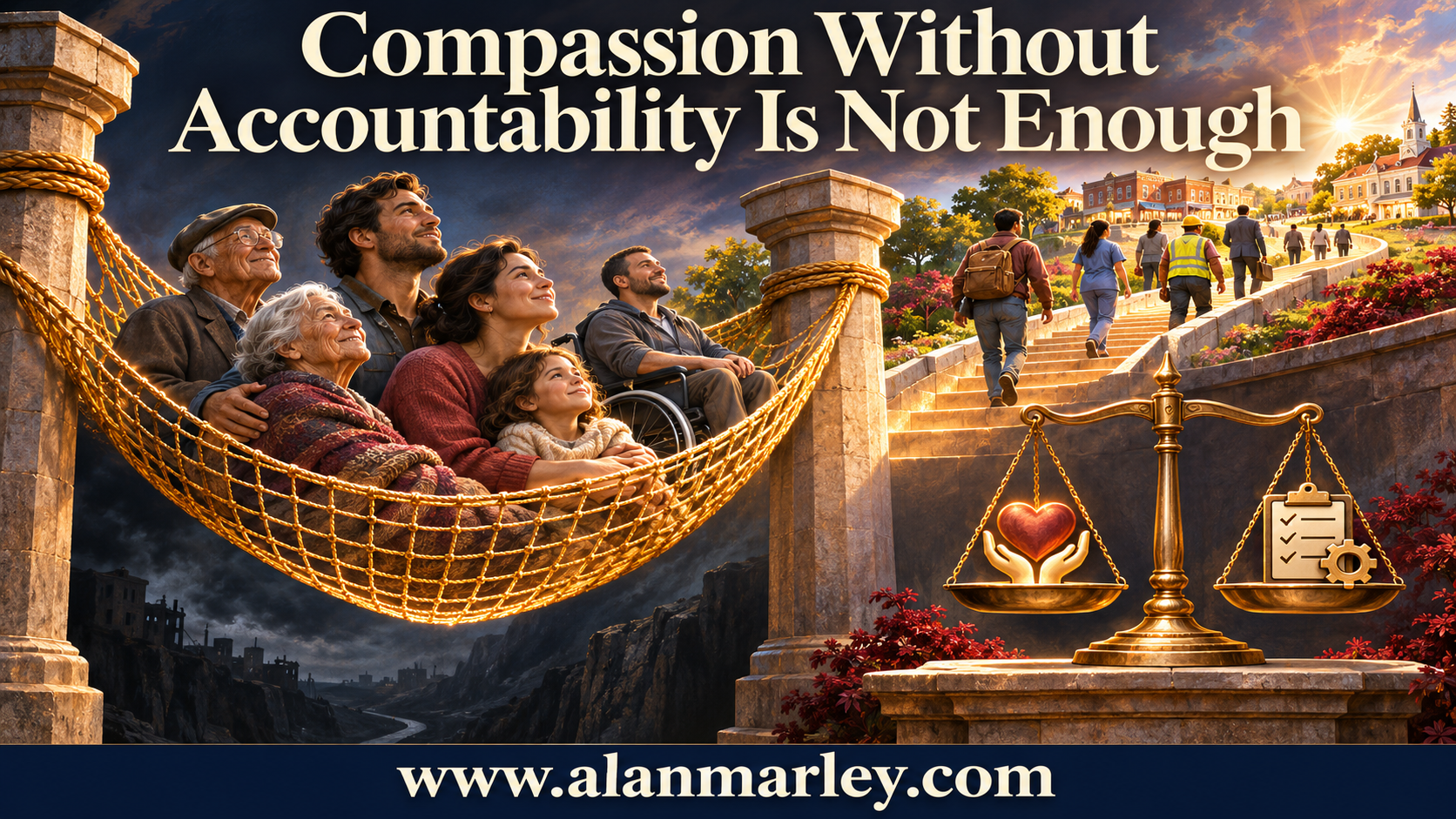
Compassion Without Accountability Is Not Enough
One of the great frustrations of modern American politics is our inability to discuss difficult subjects without immediately retreating into partisan camps.
Republicans are accused of wanting children to starve.
Democrats are accused of wanting everyone dependent on government.
Neither accusation contributes much to solving the underlying problems.
I am fiscally conservative. I believe government should spend taxpayer money responsibly, and I believe individuals should accept responsibility for their decisions whenever they are capable of doing so.
But fiscal conservatism does not require indifference to suffering.
Nor does compassion require accepting every existing government program as effective simply because its intentions are good.
We should be able to acknowledge that some Americans abuse public assistance while recognizing that many others genuinely need it.
We should be able to support reasonable work expectations while recognizing that not everyone can work.
We should be able to encourage responsible family planning without punishing innocent children.
And we should be able to question government spending without being accused of wanting people to go hungry.
My concern is not that America helps too many people.
My concern is that we spend enormous amounts of money without consistently demonstrating that those expenditures are helping people build better lives.
I want a safety net strong enough to catch people when they fall.
I also want a system designed to help those who can get back on their feet.
Most importantly, I want the children growing up in struggling households to have opportunities their parents may never have enjoyed.
I don’t want them inheriting poverty.
I don’t want them inheriting dependency.
And I certainly don’t want them inheriting the belief that their future has already been decided by their circumstances.
If we cannot agree on that objective, perhaps our political differences have become more important to us than the people these programs were created to serve.
And that would be a tragedy.
- Center on Budget and Policy Priorities. (2026, October 23). SNAP tracker: People are losing food assistance as the harmful 2025 Republican reconciliation law is implemented. cbpp.org/research/food-assistance/snap-tracker-people-are-losing-food-assistance-as-the-harmful-2025
- Government Accountability Office. (2001). Welfare reform: More research needed on TANF family caps and other policies for reducing out-of-wedlock births. gao.gov/products/gao-01-924
- Government Accountability Office. (2024). Improper payments: USDA’s oversight of the Supplemental Nutrition Assistance Program. gao.gov/products/gao-24-107461
- National Bureau of Economic Research. (2004). Family cap provisions and changes in births and abortions. Working Paper No. 10214. nber.org/papers/w10214
- Scott, D. (2026, November 19). The astonishing toll of America’s food stamp cuts. Vox. vox.com/good-medicine-newsletter/511217/food-stamp-snap-benefits-grocery-prices-hunger
- U.S. Census Bureau. (2026). Screening out the needy: The effects of SNAP work requirements. census.gov/library/working-papers/2026/adrm/CES-WP-26-46.html
- U.S. Department of Agriculture. (2025). USDA releases annual SNAP payment error rates for FY 2024. fns.usda.gov/newsroom/fns-0003.25
- Urban Institute. (2026, March 18). Food insecurity remained high in 2025, as safety net cuts loom. urban.org/research/publication/food-insecurity-remained-high-2025-safety-net-cuts-loom