
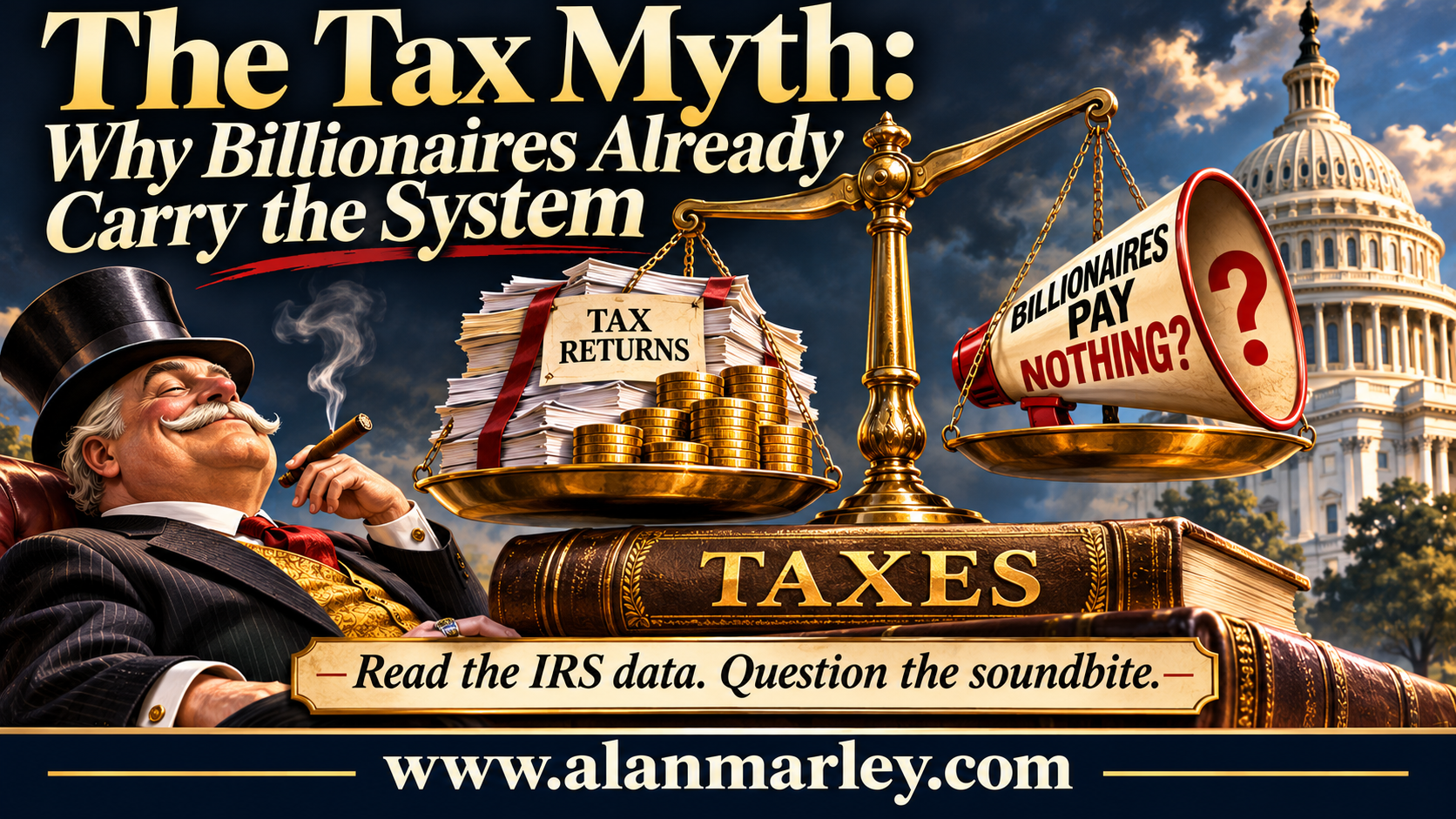
It has become one of the favorite applause lines in progressive politics: billionaires don’t pay taxes. On debate stages, in campaign ads, in social media posts with the confidence of settled fact, the claim repeats that the ultra-wealthy cheat the system, dodge their fair share and live off loopholes while ordinary Americans foot the bill. It sounds righteous. It sounds like holding power accountable. It is also wrong, and wrong in ways that matter because the policy prescriptions built on it - wealth taxes, unrealized gains taxes, punitive rate structures - would damage the investment economy that funds the government programs the same politicians claim to champion. The actual IRS data, available to anyone willing to read it, describes a tax system that is already heavily progressive and in which high earners carry the overwhelming majority of the federal income tax burden. That is not an argument against asking whether the system is fair. It is an argument for making that case with accurate numbers rather than a soundbite.
— ✦ —
How the Zero-Tax Myth Gets Built
The claim that billionaires pay nothing typically rests on two related confusions, and understanding them is necessary before any honest policy conversation can happen. The first is the conflation of wealth with income. A billionaire whose stock holdings increase in value by several billion dollars in a given year has not received income in any legal or practical sense. The stock is worth more on paper, but it has not been sold, it has not been converted to cash and it cannot be spent. Under U.S. tax law, unrealized capital gains are not income and are not taxed as income. The same principle applies to every American homeowner whose house has appreciated in value. Nobody pays income tax on that appreciation until the house is sold. Calling unrealized stock appreciation “untaxed income” is a category error, and it is used deliberately because it produces large and alarming numbers that actual realized income does not.
The second confusion is the use of cherry-picked single-year snapshots. Headlines citing a particular billionaire’s low tax bill in a particular year rarely mention that the year in question often coincides with major reinvestments, losses carried forward from earlier failed ventures or accounting treatment of long-term asset positions. Tax liability across a single year is a poor proxy for tax contribution across a career. A founder who builds a company over thirty years, living modestly during that period and eventually selling a large position, will show years of near-zero tax liability followed by a single-year bill that dwarfs what most people pay in a lifetime. The snapshot captures the lean years. The headline leaves out the exit.
What the IRS Data Actually Shows
The IRS Statistics of Income tables are public documents and they are unambiguous. The top one percent of earners pay more than 40 percent of all federal income taxes collected. The top ten percent pay approximately 74 percent. The bottom fifty percent of all taxpayers pay less than three percent of federal income taxes combined. The Congressional Budget Office’s distributional analysis confirms that the federal tax system as a whole - including payroll taxes, which fall more heavily on middle-income earners - is still meaningfully progressive at the top end. The system is not rigged in favor of the wealthy. It is built on a foundation where a small number of very high earners fund the majority of federal operations. The claim that this system is designed to protect the rich from taxation requires ignoring the data that describes it.
— ✦ —
Capital Gains Are Taxed. Here Is How.
Much of the progressive critique of billionaire taxation depends on portraying capital gains as somehow illegitimate or lightly taxed relative to ordinary income. The reality is more complicated and less scandalous than the rhetoric suggests. Long-term capital gains - profits from assets held more than a year - are taxed at a federal rate of 20 percent for high earners, plus the 3.8 percent net investment income tax that applies above certain income thresholds, plus applicable state taxes. In high-tax states like California, the combined federal and state rate on long-term capital gains for a billionaire can exceed 35 percent. Short-term capital gains are taxed as ordinary income at rates up to 37 percent federally. When a billionaire sells a significant stock position, the tax bill is not theoretical. It is substantial and immediate.
Warren Buffett’s frequently cited observation that his effective tax rate is lower than his secretary’s is technically accurate and practically misleading as a policy argument. Buffett’s income is overwhelmingly capital gains rather than wages. The lower rate on capital gains is not a loophole or an accident. It is a deliberate policy choice reflecting the recognition that capital gains represent returns on investment that was already subject to corporate income tax before it generated returns, and that taxing investment returns at the same rate as labor income would reduce the incentive to invest. Whether that policy choice is correct is a legitimate debate. Calling it cheating is not.
Billionaire wealth is not a pile of cash under a mattress. It is ownership stakes in operating companies. Taxing unrealized gains as income would require forced annual liquidation of those stakes, which is not a tax policy. It is a corporate dismemberment program.
Wealth Is Not a Checking Account
The rhetorical move that produces the most impressive and misleading numbers is treating a billionaire’s net worth as though it were liquid cash available for immediate taxation. Elon Musk does not have $200 billion sitting in a bank account. He owns large stakes in Tesla and SpaceX - companies with thousands of employees, ongoing capital requirements and market valuations that fluctuate substantially from quarter to quarter. To tax the paper value of those stakes as income would require him to sell portions of those stakes annually to generate cash to pay the tax, regardless of whether selling is strategically optimal for the company or its employees and shareholders. The same logic applies to every founder, family business owner or long-term investor whose wealth is concentrated in illiquid operating assets.
This is the practical reason why wealth tax proposals consistently fail on implementation even when they poll well as abstract concepts. Sweden tried a wealth tax and repealed it. France tried a wealth tax and repealed it. The administrative complexity, the capital flight, the forced liquidation effects and the damage to investment-stage companies that have not yet generated the cash to pay the tax all produce outcomes that undermine the stated goals of the policy. Treating wealth as income for tax purposes is not a clever redistribution mechanism. It is a mechanism for disrupting investment in ways that cost jobs and reduce the tax base that funds everything else.
Loopholes and the People Who Use Them
Billionaires use legal tax minimization strategies. So does everyone else. Middle-class homeowners use the mortgage interest deduction. Parents claim child tax credits. Retirees shelter savings in IRAs and 401(k)s. Small business owners deduct legitimate business expenses. Billionaires, operating with more complex financial structures, use more complex versions of the same basic principle: provisions in the tax code that allow deferral of gains, deductions for charitable giving, losses carried forward from failed investments and a range of other features that Congress put in the code deliberately to encourage specific behaviors. Using these provisions is not cheating. It is compliance with the law as written.
The IRS has substantial enforcement resources and a long history of auditing high-net-worth individuals at elevated rates relative to the general population. A billionaire who genuinely paid no taxes on hundreds of millions in income would not be generating op-eds about the injustice of the system. They would be generating federal indictments. The system is enforced. The enforcement is imperfect, as all enforcement is, and there are legitimate arguments about whether additional resources for high-net-worth auditing would generate positive returns. But the gap between “the system is imperfectly enforced” and “billionaires pay nothing” is the gap between a policy problem and a political narrative.
The Reich Meme: Not Apples to Apples
Which brings me to a graphic attributed to Robert Reich that keeps circulating whenever this subject comes up. It says a worker making $50,000 pays Social Security tax on 100 percent of their income, while a CEO making $20 million pays on less than 1 percent. Its conclusion: scrap the Social Security tax cap.
The numbers are real. The comparison is not honest.
Look at what the graphic does. It takes one tax, the Social Security payroll tax, and compares the share of income it consumes. Then it presents that single slice as though it were the whole system. That is not apples to apples. It is one slice of an apple set against a whole orchard.
Same tax, same rate. In 2026, Social Security tax applies to wages up to $184,500, at 6.2 percent for the employee and 6.2 percent for the employer.[7] The CEO pays that same 6.2 percent on his first $184,500 that the $50,000 worker pays on every dollar she earns. He just earns far more dollars, so he pays more of them: $11,439 against her $3,100, about 3.7 times as much.
The cap has a twin. The graphic treats the cap as a loophole. It is half of a design. Earnings above the cap are not taxed, and they are not counted for benefits either. The benefit formula pays 90 percent of the first $1,286 of average monthly indexed earnings, 32 percent of the next slice up to $7,749, and only 15 percent above that.[8][9] A career earner at the cap pays 3.7 times the tax of the $50,000 worker and receives about 2.1 times the monthly benefit, roughly $4,370 against roughly $2,080 (an illustration using the 2026 formula and steady wage-indexed earnings). The CEO collects the same check whether he made $184,500 or $20 million. The graphic compares what he pays with what she pays and says nothing about what either one gets back.
Wages are not the same thing as wealth. Reich’s CEO is paid a salary, which is conveniently the one kind of income the payroll tax reaches. Most of what makes someone a billionaire is not a salary. It is stock, business ownership, and gains, which this whole post has been about. Lifting the payroll cap would not touch any of it.
The Medicare tax has no cap at all. The 1.45 percent Medicare tax applies to every dollar of the CEO’s pay.[7] A fair comparison puts that on the table too.
And the payroll tax is not the whole bill. The honest apples-to-apples comparison is total federal tax paid, income tax and payroll tax together, which is exactly what the IRS figures earlier in this post measure. On that measure, the picture is the opposite of the meme’s.
Even a cap-free system does not solve the problem. Lifting the cap is a fair policy to argue for. But the meme frames it as the alternative to raising the retirement age, as if it were the whole fix. The Committee for a Responsible Federal Budget estimates that eliminating the cap, if enacted in 2026, would close about 65 percent of the 75-year funding gap.[10] That is a large step, and it still leaves roughly a third of the problem untouched. And if the extra earnings earn no extra benefit, Social Security stops being an earned-benefit program and becomes a straight tax on high earners.[11] That is a real change in what the program is, and the meme never mentions it.
The honest argument is that high earners should pay more into Social Security, and people can make it. But “the worker pays 100 percent and the CEO pays 1 percent” does not make that argument. It hides the benefit formula, the Medicare tax, and the income tax, and it compares a single slice to a whole system. A claim that has to be built that way is a slogan, not an analysis.
My Bottom Line
The progressive argument that the wealthy should contribute more to the costs of the society that made their wealth possible is not inherently unreasonable. It is an argument worth having on the merits, with accurate data, about specific marginal rates and specific structural changes that would produce specific outcomes. What it does not require and should not use is the factual claim that billionaires currently pay nothing, because that claim is false and the policies it justifies - unrealized gains taxes, wealth taxes, punitive rate structures on investment income - would damage the investment economy that funds the government programs the same politicians claim to expand.
The next time a politician says billionaires don’t pay taxes, the right response is to ask which year, which individual and which tax they are talking about. The IRS data will answer the question they did not ask. Americans are not stupid. They can tell the difference between a policy argument and a soundbite. The billionaire tax myth is a soundbite that collapses the moment someone reads the source documents. The source documents are public. Read them.
- Internal Revenue Service. (2024). SOI Tax Stats: Individual Income Tax Returns Publication 1304. irs.gov.
- Tax Foundation. (2023). Summary of the Latest Federal Income Tax Data, 2023 Update. taxfoundation.org.
- Congressional Budget Office. (2022). The Distribution of Household Income and Federal Taxes, 2019. cbo.gov.
- Joint Committee on Taxation. (2021). Overview of the Federal Tax System as in Effect for 2021. jct.gov.
- Saez, E., & Zucman, G. (2019). The Triumph of Injustice: How the Rich Dodge Taxes and How to Make Them Pay. W.W. Norton. (For the progressive counterargument on effective rates.)
- Auerbach, A. J. (2019). Measuring the effects of corporate tax cuts. Journal of Economic Perspectives, 33 (4), 97-120.
- Social Security Administration. (2026). Contribution and benefit base. ssa.gov/oact/cola/cbb.html
- Social Security Administration. (2026). Primary insurance amount (PIA) formula bend points. ssa.gov/oact/cola/piaformula.html
- Congressional Research Service. (2026, January 26). Social Security: Benefit calculation overview (IF11747). crsreports.congress.gov
- Committee for a Responsible Federal Budget. (2026). Waiting to rescue Social Security has weakened our options. crfb.org/blogs/waiting-rescue-social-security-has-weakened-our-options
- Social Security Administration, Office of the Chief Actuary. (2025). Provision E2.1: Eliminate the taxable maximum, no benefit credit above the current-law maximum. ssa.gov/oact/solvency/provisions/charts/chart_run415.html