Supreme Court: The Least Dangerous Branch Has Earned Its Keep
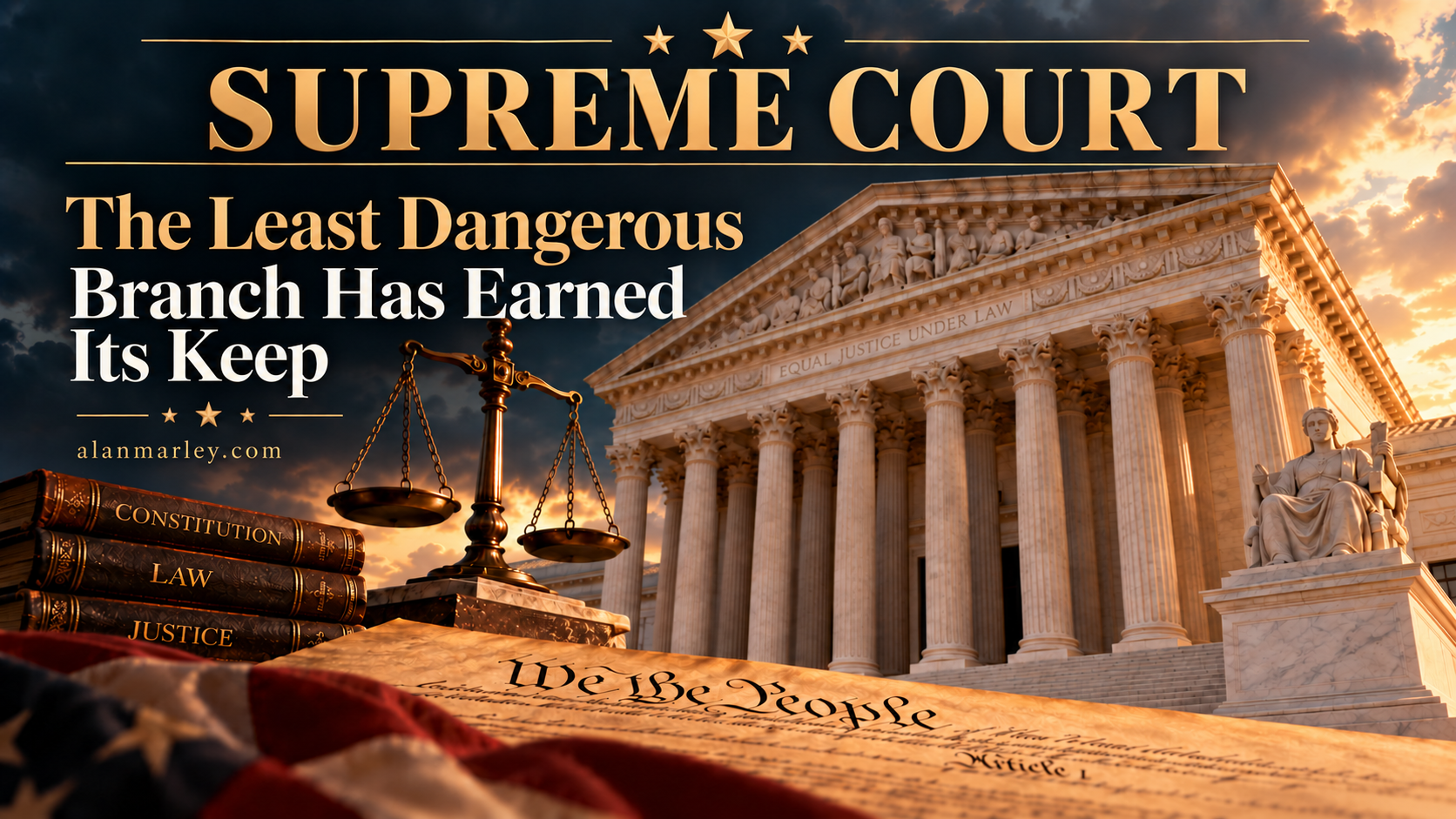
The justices agree unanimously in about 44 percent of cases and by lopsided margins in roughly 60 percent. The people who want to pack the Court or abolish it are borrowing a page from the French Revolution.
Every few years the same chorus rises. The Supreme Court is a partisan machine, a collection of politicians in robes, a body that votes by party and rules by ideology. Pack it, the loudest voices say. Cap it, shrink it, strip it of power, or abolish it and start over. It makes for a fine speech. It does not survive contact with the record.
Constitutional law professor Jonathan Turley, writing in the September 2026 issue of Imprimis, points out that 44 percent of the Court's cases are decided unanimously and calls it a fact too few people know. SCOTUSblog's term-by-term Stat Pack backs him up. Since 2005, the justices have averaged 44.5 percent unanimous decisions. The 2022 term hit 50 percent. The 2023 term came in at 44. The 2024 term, in which the Court ruled on nationwide injunctions, internet age verification and the Affordable Care Act, was 42 percent unanimous, and only 9 percent of its decisions were 6-3 splits along ideological lines. A partisan machine does not produce numbers like that. A court of nine people trying to read the same law honestly does.
The Numbers Say Something Else
Unanimity is only half the picture. Turley adds that when the nearly unanimous decisions, the 8-1 and 7-2 rulings, are counted with the unanimous ones, the share of cases decided by overwhelming majorities jumps to over 60 percent. An independent check lands in the same neighborhood. The Supreme Court Database has 8-1 and 7-2 decisions running at roughly 15 percent of the docket, and stacked on the 44.5 percent unanimous average that comes to about 60 percent. Different trackers code split votes differently, so the exact decimal will vary from one count to the next. The direction does not.
Chief Justice John Roberts, appointed by a Republican, and Justice Elena Kagan, appointed by a Democrat, voted the same way in 82 percent of cases in the 2024 term. Justice Ketanji Brown Jackson, the most frequent liberal dissenter, was still in the majority 72 percent of the time. The Court's own record shows a body that argues, persuades and frequently lands in the same place.
None of this means the Court never splits along ideological lines. It does, and I will get to that. It means the picture of nine partisans voting in lockstep is a caricature, and the people who draw it rely on the public never opening the box score.
It Started Out a Brawl
The independence we now take for granted was not handed down. It was fought for, in the most partisan terms imaginable.
In the last weeks of his presidency, John Adams signed the Judiciary Act of 1801. The lame-duck Federalist Congress created sixteen new judgeships and Adams filled them before he left office. Jeffersonian Republicans called them the midnight judges and accused the Federalists of packing the courts after losing the election. When the Republicans took over they repealed the act in 1802, and they changed the Court's calendar so that it did not sit for fourteen months, which delayed any constitutional challenge to the repeal. That is not a footnote about procedure. That is a political party rearranging the Supreme Court's schedule to protect its own victory.
In 1804 the House impeached Justice Samuel Chase, a Federalist who had behaved like a partisan on the bench, in a transparent attempt to clear Federalists off the Court. The Senate acquitted him in 1805. Six Republicans crossed over to join nine Federalists, and in doing so established a principle that has held for more than two centuries: a justice does not lose his seat because the party in power dislikes his rulings.
Congress also treated the size of the Court as a political toy. It changed the number of justices seven times in the first eighty years of the Constitution. In 1866 it cut the Court to seven specifically to keep President Andrew Johnson from filling seats. In 1869 it went back to nine. Nine has held for 157 years. The Court did not begin independent and apolitical. It became both because enough Americans, in enough generations, declined to use the tools that were lying within reach.
The Last Time a President Tried to Pack It
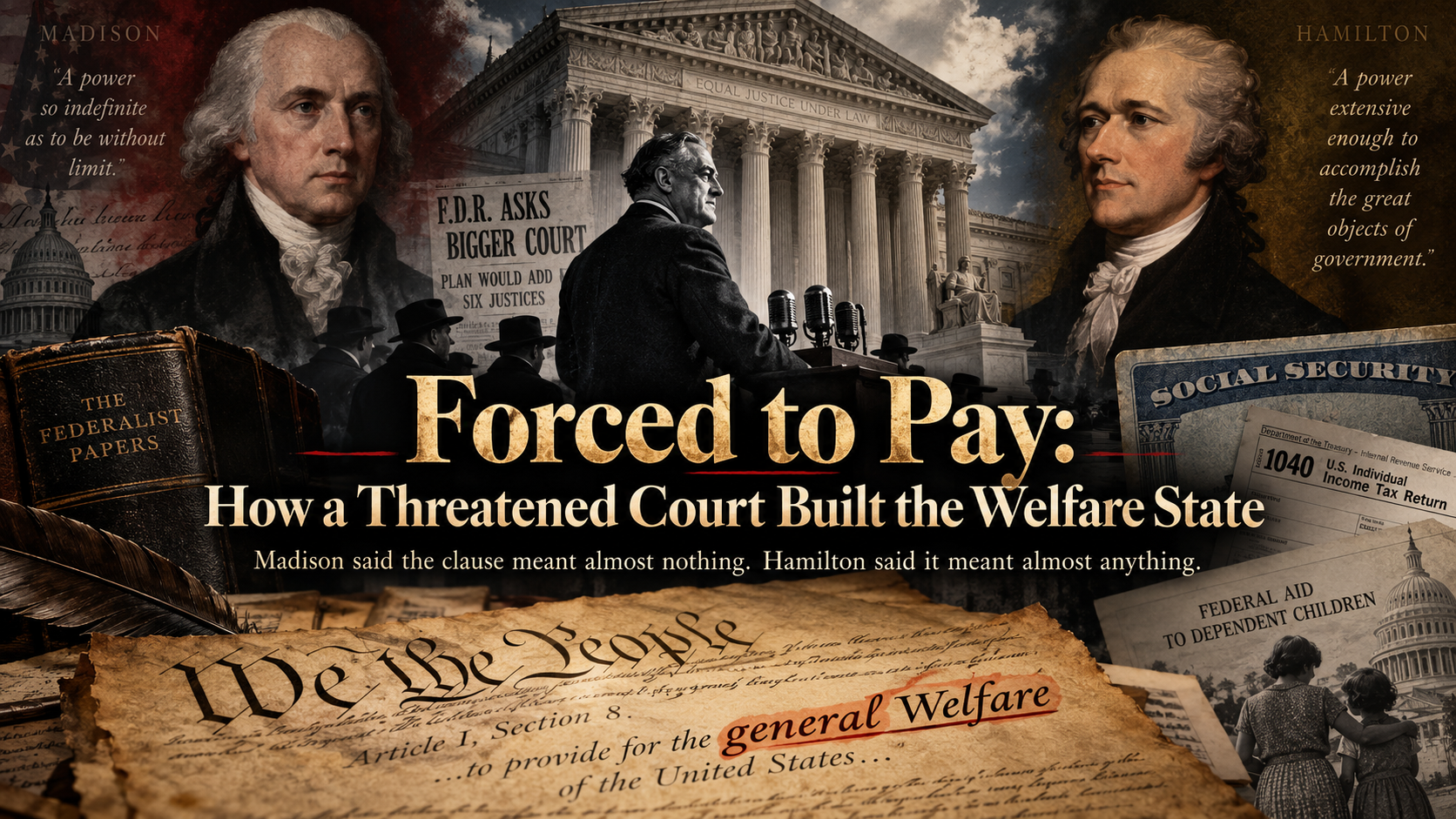
In February 1937, Franklin Roosevelt asked Congress for authority to add up to six justices, one for every sitting justice over seventy who did not retire. He had just won a landslide reelection. He had overwhelming Democratic majorities in both chambers of Congress. He lost anyway.
The Senate Judiciary Committee issued an adverse report in June 1937 that called the plan a needless, futile and utterly dangerous abandonment of constitutional principle, and said it should be so emphatically rejected that its parallel would never again be presented to the free representatives of the free people of America. Seven of the ten senators who signed that report were Democrats, members of the president's own party. On July 22 the Senate voted 70 to 20 to send the bill back to committee, and it died there.
I have written elsewhere that the threat alone bent the Court that spring, and I stand by that. It is exactly why the lesson of 1937 should never be forgotten. The plan failed because members of the president's own party chose the institution over the man. Nearly ninety years later, the sentence in that report has largely held. Nobody has packed the Court since, because the memory of what it would cost is still alive.
France Tried It
Abolishing or packing a court because it stands in the way of the majority is not a new idea. It is one of the oldest moves of revolutionary politics, and France ran the experiment to its end. Turley draws the same comparison in Imprimis, arguing that today's demands to eliminate or pack the Court come straight out of the French revolutionary playbook.
The old regime's high courts, the parlements, had spent years blocking royal decrees. In September 1790 the National Assembly abolished them. In March 1793 the National Convention created a Revolutionary Tribunal in Paris, a court whose purpose was to serve the Revolution rather than to judge it. In June 1794 the Law of 22 Prairial limited trials to three days, stripped the accused of defense counsel and witnesses, and left the judges two verdicts: acquittal or death. Over its 25 months, the Paris tribunal sent roughly 2,750 people to the guillotine, more than half of them in the 49 days after that law passed. Across the Terror as a whole, about 16,000 people were sentenced and executed. In May 1795 the tribunal's own chief prosecutor, Antoine Fouquier-Tinville, went to the guillotine himself, and a few weeks later the Convention abolished the tribunal.
No one proposing to add four justices to the Supreme Court wants a guillotine, and I am not suggesting otherwise. The comparison is to the logic, not the blade. The logic says the court is an obstacle to the will of the majority, so remake it. Once a court exists to deliver the result the party in power wants, it stops being a court and becomes an instrument. The next party to hold power inherits the instrument. France learned where that road ends. We have no obligation to walk it.
What the Critics Get Right
An honest defense has to deal with the most recent evidence, because it cuts the other way. The 2025-26 term was more divided than the one before it. SCOTUSblog's final Stat Pack found that 28.8 percent of decisions were 6-3 splits, up from 15.2 percent, and 22.7 percent were 6-3 along ideological lines, up from 9 percent. The three liberal justices dissented together in 24.2 percent of cases, up from 15. In the second-to-last week of the term, seven of nine decisions split along ideological lines. One case in five this term was a party-line split. Critics who say the Court is more polarized than it used to be have numbers to point to.
They also have a counterweight to deal with. Even in this most divided term, roughly three decisions in four were not ideological splits, and in several of the term's most visible disputes the three liberal justices were in the majority. One term of elevated division is a reason to watch the Court, argue with its reasoning and lobby for better appointments. It is not a reason to rebuild the institution whenever the scoreboard disappoints one side. The cure for a bad term is the next term, the next argument and the next case, not a bigger bench.
Why This Matters
Alexander Hamilton called the judiciary the least dangerous branch because it holds neither the sword nor the purse, only judgment. That is the whole bargain. The Court has no army and no budget of its own. Its authority rests on the willingness of the other branches and the public to accept what it says, even when they hate it. Spend that willingness on a rigged majority and it does not come back.
The numbers show a body that agrees more than its critics admit. The history shows an independence that was earned across generations by people who could have wrecked the Court and chose not to. France shows what comes after the first successful act of remaking a judiciary to fit a mood. We are lucky to have inherited a system that started as a brawl and matured into something steadier. The way to keep it is to treat it as the one institution in Washington that is not supposed to give the winners everything they want.
- Alpha History. Revolutionary Tribunals. alphahistory.com. [Paris tribunal executions, 49-day figure, provincial tribunals]
- Annenberg Classroom. Article III Timeline. annenbergclassroom.org. [Chase impeachment in 1804 and acquittal in 1805, six Republicans joining nine Federalists]
- Britannica. Law of 22 Prairial Year II. britannica.com. [Loss of defense rights, acquittal or death as the only verdicts]
- Center for History and New Media, George Mason University. Liberty, Equality, Fraternity: Exploring the French Revolution. revolution.chnm.org. [Law of 22 Prairial and the Great Terror]
- Congress.gov. Constitution Annotated, Article III: Supreme Court and Congress. constitution.congress.gov. [Court size changes, the 1866 reduction aimed at President Johnson, the fourteen-month gap in sessions]
- Federal Judicial Center. Landmark Legislation: Judiciary Act of 1801. fjc.gov. [The midnight judges, the partisan character of the act]
- Feldman, Adam. (2025, July 2). The 2024-2025 Supreme Court Term and the Roberts Court History. Legalytics. legalytics.substack.com. [Justice Jackson in the majority 72 percent of the time]
- Hamilton, Alexander. Federalist No. 78. [The judiciary as the least dangerous branch]
- Newsweek. (2025, July). Supreme Court's Ideologically Split Rulings Occur Less Often Than You Think. newsweek.com. [9.09 percent ideologically split rulings in OT2024, Roberts-Kagan agreement at 82 percent]
- Project On Government Oversight. Those 5-to-4 Decisions on the Supreme Court? 9 to 0 Is Far More Common. pogo.org. [Supreme Court Database figures: 7-2 and 8-1 judgments at roughly 15 percent of decisions]
- Senate Judiciary Committee. (1937, June 7). Adverse Report on the Judicial Reorganization Bill, S. Rep. No. 711. Pepperdine School of Public Policy, New Deal Legislation archive. publicpolicy.pepperdine.edu. [The "emphatically rejected" language]
- Supreme Court Historical Society. FDR and the Court-Packing Controversy. supremecourthistory.org. [Seven of ten signers were Democrats, July 22, 1937 defeat]
- Sutherland Institute. Congress' History of Messing With Supreme Court Size. sutherlandinstitute.org. [Seven changes in the first eighty years, nine justices since 1869]
- Truscott, Jake S., and Adam Feldman. (2025, June 27). Final Stat Pack for the 2024-25 Term. SCOTUSblog. scotusblog.com. [42 percent unanimous in OT2024, 44 percent in OT2023, 50 percent in OT2022]
- Truscott, Jake S., and Adam Feldman. (2026, July). The 2025-26 Term by the Numbers. SCOTUSblog. scotusblog.com. [28.8 percent 6-3 splits, 22.7 percent ideological splits, comparison to the prior term]
- Truscott, Jake S., and Adam Feldman. (2026, July 6). Final Stat Pack for the 2025-26 Term. SCOTUSblog. scotusblog.com. [Post-2005 unanimity average of 44.5 percent, 2025-26 ideological split figures, liberal bloc dissent rate]
- Turley, Jonathan. (2026, September). Why We Shouldn't Cancel the Supreme Court. Imprimis, vol. 55, no. 9. Hillsdale College. imprimis.hillsdale.edu. [44 percent of cases decided unanimously, over 60 percent counting 8-1 and 7-2 decisions, and the comparison of court-packing demands to the French Revolution; adapted from an August 6, 2026 speech at Hillsdale College's Kirby Center]