Suppose I write a book tomorrow claiming I walked across Cherry Creek Reservoir without sinking. The book says I did it. Page 47 gives a detailed description. Page 103 mentions it again. Another chapter says several people saw me do it. Four chapters tell four slightly different versions.
Have I proven that I walked on water? Of course not. I have created a document that claims I walked on water.
The document itself becomes something historians can examine. When was it written? Who wrote it? Where did the information come from? Are the accounts independent of each other? Did any contemporary witness mention the event? Does anything outside my book corroborate what I said? That is how historical investigation works. Christianity does not get an exemption.
When the Gospel of John says Jesus raised Lazarus from the dead, the Gospel is the source of the claim. It cannot also serve as independent confirmation that the claim happened. When Matthew says graves opened and dead people walked into Jerusalem after Jesus died, Matthew is making an extraordinary assertion. When the Gospels say Jesus fed thousands with a few loaves and fishes, walked on water, healed the blind, controlled storms and rose from the dead, those are claims that require evidence.
The fact that Christians eventually collected these documents into something called the Bible does not transform the assertions into proof.
A claim does not become evidence for itself merely because later generations declare the book containing it sacred.
The Zombies of Matthew 27
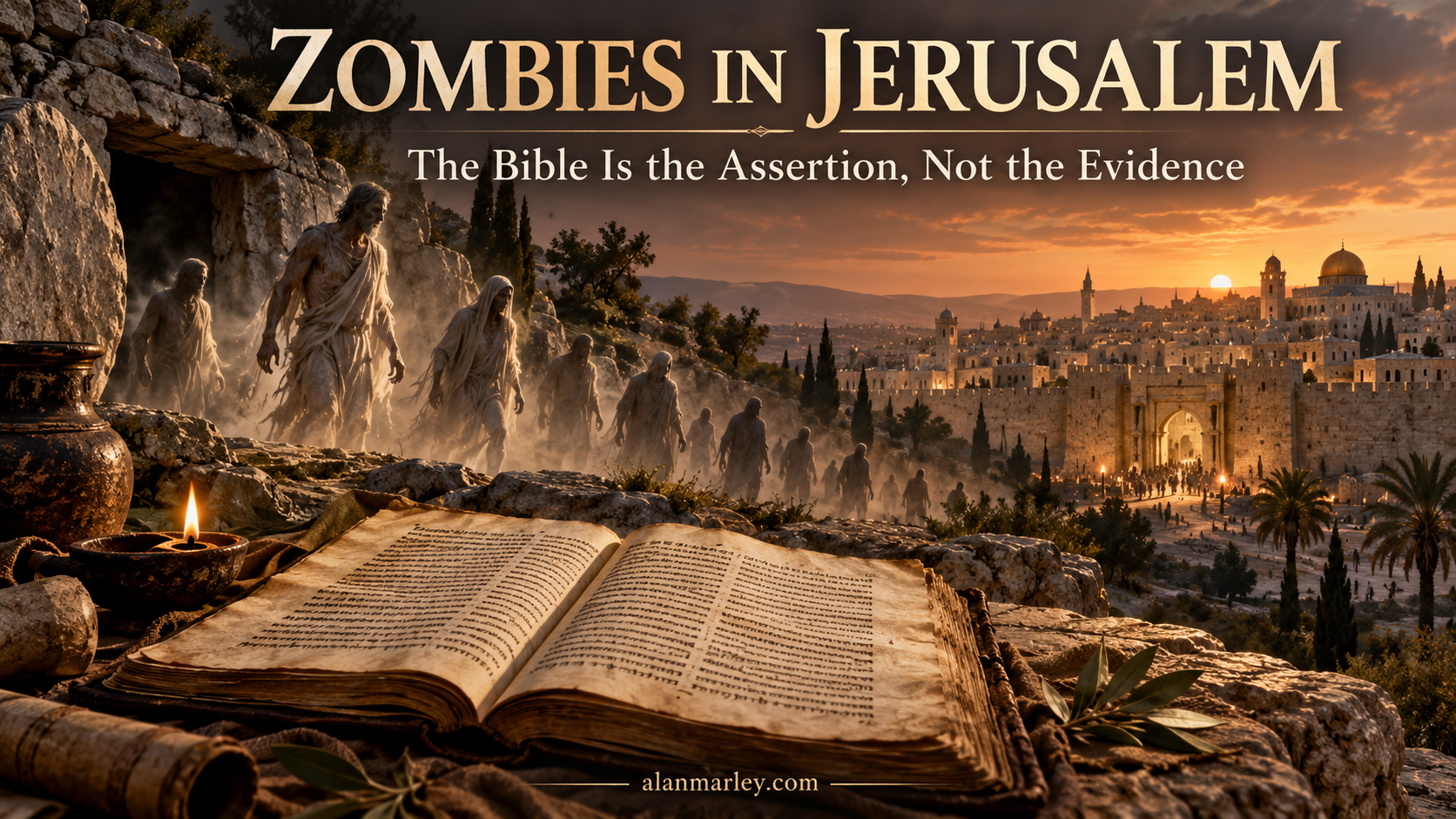
Of every claim in the Gospels, the one in Matthew 27:52-53 is the sharpest illustration of the problem, because it is the easiest to test against everything else historians know about the period. At the moment of Jesus's death, Matthew reports, tombs broke open, the bodies of many holy people who had died were raised, and after Jesus's resurrection they came out of the tombs, entered the holy city and appeared to many people.
Read that again. Multiple dead bodies reanimate, leave their tombs and walk into Jerusalem, one of the most documented cities in the ancient Mediterranean world, during a period covered by Roman administrators, Jewish historians and multiple Gospel writers working from overlapping source material.
And it appears exactly once, in exactly one Gospel, and nowhere else in ancient literature. Mark does not mention it. Luke does not mention it, despite explicitly claiming in his opening verses to have carefully investigated everything from the beginning. John does not mention it. Josephus, who wrote extensively about first-century Jerusalem and had every incentive to record anything that reflected on the religious upheaval of the period, does not mention it. No Roman administrator, no contemporary Jewish source, nobody writing anywhere near Jerusalem in the following decades thought an army of walking corpses was worth a sentence.
An event like that, if it happened, is not the kind of thing that stays contained to a single paragraph in a single document. It is the kind of thing that gets discussed, disputed, mocked, investigated or at minimum mentioned by someone who was not already a committed believer in the text making the claim. Its complete absence everywhere else is not a minor gap. It is exactly what you would expect to find if the claim were literary rather than historical, and it is worth holding onto this example for later, because it is the cleanest test case for the rule Hume laid out for exactly this kind of claim.
What Historians Outside the Bible Actually Wrote
This is not to say nothing outside the Bible mentions Jesus or early Christians. Several Roman sources do, and it is worth being precise about what they actually corroborate, because it is considerably less than most people assume.
Tacitus, writing around 116 CE in the Annals , states that Christus was executed by Pontius Pilate during the reign of Tiberius. That corroborates a historical execution under a named Roman prefect. It says nothing about a resurrection, because Tacitus is reporting what Christians of his own day believed, not investigating a miracle claim himself.
Pliny the Younger, in a letter to Emperor Trajan around 112 CE, describes how Christians worshipped, meeting before dawn to sing hymns to Christ as to a god. That corroborates the existence of an organized Christian movement two generations after Jesus's death. It says nothing about whether the object of that worship actually rose from the dead.
Suetonius mentions disturbances among Roman Jews instigated by someone called Chrestus, a passage many scholars connect to early Christian agitation in Rome. That, at best, corroborates the movement's early spread and the controversy it caused. It corroborates no miracle.
Every one of these sources, read honestly, corroborates that a man named Jesus existed, was executed under Pilate and inspired a religious movement that Roman authorities found worth commenting on. None of them corroborates a single water-walking, storm-calming, dead-raising or resurrecting event. That is precisely the distinction the Cherry Creek analogy is built to expose. A movement having believers, even devoted ones willing to worship at personal risk, tells you the belief was sincere. It does not tell you the belief was true.
The Double Standard: Vespasian's Miracles
Here is where the inconsistency becomes impossible to ignore. Roman history preserves a healing story that is, by ordinary historical standards, better attested than anything in the Gospels.
Tacitus, in the Histories , describes the emperor Vespasian in Alexandria in 69 CE being approached by a blind man and a man with a crippled hand, both of whom claimed the god Serapis had told them Vespasian's touch would heal them. Vespasian, skeptical, consulted physicians who told him the conditions were curable by natural intervention. He touched them. Both were reportedly healed, in front of a crowd, and Tacitus reports that witnesses who had no reason to lie still maintained the story long after the emperor no longer needed the flattery.
Tacitus was not a Christian apologist writing decades after the fact from a devotional tradition. He was a skeptical Roman senator writing history, describing a contemporary event with named witnesses and a named location, and explicitly noting his own skepticism before reporting what he was told.
By the exact evidentiary standard many Christians apply to Roman miracle claims, Vespasian's healing has a real historian, a real name, a real place and real skepticism built into the account. Ask a Christian apologist whether Vespasian healed a blind man in Alexandria, and watch how quickly the standards of evidence get strict again.
That is not a trick question. It is the whole argument in miniature. Nobody applies uniform skepticism to miracle claims. They apply skepticism to everyone else's miracle claims and an exemption to their own.
The Burden of Proof Is Not on the Skeptic
This is another place where these conversations go off the rails. The Christian makes the extraordinary claim: Jesus was dead for several days and physically returned to life. Then the skeptic gets asked, "Can you prove he didn't?"
No. And I do not have to. That is not how the burden of proof works.
The standard, stated plainly. If I claim there is an invisible dragon living in my attic, you are not obligated to search every square inch of my house and prove there isn't one. I made the assertion. The burden belongs to me.
If someone claims Jesus was resurrected, that person bears the burden of demonstrating a resurrection occurred. If someone claims God inspired a particular collection of ancient books, that person must establish divine authorship. The skeptic does not have to disprove Christianity any more than the Christian has to disprove Zeus, Odin, Vishnu or Osiris. The person making the claim carries the burden.
That principle does not disappear when the subject becomes Christianity.
Four Centuries of the Same Rule
This is not a new idea invented to needle religious believers. It has a direct philosophical lineage running back centuries, and every version of it says essentially the same thing in different words.
Occam's razor, attributed to the 14th-century friar William of Ockham, holds that among competing explanations for the same evidence, the one requiring the fewest new assumptions should be preferred. Applied here, a claim that a dead man rose, a document that says so, and no other trace anywhere in the historical record admits of two explanations. Either the laws governing decomposition and brain death were suspended in one specific case for one specific person, or a claim grew, as claims demonstrably do, through retelling, theological elaboration and decades of oral transmission before being written down. The second explanation requires nothing the world does not already demonstrably produce. The first requires physics to have made an exception. Occam's razor says take the explanation that doesn't require inventing a new category of event to account for the evidence.
David Hume turned this into an explicit rule for testimony about miracles in his 1748 essay "Of Miracles." His formulation is still the standard reference point in this argument nearly three centuries later: no testimony is sufficient to establish a miracle unless the falsehood of that testimony would be more miraculous than the miracle it is trying to establish. In practice, that means weighing two probabilities against each other every time. How unlikely is it that the natural order was actually violated, against how unlikely is it that a story was mistaken, exaggerated, invented or transformed somewhere in decades of retelling before it reached the page. Human testimony being wrong, embellished or legendary is not a rare event. It is the ordinary condition of ancient reporting. A suspension of the laws of nature is not ordinary at all. Hume's rule holds that the first explanation will essentially always outweigh the second, not because miracles are impossible by definition, but because the alternative explanation is, on the evidence available, almost always more probable.
Bertrand Russell made essentially the same point in 1952, imagining a teapot orbiting the sun somewhere between Earth and Mars, too small for any telescope to detect. If Russell insisted this teapot existed and that nobody could prove otherwise, he argued, that would not entitle the claim to serious belief just because it could not be disproven. The burden was always on the person asserting the teapot's existence, not on everyone else to search the solar system.
Christopher Hitchens later distilled the same principle into a single line, now commonly called Hitchens's razor: what can be asserted without evidence can be dismissed without evidence. It is not an insult. It is a housekeeping rule. Without it, every unfalsifiable claim, dragons, teapots, resurrections, would be entitled to equal standing simply by virtue of being unfalsifiable, and nobody actually lives that way. Nobody extends that courtesy to claims about Zeus, Osiris or the Flying Spaghetti Monster. The courtesy gets extended selectively, almost always to whichever tradition the person extending it already believes.
Occam wrote in the 1300s. Hume wrote in the 1740s. Russell wrote in the 1950s. Hitchens wrote in the 2000s. Four different centuries, four different vocabularies, the same underlying rule: the more extraordinary the claim, the more it costs to accept, and testimony alone has rarely covered that bill.
Run Matthew's walking corpses back through Hume's own test. Which is more miraculous: that decomposing bodies reanimated and strolled into a garrisoned Roman city without a single outside source noticing, or that a resurrection narrative acquired an extra flourish somewhere in the decades between the event and the page? Hume's rule does not require certainty that the second explanation is what happened. It only requires noticing that the second explanation is always, on any fair reading of how ancient texts actually behave, the less extraordinary of the two.
Multiple Witnesses Is Not Independent Corroboration
The most common reply at this point is that the Gospels report many witnesses, five hundred people at once according to Paul's letter to the Corinthians, women at the tomb, disciples on the road to Emmaus. Surely that many claimed witnesses count for something.
It counts for something about how the story was told. It does not solve the underlying problem, because the reports of those witnesses come to us exclusively through the same religious tradition making the claim. There is no independent transcript of the five hundred, no external record of anyone interviewing them, no account from a skeptical outsider who went and checked. The witnesses exist inside the document, asserted by the document, the same way my hypothetical book about Cherry Creek Reservoir could claim four different chapters of eyewitnesses without any of them being independently verifiable.
It is worth noticing that Christians generally do not accept this same structure when it appears in other traditions. Joseph Smith's claim to have translated the Book of Mormon from golden plates was attested by eleven named witnesses who signed statements describing what they saw, several of whom never recanted even after later disputes with Smith. Most Christians, quite reasonably, do not find eleven named, signed witness statements sufficient to establish that Smith translated golden plates delivered by an angel. The reasoning they apply there, sincere belief is not the same as verified fact, and claimed witnesses inside a text are not independent of that text, is exactly the reasoning this piece is applying to the Gospels. The method does not change. Only the willingness to apply it consistently does.
Why This Isn't Just Philosophy
All of the above could stay a purely academic exercise if the stakes ended at a seminar table. They don't. There is an active, organized, well-funded political movement in the United States working to govern as though the Bible's supernatural claims were established fact rather than sincerely held assertion, and it has moved well past rhetoric into actual legislation.
Louisiana's HB 71, signed into law in 2024, requires the Ten Commandments to be displayed in every public school classroom in the state, funded in part by private donations solicited explicitly for that purpose. Texas, Oklahoma and several other states have advanced or passed similar mandates, along with bills requiring "In God We Trust" displays, chaplains in public schools and Bible-based curriculum content.
PRRI's research on Christian nationalism, based on national surveys conducted with the Brookings Institution, found that roughly three in ten Americans qualify as Christian nationalism adherents or sympathizers, defined by agreement with statements such as the U.S. government should declare America a Christian nation and American laws should be based on Christian values. That is not a fringe position confined to message boards. It is a sizable, organized constituency actively shaping state legislative agendas.
This is precisely where the argument of this piece stops being abstract. If the resurrection, the Matthew 27 mass reanimation, biblical cosmology or any other supernatural claim in scripture is an assertion rather than demonstrated fact, and the argument above holds that it is, then no government has any legitimate basis for treating that assertion as a foundation for law. Doing so does not merely favor religion over non-religion. It favors one sect's reading of a contested, internally inconsistent, historically unverified text over every other citizen's right to be governed by laws that do not presuppose a specific theology as true.
A Constitutional Republic, Not a Christian Nation
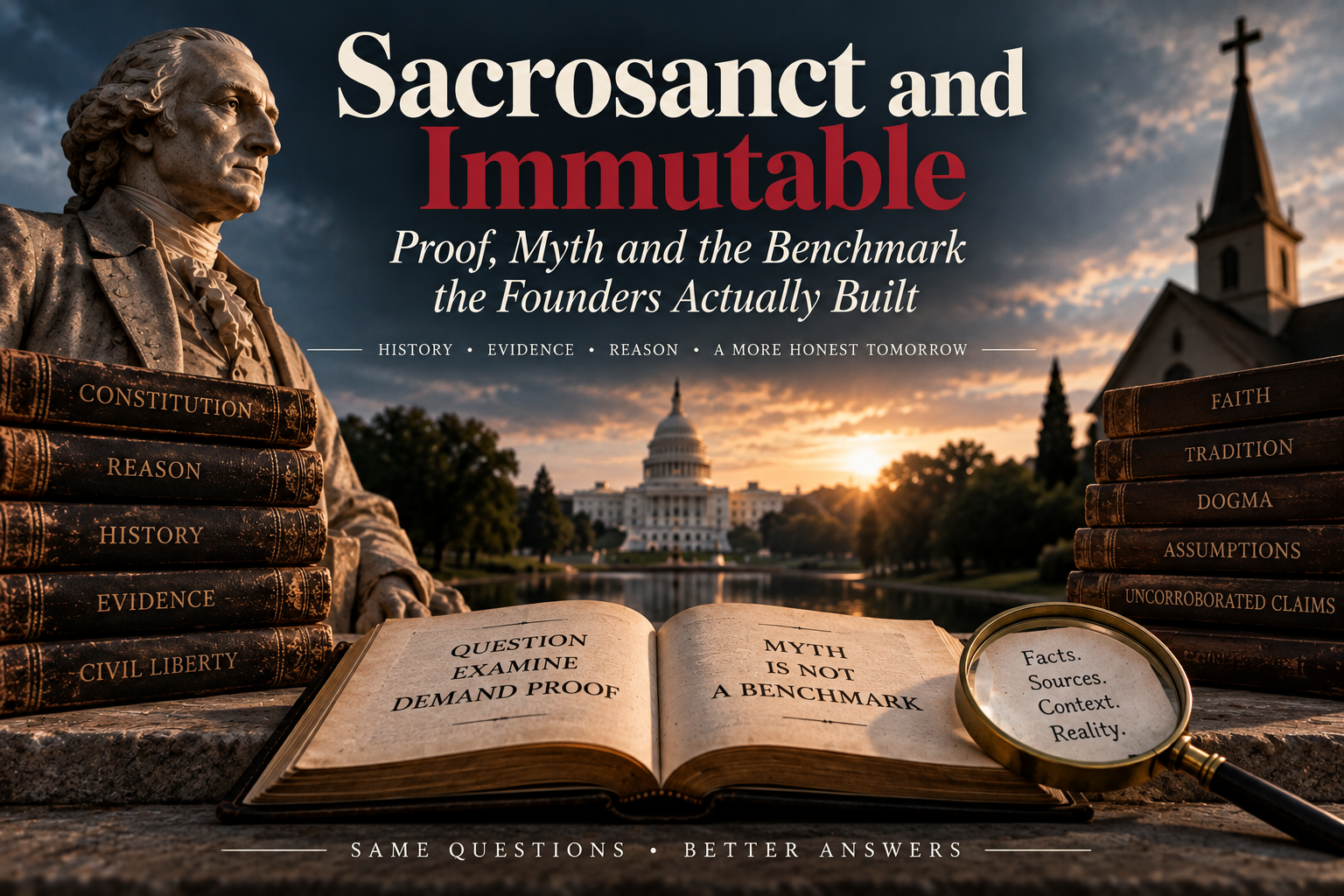
The counter to Christian nationalism is not anti-Christian. It is constitutional, and the Constitution itself is remarkably explicit about it. Article VI states plainly that no religious test shall ever be required as a qualification to any office or public trust under the United States. The First Amendment prohibits Congress from making any law respecting an establishment of religion. Neither God nor Christianity nor scripture appears anywhere in the document's operative text.
That was not an oversight. In 1797, the Senate unanimously ratified the Treaty of Tripoli, which states outright that the government of the United States is not, in any sense, founded on the Christian religion. James Madison's Memorial and Remonstrance Against Religious Assessments, written a decade earlier, argued that tying civil government to any established religion corrupts both. Thomas Jefferson's 1802 letter to the Danbury Baptist Association described the First Amendment as building a wall of separation between church and state, a phrase he used specifically to reassure a religious minority that the government could not impose a majority faith on them.
None of that denies the obvious. The founding generation was overwhelmingly Christian, and American culture, its holidays, its moral vocabulary, its civic rituals, carries that inheritance everywhere. A nation formed in a Christian culture is a straightforward historical fact. A nation constitutionally founded on Christianity is not, and the founders said so themselves, in writing, on purpose.
That distinction, culturally Christian versus constitutionally Christian, is the entire ballgame. Christian nationalists routinely erase it, treating cultural inheritance as though it were legal foundation, and using that conflation to argue that biblical law deserves a privileged place in secular governance. It does not. A document whose central claims cannot survive the same evidentiary standard applied to any other ancient text is not a sound basis for compulsory civic law, no matter how many state legislatures vote to hang it on a classroom wall.
None of this is an attack on Christians, or on anyone's right to worship however they choose. Pray. Attend church. Raise children in the faith. Evangelize on a street corner if that is your calling. Nothing in this argument asks any of that to stop, and nothing in the Constitution permits the government to interfere with it. The target here is not devotion. It is the attempt by a zealous subset of believers to convert personal faith into governing authority over people who do not share it, to write one sect's theology into school curricula, courtroom procedure and statute law as though it carried the force of demonstrated fact rather than sincerely held belief.
Calling that out is not persecution. It is exactly the deal the founders struck: keep religion in its lane, free to flourish in the lives of individuals and congregations, and out of the machinery that governs everyone regardless of what they believe. Separation of church and state was never designed to protect the state from religion. It was designed to protect religion, all of it, equally, from being conscripted or suppressed by whichever faction happens to hold power.
Why This Matters
None of this requires anyone to stop believing whatever they believe. Faith, by definition, does not need historical proof to function for the person holding it, and I am not interested in taking that away from anyone who finds genuine meaning in it.
What it cannot do is claim historical or evidentiary standing it has not earned, and then use that borrowed authority to shape public policy, science education or civic life as though the underlying claims were established fact rather than sincerely held assertion. The distinction between a document that claims something happened and evidence that it happened is not a technicality. It is the entire foundation of how any of us are supposed to know anything, and it applies the same way whether the book in question is about Cherry Creek Reservoir, an angel with golden plates, an emperor's touch in Alexandria or an empty tomb in Jerusalem.
The assertion is not the evidence. It never was, and calling it sacred does not change that.
References
- Matthew 27:52-53 (the raising of the saints at Jerusalem).
- Tacitus. Annals, Book 15, Chapter 44 (execution of Christus under Pontius Pilate).
- Tacitus. Histories, Book 4, Chapters 81-82 (Vespasian's healings in Alexandria).
- Pliny the Younger. Epistulae, Book 10, Letter 96 (correspondence with Trajan on Christian worship practices).
- Suetonius. The Twelve Caesars, Life of Claudius, 25 (disturbances instigated by "Chrestus").
- 1 Corinthians 15:6 (the claim of five hundred witnesses).
- Luke 1:1-4 (Luke's claim to have carefully investigated events from the beginning).
- William of Ockham (attributed). Occam's Razor (lex parsimoniae), 14th century. [Principle of preferring the explanation requiring fewest new assumptions.]
- Hume, D. (1748). An Enquiry Concerning Human Understanding, Section X, "Of Miracles."
- Russell, B. (1952). Is There a God? Commissioned by Illustrated Magazine, published posthumously. [Origin of the "celestial teapot" argument.]
- Hitchens, C. Various interviews and writings, 2000s. [Popularization of "what can be asserted without evidence can be dismissed without evidence."]
- Wikipedia and associated primary-source summaries. Three Witnesses; Eight Witnesses (Book of Mormon). en.wikipedia.org.
- Louisiana House Bill 71 (2024). Ten Commandments display mandate for public school classrooms.
- PRRI, with the Brookings Institution. (2023). A Christian Nation? Understanding the Threat of Christian Nationalism to American Democracy and Culture. prri.org.
- U.S. Constitution, Article VI, Clause 3 (no religious test for public office).
- U.S. Constitution, Amendment I (establishment and free exercise clauses).
- Treaty of Tripoli (1797), Article 11, as ratified unanimously by the U.S. Senate.
- Madison, J. (1785). Memorial and Remonstrance Against Religious Assessments.
- Jefferson, T. (1802, January 1). Letter to the Danbury Baptist Association. [Origin of "a wall of separation between church and state."]
Disclaimer: The views expressed in this post are opinions of the author for educational and commentary purposes only. They are not statements of fact about any individual, denomination or organization, and should not be construed as legal, medical or financial advice. Religious commentary is protected opinion under the First Amendment. It does not represent the positions of any institution, employer, organization or affiliated entity with which the author may be associated in any capacity.