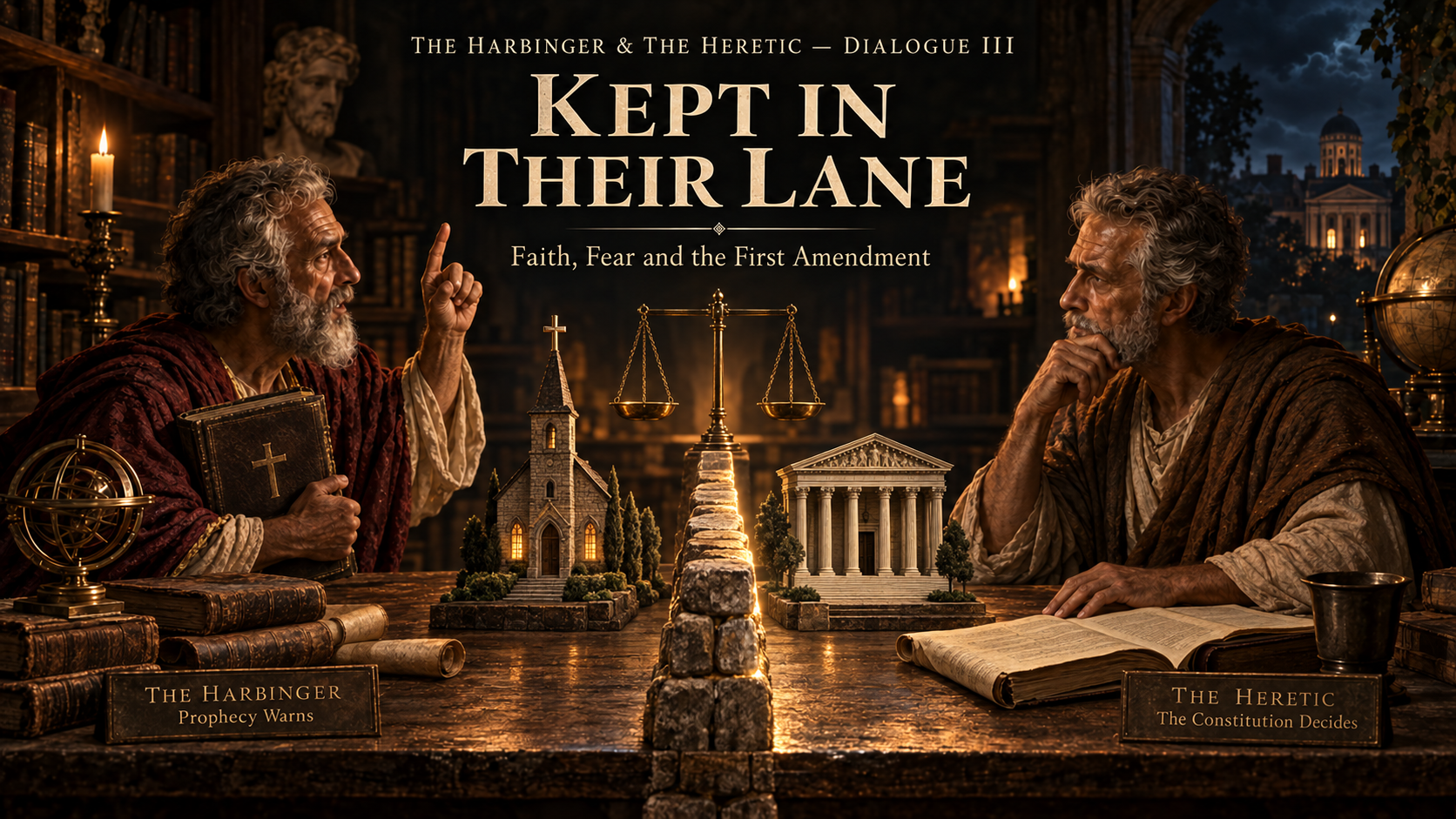
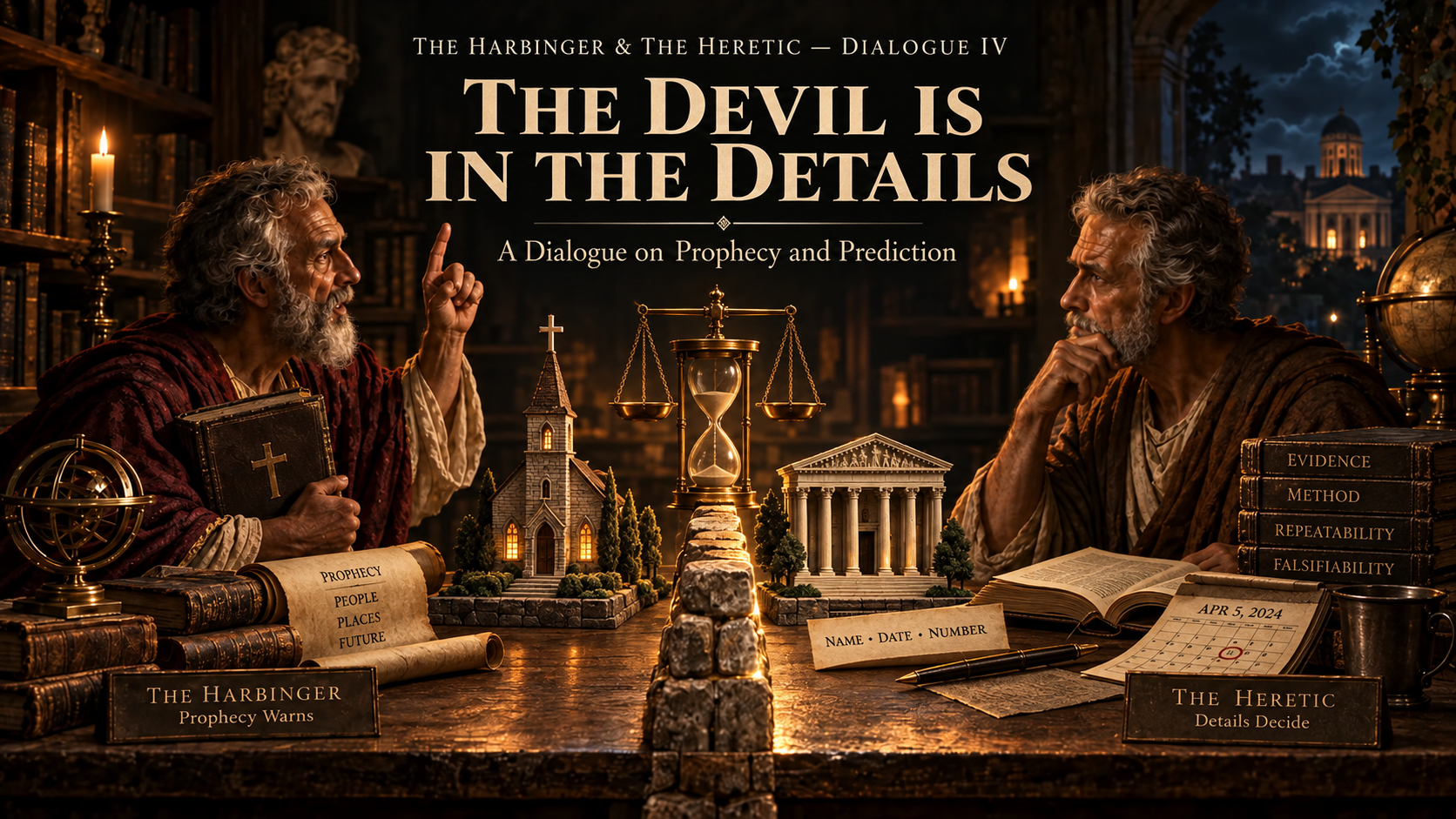
This argument has been running for three decades, through four presidents and one long email chain that never ends. It resurfaces every time the news gets loud, and it always lands in the same place. One friend says he saw it coming. The other asks him to name the thing, the date and the reason. What follows is the conversation almost word for word, cleaned up only where the caps lock needed to come off.
The Harbinger
Thirty years ago I told you we were headed in the wrong direction, that dark times were coming. I didn't know the exact shape of it, but I knew we were headed down. You fought me on it every time. Now look where we are. Woke, DEI, the socialists in office, the world coming apart at the seams. I was right about the direction then, and I'm right about it now, and it's only getting started.
The Heretic
You told me things were going to get dark. That's not a prediction, that's a mood. A prediction has a name attached to it, a date attached to it, a mechanism attached to it, something that can actually be checked against what happened. "Bad things are coming" has been true in every decade since the printing press, because bad things are always coming for somebody. That's not insight. That's the weather report for being alive.
The Harbinger
Of course I didn't know the details. Nobody can know the details. But if I had described exactly what's happening right now thirty years ago, in specific terms, you wouldn't have believed a word of it.
The Heretic
That's the whole problem in one sentence. You're asking me to give you credit for a level of detail you admit you never had, based on your confidence that I would have rejected detail you also never gave me. That's not a claim I can test. That's a claim built specifically so it can never be tested. Meanwhile I remember the actual specifics you did commit to over the years, because you committed to plenty. China was going to dethrone the dollar. The BRICS bloc was going to collapse our currency. China's navy had grown so far past ours that we would not be able to stop them. Every one of those had a name, a mechanism and a timeline, and every one of those failed to happen on schedule. Those are the predictions you actually made. "It's getting dark" is not one of them, it's just the one you remember making because it never had to be wrong.
The Harbinger
You're missing the point entirely. All one has to do is watch the news to feel that the world is coming apart. It doesn't take a Christian to see it.
The Heretic
The world came apart in the 1930s. Two world wars, a depression, genocide on an industrial scale. We have gone eighty years since the last one without another world war, longer than almost any stretch in modern history. If your test for civilizational collapse is a rough news cycle and some cultural fights you don't like, every generation that ever lived qualifies. My grandparents' generation watched actual cities burn. What you're describing is discomfort with change, and discomfort with change is not the same thing as the end of the world, no matter how many decades a preacher has told you it was.
Preachers Have Been Selling This Same Sermon for Two Hundred Years
The Harbinger's argument is not new, and it did not start with him. In 1844, tens of thousands of Americans sold their farms and gave away their possessions because a preacher named William Miller had convinced them Christ would return that October. When the date passed with nothing happening, history remembers it as the Great Disappointment, and the movement it spawned had to reinvent itself to survive the embarrassment. In the 1970s, Hal Lindsey's book The Late Great Planet Earth sold tens of millions of copies predicting an imminent apocalypse tied to the Cold War and the founding of modern Israel, confidently timed to arrive within a generation. That generation came and went. In 2011, radio host Harold Camping told his followers Judgment Day would arrive on May 21, then revised the date when it didn't, then quietly stopped talking about it. Every one of these men had the same tone the Harbinger has. Total certainty, cosmic stakes, a world visibly falling apart in front of them. None of them had a prediction that survived contact with the calendar.
The Millerite movement of the 1840s, Hal Lindsey's bestselling apocalyptic predictions of the 1970s, and Harold Camping's 2011 Judgment Day forecast are all documented, dated, named failures of specific religious prediction. Each one felt certain to the people inside it at the time. That certainty is not evidence the next one is different.
The Harbinger
You still haven't told me why the last thirty years don't count as proof I was right.
The Heretic
Because I can say I knew the Chiefs would beat the Broncos because I had a feeling, and if I'm right it still means nothing, and if I'm wrong nobody remembers I said it. That's not prediction, that's a coin flip with a testimony attached after the fact. If your instincts actually had predictive power, you could point to one specific, dated, falsifiable claim you made that came true on schedule for the reason you gave. Not a feeling. A claim. Thirty years is a long time to have made at least one.
Where the Harbinger Has a Point
Strip away the prophecy and there's a real argument buried in his rant, and it deserves to be named instead of dismissed. Institutional trust has collapsed across the board in the last three decades, not just in religion but in media, government, academia and both political parties. Cultural change has genuinely accelerated faster than a lot of people, religious or not, have had time to process. Feeling disoriented by that pace is not delusional, it's a documented and measurable phenomenon, and dismissing it as pure paranoia gives it less credit than it deserves. Where the argument fails is the jump from "the pace of change feels destabilizing" to "I predicted this exact outcome thirty years ago and only I saw it coming," because that second claim requires a specificity his actual thirty-year record never had.
A Prediction Needs a Name, a Date and a Number
This is the same failure this series covered with Matthew 24, just wearing a secular costume. A real prediction commits in advance to a specific, checkable outcome and accepts the risk of being provably wrong. "Things are getting worse" cannot lose, because worse is always available somewhere if you look hard enough for it. That is not a strength of the claim. It's the tell that it was never really a claim, just a feeling wearing the costume of one.
Why This Matters
Every generation produces someone convinced they are the one watching civilization end in real time, and every generation of preachers, pundits and prophets has been happy to sell them the certainty that comes with that belief. The way to tell the difference between insight and anxiety dressed up as insight is simple and has not changed in two hundred years. Ask for the name, the date and the number. If what comes back is a mood instead of a claim, you are not talking to a forecaster. You are talking to someone who needs the world to be ending, because the alternative is admitting it's just Tuesday, and it has been just Tuesday for as long as people have been predicting otherwise.
- Festinger, L., Riecken, H. W., & Schachter, S. (1956). *When Prophecy Fails.* University of Minnesota Press. [Classic study of the Millerite movement and the psychological aftermath of a failed, dated apocalyptic prediction, known as the Great Disappointment of 1844.]
- Lindsey, H. (1970). *The Late Great Planet Earth.* Zondervan. [Bestselling apocalyptic prediction tying Cold War geopolitics to an imminent, generation-bound end times timeline that did not materialize.]
- Associated Press. (2011, May 23). *Harold Camping's Judgment Day prediction fails to come true.* [Coverage of the dated, named and falsified May 21, 2011 Judgment Day prediction.]
- Popper, K. (1959). *The Logic of Scientific Discovery.* Basic Books. [Falsifiability as the line between a testable claim and one built to survive any outcome.]