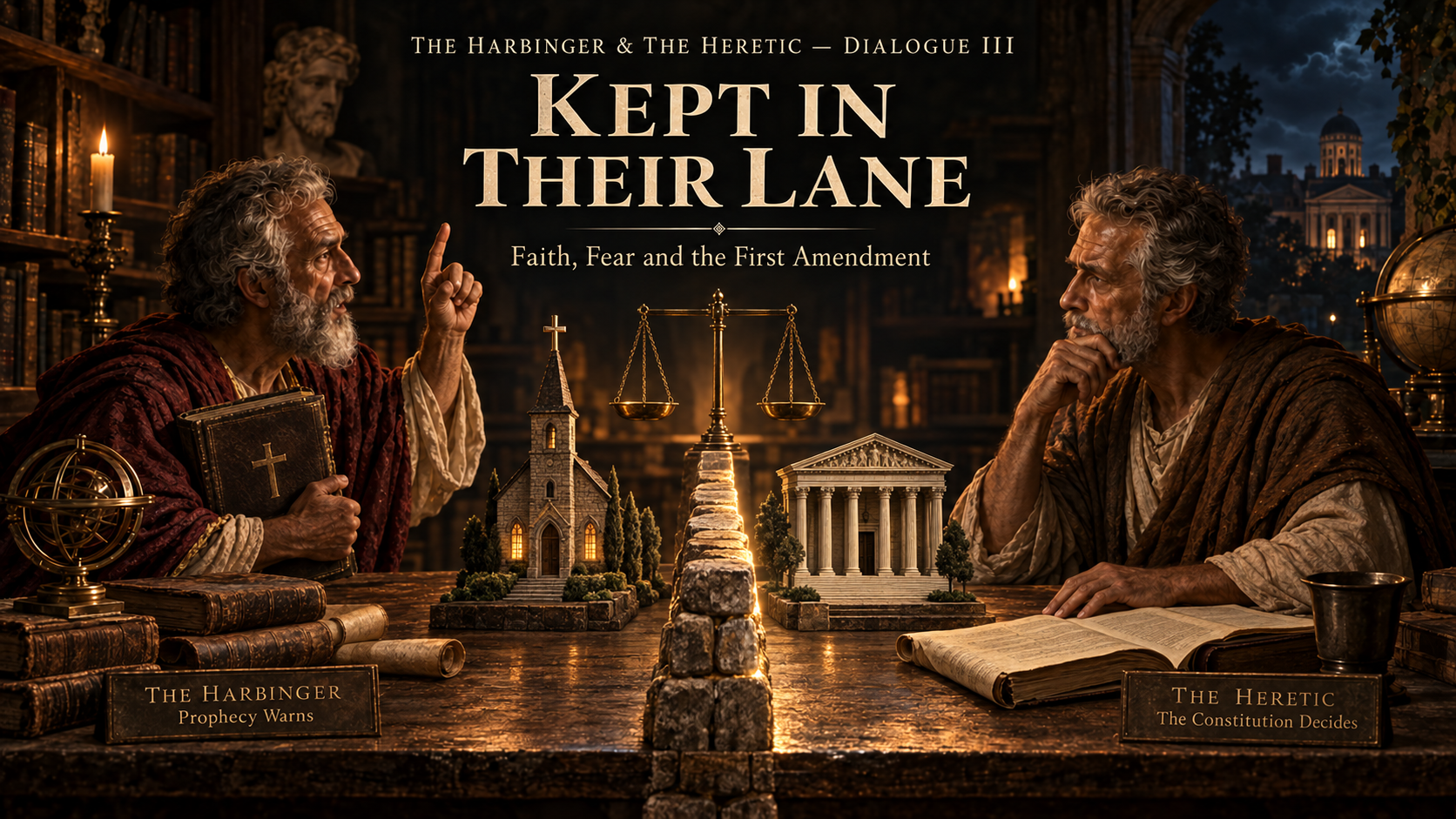
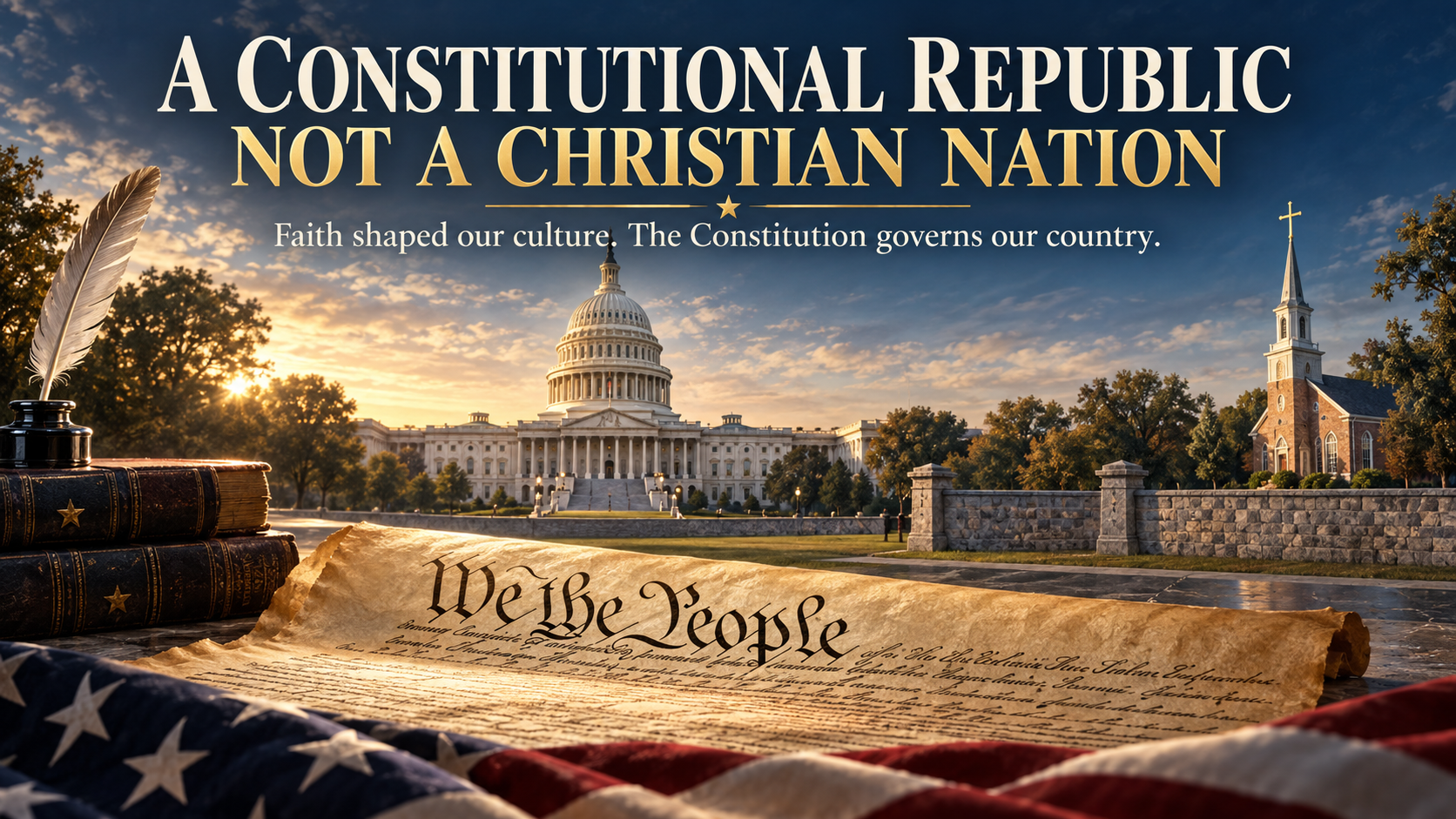
America is a constitutional republic. Its culture was shaped heavily by Christianity, because the overwhelming majority of the people who settled, populated and governed it for the first two centuries of its existence were Christian. Both of those sentences are true, and neither one requires the other to be false. What is not true is the claim, now repeated with growing confidence by Christian nationalists and fundamentalist activists, that the country was founded as a Christian nation in any legal or constitutional sense, and that its laws therefore carry a standing obligation to reflect Christian doctrine.
That claim is not a modest historical observation. It is a political program. Once you accept that the nation was founded as Christian, the next move is always the same. Someone gets to decide what counts as authentically Christian, and everyone else gets governed accordingly. That is the hijack, and it deserves to be named as one.
What "Christian Nation" Actually Means When It Gets Said Out Loud
Nobody organizing around this phrase means it as a compliment to the country's religious demographics. Say it plainly. When a Christian nationalist activist argues America is a Christian nation, the claim being made is that the Constitution itself encodes Christian authority, that secular law should defer to a particular reading of scripture, and that policy on marriage, sexuality, reproduction and public education should answer to that reading rather than to pluralistic democratic deliberation.
That is a categorically different claim from "most early Americans were Christian" or "Christian ethics influenced the moral vocabulary of the founding generation." Both of those statements are true and nobody serious disputes them. The claim under examination here is narrower and far more consequential. It says the republic's legal architecture was built to answer to one religion's authority, and that anyone governing it today inherits an obligation to restore that arrangement.
The founders left an unusually clear paper trail on exactly this question, and it does not support the claim.
The Constitution Itself Says So
Article VI of the Constitution states plainly that "no religious Test shall ever be required as a Qualification to any Office or public Trust under the United States." In an era when several state constitutions still barred non-Protestants, non-Christians or nonbelievers from holding office, the framers wrote a federal charter that explicitly forbade a religious gate on federal power. That is not an accident of drafting. It was debated and adopted deliberately at the Constitutional Convention.
The First Amendment then bars Congress from making any law "respecting an establishment of religion, or prohibiting the free exercise thereof." Two clauses, doing two different jobs. The government cannot install a state religion, and the government cannot stop you from practicing yours. A document that intended to found a Christian nation in any binding legal sense would not open its treatment of religion by forbidding the government from establishing one.
The Founders Said So Too
James Madison, the Constitution's principal architect, wrote his Memorial and Remonstrance Against Religious Assessments in 1785, arguing against a Virginia bill that would have taxed citizens to support Christian teachers. Madison's case was not narrowly practical. He argued that civil government has no authority to judge religious truth at all, and that mixing the two corrupts both. The bill died, and Virginia adopted Jefferson's Statute for Religious Freedom instead, a document Jefferson considered important enough to list on his own gravestone alongside the Declaration of Independence and the University of Virginia.
Thomas Jefferson, writing to the Danbury Baptist Association in 1802, described the First Amendment as building "a wall of separation between church and state." He was reassuring a religious minority that the federal government had no authority to interfere with their worship, precisely because it had no religious authority to exercise in the first place.
Then there is the treaty. In 1797, the Senate ratified the Treaty of Tripoli by a unanimous vote of 23 to 0, with no recorded debate, and John Adams signed it the same day. Article 11 states outright that "the government of the United States of America is not in any sense founded on the Christian Religion." A devoutly religious president and a Senate not exactly known for consensus let that sentence become the law of the land without a single recorded objection.
Defenders of the "Christian nation" framing correctly point out that Article 11's sentence sat inside a longer, eighty-one word passage aimed specifically at reassuring a Muslim state that religious differences would not become a pretext for war, and that the 1805 renegotiated treaty dropped the clause entirely once it was no longer legally in force. That context is real and deserves acknowledgment rather than erasure.
What it does not do is explain away the unanimous, undebated ratification of language that flatly contradicts a constitutional Christian founding. A diplomatic purpose for including the sentence does not require the sentence to be false, and nobody in the Adams administration or the Senate treated it as such.
The Best Version of the Christian Nation Argument
Fairness requires taking the opposing case at its strongest, not its weakest.
It is true that most founders were personally religious, that many state constitutions retained religious tests and established churches well after 1789, and that Massachusetts did not fully disestablish its state church until 1833. It is true that the Declaration of Independence invokes "Nature's God" and a "Creator" as the source of unalienable rights, language the founders did not treat as decorative. It is true that Christian moral vocabulary, drawn directly from scripture and church teaching, ran through abolitionist argument, through the civil rights movement a century later, and through countless reform movements that improved the country. Religious conviction has been one of the most consistently constructive forces in American political life, not merely a historical footnote.
A thoughtful defender of America's Christian character can reasonably argue that a nation's laws inevitably reflect the moral instincts of the people who write them, that those instincts were shaped by Christianity for most of the country's history, and that pretending the founding was religiously neutral erases a real and formative inheritance. That argument has genuine merit, and a fair treatment of this subject has to say so.
Where the Argument Actually Breaks
Here is the distinction the strongest version of that argument still cannot close. Cultural influence explains where a nation's moral instincts came from. It does not establish a legal claim that current law must answer to a specific religious authority. The framers built a government that could be influenced by Christian ethics, populated by Christian citizens, and shaped by Christian moral argument, while deliberately withholding from that religion, or any religion, the constitutional power to bind the law to its doctrine. That is the entire design. Influence, yes. Establishment, no.
Christian nationalism as a political movement collapses that distinction on purpose. It treats "Christianity shaped American culture" and "American law must enforce Christian doctrine" as the same claim, when the founders went out of their way to keep them separate. The first is a historical observation nearly everyone accepts. The second is a theocratic demand that the same founders wrote a Constitution specifically to prevent.
This Is Not a Fringe Curiosity Anymore
PRRI's 2025 American Values Atlas, released in February 2026, found that roughly one in three Americans now qualifies as either an Adherent (11 percent) or a Sympathizer (21 percent) of Christian nationalist ideology, based on a survey of more than 22,000 adults across all fifty states. Those numbers have held essentially steady since PRRI began tracking them in 2022, which means this is not a passing moment. It is a stable, organized current in American political life.
The same research found that among the most committed adherents, roughly two-thirds agreed that God ordained the outcome of the 2024 presidential election, more than a third agreed the country might need to resort to violence to save itself, and half endorsed core QAnon conspiracy beliefs, compared with about one in five Americans overall. Those figures describe the committed core of the movement, not the ordinary churchgoer down the street, and that distinction matters. Most Christians in this country are not Christian nationalists, and treating the two as identical would be its own kind of intellectual dishonesty.
But a movement holding those views at that scale, organized explicitly around the claim that American law should answer to a specific religious authority, is not a rhetorical curiosity. It is a political constituency actively working to legislate policy on marriage, education, reproduction and public life through a two-thousand-year-old text whose authority the Constitution never granted it in the first place.
Culture, Not Control
None of this requires erasing Christianity's genuine role in shaping the country. It requires keeping two honest ideas in the same sentence instead of collapsing them into one. Christian belief and Christian ethics helped build American culture, animated some of its finest reform movements, and remain a legitimate voice in its ongoing democratic argument, the same as any other tradition of conviction. What it never received, and what the founders specifically withheld, was constitutional authority to govern that argument from the outside. No religious test. No establishment. A wall, in Jefferson's words, that the government does not get to breach because a movement inside one religion has decided its reading of scripture should function as public law.
A constitutional republic tolerates every citizen's faith. It answers to none of them. That is not secularism erasing Christianity's role in American history. That is the Constitution doing exactly the job Madison, Jefferson and Adams built it to do.
- U.S. Constitution, Article VI. [No religious test clause]
- U.S. Constitution, First Amendment. [Establishment and free exercise clauses]
- Madison, James. (1785). Memorial and Remonstrance Against Religious Assessments. [Argument against Virginia's religious assessment bill]
- Jefferson, Thomas. (1802, January 1). Letter to the Danbury Baptist Association. [Origin of the "wall of separation" phrase]
- The Avalon Project, Yale Law School. Treaty of Peace and Friendship, Signed at Tripoli, November 4, 1796. avalon.law.yale.edu. [Full text of Article 11]
- Americans United for Separation of Church and State. (2021, February 25). A Word From John Adams: A 224-Year-Old Treaty Says The U.S. Was Not Founded As A Christian Nation. au.org. [Unanimous 1797 Senate ratification]
- WallBuilders. Treaty of Tripoli. wallbuilders.com. [Counterargument on Article 11's diplomatic context]
- LegalClarity. (2026). 1797 Treaty of Tripoli Article 11: Text and Meaning. legalclarity.org. [1805 treaty's removal of the clause]
- PRRI. (2026, February). Mapping Christian Nationalism Across the 50 States: Insights from PRRI's 2025 American Values Atlas. prri.org. [Adherent and Sympathizer percentages, survey methodology]
- PRRI. (2025, February). Christian Nationalism Across All 50 States: Insights from PRRI's 2024 American Values Atlas. prri.org. [QAnon overlap, political violence and election-outcome beliefs among adherents]