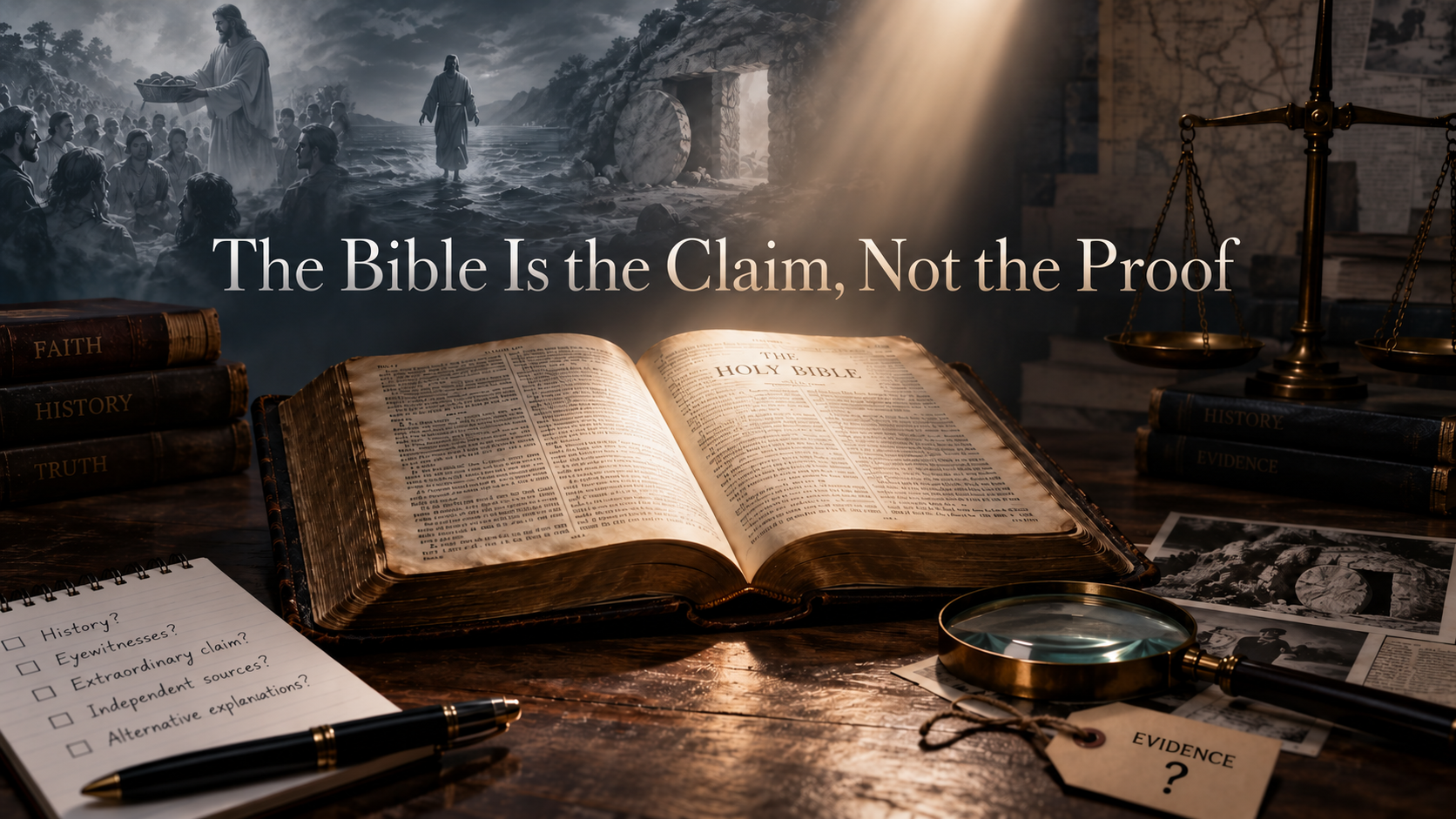
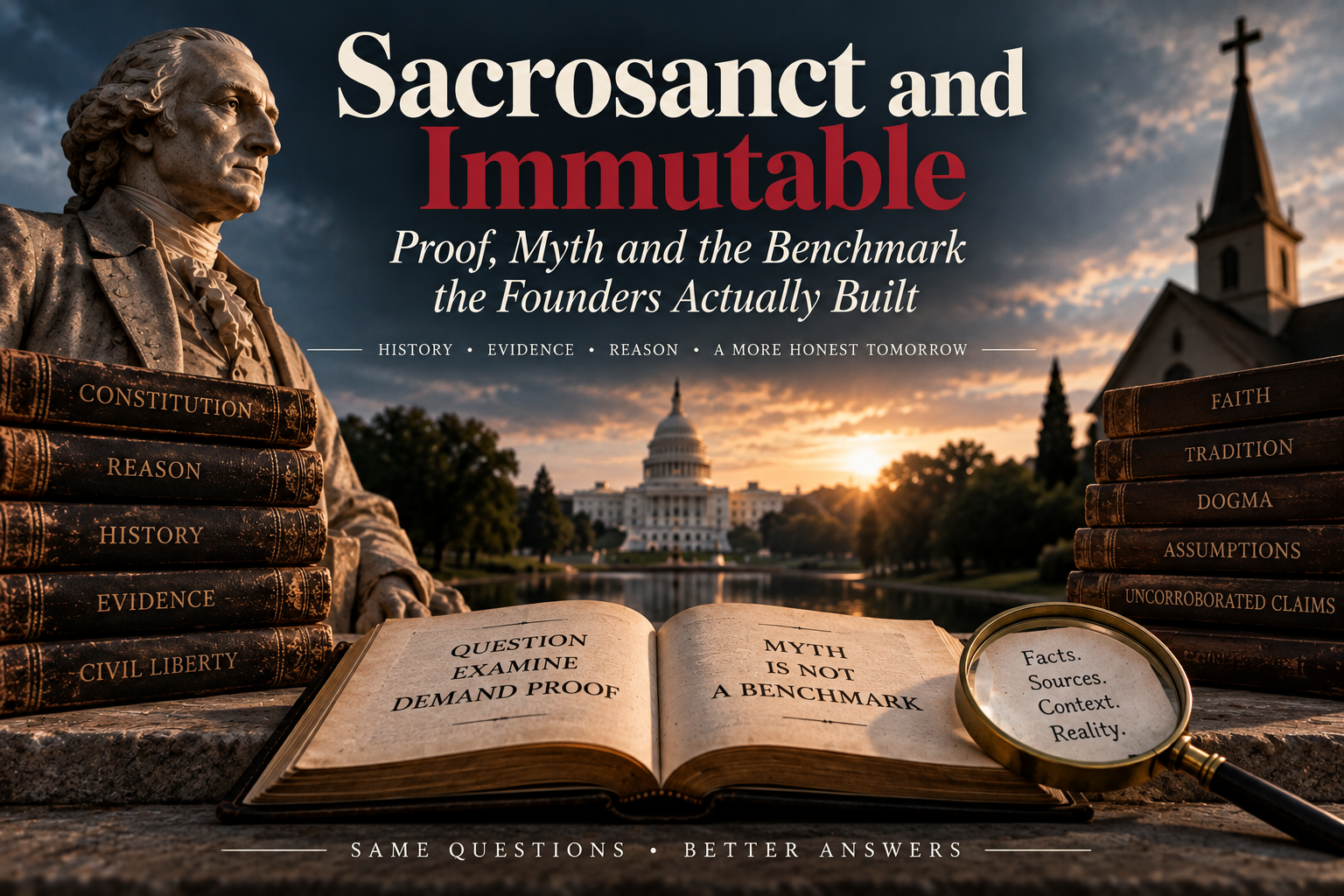
Proof and myth are not two flavors of the same thing. They are two different systems running on two different rules. Proof only counts as knowledge once it survives someone actually trying to prove it wrong. Myth counts as knowledge because it was said a long time ago and has been repeated ever since without needing to survive anything. America's government was deliberately built to run on the first system. A significant slice of American Christianity has spent the last several decades insisting it should be allowed to run on the second one instead, while still getting a vote on laws that bind people who never signed up for its myth. That is the actual disconnect at the center of separation of church and state, and it deserves to be said plainly instead of danced around.
What the Founders Actually Built
None of this requires guessing at the founders' intent, because they wrote it down. Article VI of the Constitution bars any religious test for holding federal office, a direct rejection of the state-church model most of the founders had just fought a war to get away from. In 1797, the Senate unanimously ratified the Treaty of Tripoli, a document negotiated under President Washington and signed under President Adams, which states outright that the government of the United States "is not, in any sense, founded on the Christian religion." Five years later, Jefferson wrote to the Danbury Baptist Association describing the First Amendment as building a wall of separation between church and state, using that exact phrase because the Baptists writing to him were themselves a religious minority worried about a government church dictating their worship. The founders were not uniformly irreligious men. Several were devout. What they built anyway was a government with no religious test, no established church and no scripture cited as legal authority anywhere in the document they wrote. That was not an oversight. It was the design.
Proof Answers to Evidence. Myth Answers to Itself.
Calling something a myth is not an insult, it is a structural description. A proof-based claim specifies in advance what would count as evidence against it and accepts the risk of being wrong. A myth-based claim does not, and cannot, because its authority comes from being handed down rather than tested. This distinction is not hostile to religion as private practice. It becomes a problem only the moment myth-based claims are asked to carry the same weight as proof-based ones in a system, like law, where the consequences fall on people who never accepted the myth's premises in the first place. A government has to run on the kind of claim that can be checked by anyone regardless of what they believe, because that is the only kind of claim a stranger with no religious stake in the outcome can be expected to accept.
The Double Standard Nobody Notices
This is the shape the argument always takes. A modern professional with access to peer reviewed research, cross examined data and two hundred years of scientific method behind him has no standing to question the natural world, while a Bronze Age shepherd with none of those things gets treated as an unimpeachable authority on how that same world began. That is worth sitting with for a second, because it is exactly backward.
The authors of Genesis were not stupid. They were working with the best tools their era had, which were oral tradition, observation with the naked eye and no concept of geology, genetics, astronomy or medicine as we understand them today. Nobody writing in the ancient Near East had access to ice core samples, sediment layers or a genome to sequence. That is not an insult to them, it is a simple fact about when they lived. The problem is not that they got it wrong by the standards of their own time. The problem is expecting their conclusions to hold up against evidence they had no way of collecting, while dismissing anyone alive today who has that evidence.
Take the flood. Genesis describes a global deluge that covered every mountain on earth. Geology has no record of it anywhere, no missing layer of soil, no global sediment deposit, no genetic bottleneck in the fossil record that an event of that scale would leave behind. What the ancient Near East does have is an older flood story. The flood tablet in the Epic of Gilgamesh predates the Genesis account by several centuries and follows nearly the same structure, a warned man, a boat, animals, a bird sent out to find land. That is not two independent eyewitnesses corroborating each other. That is one culture's flood myth getting passed down and reworked by a later one, the same way flood stories show up in dozens of unrelated cultures for the same ordinary reason, those cultures lived near rivers that occasionally flooded badly.
Adam and Eve as the literal first two human beings runs into a wall that has nothing to do with faith and everything to do with population genetics. The human genome carries a record of how much genetic diversity a population needs to produce it, and that record rules out a bottleneck of two individuals. It takes thousands of breeding individuals, not two, to generate the diversity actually present in modern humans. This is not a fringe atheist talking point. Dennis Venema, an evangelical biologist, laid out the genetic case in detail and it cost him his teaching position at a Christian university for saying it plainly. The data does not care what either side of this argument believes about who said it.
The resurrection sits in a different category entirely, because it is not a claim about ancient people misreading a natural process, it is a claim about a one time supernatural suspension of every natural process. That kind of claim cannot be checked by geology or genetics. It can only be accepted or not, which is exactly why it belongs in the category of faith rather than the category of fact, and why citing it as evidence in an argument about evidence does not work.
None of this means the people who wrote these books were fools, or that everything ancient is worthless. It means a shepherd with no telescope does not automatically outrank a professor with a library just because he lived three thousand years earlier. Age is not a credential.
The Mesopotamian flood tradition preserved on the Gilgamesh flood tablet predates the Genesis flood narrative by several centuries, a dating established by Assyriologists independent of any theological argument. Evangelical biologist Dennis Venema's population genetics analysis in *Adam and the Genome* found no point in the human species' history consistent with a two-person bottleneck. Radiometric dating independently places the age of the earth at roughly 4.5 billion years, a figure derived from meteorite and rock samples using methods unrelated to any biblical text.
Sacrosanct and Immutable
Here is the cognitive dissonance at the center of it. The same tradition that insists the text cannot be wrong, cannot be updated and cannot be read as anything other than literal history runs entirely on the products of the scientific method it refuses to apply to its own origin claims. The smartphone used to forward the sermon, the anesthesia used in the surgery, the GPS used to find the church on Sunday morning, all of it comes from the same body of testable, falsifiable, peer reviewed knowledge that gets waved away the moment it touches Genesis. That is not consistent skepticism of modern science. That is selective skepticism, applied only where the conclusions are inconvenient, which is the definition of motivated reasoning rather than principled doubt.
Worth noting, not every Christian tradition handles this the same way. Venema himself is proof that a scientist can hold both a genuine Christian faith and an accurate picture of population genetics, by treating Genesis as theology rather than as a geology textbook. The sacrosanct and immutable version of the text is not an inherent feature of Christianity, it is a choice a particular strand of it has made, and that choice is exactly what produces the dissonance. A text does not become more true by being declared unchangeable. It just becomes harder to correct.
Why the Constitution Has to Be the Benchmark
The Constitution was built with a built-in admission that it would need correcting, which is what Article V and two hundred and thirty years of amendments actually are. The document that originally counted enslaved people as three-fifths of a person also contains the mechanism that abolished slavery, extended citizenship, and extended the vote to women and to eighteen year olds. It is not immutable and never claimed to be. It updates when the moral and factual evidence changes, in public, through a process anyone can trace.
Scripture, treated as sacrosanct and immutable, has no equivalent mechanism, and history shows exactly what that produces. Historian Mark Noll documented how both sides of the American slavery debate built detailed biblical arguments, pro-slavery ministers citing the same book abolitionist ministers cited to oppose them, because a text declared inerrant and unchangeable can still be read in opposite directions by people equally convinced they have the correct reading. A benchmark that can be honestly argued into justifying either side of a moral catastrophe is not a stable benchmark. The Constitution, whatever its original flaws, at least contains the tool to fix itself without anyone needing to claim it was right all along.
Where People of Faith Have a Point
None of this is an argument that faith is worthless or that religious people have nothing to offer a public conversation. Most of the founders were religious men, some devoutly so, and they built a secular government anyway, which shows personal faith and public secularism were never actually in tension for them. Science, for its part, is not equipped to answer every question that matters. It can tell you what is, not what ought to be, and a society that pretends otherwise, that treats scientific method as a complete substitute for moral reasoning, is making its own version of the sacrosanct and immutable mistake. Plenty of religious traditions and religious scholars, Venema included, have made peace with the evidence without abandoning their faith, which proves the two are not automatically incompatible. What is incompatible with a shared government is insisting your specific unfalsifiable reading of your specific text gets to override evidence-based law for people who never agreed to be governed by it.
Why This Matters
Keeping religion in its lane was never an attack on religion. It was the deal that let every religion, and no religion, coexist under one government without any of them getting to write the rules for everyone else. The Constitution earns its place as the benchmark precisely because it can be wrong and can say so. Scripture, treated as sacrosanct and immutable, cannot say that about itself without giving up the claim that makes it scripture. A nation has to run on the one that can admit a mistake, because a government that cannot correct itself when the evidence changes is not a government built to last. That was the founders' bet, made in writing, and it has outlasted every prediction that it wouldn't.
- U.S. Const. art. VI, cl. 3. [The no religious test clause for federal office.]
- Treaty of Tripoli, art. 11 (1797). [Ratified unanimously by the U.S. Senate under President Adams; states the government "is not, in any sense, founded on the Christian religion."]
- Jefferson, T. (1802, January 1). *Letter to the Danbury Baptist Association.* [Source of the "wall of separation between church and state" language.]
- Popper, K. (1959). *The Logic of Scientific Discovery.* Basic Books. [Falsifiability as the line between a testable claim and one built to survive any outcome.]
- George, A. (2003). *The Epic of Gilgamesh.* Penguin Classics. [Scholarly translation and dating of the Mesopotamian flood tablet predating the Genesis flood narrative.]
- Venema, D., & McKnight, S. (2017). *Adam and the Genome: Reading Scripture after Genetic Science.* Brazos Press. [Evangelical biologist's population genetics analysis ruling out a two-person human bottleneck.]
- U.S. Geological Survey. *Age of the Earth.* usgs.gov. [Radiometric dating placing the age of the earth at approximately 4.5 billion years.]
- Noll, M. (2006). *The Civil War as a Theological Crisis.* University of North Carolina Press. [Documents biblically grounded arguments made on both sides of the American slavery debate.]