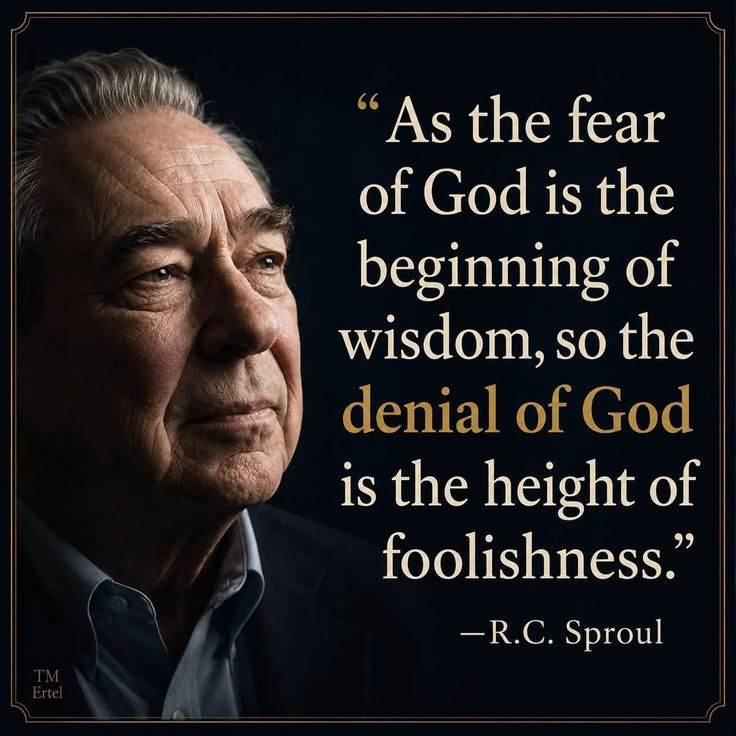
There is a familiar religious argument that appears whenever life becomes difficult: human beings get into trouble because we rely too heavily on ourselves. One version puts it this way:
The biblical justification usually comes from passages such as Proverbs 3:5-6, which instruct believers to trust God rather than their own understanding, and 1 Peter 4:11, which attributes the believer's ability to serve to strength supplied by God.
Fair enough. That is what the theology says. But there is a rather large gap between a book telling us to rely on God and demonstrating that a God actually intervenes to solve human problems. The Bible makes the assertion.
The assertion is not the evidence.
What Does "Rely on God" Actually Mean?
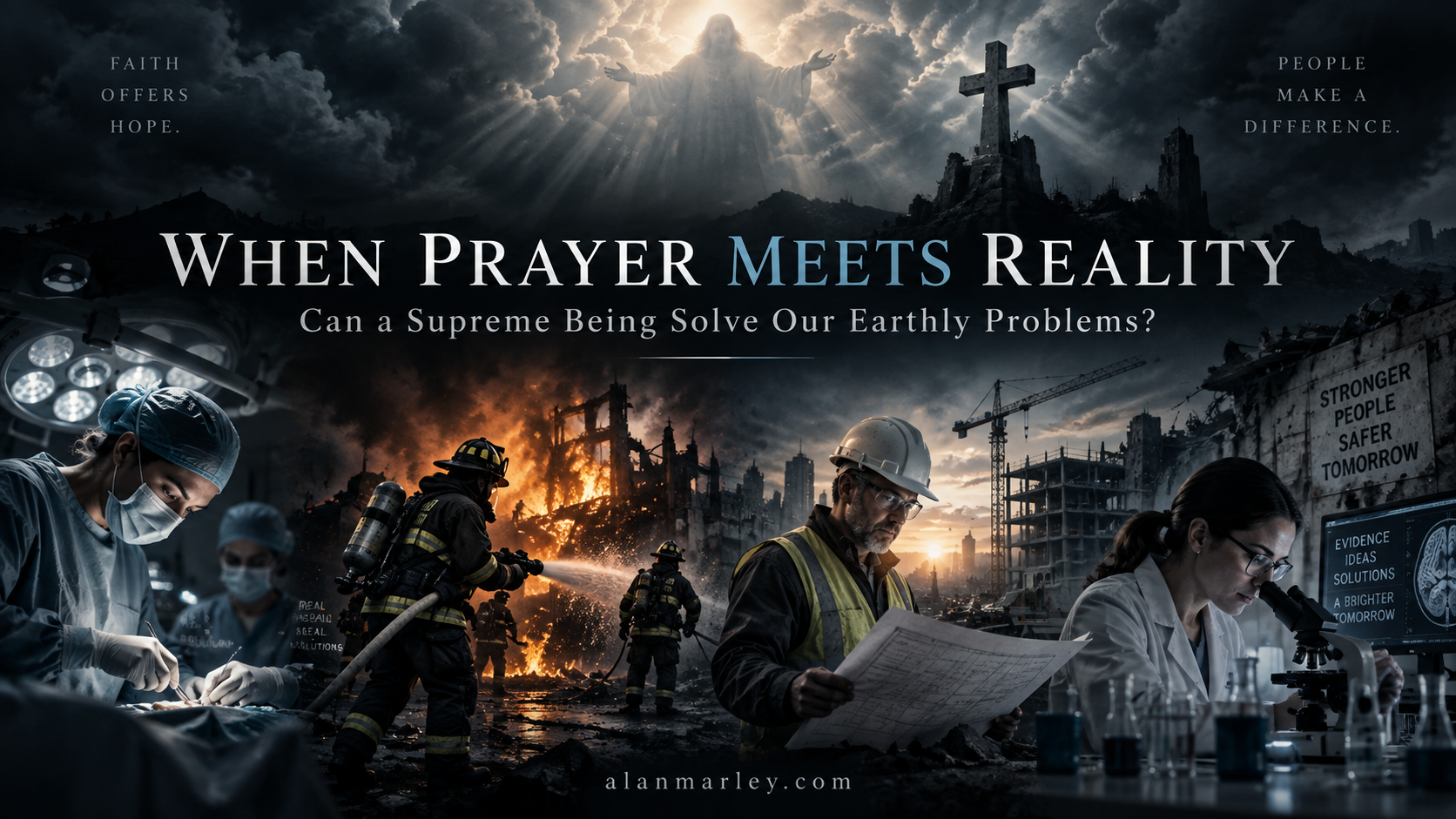
Suppose I have cancer. I can pray. I can ask other people to pray. I can tell myself that God is in control and that whatever happens is part of a larger plan. But when it comes time to actually treat the cancer, I am going to an oncologist. The oncologist is going to rely on pathology, imaging, chemistry, accumulated medical research and human judgment. If surgery is necessary, I certainly hope the surgeon leans rather heavily on his or her own understanding.
The same principle applies everywhere else. If an airplane develops engine trouble at 35,000 feet, I want the pilots using their training. If my house is on fire, I want firefighters. If my roof leaks, I want somebody who understands roofing. If my heart stops, I want a defibrillator. If my brakes fail, I want a mechanic. Prayer may accompany all of those things, but prayer is not doing the measurable work. Human beings are.
That makes the admonition against "leaning on our own understanding" rather peculiar. Nearly everything that has made human existence safer, longer and more comfortable resulted precisely from human beings refusing to accept ignorance and instead attempting to understand the world around them.
- Medicine
- Engineering
- Sanitation
- Electricity
- Vaccines
- Agriculture
- Weather forecasting
- Modern construction
- Antibiotics
- Anesthesia
None of these appeared because humanity stopped asking questions and waited for divine wisdom. They appeared because somebody leaned very hard on human understanding.
The Problem With Answered Prayer
There is another difficulty. How would we determine whether God actually intervened? Imagine two cancer patients. Both are Christians. Both pray. Their churches pray. Their families pray. Both receive treatment. One recovers. The other dies.
The survivor may say God answered our prayers. But what do we say about the person who died?
- God had another plan.
- God works in mysterious ways.
- It wasn't God's will.
- God answered, but the answer was no.
- The timing wasn't right.
- Perhaps something greater will come from the suffering.
Notice what has happened. Every possible outcome confirms the original belief. Recovery proves God answered the prayer. Death does not disprove it. Silence does not disprove it. A worsening condition does not disprove it. A completely random outcome does not disprove it.
That is not an explanation in any scientific or evidentiary sense. It is an assertion constructed so that no possible observation can demonstrate that it is wrong. A proposition that explains every conceivable outcome ultimately explains very little.
We Have Actually Tested Prayer
Prayer presents an unusual religious claim because at least one version of it can be tested. If people praying to God on behalf of sick strangers actually changes medical outcomes, there should be some detectable difference between patients receiving intercessory prayer and comparable patients who are not. Researchers have tried.
One of the largest experiments was the Study of the Therapeutic Effects of Intercessory Prayer, commonly called STEP. Researchers studied 1,802 coronary bypass patients at six hospitals and randomly assigned them to groups receiving or not receiving intercessory prayer. The study found no benefit from receiving prayer in the primary outcome being measured.
A later Cochrane review examined ten randomized trials involving 7,646 people. It found no clear evidence that intercessory prayer reduced death, poor clinical outcomes, coronary-care readmission or rehospitalization. The authors concluded that the evidence did not establish a meaningful health benefit from intercessory prayer.
That does not prove there is no God. It doesn't even prove that prayer has no personal value. It does tell us something considerably narrower but important: when we try to detect whether prayer reliably changes external medical outcomes, the expected divine effect does not clearly appear. That matters when someone claims that turning toward God instead of human understanding provides an actual solution to earthly problems.
Prayer Can Still Do Something
There is no need to pretend prayer has no value whatsoever. A person who prays may feel calmer. Prayer may organize thoughts. It may provide hope. It may help someone endure grief. It may create a feeling of community when other people say they are praying for you. It may even influence behavior by causing someone to slow down, reflect and reconsider a decision. Those are perfectly plausible human effects.
But those are very different claims from a supernatural being intervening in physical reality and changing the outcome.
We should not confuse psychological benefit with supernatural causation.
Meditation can calm someone without Buddha rearranging the universe. A conversation with a friend can provide courage without the friend possessing supernatural powers. Music can help someone endure grief without the composer intervening from beyond the grave. Prayer may be meaningful because of what happens inside the person praying. That does not establish that something supernatural happened outside of them.
Then There Is the Bigger Problem
Suppose, however, that God really does intervene. That creates an even more difficult question. Why these interventions? A believer finds employment and thanks God. Someone survives surgery and thanks God. A family avoids an automobile accident and says God protected them. Someone's financial crisis unexpectedly resolves and God receives the credit.
But somewhere else a child dies of leukemia. A family is buried beneath an earthquake. A baby is born with a devastating genetic disorder. People starve. Children are abused. Floods erase entire communities. People pray desperately through all of it.
If an omnipotent God can intervene in earthly affairs, then the question isn't merely why he occasionally helps.
The question is why he so often doesn't.
This is hardly a new objection. Philosophers have wrestled with the problem of evil for centuries: how the existence of enormous amounts of apparently unnecessary suffering fits with an all-powerful, all-knowing and perfectly good God. There is a related problem known as divine hiddenness: if a loving God desires a relationship with human beings and actively participates in our lives, why is his presence so difficult to distinguish from his absence?
Those questions become especially uncomfortable once God is credited with everyday interventions. If God gets credit for helping one person's surgery succeed, we cannot simply remove him from the discussion when another person's surgery fails. If he controls both outcomes, then both require explanation.
God's Wisdom Looks Suspiciously Like Human Action
There is another pattern worth noticing. When earthly problems actually get solved, the mechanism is usually visible.
- Someone learned something.
- Someone invented something.
- Someone intervened.
- Someone changed behavior.
- Someone made a difficult decision.
- Someone developed a drug.
- Someone performed surgery.
- Someone repaired the bridge.
- Someone put out the fire.
- Someone rescued the child.
- Someone developed a better crop.
- Someone negotiated the peace.
- Someone solved the equation.
The more humanity understands the natural world, the less supernatural intervention seems necessary to explain what happened.
- Disease
- For most of human history, easily attributed to gods, demons, curses or divine judgment. Then we discovered microorganisms.
- Lightning
- Once required supernatural explanation. Then we understood electricity.
- Mental illness
- Sometimes blamed on possession. Now we study the brain.
- Drought
- Once inspired sacrifice. Now meteorologists track atmospheric systems from satellites.
Human understanding has repeatedly replaced supernatural explanation because human understanding produces something theology rarely does: a mechanism that can be demonstrated, tested and used again.
"Trust God" Is Not a Method
This is ultimately where the argument fails for me. Telling someone facing an insurmountable problem to trust God's wisdom sounds profound. But what exactly should that person do Tuesday morning?
Suppose the business is failing. Should the owner cut expenses? Raise prices? Negotiate debt? Change products? Fire employees? Borrow money? Close the company? "Trust God" tells us none of that.
Suppose a marriage is failing. Counseling? Separation? Communication? Medication for an underlying problem? Change behavior? Leave an abusive spouse? Again, "God's wisdom" produces no independently identifiable answer.
The human being must still gather information, evaluate alternatives, make judgments and live with the consequences.
In other words, he must lean on his understanding.
The Strange Double Standard
There is also a strange habit within religious thinking. When human understanding fails, it is evidence of our limitations. When religious faith fails, it is evidence that we failed to understand God. That gives religion an extraordinary advantage.
- Science makes a prediction and gets it wrong
- Fix the theory.
- Medicine fails
- Investigate the treatment.
- Engineering fails
- Determine what broke.
- Prayer fails
- God had other plans.
The first three systems are forced to confront failure. The fourth converts failure into confirmation. That may preserve faith. It does not increase knowledge.
The Better Approach
I have no objection to someone praying before surgery. Pray. Meditate. Call your pastor. Hold your family's hands. Ask God for strength. If it gives you comfort, use it. But then listen to the surgeon.
If your house is burning, pray while dialing 911. If your business is failing, pray while opening the financial statements. If your child is sick, pray on the way to the hospital. Because whether or not there is a God listening, we know the hospital exists. We know the physician exists. We know antibiotics work. We know firefighters put out fires. We know engineering keeps bridges standing. Those are not matters of faith. They are things humanity has learned by leaning on its own understanding.
Perhaps We Have It Backward
Proverbs tells us not to lean on our own understanding. Human history suggests almost the opposite. Our understanding is imperfect. It always has been. But the answer to imperfect understanding has not been less understanding. It has been more.
- Ask another question.
- Run another experiment.
- Gather more evidence.
- Challenge the assumption.
- Admit when we are wrong.
- Learn something new.
- Try again.
Perhaps there is a supreme being somewhere beyond our ability to detect. Perhaps people find genuine strength in believing that there is. But when it comes to alleviating earthly problems, the evidence we can actually observe points overwhelmingly toward earthly solutions. Human beings solving human problems. Not perfectly. Not always successfully. But demonstrably.
And until someone can show that supernatural intervention works better than human understanding rather than merely asserting that it does, I think I will continue leaning on the latter. It has a considerably better track record.
Why This Matters
This isn't ultimately an argument about whether God exists. It's an argument about what happens when real people facing real problems are told that trust is a substitute for method. A doctor who is wrong gets corrected by the next scan, the next lab result, the next patient outcome. A theology that is wrong gets reinterpreted, never falsified, no matter how badly things turn out for the person who trusted it. That difference has consequences outside of any seminar on epistemology. It shows up when someone delays treatment for faith healing instead of a second opinion. It shows up when a family exhausts its savings waiting for a miracle instead of confronting a failing business. It shows up when a person stays in a dangerous marriage waiting for God's plan to reveal itself instead of doing the difficult, uncertain, human work of actually addressing the problem.
None of this requires anyone to stop praying. It requires being honest about what prayer has actually been shown to do, and what it hasn't. That honesty isn't an abstraction. It's paid for, sometimes literally, by people who were told to lean on something that cannot be checked instead of something that can.
References
- Proverbs 3:5-6 (trust in God rather than one's own understanding).
- 1 Peter 4:11 (strength for service attributed to God).
- Benson, H., et al. (2006). Study of the Therapeutic Effects of Intercessory Prayer (STEP) in cardiac bypass patients. American Heart Journal. [1,802 patients, six hospitals.]
- Roberts, L., Ahmed, I., Davison, A., & Hall, S. (2009). Intercessory prayer for the alleviation of ill health. Cochrane Database of Systematic Reviews. [Ten trials, 7,646 participants.]
- Stanford Encyclopedia of Philosophy. The Problem of Evil. plato.stanford.edu.
- Stanford Encyclopedia of Philosophy. Divine Hiddenness. plato.stanford.edu.
Disclaimer: The views expressed in this post are opinions of the author for educational and commentary purposes only. They are not statements of fact about any individual, denomination or organization, and should not be construed as legal, medical or financial advice. Religious commentary is protected opinion under the First Amendment. It does not represent the positions of any institution, employer, organization or affiliated entity with which the author may be associated in any capacity.