Donald Trump dominates American political coverage. His speeches, executive decisions, legal battles and controversies provide Democrats with an almost unlimited supply of material. Opposition to Trump has consequently become one of the party's most visible messages.
That focus may motivate committed Democrats, but it does not answer a more immediate question for millions of voters. How will any of this help my family build wealth?
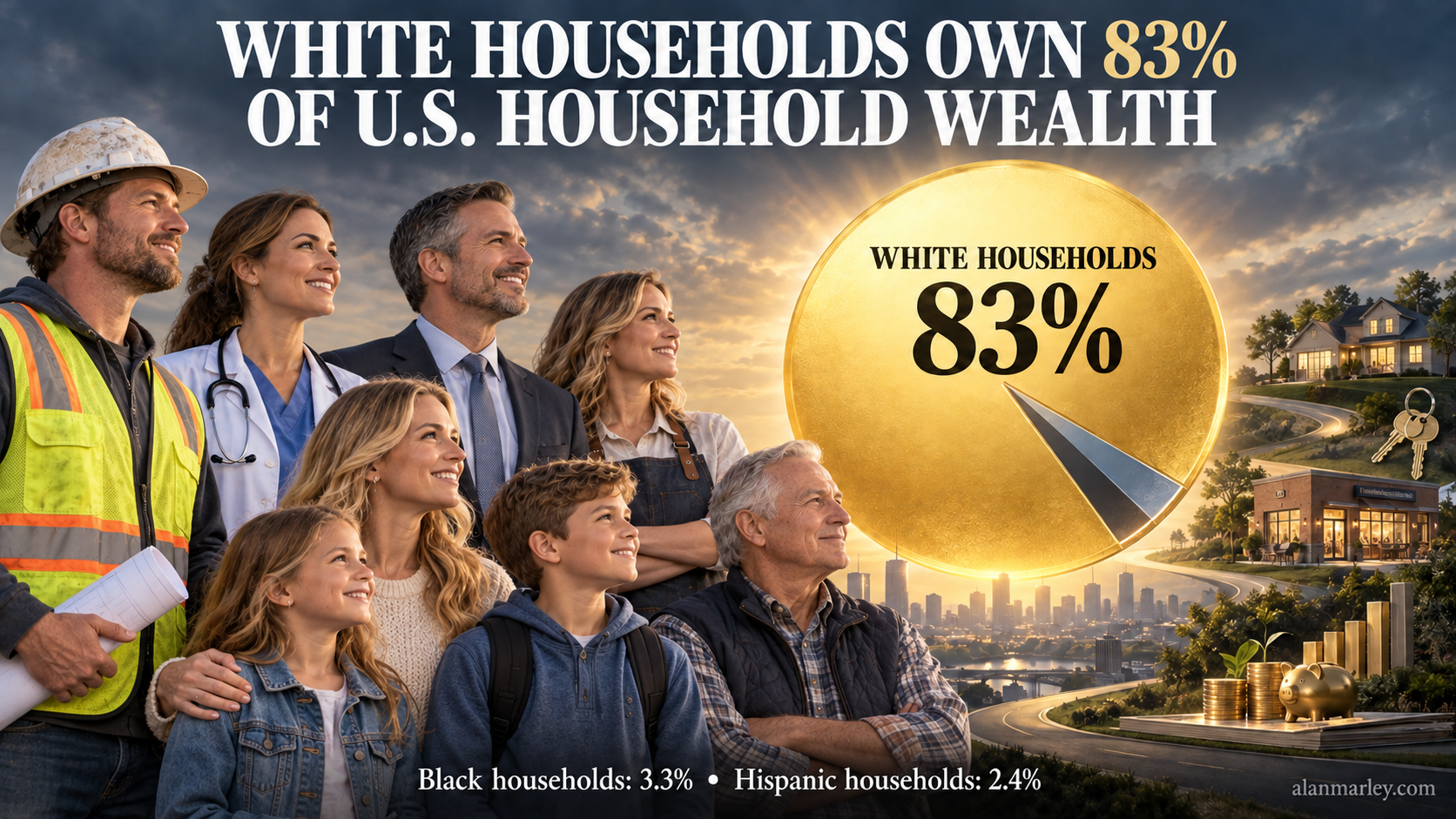
That question deserves more attention because the distribution of American wealth is dramatically uneven. According to the Federal Reserve's Distributional Financial Accounts, non-Hispanic White households hold approximately 83 percent of total U.S. household wealth. The Census Bureau estimates non-Hispanic White people represent about 56 percent of the population.
The shorthand is blunt but generally accurate. Roughly 60 percent of the population owns almost 85 percent of the wealth.
This does not mean every White household is wealthy. Millions are not. Wealth is also heavily concentrated among the richest households within every racial group. Nevertheless, the racial difference in accumulated assets is too large and too persistent to hide behind qualifications.
Black households hold approximately 3.3 percent of American household wealth, even though Black Americans constitute roughly 12 to 14 percent of the population. Hispanic households hold approximately 2.4 percent while Hispanics represent more than 19 percent of the population.
For a Democratic Party that has received overwhelming support from Black voters and substantial support from Hispanic voters for decades, these figures demand more than another speech about discrimination, another government program or another warning about Donald Trump. They demand an accounting.
Minority Voters Gave Democrats Their Loyalty
Black Americans have been among the Democratic Party's most dependable constituencies for generations. Democratic candidates routinely campaign as defenders of civil rights, social programs, labor protections, education, healthcare and economic opportunity.
That political relationship has been extraordinarily valuable to the party. In close elections, Black turnout can determine who controls city halls, state legislatures, Congress and the White House.
What has that loyalty produced in household ownership?
After decades of public programs and trillions of dollars in federal, state and local spending, the median Black household still possesses only a fraction of the wealth held by the median White household.
The Federal Reserve estimated median net worth at approximately $536,000 for Asian households, $285,000 for White households, $61,600 for Hispanic households and $44,900 for Black households.
The median White household therefore held about 6.3 times the wealth of the median Black household and 4.6 times the wealth of the median Hispanic household.
These numbers do not prove public programs accomplished nothing. Nutrition assistance reduced hunger. Medicaid provided healthcare. Housing programs kept families sheltered. Educational assistance helped people attend college. Social insurance prevented many elderly and disabled Americans from falling into destitution.
Those are real benefits. They are not wealth.
Relieving immediate hardship and creating economic independence are different objectives. A program can succeed at helping someone survive this month while doing nothing to help that person acquire an appreciating asset over the next twenty years.
That is the failure Democrats must confront.
Managing Poverty Is Not the Same as Ending It
For all its rhetoric about being the champion of minorities, the Democratic Party faces an uncomfortable result. After decades of political loyalty and trillions of dollars in public spending, Black households still hold only about 3.3 percent of American household wealth.
Government constructed an enormous system for managing poverty. It did not construct a reliable path from poverty to ownership.
A rent subsidy may help keep a family housed, but it does not create home equity. Food assistance may prevent hunger, but it does not establish a retirement account. Medicaid may pay for healthcare, but it does not produce business ownership. Student aid may provide access to college, but it can leave students worse off if they borrow heavily for credentials employers do not value.
The problem is not necessarily that every program failed at its stated purpose. The problem is that temporary support became confused with long-term advancement.
Washington measured compassion through money spent, benefits distributed and people enrolled. It rarely asked whether recipients eventually owned more, earned more or became less dependent on assistance. After spending trillions, the racial wealth figures remain dismal. That does not establish every dollar was wasted. It does establish that the overall system failed to produce broad, durable wealth creation among many of the people it claimed to advance.
The Politics of Grievance Cannot Build an Asset
Democratic messaging frequently explains disparities through discrimination, historical exclusion and structural barriers. Those factors are part of the record, particularly in housing, lending, education and employment.
They are not the entire explanation.
Wealth is also affected by employment, income, education, marriage, family stability, age, homeownership, business formation, saving, investment participation, inheritance, debt and individual decision-making. A serious wealth strategy must be willing to discuss all of them.
A political message that treats minority voters primarily as victims can become its own trap. It may explain why someone began behind, but it does not explain how that person moves forward. It can identify an injustice without providing a workable exit from it.
Opportunity matters. Discrimination matters. Personal behavior also matters. Finishing school matters. Selecting training that employers actually need matters. Avoiding destructive debt matters. Delaying parenthood until a household is prepared matters. Maintaining employment matters. Saving matters. Investing matters. Staying out of prison matters. Building stable families matters.
None of these statements denies historical discrimination. They recognize that public policy cannot create wealth unless individuals and families make decisions that convert opportunity into ownership.
A party genuinely interested in economic advancement must be able to discuss barriers and responsibilities in the same conversation.
Income Pays the Bills. Wealth Changes the Future.
Political debates often use income and wealth as though they were interchangeable. They are not.
Income is the money a household receives from wages, business earnings, benefits and investments. Wealth is what remains after adding assets and subtracting liabilities. Income keeps a family operating. Wealth gives it options.
Wealth provides the down payment for a home. It finances a business. It covers an emergency without a payday loan. It allows parents to help their children begin adult life without crushing debt. It funds retirement. Most importantly, wealth compounds. A household that owns appreciating assets receives returns unavailable to a household living entirely from wages and government benefits.
That is why another increase in program spending cannot automatically solve the wealth problem. Unless the money helps recipients acquire productive assets, improve marketable skills or increase stable earnings, it may relieve hardship without changing the family's long-term position.
The objective cannot merely be to distribute more. It must be to help people produce, save, invest and own more.
What a Real Wealth Plan Would Measure
A credible economic program would not announce success by telling voters how many billions of dollars it spent. It would publish results ordinary people can understand.
Did homeownership increase? Did mortgage defaults decrease? Did families acquire retirement accounts? Did emergency savings rise? Did household debt become more manageable?
Did vocational graduates obtain jobs in their fields? Did college graduates earn enough to justify their debt? Did new businesses survive beyond their first few years? Did household net worth increase? Did dependence on public assistance decline?
If those figures do not improve, the program did not create economic advancement regardless of how noble its intentions sounded.
Democrats often criticize businesses for rewarding activity rather than results. Government deserves the same standard. No contractor could collect billions of dollars, fail to complete the project and defend himself by pointing to how much material he purchased. No business could survive by measuring success through expenses while ignoring revenue, assets and customer results.
Education Must Be Connected to Employment
Education remains one of the strongest potential paths into the middle class, but only when it produces useful knowledge and marketable skills.
The country has spent decades telling young people college is the preferred path, even when a student's interests, preparation or abilities point elsewhere. That approach can produce debt without proficiency.
Technical education, apprenticeships, military training, certifications and skilled trades can lead to stable careers without four years of university tuition. Electricians, plumbers, welders, technicians, equipment operators and construction managers perform work the economy needs and can build substantial incomes.
Europe is often more willing to direct students toward vocational education without treating that direction as an insult. The United States continues to stigmatize trades while admitting students into colleges where many accumulate debt, use technology to complete assignments they do not understand and graduate without the proficiency employers expect.
A serious economic strategy would stop confusing enrollment with education and credentials with competence. The measure should be whether the student can perform valuable work.
Homeownership Cannot Be Created by Subsidies Alone
Home equity remains the largest source of wealth for many American families. Expanding responsible homeownership could therefore play a major role in narrowing wealth differences.
Demand subsidies alone are not enough. Giving buyers additional money while the supply of homes remains restricted can raise prices. Zoning limitations, permitting delays, construction costs, material prices, labor shortages and infrastructure constraints all affect housing affordability. A workable housing strategy must address both buyers and supply.
It must also avoid repeating lending policies that place borrowers into homes they cannot sustain. Ownership creates wealth only when the owner can afford the mortgage, taxes, insurance, maintenance and inevitable repairs. The objective is not simply putting someone's name on a deed. It is helping that person retain the property long enough to build equity.
Business Ownership Requires More Than Grants
Small-business ownership can create income, employment and transferable equity. It can also end in bankruptcy.
Capital matters, but money alone cannot create a viable business. Entrepreneurs need customers, pricing discipline, financial controls, market knowledge, competent employees and the ability to manage risk.
Government programs frequently celebrate the number of businesses launched or loans distributed. Those statistics say little about whether the businesses remained open, became profitable or created jobs. A credible program would track survival, profitability, payroll, repayment and equity creation over several years.
Democrats Need More Than an Opponent
Donald Trump may be politically useful to Democrats because he provides a recognizable opponent around whom the party can organize. He cannot provide the party with its own identity.
Opposition explains what a party rejects. Leadership explains what it intends to build.
Pew Research Center reported in July 2026 that Americans were almost evenly divided over which party they trusted more on economic policy. Thirty-seven percent selected Democrats while 36 percent selected Republicans. Neither party owns the economic argument.
That should concern Democrats because many voters in their coalition remain far behind in homeownership, business ownership, investment participation and household wealth. Another campaign centered on Trump may energize people who already oppose him. It may not persuade a working family that cannot buy a house, a young adult buried under student debt or a small-business owner struggling with costs.
Those voters need more than an enemy. They need a vision. They need a mission. They need a plan. They need leadership capable of explaining how policy will move people from assistance to independence and from consumption to ownership.
Most importantly, the plan must apply to all Americans. A national wealth strategy cannot succeed if it is marketed as one racial group taking something from another. It must expand opportunity while preserving responsibility, rewarding work and creating more owners across the country.
Why This Matters
Minority voters gave Democrats their loyalty. Democrats gave them programs. What they still have not delivered is broad ownership.
That does not mean government assistance has no value. It means assistance must not be confused with advancement. A family does not become economically independent because another benefit was added to its monthly budget. It becomes independent when its earnings rise, its debts fall and its assets begin producing value.
For all their talk about inequality, Democrats have yet to explain convincingly why decades of spending left the fundamental wealth distribution largely intact.
Blaming Trump will not answer that question. Blaming discrimination alone will not answer it. Demanding more spending without measuring ownership will not answer it.
The Democratic Party's challenge is not to promise minorities that government will protect them forever. It is to develop a vision, mission, plan and leader capable of helping Americans build the skills, habits, businesses, homes and investments that make permanent protection less necessary.
That would require abandoning symbolic victories, rejecting the politics of permanent grievance and measuring success through independence rather than enrollment.
The wealth pie will not be redistributed into prosperity through rhetoric. It must be expanded, and more Americans must acquire a genuine piece of it.
- Board of Governors of the Federal Reserve System. Distributional Financial Accounts: Distribution of Household Wealth in the United States Since 1989. federalreserve.gov.
- Board of Governors of the Federal Reserve System. (2023, October 18). Changes in Racial Inequality in the Survey of Consumer Finances. federalreserve.gov. [Median net worth by race, 2022 Survey of Consumer Finances]
- Pew Research Center. (2026, July 23). As the 2026 Midterms Approach, Economy Is Front and Center. pewresearch.org. [Party trust on economic policy]
- U.S. Census Bureau. QuickFacts: United States. census.gov. [Population share by race]