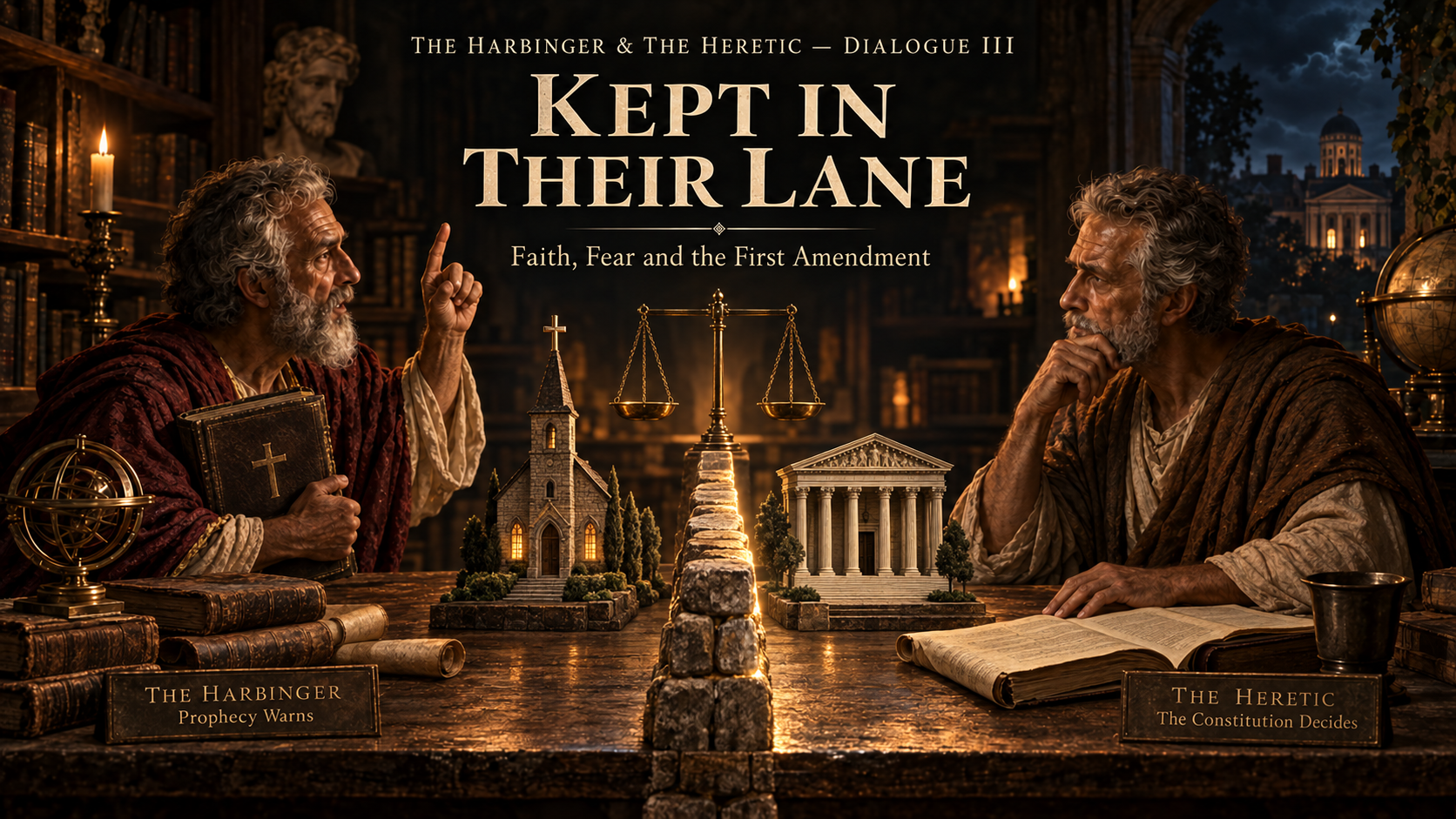
Two old friends have been having the same argument for thirty years, first across a table, now across an inbox. One sees a nation drifting from God and reads that drift as a sign the end is near. The other sees a nation doing what nations have always done with unfalsifiable claims, which is slowly stop finding them persuasive.
The Harbinger
I know you're excited church attendance is down and people are questioning their faith. You think you're onto something. Your grand scheme to turn this country secular looks like it might actually happen. I hate to burst your bubble, my friend.
The Heretic
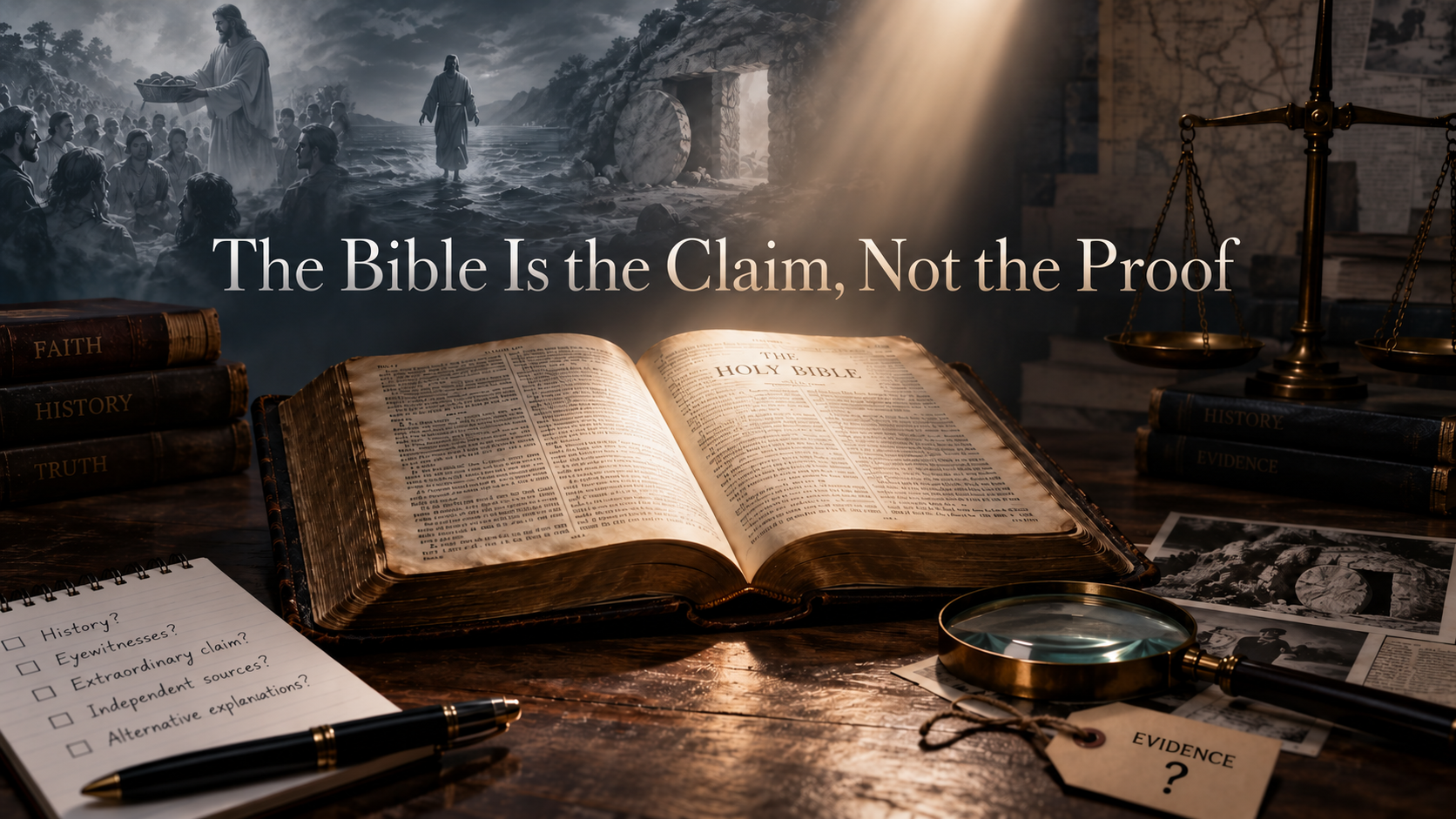
Church attendance rises and falls with the times. It climbs during trouble and drops during prosperity. Scripture notices this pattern in both testaments, so it shouldn't surprise either of us. I have no scheme and no excitement about anyone losing their faith. I could not care less whether people question it. What I care about is this. When a belief is accepted without evidence rather than because of it, doubt eventually shows up. That isn't a plot I'm running. That's just what happens to claims that were never built to survive scrutiny.
The Harbinger
Jesus already called this, two thousand years ahead of you. Matthew 24. "Many will turn away from the faith and will betray and hate each other. Many false prophets will appear and deceive many people. Because of the increase in wickedness, the love of most will grow cold." That's today. That's us.
The Heretic
It's also every decade since. No date is attached to that passage. No nation, no generation, no name. That isn't prophecy, it's a net cast wide enough to catch anything that drifts through it eventually. Betrayal, false teachers and cooling affection have been present in every century anyone bothered to write history down. Calling that a prediction is like predicting rain sometime this year and taking credit every time it rains.
The Harbinger
So now you're the great, all knowing, all seeing Dr. Marley. Jesus already tagged you. A false prophet, deceiving many. The fact that people are walking away from faith is one more proof that God's word is true.
The Heretic
Notice what just happened there. Instead of defending the prophecy, you attached my name to it. That doesn't strengthen the argument, it just changes the subject to me instead of the claim. Here's the actual problem with the claim. If people stay in the pews, the verse about the love of most growing cold gets quietly set aside. If people leave the pews, that same verse becomes proof. Deny it and you're the false prophet it warned about. Accept it and you're one more example of it coming true. There is no outcome that counts against it, and a claim with no possible outcome against it was never a claim to begin with. It's a trap built out of language.
The Harbinger
You ain't gonna win this one, brother.
The Heretic
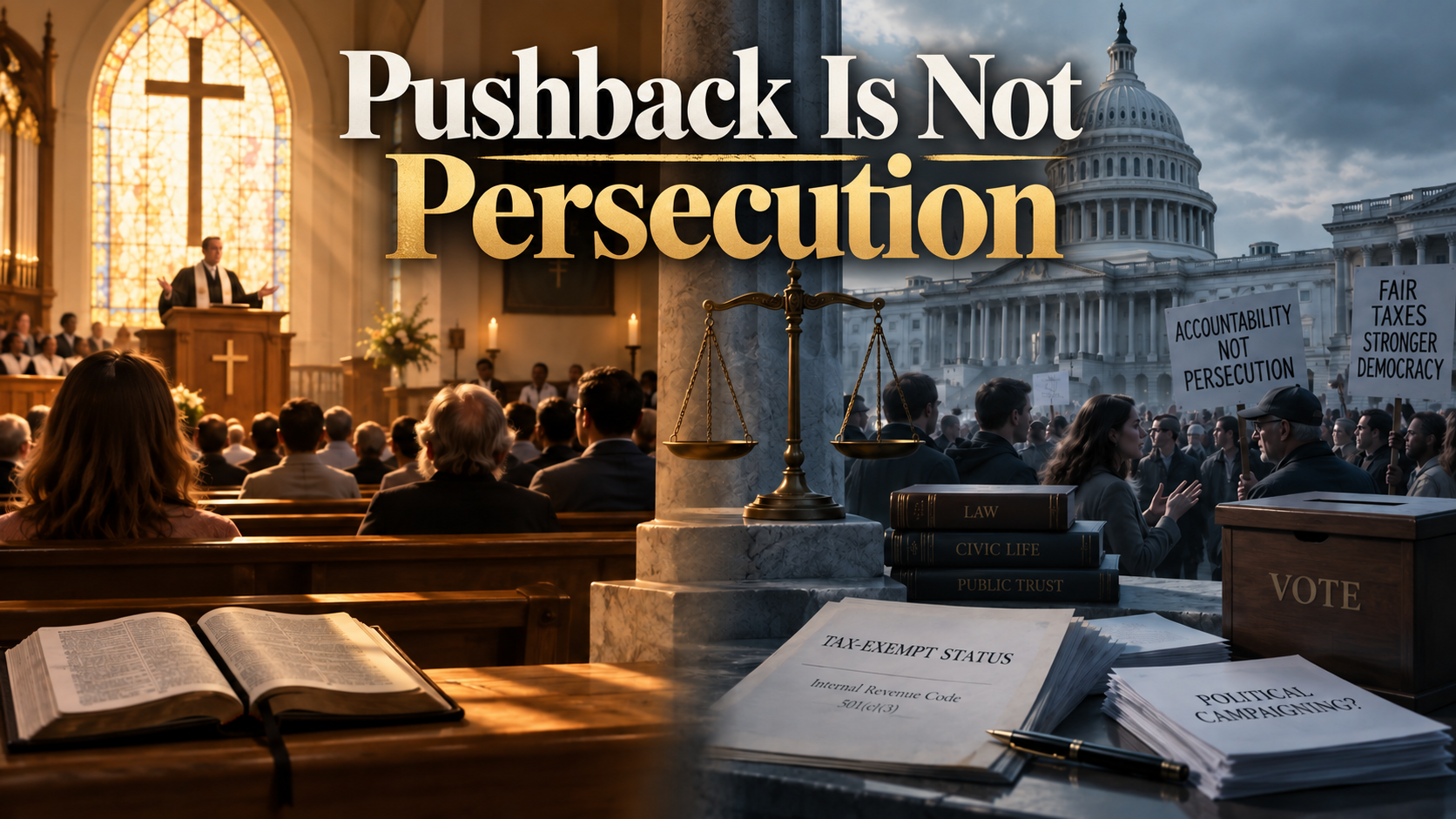
Winning was never about beating your faith. I don't have an all or nothing attitude toward religion, and I'm not interested in one. What I want is every religion, yours included, kept inside the lane the Constitution actually drew for it. Worship however you like. Organize your church however you like. What you don't get is tax exempt status while that same organization funds political operations built to write your interpretation of a two thousand year old text into law for people who never signed up for your church in the first place.
The Harbinger
That's rich, coming from a strict constitutionalist only when it's convenient for you.
The Heretic
It's not convenient, it's consistent. Jefferson took a razor to his own copy of the Gospels and cut out the miracles, including the resurrection, because he thought the moral teaching held up fine without the supernatural scaffolding around it. The man who wrote about a wall separating church and state wasn't hostile to faith. He was hostile to faith running the government. That distinction gets lost every time someone treats "keep religion out of civil law" as an attack on religion itself. It isn't. It's the deal that let your church exist tax free and unmolested for two hundred and fifty years, right alongside mine, right alongside none at all.
The federal tax code has, since 1954, barred 501(c)(3) organizations, churches included, from directly participating in political campaigns as a condition of their tax exempt status. That restriction, known as the Johnson Amendment, is not a modern attack on religion. It's the exact bargain the Harbinger's own church has operated under for seventy years.
The Harbinger
Abortion, though. That's a moral issue, not a political one, and the country got that wrong.
The Heretic
Abortion isn't addressed in the Bible and it isn't addressed in the Constitution. It got handed back to the states, and the states now decide it the way the Constitution says everything gets decided that isn't settled at the federal level, through the people who actually live there, not through a pulpit's reading of a text most of those voters never agreed to be governed by. That's not persecution of your church. That's the system working exactly as designed.
The Harbinger
You still think you're winning.
The Heretic
I think the last thirty years have gone the way the Constitution intended, not the way either of us personally wanted every time. Creationism lost its case for the science classroom, because a fifth grader can tell the difference between a testable theory and an origin story. Prayer stayed voluntary instead of mandatory. Religious organizations kept every ounce of freedom to worship and lost every attempt to convert that freedom into authority over people who don't share their faith. That's not the country hating Christians. That's the country doing precisely what the framers built it to do, letting belief stay personal and keeping law secular. You have the freedom to worship however you choose. That freedom was never a license to make the rest of us live inside your church.
A Prophecy That Cannot Lose Is Not a Prophecy
The philosopher of science Karl Popper spent much of his career on one question: what separates a genuine claim about the world from a claim dressed up to look like one. His answer was falsifiability. A real prediction has to specify, in advance, what would prove it wrong. Astrology, certain strains of political conspiracy and, yes, open ended religious prophecy all share the same structural flaw. They are compatible with literally any outcome, which means no outcome can ever count as evidence against them. That isn't a flaw unique to Christianity. It's a flaw in any claim built without an exit door.
Meanwhile, the church attendance the Harbinger reads as end times evidence has a much more ordinary explanation on record. Gallup has tracked U.S. church membership falling below fifty percent for the first time in over eighty years of polling, a decline that tracks closely with generational replacement rather than any single cultural crisis. Pew Research has documented the same pattern from a different angle, a steadily rising share of Americans who describe themselves as religiously unaffiliated. Neither institution needed a two thousand year old warning to see it coming. Sociologists watched it happen in real time, decade by decade, and wrote down why.
Where the Harbinger Has a Point
To be fair to him, he isn't wrong that something real is fraying. Trust in institutions, including churches, has genuinely eroded, and some of that erosion is earned rather than manufactured by secular hostility. Congregations that treated politics as doctrine gave their own members a reason to walk out the door that has nothing to do with unbelief and everything to do with feeling used. If the Harbinger's real complaint is that American life has grown colder, more suspicious and less patient with anyone who disagrees, that complaint deserves a hearing, and it applies just as much to secular tribalism as it does to religious tribalism. Where the argument breaks down is the leap from "something is fraying" to "a specific verse foresaw exactly this," because that leap only works if you ignore every other era in history that could make the identical claim with the identical text.
Why This Matters
The republic doesn't need every citizen to lose their faith, and it was never built to try. It needs every faith, including the ones convinced they've been handed the final word on history, to accept that conviction is not the same thing as jurisdiction. A prophecy that cannot fail isn't evidence of anything except how badly some people want to be told they were right all along. The Constitution was never asking anyone to stop believing. It was asking everyone, believer and skeptic alike, to keep their beliefs out of the one place they don't belong, which is on top of everybody else's freedom to disagree.
- Jones, J. M. (2021, March 29). *U.S. Church Membership Falls Below Majority for First Time.* gallup.com. [Gallup polling on the decline of U.S. church membership since 1937.]
- Pew Research Center. *Modeling the Future of Religion in America.* pewresearch.org. [Tracking the rising share of religiously unaffiliated Americans.]
- Popper, K. (1959). *The Logic of Scientific Discovery.* Basic Books. [Falsifiability as the criterion separating testable claims from unfalsifiable ones.]
- Internal Revenue Service. *Political Campaign Activity by section 501(c)(3) tax-exempt organizations.* irs.gov. [The Johnson Amendment's restriction on political campaign activity by tax-exempt religious organizations.]
- Jefferson, T. (1820). *The Life and Morals of Jesus of Nazareth.* [Known as the Jefferson Bible, Jefferson's own compilation removing supernatural elements from the Gospel narratives.]