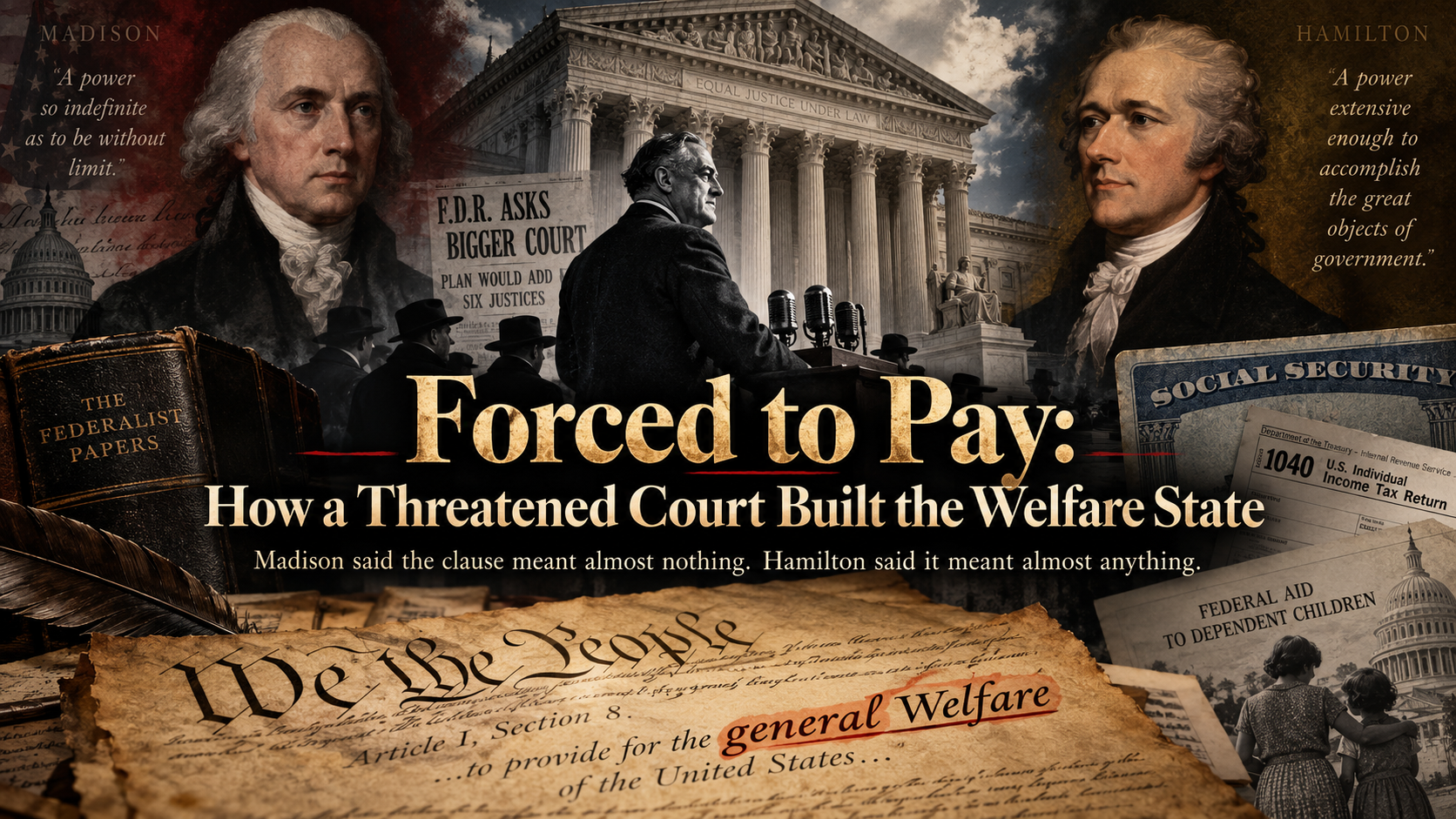
Article I, Section 8 of the Constitution gives Congress the power to "lay and collect Taxes, Duties, Imposts and Excises, to pay the Debts and provide for the common Defence and general Welfare of the United States." Eight words at the end of that sentence, "and general Welfare," have done more to expand the size of the federal government than almost any other clause in the document. The founders who wrote that sentence disagreed sharply about what it meant, and the disagreement was never really settled by debate. It was settled by a threat.
James Madison, the man most responsible for drafting the Constitution, believed the general welfare clause authorized nothing on its own. In his view, Congress could tax and spend only to carry out the specific, enumerated powers listed elsewhere in Section 8, raising armies, regulating commerce, establishing post roads, and so on. "General welfare" was a description of the purpose behind those enumerated powers, not a separate, freestanding grant of authority. Madison warned that reading it any other way would hand Congress what amounted to an unlimited power to spend on anything it decided was good for the country, swallowing the entire structure of limited, enumerated government the Constitution was built to establish.
Alexander Hamilton disagreed, and he said so directly in his 1791 Report on Manufactures. Hamilton argued that the power to spend for the general welfare was a distinct power in its own right, not tethered to the other enumerated powers. Congress, in his view, could tax and spend on anything it judged to serve the nation's general welfare, full stop. The only constraint was that the spending had to be general in character rather than aimed at narrow, particular interests.
Madison: taxation and spending are valid only in service of the powers Congress is already given elsewhere in the Constitution. Hamilton: taxation and spending for the general welfare is a power unto itself, limited mainly by Congress's own judgment of what counts as general rather than particular.
For nearly a century and a half, this was an unresolved argument among legal scholars rather than settled law. The Supreme Court never had to choose definitively between the two readings, because the federal government rarely tried to spend in the way Hamilton's theory would have permitted.
Roosevelt is remembered as a Democrat, politically descended from the Jeffersonian and Madisonian tradition of limited, enumerated federal power. On the actual question of what the federal government was constitutionally permitted to do, he governed far closer to Hamilton than to either man. The formulation goes back to the political theorist Herbert Croly, whose 1909 book The Promise of American Life argued that America needed "Hamiltonian means" to achieve "Jeffersonian ends," a strong, centralized national government deployed in the service of broadly democratic, egalitarian goals. Croly's synthesis directly shaped Theodore Roosevelt's New Nationalism and, a generation later, the intellectual architecture of FDR's New Deal. Roosevelt wanted a federal government with the capacity to act broadly and nationally on an economic crisis the states could not solve alone. That is a Hamiltonian instinct, dressed in Jeffersonian language about security and equality for the common man.
The New Deal Forces the Question
That changed in the 1930s. Franklin Roosevelt's New Deal programs, built to answer the Great Depression, pushed federal spending and regulation into territory no administration had previously attempted, and the Supreme Court pushed back. In 1935, the Court struck down the National Industrial Recovery Act in Schechter Poultry Corp. v. United States. In January 1936, it struck down the Agricultural Adjustment Act in United States v. Butler, though in doing so it actually adopted Hamilton's broad reading of the general welfare clause as part of its reasoning, even while ruling against Roosevelt on other grounds.
Roosevelt had been reelected in a landslide in November 1936, and he treated the Court's resistance as an obstacle to be removed rather than a boundary to be respected. In February 1937, he unveiled the Judicial Procedures Reform Bill, a plan to add up to six new justices to the Supreme Court, one for every sitting justice over the age of seventy who declined to retire. Nobody mistook the purpose. The plan was designed to dilute the votes of the justices blocking his agenda by simply adding enough new appointees to outvote them.
The Switch, and What It Built
The court-packing bill never passed Congress. It didn't have to. In March 1937, the Court's decision in West Coast Hotel Co. v. Parrish upheld a Washington state minimum wage law, reversing the direction the Court had been heading for years. Justice Owen Roberts, whose vote had swung several previous decisions against the New Deal, joined the majority. Legal historians still debate exactly how much the court-packing threat influenced Roberts personally, since there is evidence his vote in conference may have been cast before Roosevelt's plan was publicly announced. But the political reality at the time was unambiguous, and the episode has been known ever since as "the switch in time that saved nine."
Two months later, on May 24, 1937, the Court decided Steward Machine Co. v. Davis and Helvering v. Davis on the same day, upholding the unemployment compensation and old-age benefit provisions of the Social Security Act of 1935. Writing for a 7 to 2 majority in Helvering, Justice Benjamin Cardozo adopted Hamilton's broad reading of the general welfare clause as the Court's own doctrine. Congress, the opinion held, may spend money for the general welfare largely as Congress itself judges fit, with courts giving that judgment wide deference. Madison's narrower view, the one that had actually governed most of American history up to that point, lost, not in a floor debate, but in a courtroom under unmistakable political pressure.
Some constitutional historians argue the "switch" would have happened regardless of the court-packing threat, pointing to Roberts' private conference votes and broader doctrinal shifts already underway on the Court. That debate is real and unresolved. What is not in dispute is that Roosevelt's threat was real, public, and aimed directly at the Court's independence, and that the Court's rulings in 1937 reversed years of prior resistance to exactly the kind of spending Hamilton, not Madison, had always argued was constitutional.
From Social Security to Food Stamps
Helvering v. Davis did not just save Social Security. It established the constitutional foundation that every subsequent federal spending program for individual welfare has relied on since. The first federal food stamp program launched just two years later, in May 1939, distributing surplus-food stamps to the unemployed before it was discontinued in 1943 as wartime employment eliminated the need. President Kennedy revived it as a pilot program in 1961, and President Johnson made it permanent with the Food Stamp Act of 1964, folded into the broader War on Poverty. Congress renamed the program the Supplemental Nutrition Assistance Program in 2008.
None of that program existed, or could have existed in its modern form, without the doctrine Helvering established. Social Security and SNAP are funded differently. Social Security draws on a dedicated payroll tax that workers and employers are legally required to pay under the Federal Insurance Contributions Act. SNAP draws on general federal tax revenue appropriated through the Farm Bill rather than a program-specific tax. But both rest on the same underlying constitutional claim, that Congress may tax Americans broadly and spend the proceeds on whatever it judges serves the general welfare, a claim Madison explicitly warned against and Hamilton explicitly endorsed, and one the Supreme Court adopted only after a sitting president threatened to restructure the institution that was blocking it.
What That Money Actually Pays For Now
Nearly ninety years later, the programs built on that doctrine move enormous sums of money, and a meaningful share of it does not go where it is supposed to. The USDA's own data for fiscal year 2023 found an 11.7 percent national improper payment rate in SNAP, roughly $10.5 billion out of $90.1 billion in outlays. For fiscal year 2024, the rate was 10.93 percent. That is more than twice Medicaid's improper payment rate of 5.1 percent and well above Medicare's 7.7 percent, making SNAP one of the least accurate major federal benefit programs by this measure.
The improper payment rate measures total dollars paid in the wrong amount, whether too much or too little, due to any cause: state agency error, eligibility miscalculation, unreported income, or deliberate fraud. It is not, by the USDA's own description, a direct measure of fraud, and the agency explicitly cautions against treating the two as identical.
Separately measured retailer trafficking, benefits illegally exchanged for cash rather than food, has been estimated at around 2 percent of total SNAP benefits in USDA's most recent multi-year study. State agencies also replaced more than $320 million in stolen benefits for nearly 679,000 households in fiscal years 2023 and 2024 combined, most of it tied to electronic benefit theft rather than recipient fraud.
Put plainly: the honest fraud rate, the deliberate theft and trafficking, is a real but comparatively small slice of the total. The improper payment rate, the broader measure of money simply going to the wrong place in the wrong amount, is the far larger and more damning number, and it has risen every year on record since bottoming out in 2013. A program that gets more than one in nine dollars wrong, in a year when it is also replacing hundreds of millions of dollars stolen through EBT card theft, has an accountability problem independent of anyone's view on whether the program should exist in the first place.
Not Constitutional. Asserted.
Call this what it actually is. The general welfare clause was never cleanly resolved in Hamilton's favor through debate, through amendment, or through a vote the public ever cast on the specific question. It was resolved by a Court that changed its answer the same year a sitting president threatened to change its membership. That is not a constitutional settlement. It is a congressional authority that got asserted, then backed into permanence by nine frightened votes, and every dollar collected under it since has been collected on the strength of that fear rather than on the strength of the argument. Madison lost the debate he never actually got to finish having.
The Goose and the Golden Egg
Coercion that produced a sustainable result would still be coercion, but at least a defensible one. What it has actually produced is a trajectory now barreling toward its own collapse. Social Security's own trustees reported in 2026 that the Old-Age and Survivors Insurance trust fund will be depleted in 2032, two years earlier than projected just two years before that. Once the trust fund is exhausted, the trustees project the program will only be able to pay roughly 78 percent of scheduled benefits from incoming payroll tax revenue alone, a built-in 22 percent cut to everyone currently paying in and everyone currently drawing a check, unless Congress raises taxes, cuts benefits, or both. Total Social Security income in 2025 was $160 billion short of total cost. That gap does not close itself, and it has existed every year since 2010.
SNAP sits on a less dramatic but still unsustainable trajectory of its own, a program whose basic cost keeps climbing while losing more than a tenth of every dollar to error on top of that growth. And the program has not been shielded from a newer problem either. SNAP eligibility has excluded undocumented immigrants outright since 1996, and the One Big Beautiful Bill Act of 2025 tightened the rules further, cutting off refugees, asylees and several other previously eligible categories entirely. But federal rules still allow a mixed-status household, one built around an undocumented parent, to receive prorated SNAP benefits on behalf of a household member who is a citizen, typically a child. That is not a loophole anyone hid. It is the plain, acknowledged structure of the program, and it means a household headed by someone with no legal right to be in the country can still draw against a system every taxpaying citizen is forced to fund.
Layer a third problem on top of the first two. A program built to catch people during a temporary emergency has, for a meaningful share of recipients, become a multi-generational fixture instead, with children raised in a household drawing benefits becoming adults who draw benefits of their own. Supporters call this the persistence of poverty. It is at minimum fair to call it the opposite of what the program was sold as, a bridge rather than a permanent address, and a program three generations deep into the same households is not producing the independence it promised.
Why This Matters
A congressional authority asserted under threat, rather than settled by honest debate, owes the people forced to fund it more than this. It owes them a program that can keep its own word, one that does not quietly extend itself to people with no legal claim on it, and one that does not calcify into something families inherit rather than escape. Social Security's own trustees do not dispute that the program cannot keep its promise on the current path. Keep adding new obligations onto a foundation this shaky, with no serious reckoning of the math, the eligibility or the dependency underneath any of it, and eventually there is no goose left to lay anything. Americans did not get a real vote on the premise in 1937. They should not have to keep accepting, decade after decade, a bill that keeps growing regardless.
- U.S. Constitution, Article I, Section 8. [Text of the taxing and spending clause]
- Hamilton, Alexander. (1791). Report on the Subject of Manufactures. [Hamilton's broad reading of the general welfare clause]
- Madison, James. Federalist No. 41. [Madison's narrow, enumerated-powers reading of the general welfare clause]
- Croly, Herbert. (1909). The Promise of American Life. Macmillan. [Origin of the "Hamiltonian means to achieve Jeffersonian ends" formulation, influence on Theodore Roosevelt's New Nationalism and FDR's New Deal]
- United States v. Butler, 297 U.S. 1 (1936). Supreme Court of the United States.
- West Coast Hotel Co. v. Parrish, 300 U.S. 379 (1937). Supreme Court of the United States. [The "switch in time that saved nine"]
- Helvering v. Davis, 301 U.S. 619 (1937). Supreme Court of the United States. [7-2 ruling adopting the broad general welfare doctrine, Social Security Title II upheld]
- Steward Machine Co. v. Davis, 301 U.S. 548 (1937). Supreme Court of the United States. [Social Security unemployment compensation provisions upheld]
- National Constitution Center. How the Supreme Court Upheld Social Security. constitutioncenter.org.
- USDA Food and Nutrition Service. History of SNAP. fns.usda.gov. [1939 pilot program, 1961 Kennedy pilot, 1964 Food Stamp Act, 2008 SNAP renaming]
- USDA Food and Nutrition Service. (2025, June 30). Fiscal Year 2024 SNAP Quality Control Payment Error Rates. fns.usda.gov. [10.93 percent national payment error rate]
- U.S. Government Accountability Office. (2024). Improper Payments: USDA's Oversight of the Supplemental Nutrition Assistance Program, GAO-24-107461. gao.gov. [FY2023 11.7 percent improper payment rate, $10.5 billion, Medicaid and Medicare comparison]
- Mercatus Center. Reducing Waste and Fraud in SNAP. mercatus.org. [2014-2017 trafficking rate estimate, approximately 2 percent]
- Social Security Administration, Office of the Chief Actuary. (2026). The 2026 Annual Report of the Board of Trustees of the Federal Old-Age and Survivors Insurance and Federal Disability Insurance Trust Funds. ssa.gov. [OASI depletion projected 2032, 78 percent of scheduled benefits payable thereafter, 2025 income shortfall of $160 billion]
- National Committee to Preserve Social Security and Medicare. (2026). Making Sense of the New Social Security Trustees Report. ncpssm.org. [Combined OASDI depletion 2034, 83 percent of benefits payable]
- Personal Responsibility and Work Opportunity Reconciliation Act of 1996 (PRWORA). Pub. L. 104-193. [Original federal bar on undocumented immigrant eligibility for SNAP]
- USDA Food and Nutrition Service. SNAP Eligibility. fns.usda.gov. [Confirmation that SNAP eligibility has never extended to undocumented non-citizens; mixed-status household prorated benefit structure]
- Global Refuge. (2026, January). Updated OBBBA FAQ on SNAP. globalrefuge.org. [One Big Beautiful Bill Act, Section 10108, narrowing of SNAP-eligible noncitizen categories in 2025]
- Third Way. Fast Facts: SNAP and Program Integrity. thirdway.org. [EBT theft replacement figures, FY2023-2024]