"End Racism" Stencil In The End Zone Says It All
Since 2020, the NFL has stenciled "End Racism" and "It Takes All of Us" into its end zones as part of the league's Inspire Change initiative, a message Commissioner Roger Goodell has personally reaffirmed season after season, now running for seven straight years. Stand at either end zone and look down at the roster playing beneath that stencil. Black men make up roughly 7 percent of the United States population. Depending on the year and how the count is done, Black players have made up anywhere from the low 50s to numbers approaching 70 percent of NFL rosters, with the league's own 2023 TIDES report placing it at 53.5 percent and other independent tallies for recent seasons running considerably higher.
If a construction company, an engineering firm or a corporate office in America had a workforce that lopsided relative to the surrounding population, the raw numbers alone would be treated in plenty of quarters as prima facie evidence of discrimination against everyone else. That is the exact inference the league's own social-justice branding invites people to draw whenever an institution's numbers diverge sharply from the population it draws from.
Nobody serious makes that accusation against the NFL, and they shouldn't. The roster is the product of an unapologetically brutal, colorblind meritocracy. The best available athletes win the job, and the demographic result is whatever it is. That is precisely my argument, and it cuts in exactly one direction: the league cannot stencil "End Racism" into the ground under a roster built entirely on that logic, then turn around and treat identical demographic outcomes elsewhere as evidence that someone else's hiring must be broken.
An NFL prospect does not earn that roster spot by giving a compelling speech about representation. He has to perform. His game film gets scrutinized. His conditioning gets tested. His judgment, discipline, strength and speed become subjects of relentless evaluation.
Then he competes against other exceptional athletes who want the same job.
I have no objection to that process. Professional football demands extraordinary ability. A team has every reason to select the people best equipped to win.
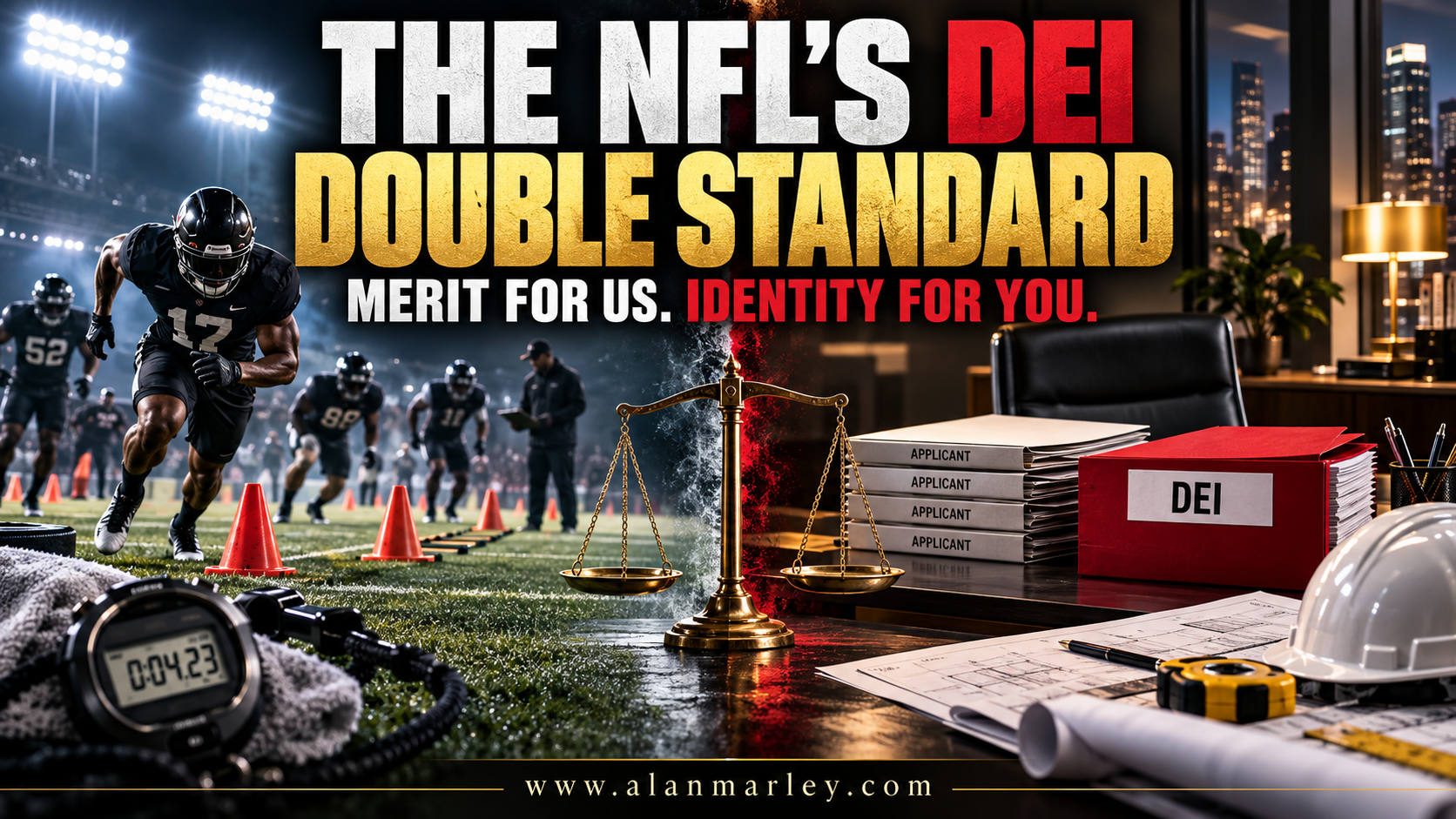
What I object to is the willingness to defend demanding, performance-based selection in professional sports while treating that same principle with suspicion in other workplaces.
The NFL publicly supports diversity, equity and inclusion. Commissioner Goodell has defended the league's DEI programs. That makes it reasonable to ask exactly what the league means by equity, and whether its standard applies consistently beyond the stadium.
If it means giving qualified people a fair opportunity to compete, there is no disagreement. If it means treating an unequal racial outcome as evidence that the selection process must be defective, professional football presents an obvious problem, starting with the very field the league paints its message on.
The NFL does not resemble a random sample of America. It is a highly selective workforce in which Black athletes constitute a majority. The 2023 TIDES Racial and Gender Report Card classified 53.5 percent of players as Black, with multiracial players recorded separately.
That is no reason to change a roster. A player's opportunity should depend on his qualifications and performance, not whether his race needs another representative.
But the principle works both ways. You cannot establish discrimination merely by counting faces in a locker room. You cannot establish it merely by counting faces in a construction company, an engineering firm or a corporate office either. Numbers can prompt an investigation. They cannot substitute for one.
What I Actually Need on a Job Site
As a general contractor, I am responsible for work that has to function in the real world. A roof has to keep water out. A beam has to carry its load. A deck has to support the people standing on it.
Those requirements do not become more forgiving because a hiring decision served somebody's demographic objective.
I need people who can do the work, follow instructions, recognize problems and take responsibility. Experience matters. Training matters. Reliability matters. Skin color cannot tell me any of those things.
The NFL understands the importance of relevant qualifications whenever it evaluates a player. Nobody reasonably expects a coach to overlook poor preparation because an applicant would improve the team's racial balance. Nobody should expect a contractor to do the equivalent.
Opportunity Is Not the Same as Outcome
And spare me the suggestion that insisting on competence somehow means opposing opportunity.
Advertise positions broadly. Recruit beyond familiar networks. Offer training. Remove irrelevant barriers. Give people a genuine chance to demonstrate what they can do. Those measures can strengthen merit-based selection by helping employers find talent they otherwise might miss.
But access to competition and entitlement to a particular outcome are different propositions.
The NFL itself says its Rooney Rule does not impose hiring quotas and that hiring decisions must rest on merit. That distinction matters. It would be inaccurate to describe every diversity initiative as an instruction to hire unqualified people.
Fine. Then defend that distinction everywhere.
That would be a useful public message.
Instead, corporate diversity rhetoric too often leaves the central question unresolved. Are we expanding the opportunity to compete, or judging the competition by whether it produces politically preferred numbers?
I reject the second standard. Whether it favors Black applicants, white applicants, men, women or anyone else, the objection is the same. People deserve individual consideration.
That standard also protects successful minority employees. Their achievements should be recognized as their own, rather than reduced to a company's diversity statistics.
Nobody Is Owed a Roster Spot
The NFL does not owe white players additional roster spots to achieve population parity. No employer owes anyone a position merely because of identity. Every applicant deserves a fair assessment against requirements that actually matter to the job.
Real discrimination deserves investigation and consequences. But accusing an employer of discrimination requires evidence about its conduct, not simply disappointment with its demographic totals.
Football fans understand why competition is demanding. Preparation, skill and execution matter. A roster spot is an opportunity someone else also wants, and the decision needs a defensible basis.
The rest of us have responsibilities that deserve equally serious consideration. Our customers depend on our judgment. Our employees depend on the business remaining viable. In construction, people's safety can depend on whether we chose someone capable of doing the job.
If the league believes fair opportunity and merit belong together, it should say so without qualification. If anyone uses its diversity message to argue for identity over demonstrated ability, the answer should be the same one a competitive roster demands. Show us what you can do.
- The Institute for Diversity and Ethics in Sport (TIDES), University of Central Florida. (2023, December 14). 2023 NFL Racial and Gender Report Card. tidesport.org. [53.5 percent of players classified as Black]
- National Football League. Rooney Rule Policy Overview. nfl.com/nflpa hiring policy documentation. [Rooney Rule's stated merit-based hiring standard, no quota provision]
- Statements of NFL Commissioner Roger Goodell defending the league's diversity, equity and inclusion programs, as reported across NFL and sports media coverage.
- ESPN. (2020, July 27). NFL to Stencil 'End Racism' on End Zone Borders as Part of Social Justice Rollout for Kickoff Week. espn.com. [Origin of the end zone stencil program]
- NFL.com. (2025, August 14). NFL Teams Will Again Stencil Messages in End Zone, Including 'End Racism' and 'Choose Love.' nfl.com. [Continuation of the program into its most recent season]
- U.S. Census Bureau. QuickFacts: United States. census.gov. [Black population share used to calculate the approximate Black male population percentage]
- Wikipedia. Racial Issues Faced by Black Quarterbacks; Black Players in Professional American Football. en.wikipedia.org. [Historical NFL Black player percentage estimates ranging into the high 60s and near 70 percent, depending on year and counting method]