
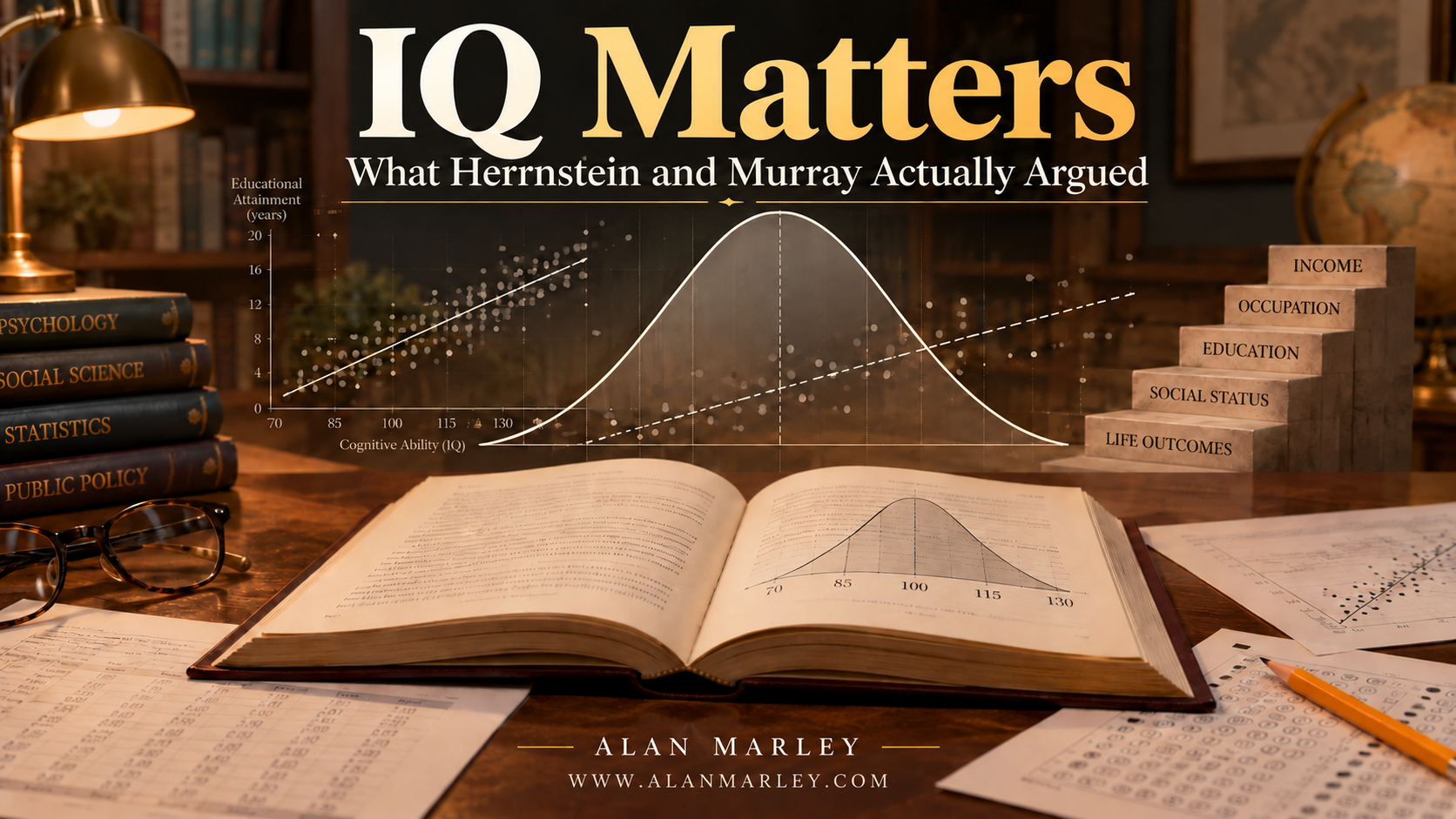
Richard Herrnstein and Charles Murray published The Bell Curve: Intelligence and Class Structure in American Life in 1994. It runs to more than 800 pages including appendices, built almost entirely on statistical analysis of the National Longitudinal Survey of Youth, a federal dataset tracking thousands of Americans over decades. What follows is a summary of what the book itself claims, organized the way the authors organized it, without added commentary.
The Core Premise: IQ Is Real and It Matters
The book opens by arguing that general cognitive ability, what IQ tests measure, is a real, stable, measurable trait rather than a cultural artifact or testing illusion. The authors argue IQ tests measure a genuine underlying factor of general intelligence, sometimes called "g," and that this factor predicts outcomes better than competing measures like parental socioeconomic status.
They state IQ is substantially heritable, citing twin and adoption studies to support heritability estimates in the range of 40 to 80 percent for individuals, meaning a large share of the variation in IQ scores within a population traces to genetic differences between individuals. The authors are explicit that heritability of a trait within a population does not by itself explain differences between populations, and note this distinction directly in the text, though they go on to apply the finding to group comparisons regardless.
The Cognitive Elite and Social Stratification
The book's central sociological argument is that American society was increasingly sorting itself by cognitive ability rather than by family wealth or social class of origin. The authors describe elite universities and high-paying professional fields as increasingly selecting for high IQ specifically, concentrating high-IQ individuals together geographically, economically and maritally, a process they call the formation of a "cognitive elite."
They argue this sorting was producing a widening gap between that cognitive elite and everyone else, and predicted this stratification would intensify as an information economy rewarded abstract reasoning ability more heavily than earlier industrial-era economies had.
IQ and Social Outcomes
Using regression analysis on the NLSY data, the authors argue that IQ score predicts a range of life outcomes independent of, and often more strongly than, parental socioeconomic status. They report IQ as a stronger predictor than family background for outcomes including poverty, unemployment, receiving welfare, dropping out of high school, having a child outside marriage, and involvement in the criminal justice system.
The authors' approach throughout was to statistically hold IQ score constant and observe whether socioeconomic background still predicted outcomes, and separately to hold socioeconomic background constant and observe whether IQ still predicted outcomes. They report that in most of their models, IQ retained predictive power after controlling for background, while background's predictive power was often diminished after controlling for IQ.
From this, the authors argue that cognitive ability, not class origin, environment or opportunity alone, was the stronger statistical driver of a range of American social outcomes measured in the dataset.
The Chapter on Ethnic Differences
Chapter 13 and the surrounding material address group differences in measured IQ, the book's most publicly debated section. The authors report an average gap of approximately one standard deviation, about 15 points, between Black and white test-takers' average scores on standardized IQ tests, a gap they describe as well documented and long-standing in psychometric literature predating their book.
On the cause of that gap, the authors state their own position directly in the text: that the evidence available did not allow a confident determination of how much of the gap was attributable to genetic factors versus environmental factors, and that in their assessment it was "likely" some combination of both contributed, without specifying a ratio. They explicitly reject the claim that the gap is entirely environmental, and separately state they are not claiming to have proven a genetic component, positioning their own conclusion as an open question rather than a settled finding.
The authors also discuss the Flynn effect, the documented rise in average IQ scores across entire populations over the 20th century, and acknowledge it as evidence that environment can move average scores substantially over time, while arguing it does not by itself resolve the question of what portion of the racial gap, at any given point in time, was environmental versus genetic in origin.
Policy Recommendations
The book's final chapters translate its empirical claims into specific policy positions. The authors argue against large-scale government programs aimed at raising IQ or closing outcome gaps between groups, on the grounds that IQ is difficult to change substantially through intervention once established, and cite intervention studies they interpret as showing limited or fading long-term effects.
They argue against race-based affirmative action in university admissions and hiring, contending it selects some individuals over higher-scoring individuals of other groups and, in their assessment, does not address the underlying distribution of cognitive ability. They recommend immigration policy favor applicants with higher measured skills and education levels. They also argue for simplifying the American legal and regulatory system, contending its complexity disproportionately burdens people with lower cognitive ability who must navigate it.
What the Book Says About Itself
In their introduction and conclusion, Herrnstein and Murray anticipate controversy and state their intention was to present statistical findings from available data rather than to advocate for any particular view of human worth or moral hierarchy. They write that they expected significant portions of their argument, particularly the ethnic differences chapter, to generate strong public reaction, and address that expectation directly in the text before the relevant chapters begin.
A Separate Note: My Own Opinion on Military Testing
Everything above is a summary of what Herrnstein and Murray argued in their own book. What follows is a different subject entirely, and it is my own opinion, not a summary of anyone else's work.
The United States military has used some form of standardized aptitude and cognitive testing to place recruits since the Army Alpha and Beta tests of 1917, now over a century ago. That lineage continued through the Army General Classification Test in World War II, the Armed Forces Qualification Test introduced in 1950, and the Armed Services Vocational Aptitude Battery, introduced in 1968 and adopted tri-service in 1976. In one form or another, the federal government has continuously used this kind of testing to sort recruits into military occupations for more than one hundred years.
I went through that process myself when I joined the Marine Corps. I was tested, and I was placed into my occupational specialty according to my scores. In my opinion, based on my own experience, the test worked exactly as intended. It matched aptitude to job, and it has kept doing that for generation after generation of American servicemembers across more than a century of continuous federal use.
In my opinion, a testing program the federal government has trusted for over a hundred years to make consequential job placement decisions for millions of recruits has more than proven itself as an effective, practical tool for exactly what it was built to do.
I also believe that same kind of cognitive and aptitude testing has a legitimate place outside the military. In my opinion, the United States could use it after eighth grade to help direct students toward trade schools or toward academic tracks, the way a number of other countries already do, rather than pushing nearly everyone down the same college-preparatory path regardless of aptitude or interest. And in my opinion, private employers should be free to use aptitude testing as part of job screening, the same basic logic the military has relied on for a century, applied to the civilian workforce.
- Herrnstein, Richard J., and Charles Murray. (1994). The Bell Curve: Intelligence and Class Structure in American Life. Free Press.
- U.S. Department of Defense. History of the ASVAB and Its Predecessor Tests. asvabprogram.com. [Army Alpha and Beta, 1917; AGCT, World War II; AFQT, 1950; ASVAB, 1968, tri-service adoption, 1976]