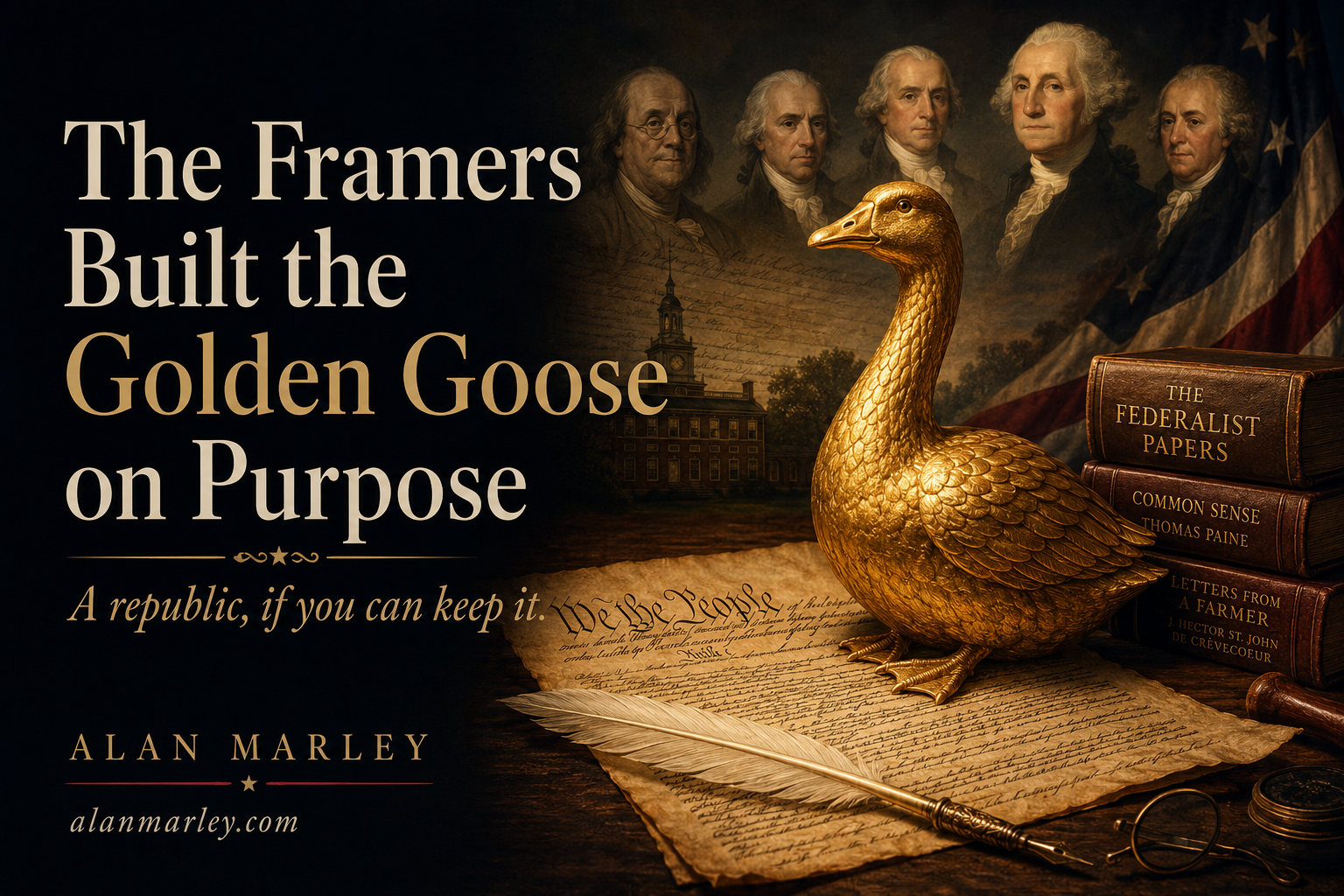
America's prosperity is not an accident of geography, luck or destiny, and the people who built the system that produced it never claimed otherwise. They said, in writing, in speeches, in the Constitution's own structure, exactly what they thought would make the experiment work, and exactly what they feared would tear it apart. That record still exists. It is not a matter of interpretation or modern spin. The Framers told us, in their own words, that liberty and prosperity were the product of a specific, deliberately engineered arrangement of institutions, and that the arrangement would only survive as long as the people living under it chose to maintain it.
That is not a new argument. It is the oldest argument this country has, older than the argument itself being forgotten.
"A Republic, If You Can Keep It"
As the Constitutional Convention adjourned in September 1787, Elizabeth Willing Powel, a prominent Philadelphian, reportedly asked Benjamin Franklin what the delegates had produced. The exchange survives in the convention journal of Maryland delegate James McHenry, now held at the Library of Congress: "A lady asked Dr. Franklin, well Doctor, what have we got, a republic or a monarchy. A republic, replied the Doctor, if you can keep it."
Franklin did not say democracy. He said republic, and the distinction mattered enormously to the men who wrote the Constitution. A republic, in their understanding, was a government of laws rather than of momentary majorities, built with deliberate friction, separated powers and enumerated limits precisely so that no single faction, however popular in the moment, could simply seize the whole of it. And Franklin's addition, if you can keep it, was not a throwaway line. It was a warning built directly into the founding anecdote of the country: the system he had just helped design was conditional. It required maintenance. It was never described as self-sustaining.
Government Exists to Protect the "Diversity in the Faculties of Men"
James Madison made the connection between liberty and prosperity explicit in Federalist No. 10, writing that the protection of the different and unequal human faculties for acquiring property is, in his words, "the first object of government." That is a specific, deliberate claim, not an afterthought. Madison was arguing that a government's core purpose is to protect the conditions under which individual initiative, talent and effort can produce unequal but legitimately earned outcomes, rather than to guarantee equal results or to redistribute according to any single faction's preferences.
This is the intellectual root of the argument that prosperity is not an accident. Madison did not believe wealth or opportunity fell from the sky onto a fortunate people. He believed a specific legal architecture, property rights, contract enforcement, protection from arbitrary seizure, was the precondition for a society in which effort could reliably translate into reward. Remove that architecture, and the reward stops being reliable, regardless of how talented or hardworking the people underneath it remain.
"Ambition Must Be Made to Counteract Ambition"
The same logic runs through Madison's Federalist No. 51, where he lays out why the Constitution divides power across separate branches rather than trusting any single institution, however well-intentioned, to govern alone. "If men were angels, no government would be necessary," Madison wrote. Because men are not angels, and because those who govern them are not angels either, "ambition must be made to counteract ambition," with each branch given the constitutional means and personal motive to resist encroachment by the others.
The Framers did not design checks and balances because they distrusted foreign threats. They designed it because they distrusted concentrated power itself, including power held by people who claimed the best of intentions. That structural skepticism, applied evenly to every faction rather than only to one's opponents, is precisely what the "golden goose" argument depends on. The system protects prosperity by refusing to let any single group, however righteous it believes itself to be, capture the whole of it.
"A Moral and Religious People," Adams Warned, and Not Just Any People
John Adams made the fragility of the arrangement even more explicit in an 1798 address to the Massachusetts militia: "Our Constitution was made only for a moral and religious people. It is wholly inadequate to the government of any other." Whatever one makes of Adams's specific religious framing, the structural claim underneath it is the same one running through Franklin and Madison. The Constitution does not enforce itself. It assumes a citizenry willing to exercise self-restraint, respect the outcomes of elections they lose, and place loyalty to the constitutional order above loyalty to any single faction, religious tradition or political tribe. Remove that underlying civic character, Adams argued, and no document, however well drafted, can compensate for its absence.
Washington's Warning About Faction
George Washington used his 1796 Farewell Address to warn the country against exactly the kind of tribal division this site has written about elsewhere. He cautioned against "the baneful effects of the spirit of party," arguing that unchecked factionalism would eventually enable "cunning, ambitious and unprincipled men" to subvert the power of the people and usurp the government for themselves. He also called religion and morality "indispensable supports" of political prosperity, arguing that national character, not just legal architecture, was part of what held the whole structure up.
Washington was not describing a hypothetical danger. He was describing the specific mechanism by which he expected the republic to eventually fail, if it ever did.
The Golden Goose, in Their Words and Ours
Put these four threads together and the modern argument about the golden goose is not a new metaphor. It is a restatement of what the Framers said plainly at the founding. Prosperity did not materialize by magic. It grew from a particular combination of constitutional liberty, representative government, private property, free enterprise, individual responsibility, ordered freedom and equality before the law. The system has never operated perfectly, and Americans have repeatedly fought, correctly, to make its promises apply more honestly and broadly than the Framers themselves originally allowed. Nevertheless, those principles helped create one of the freest and most prosperous nations in human history, and the Framers said, in their own writing, that this outcome depended entirely on the people continuing to maintain the architecture that produced it.
We cannot dismantle the cultural and institutional foundations of American prosperity and then act surprised when the prosperity disappears. The Framers were explicit that this was always a possibility, not a paranoid modern invention.
If America allows incompatible political ideologies to establish permanent enclaves, demand immunity from common laws and gradually undermine constitutional principles, it will eventually kill the goose that lays the golden egg, exactly the outcome Franklin, Madison, Adams and Washington each independently warned about, using different language, in the founding decade of the country.
The Honest Counterargument
A fair version of this piece has to acknowledge what the Framers got wrong, not only what they got right. The generation that wrote these words also wrote a Constitution that counted enslaved human beings as three-fifths of a person, restricted the franchise to property-owning white men in most states, and left women and Native Americans entirely outside its promises. Madison, who wrote so precisely about protecting the individual's faculty to acquire property, owned enslaved people himself. The gap between the Framers' stated principles and their actual practice is real, well documented and should never be minimized in the name of admiring their architecture.
What survived that hypocrisy, and what later generations used to correct it, was the structure itself, the amendment process, the language of equal protection, the mechanism of self-correction Madison built into the system. The Thirteenth, Fourteenth, Fifteenth and Nineteenth Amendments did not require abandoning the Framers' architecture. They required finally applying it honestly to people it had excluded. That history cuts both ways: it is evidence the system was flawed at its founding, and it is evidence the structural design the Framers described was sound enough to eventually correct its own worst failures without being torn down and replaced.
My Bottom Line
Franklin, Madison, Adams and Washington were not writing inspirational plaques. They were describing an engineering problem and their proposed solution to it, in plain, specific language that has survived intact for over two centuries. A republic, not a democracy. Government's first object as the protection of individual faculties, not the redistribution of outcomes by whichever faction holds power. Ambition checking ambition, because no group, however well-intentioned, can be trusted with unchecked authority. A citizenry willing to restrain itself, because no document restrains a people who no longer wish to be restrained.
None of that happened by accident, and none of it continues by accident either. The Framers said so themselves, plainly, in writing, and the burden of keeping their arrangement running never left the hands of the people it was built for.
Why This Matters
Every generation that inherits this system is tempted to treat American prosperity as a fixed condition, something that will simply continue regardless of what its citizens do or fail to do. The Framers explicitly rejected that assumption before the ink on the Constitution was even dry. Franklin's answer to Mrs. Powel was not a boast. It was a caution, delivered at the exact moment the document was finished, by the man who had just helped write it. Two and a half centuries later, the caution has not expired. The goose still lays the golden egg for exactly as long as the people who inherited it choose to keep the arrangement that makes the egg possible in the first place.
References
- McHenry, J. Constitutional Convention journal, September 18, 1787. Library of Congress, Manuscript Division. [Source of Franklin's "a republic, if you can keep it."]
- Madison, J. (1787). Federalist No. 10. [On the protection of "the diverse faculties of men" as "the first object of government."]
- Madison, J. (1788). Federalist No. 51. ["If men were angels, no government would be necessary"; "ambition must be made to counteract ambition."]
- Adams, J. (1798, October 11). Address to the officers of the First Brigade of the Third Division of the Militia of Massachusetts.
- Washington, G. (1796, September 19). Farewell Address.
Disclaimer: This article reflects the author's personal opinions and historical analysis, offered for commentary and public discourse purposes only. It does not minimize or excuse the documented failures of the founding generation, including slavery and the exclusion of women and Native Americans from the Constitution's original promises. It does not represent the positions of any institution, employer, organization or affiliated entity with which the author may be associated in any capacity. Political and historical commentary is protected opinion under the First Amendment. Readers are encouraged to consult primary sources and form their own conclusions.