I recently wrote about Netflix's new adaptation of Lord of the Flies , and one detail from William Golding's novel has stayed with me since, not the violence, though there is plenty of that, but the shape of what actually causes it. A group of boys stranded on an island splits into two camps. One keeps trying to maintain rules, a signal fire and some version of civilization. The other trades all of that away for the emotional certainty of tribal belonging. And running underneath the whole split is a monster nobody has actually seen, a beast the boys are increasingly convinced is stalking the island, hunting them, growing stronger while the adults who might protect them are nowhere to be found.
The beast turns out to be a dead paratrooper, tangled in his parachute lines on the mountaintop, moved by wind rather than intention. It was never hunting anyone. It was never even alive. The boys built an entire tribal war, complete with a sacrificial hunt and a severed pig's head on a stick, around a threat that existed almost entirely in their own imagination. The real danger on that island was never the thing they were afraid of. It was what fear did to them while they were busy being afraid of it.
I don't think that's just a plot device from a seventy-year-old novel. I think it's close to the most accurate description available of where American political life actually sits right now.
Two Camps, One Island
Ralph's camp in the novel isn't glamorous. It's boring, in fact, on purpose. Keep the fire burning. Build shelters. Take turns. Follow the rules everyone agreed to. It offers structure and a chance at rescue, but no excitement, no belonging beyond ordinary cooperation, and no enemy to define itself against.
Jack's camp offers something Ralph's never could. Identity. Excitement. A hunt. A tribe you belong to simply by joining, with face paint and a shared enemy to replace the tedious work of self-government. It is, not coincidentally, the camp that grows.
I've written before about how American politics increasingly sorts along a similar line, not left versus right in the old sense of competing policy platforms, but institutionalist versus tribal in a more basic sense. One side of any given argument tends to appeal to process, rules, evidence and the boring machinery of self-government. The other tends to appeal to belonging, identity and a named enemy responsible for whatever has gone wrong. Both instincts exist inside every party and every movement. What's changed is how reliably the tribal instinct wins the argument for attention, the same way Jack's hunt wins the boys' attention over Ralph's fire.
The Beast Was Never Real
Here is the detail that actually matters, and the one I think gets skipped over too quickly whenever this novel gets discussed as a simple parable about human nature being savage underneath. The beast the boys fear is not evidence of anything they were right about. It is a corpse. It is genuinely harmless, and by the time anyone gets close enough to see that clearly, the social structure built entirely around fearing it has already produced real violence, a real death, and a real collapse of the rules that had been holding the group together.
The fear did not respond to evidence of a real threat. The fear came first, generated by isolation, exhaustion and the absence of adult authority, and then the boys went looking for something to justify it. A half-seen shape on the mountain in bad light was enough. Nobody needed the beast to be real. They only needed something to point at.
Not every fear on the island points at nothing, and it's worth being precise about that, because collapsing every fear into "it was always fake" would be its own kind of dishonesty, the mirror image of Jack's mistake rather than a correction of it. Some of what people are currently afraid of has a real creature attached to it somewhere. Organized political Islam has an actual, documented record of pursuing exactly what its critics fear, in specific movements, specific regimes and specific historical moments, and communism has an actual, documented death toll in the tens of millions across the twentieth century. Real things. Not corpses in parachute cords. What gets exaggerated in the American context specifically isn't always the existence of the threat. It's the scale, the proximity and the odds of it actually landing here. A real but distant and largely contained danger gets described as if it were already standing at the edge of camp, ready to overrun the fire tonight, and that gap between what's actually there and what fear insists is coming is exactly where a tribal hunt gets its energy.
Other fears on the list are closer to the actual paratrooper, no creature at all, just wind moving something already dead. Divine judgment arriving on a schedule that has been announced and broken so many times across so many decades that the pattern itself is the evidence against it. Wokeness or socialism dissolving the republic inside a single election cycle, when the country's own institutional inertia, the subject of two other pieces on this site, makes that specific mechanism nearly impossible regardless of how real the underlying ideology is.
Responding correctly to a real, distant, exaggerated threat looks nothing like responding correctly to a threat that was never there to begin with, and treating both the same way gets both responses wrong. A real predator, wildly overestimated in size and proximity, still deserves a fence, just not a war. A dead paratrooper deserves a closer look and nothing else.
Jack's Tribe Understood Something Real About People
I don't want to make this too easy on the Ralphs of the world, myself included. Jack's tribe wins for a reason, and the reason isn't stupidity. Tribal belonging offers something Ralph's rules genuinely cannot, a place, an identity, a feeling of being chosen and protected rather than merely tolerated. Fear of a shared enemy is one of the fastest bonding mechanisms available to human beings, and it works precisely because it's emotionally real even when its object isn't.
Nobody joins Jack's tribe because they've been convinced by evidence. They join because the tribe offers something Ralph's fire never could, and the monster is just the price of admission.
That's worth sitting with, because it means the fix isn't simply better facts. Plenty of people currently convinced that some named villain, a religion, a party, an ideology, is coming to destroy the country are not failing to reason. They're responding, rationally enough, to a genuine hunger for belonging that the boring, institutional camp has consistently failed to offer them anything comparable to. Political operatives, media figures and preachers who traffic in existential fear are not creating that hunger out of nothing. They're the first ones to notice it's there and unmet, and they're supplying tribal identity to people the process-and-evidence camp has largely stopped bothering to recruit.
Piggy's Glasses and the Rules We Still Need
The conch in Golding's novel is a genuinely fragile thing, a shell that grants the right to speak, backed by nothing but the boys' collective agreement to respect it. It works exactly as long as enough people continue believing it's worth respecting, and it stops working the instant a large enough faction decides it isn't. Nobody votes to abolish the conch. It simply stops mattering to enough people that its authority quietly evaporates, and once it's gone, nothing written or spoken can bring it back by itself.
That is not a bad description of what happens to institutions, elections, courts, a free press, the basic norm of treating a political opponent as a fellow citizen rather than an enemy combatant. None of it enforces itself. All of it depends entirely on enough people continuing to believe it's worth defending, even when the tribal alternative is more emotionally satisfying in the moment.
The Honest Counterargument
A fair version of this piece owes its critics something specific: not every feared thing is a dead paratrooper on a mountaintop. Political Islam and communism, named above, are real and documented, not manufactured, and treating every warning as manufactured panic would be its own kind of foolishness, the mirror image of the mistake this piece is describing. Terrorism is real. Foreign adversaries pursuing genuine advantage are real. Specific documented instances of institutional failure, corruption or bad policy are real and deserve to be named and fought, specifically, the way I've argued elsewhere on this site.
What Golding's novel actually argues, and what I'm arguing here, is narrower than "nothing is ever dangerous." It's that fear reliably outruns evidence, that groups under stress will manufacture a monster to explain feelings that already exist for other reasons, and that the resulting tribal structure does far more real damage than the imagined threat ever could have. Distinguishing a real threat from a manufactured one takes exactly the kind of patient, boring, unglamorous work Ralph was trying to do the entire time, and that work is precisely what tribal fear makes people stop wanting to do.
My Bottom Line
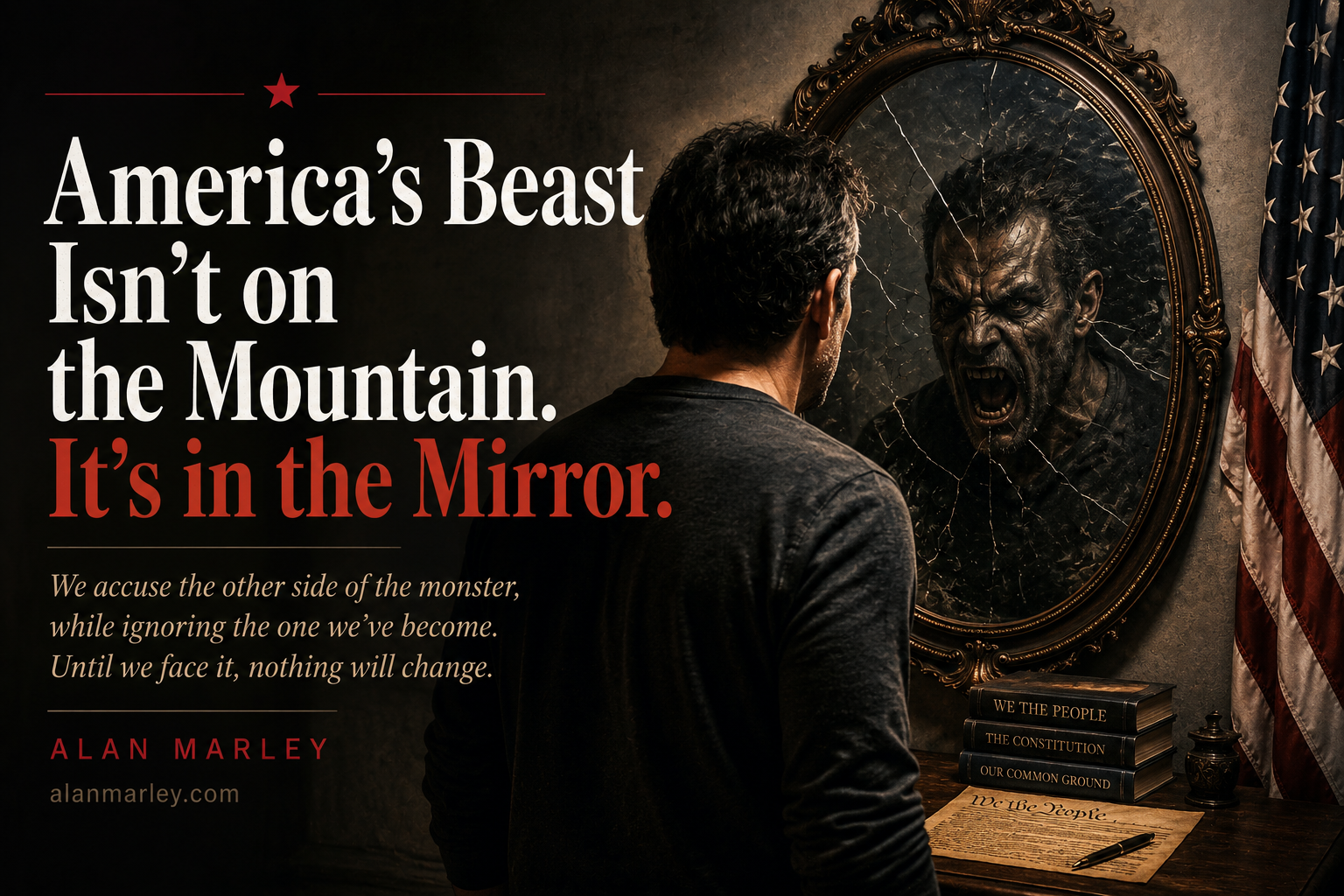
Every camp needs its beast. That's not a flaw unique to a stranded group of English schoolboys. It's a fairly reliable feature of how frightened groups of people organize themselves, and it doesn't require malice to get started, only fear, isolation and the absence of anyone willing to do the boring work of checking whether the shape on the mountain is actually alive.
The tragedy in Golding's novel was never that the boys were afraid. It was that nobody stopped long enough to climb the mountain and look closely before the hunt began.
Why This Matters
A nation is a much larger island, with far more mountains and far more shapes in the bad light that someone, somewhere, is always ready to identify as a beast. The instinct that split Ralph's camp from Jack's is not a relic of fiction. It is a standing feature of frightened human groups, and it will keep producing real tribes, real hunts and real casualties out of imagined monsters for as long as enough people find the tribe more appealing than the fire. The actual work, unglamorous and slow, is climbing the mountain before the hunt starts, and asking honestly whether the thing everyone is suddenly afraid of was ever really alive.
References
- Golding, W. (1954). Lord of the Flies. Faber and Faber.
- Mason, L. (2018). Uncivil Agreement: How Politics Became Our Identity. University of Chicago Press.
- Pew Research Center. Political Polarization and Views of the Opposing Party. pewresearch.org.
- Courtois, S. et al. (1999). The Black Book of Communism: Crimes, Terror, Repression. Harvard University Press. [On documented death tolls under twentieth-century communist regimes.]
- Marley, A. (2025). Islam's Political Dimension: What the West Keeps Refusing to Discuss. alanmarley.com.
Disclaimer: This article reflects the author's personal opinions and literary analysis, offered for commentary and public discourse purposes only. It does not target any specific political party, religion or movement as uniquely responsible for manufactured fear, and it does not represent the positions of any institution, employer, organization or affiliated entity with which the author may be associated in any capacity. Political commentary is protected opinion under the First Amendment.