
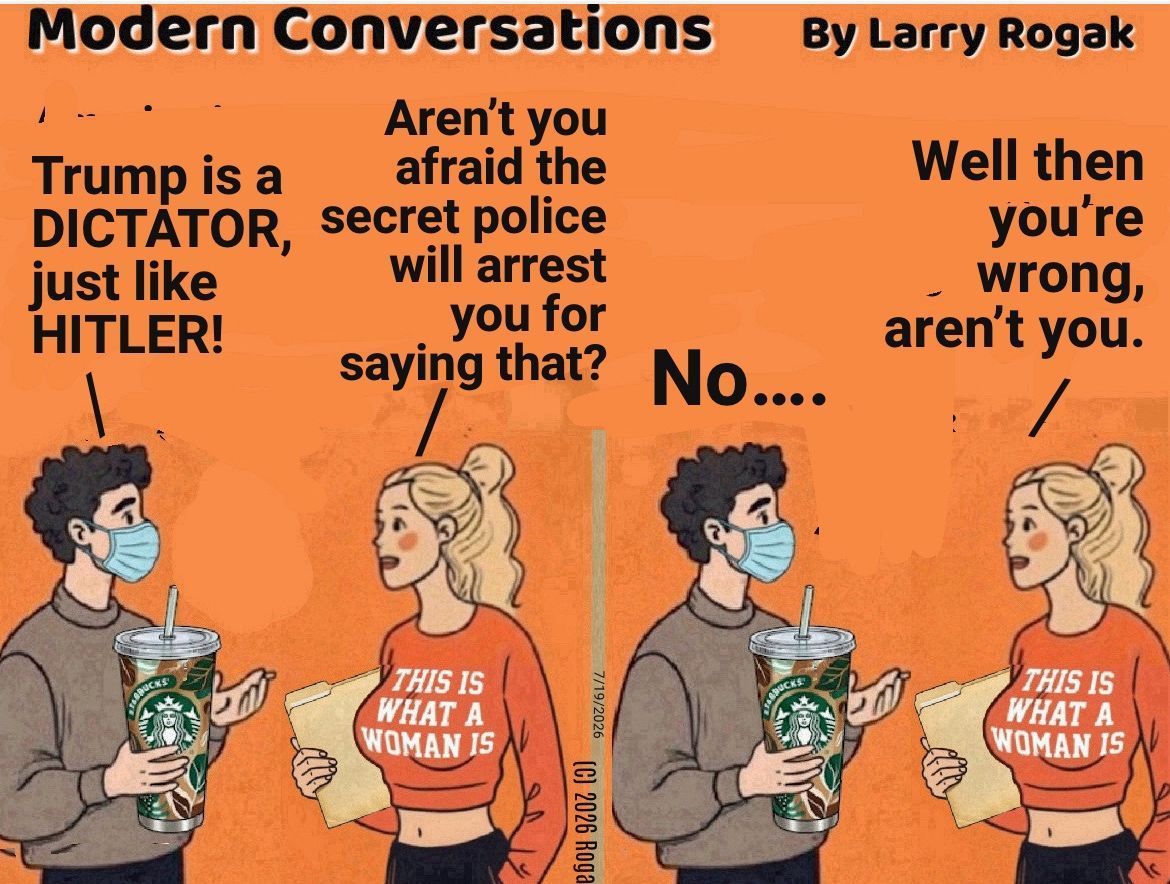
The conventional political wisdom heading into November 2026 is that the party out of the White House almost always picks up seats in the midterms, that Trump's approval ratings have softened, that the Big Beautiful Bill is polling underwater and that Democrats need only a net gain of three House seats and four Senate seats to retake both chambers. All of that is accurate and all of it points toward a Democratic wave. There is one problem with the wave theory, and it is not a small one. The Democratic Party's brand is polling at historic lows by its own internal research, its coalition is visibly fractured between people who want to win elections and people who want to perform ideology, it has no nationally recognized leader who speaks for the whole party and it has spent two years handing Republicans a gift-wrapped messaging advantage on crime, immigration and cultural sanity that the right did not even have to manufacture. You can win a midterm on anti-incumbent energy alone. You can also throw that opportunity away. Democrats are working hard at both simultaneously.
The Numbers the Party Does Not Want to Talk About
Start with the polling because the polling is damning and it comes from Democrats themselves. A Navigator Research survey shared with Politico in early 2025 found that in battleground House districts, a majority of voters believed Democrats in Congress were more focused on helping other people than people like them. Among independents, only 27 percent believed Democrats were focused on helping them, compared with 55 percent who said the party was focused on others. Only 44 percent of those surveyed said they believed Democrats respect work. Only 39 percent said the party values work. Only 42 percent said Democrats share their values. A majority, 56 percent, said Democrats are not looking out for working people. Molly Murphy, one of the pollsters on the Navigator research, put it plainly: "The Democratic brand is still not where it needs to be in terms of core trust and understanding people's challenges. Even though voters are critical about Trump and some of the things he's doing, that criticism of Trump does not translate into trust in Democrats. The trust has to be earned."
An NBC News poll found that only 30 percent of registered voters view the Democratic Party positively, compared with 52 percent who view it negatively. G. Elliott Morris, a noted electoral analyst, documented that approximately 55 percent of Americans hold an unfavorable view of the party. Democrats currently lead in generic congressional ballot polling, which suggests voters prefer them to Republicans in the abstract. The polling on the party's brand suggests those same voters do not particularly trust or respect the institution they say they prefer. Winning on pure anti-Trump energy is possible. It is also not guaranteed, as 2022 demonstrated when the expected blue wave did not materialize despite the environment.
Republicans hold 53 Senate seats to Democrats 47. Democrats need a net gain of four Senate seats to retake the majority. Of the 35 Senate seats up in 2026, 23 are held by Republicans, giving Democrats a larger target environment than usual. In the House, Democrats need a net gain of only three seats. Historical midterm patterns favor the party out of the White House. Forecasters at Cook Political Report, Sabato's Crystal Ball and Inside Elections show a genuinely competitive map. This is Democrats' race to lose. The question is whether they are disciplined enough not to lose it.
The Fracture That Will Not Heal Itself
The Democratic coalition in 2026 contains several distinct and frequently incompatible factions, and the party has not found a way to speak to all of them without alienating at least one. The largest group is ordinary working-class and middle-class Democratic voters worried about kitchen-table economics, healthcare costs, housing affordability and whether their kids can get a decent job. They are the people the party used to exist to represent and whom its own polling now shows feel increasingly unrepresented by it. They want to win elections. They want practical results. They are not primarily motivated by ideological performance.
Then there is the progressive left, which controls much of the party's activist energy, social media presence and loudest public voices. This wing is primarily motivated by immigration maximalism, climate policy, gender ideology, racial equity frameworks and opposition to virtually anything associated with the current administration. These positions poll respectably within Democratic primaries and very poorly in general elections. There is the socialist wing, currently energized by Zohran Mamdani's election as New York City's mayor, pushing nationalized utilities, rent freezes and city-owned grocery stores. There are the TDS-driven voters who have organized their entire political identity around personal hatred of Trump rather than any affirmative policy agenda. And there are the identity-politics constituencies whose positions on immigration and crime enforcement have polled so poorly with the median American voter that Republican strategists reportedly light candles in gratitude whenever one of them appears on television.
Democrats' own internal research found that 56 percent of voters in battleground districts say the party is not looking out for working people. You cannot win a midterm while losing the working class in your own swing districts. The math does not accommodate that deficit.
The Leadership Vacuum Is Real
The Democratic Party heading into November 2026 has no nationally recognized leader who speaks credibly for the whole coalition. Joe Biden left the presidency with low approval ratings and has not emerged as a party voice. Kamala Harris lost a presidential election that most analysts believed she was positioned to win, ran a campaign that struggled to articulate a clear affirmative agenda and has not led the party since. Hakeem Jeffries leads House Democrats competently but does not register as a national figure outside political circles. Bernie Sanders is 84 and represents the democratic socialist wing. Alexandria Ocasio-Cortez commands social media attention and reliably costs the party swing-district votes whenever her brand attaches to a candidate. Gavin Newsom governs a state running a $68 billion deficit whose population has been declining and whose policies have not produced the outcomes that would make him a credible national economic messenger.
The party's messaging in 2026 is essentially: Trump is bad, vote for us. That message is not wrong. Trump's approval has softened and his policies are producing real-world costs voters are noticing. But "the other guy is worse" works when your party is trusted and fails when it is not. James Carville predicted a "wipeout" for Republicans. RNC Chairman Joe Gruters pushed back and argued Republicans could defy history. Both are describing the two plausible outcomes of an election that is genuinely competitive in ways the conventional wave theory does not fully capture.
What the Extreme Wing Is Costing Them
The specific positions the party's loudest voices have been most associated with since 2020 have done measurable electoral damage. The defund-the-police movement cost the party suburban voters who had been drifting Democratic during the Trump years. The softening of enforcement rhetoric on illegal immigration, combined with the border crisis of 2022 through 2024, contributed to a historic shift of Hispanic working-class voters toward Trump in 2024. The gender ideology debates in public schools cost the party parents who were not conservatives but who objected to specific curriculum content. None of these positions reflect the majority view among ordinary Democratic voters. The person who votes Democratic because they want affordable healthcare and better wages is not the person who wants to abolish ICE and oppose every immigration enforcement action. The activists generating the loudest noise are not representative of the median Democratic voter, and the median Democratic voter is not representative of the median swing-district voter the party needs to win a majority.
Why Republicans Might Actually Hold
History is the strongest argument against Republicans holding Congress. The party in the White House almost always loses seats in midterms. In 2010 Democrats lost 63 House seats. In 2018 Republicans lost 40. What makes 2026 different is that Republicans are running on a signed legislative record. The Big Beautiful Bill passed July 4, 2025. Tax cuts are real. The border numbers are down. Republican candidates have something concrete to campaign on beyond incumbency. Democrats, by contrast, are campaigning on stopping things rather than doing things. They opposed the Big Beautiful Bill without offering a coherent alternative vision. Their Senate candidates in Georgia and Michigan are running as much against the national brand as with it, which strategists privately acknowledge is necessary and publicly describe as a strength. A party whose own candidates run away from its brand in swing states is not a party projecting confidence.
My Bottom Line
Republicans hold a weak majority and history says they should lose it. Democrats have the map, the historical pattern and anti-incumbent energy working for them. They have spent two years doing everything possible to undermine those advantages. Only 30 percent of registered voters view them favorably. Only 39 percent of voters in their own research believe the party values work. Their most visible faction is running on positions that lose general elections. Their national leadership vacuum is real and unresolved. Their message is "we are not Trump" in a cycle where voters have already decided what they think of Trump and are now asking what Democrats are actually for. That is not an insurmountable problem. It is a genuine one, and the party has about four months to address it or spend two more years in the minority wondering what happened.
The Democratic Party's own pollsters say working-class swing voters do not believe the party values work or looks out for them. Until that changes, the historical midterm advantage is a floor, not a ceiling, and a sufficiently fractured and leaderless party can absolutely fall through it.
Why This Matters
The next two years of American policy on taxes, spending, immigration, the judiciary and foreign policy will be substantially shaped by whether Republicans hold or Democrats flip one or both chambers in November. A Democratic House can subpoena, investigate and block. A Democratic Senate can block judicial nominees and force divided government. Whether voters who oppose the current administration are organized and disciplined enough to produce those outcomes, or whether they are too fractured and too captured by an activist wing that repels the voters they need, is the central political question of the next four months. The answer is not predetermined. It will be determined by whether normal Democratic voters show up despite a party brand that embarrasses them, and whether the party gives them something to vote for rather than just something to vote against.
References
- Schneider, E. (2025, March). Dems' own polling shows massive brand problem ahead of 2026. Politico. [Navigator Research internal survey.]
- NBC News / Fox News. (2025, March). Democrats sink to new voter low: 30% favorable in NBC poll.
- Morris, G. E. (2026, June 30). Can Democrats outrun their party's brand problem? gelliottmorris.com.
- NC Spin. (2026). The Democratic Party's branding woes get worse. ncspin.com.
- NBC News. (2025, August). Democrats work to transcend weak party brand. nbcnews.com.
- 270toWin. (2026, July). 2026 Senate and House election forecast maps. 270towin.com.
- Fox News. (2026, January). RNC chair pushes back after Carville predicts GOP wipeout in 2026 midterms.
- Pew Research Center. (2024). 2024 election analysis: Shift in Hispanic and working-class voting patterns. pewresearch.org.
Disclaimer: The views expressed in this post are the personal opinions of the author and are offered for educational, commentary and public discourse purposes only. They do not represent the positions of any institution, employer, organization or affiliated entity. Nothing in this post constitutes legal, financial, medical or professional advice. References to polling data, public figures and current events are based on publicly available sources cited above. Electoral predictions reflect the author's independent analysis of publicly available data, not professional election forecasting. Readers are encouraged to consult primary sources and form their own conclusions.