
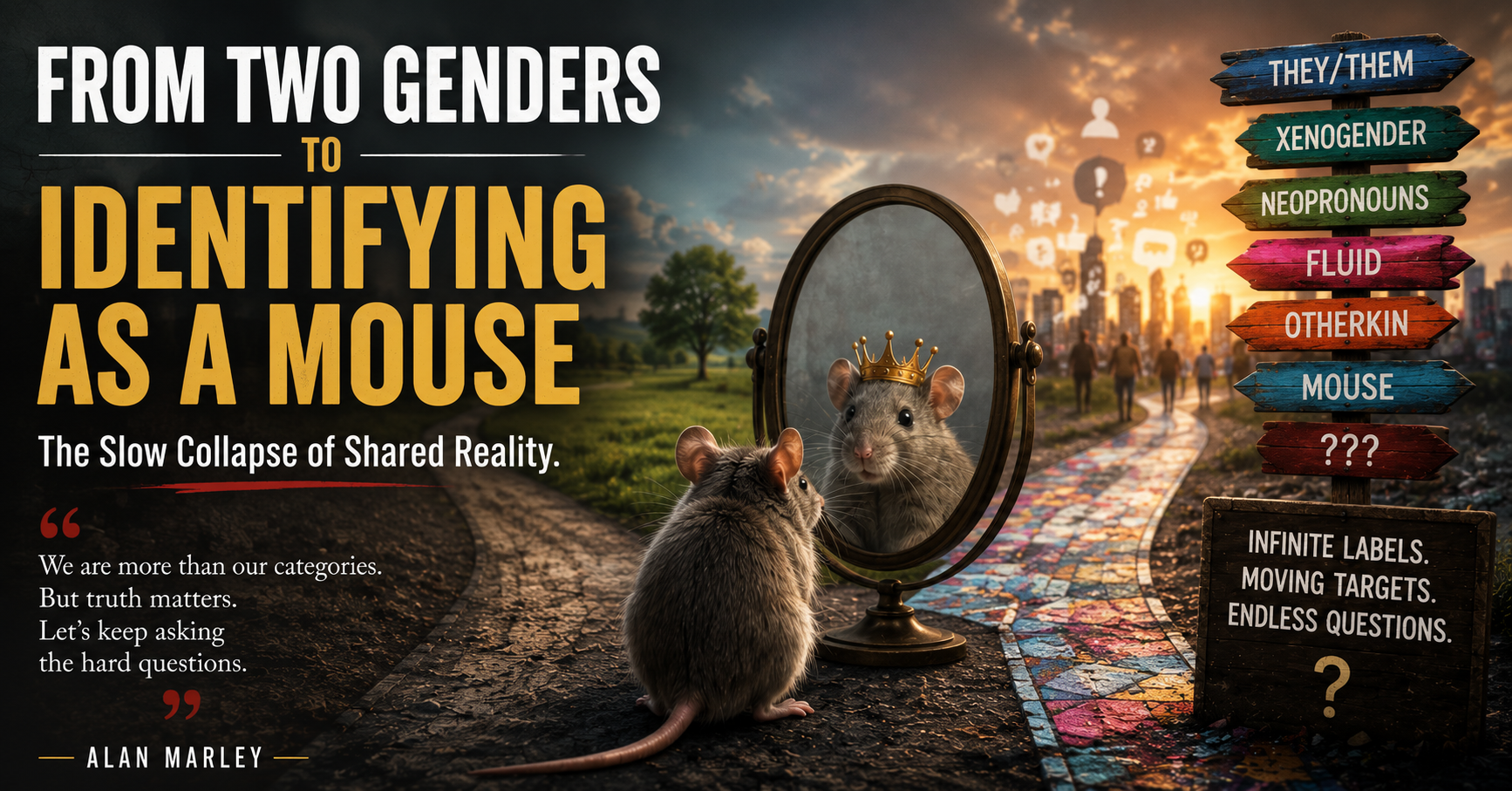
I was flipping channels more than ten years ago, doing what most people do with a remote, spending approximately half a second on each station before moving on. Then I stopped. On the screen was a talk show, and on that talk show was an overweight white kid, maybe seventeen or eighteen years old, explaining to the studio audience that he identified as a Korean female teenager. Not metaphorically. Not as a joke. With complete sincerity, with visible conviction and with the apparent expectation that the audience would nod along and affirm this as a valid identity the world was obligated to take seriously. I spent more than two years in the Marine Corps stationed in Korea. I traveled that peninsula extensively. I know what Korean female teenagers look like, how they move through the world, what pressures and expectations and cultural frameworks shape their existence. The young man on the screen had, in the most visible and obvious sense, no relationship to any of that. I laughed. It was the only reasonable response. Then I changed the channel and forgot about it. I should not have changed the channel. What was happening on that screen was not a punchline. It was an early symptom of something that took a decade to fully reveal itself.
How We Got Here From There
The identity politics that produced that talk-show moment did not emerge from nowhere. It has a traceable intellectual history running through postmodern academic theory, through Judith Butler's influential 1990 book Gender Trouble, which argued that gender is a social performance rather than a biological reality, through campus activism in the 1990s and 2000s, through social media communities on Tumblr in the early 2010s where identity frameworks multiplied in real time without any institutional gatekeeping, and eventually into mainstream corporate culture, public school curricula and federal policy. The progression from there to here took roughly three decades and it moved fast enough that most ordinary people did not notice it was happening until it arrived in their kids' classroom or their employer's mandatory training sessions.
The core philosophical claim, stated plainly, is that identity is self-determined rather than biologically or socially assigned, that the individual's sincere declaration of an identity creates an obligation on everyone else to affirm and accommodate it and that questioning that declaration is a form of harm. That claim, applied first to gender identity, spread with a logic that its originators perhaps did not anticipate. If biological sex can be overridden by sincere identification, the same argument applies to race, age, species and ultimately anything else a person chooses to declare about themselves. The logic has no natural stopping point. The Korean-female-teenager moment was not an aberration from the theory. It was the theory applied consistently.
Logo TV, the LGBTQ cable network, aired a series in 2013 called "What? I Think I'm An Animal," documenting the otherkin and therian communities, people who identify as partially or entirely nonhuman. One young man told the documentary: "Basically, other than the fact that I have a human body and human flesh, I am a wolf." By 2016, documented cases included a father of seven who identified as a six-year-old girl and a 52-year-old man living as a child with "adoptive" parents who affirmed his identity. By the early 2020s, surveys of high school students found that nearly half knew at least one classmate who identified as a furry. Self-reported species identities in online communities included bumble bee, fox, wolf, cat and, documented without apparent irony, dirt and the universe. The framework built to honor sincere self-declaration had no mechanism for stopping at any particular destination.
The Korean Female Teenager Problem
Korean female teenagers are a specific, real population of human beings living specific, real lives shaped by specific cultural, linguistic, familial and historical forces. They speak a particular language. They navigate a particular educational system of intense competitive pressure. They exist within specific beauty standards and social expectations. They carry the weight of a national history that includes a war killing millions of people within living memory of their grandparents and an ongoing geopolitical situation of real danger on their northern border. None of that was available to the young man on the screen through identification. He was not accessing Korean female teenage experience by claiming it. He was appropriating a label for its identity-politics utility while bearing none of the content that makes that label meaningful to the actual people who live it.
This is why the trans-racial variant of identity politics is so instructive about the limits of the whole project. Rachel Dolezal, the white NAACP chapter president who identified as Black until her family outed her in 2015, was subjected to near-universal ridicule and condemnation from the same progressive community that insists gender identity must be accepted without question. The inconsistency proves the principle was never really about sincere self-declaration. It was about a specific set of permitted identity claims. When the logic was applied outside that set, the architects of the framework rejected it with exactly the biological and social reality arguments they had spent years calling bigotry when applied to gender. You cannot have it both ways, and the fact that the movement tried to is the most revealing thing about it.
The same framework that demands we accept a biological male's declaration of womanhood rejected a white woman's declaration of Blackness. That inconsistency is not a crack in the theory. It is the theory revealing what it was always actually about: which identities are politically permitted and which are not.
What Two Years in Korea Actually Taught Me
Spending more than two years in the Marines in Korea and covering that peninsula from one end to the other gave me a concrete understanding of what it actually means to encounter a genuinely different culture from the inside. Korean society was hierarchical in ways unfamiliar and uncomfortable to most young Americans. Age and rank governed nearly every social interaction. The concept of nunchi, the ability to read a room and understand what is expected without being told, was not optional social polish. It was a survival skill. The relationship between individual desire and collective obligation ran differently than it does in American culture. A young Korean woman navigating that world was navigating a specific set of constraints, expectations and freedoms that had nothing to do with what any American kid watching a talk show could access through declaration.
Cultural appreciation, the genuine effort to understand and engage with a different way of organizing human life, is one of the more valuable things a person can do. Liking Korean food, listening to K-pop and feeling a strong personal connection to Korean aesthetics are real and legitimate experiences. They do not make a person Korean any more than liking Italian food makes a person Italian. Identity is not a preference. It is not a feeling. It is a relationship to a set of historical, biological and social realities that exist whether or not you declare them. The young man on the talk show had no more relationship to the actual experience of being a Korean female teenager than I have to the actual experience of being a wolf. The difference is that nobody was asking me to affirm the wolf claim as a protected identity requiring institutional accommodation.
The Institutional Capture That Made This Mainstream
The reason this matters beyond individual absurdity is that the framework did not stay on talk shows and Tumblr. It moved into institutions. By the mid-2010s, major American corporations were rewriting HR policies and mandatory training programs around self-declared gender identity. By the late 2010s, public school systems were adopting curricula introducing gender identity concepts to children as young as five. By 2020, federal agency guidance was being rewritten around self-declared identity. The American Psychological Association and the American Medical Association revised their positions on gender dysphoria treatment in ways that, as the UK's independent Cass Review found in 2024, outpaced the available clinical evidence by a considerable margin. This progression was driven by institutional capture, a process by which committed advocates gain enough leverage within professional organizations, corporate HR departments and government agencies to make a fringe position the official default faster than the broader public notices it is happening.
The public noticed eventually. The 2024 election produced measurable evidence that ordinary voters, including substantial numbers who had previously supported Democratic candidates, had decided that the cultural distance between the party's activist wing and their own common sense had grown too large. Parental organizing around what was being taught in schools showed up in school board races and state legislative contests across the country. The backlash was not manufactured. The underlying sentiment was produced by parents watching what was happening in their children's classrooms and deciding they had not been consulted about experiments they had not consented to.
Where Common Sense Draws the Line
There is a genuine conversation to be had about the experiences of people who have felt, for as long as they can remember, a profound disconnection between their biological sex and their sense of self. That experience is real and the distress it produces is real. The Cass Review found that the evidence base for pediatric medical transition was weaker than clinical practice had assumed and that the field moved faster than the science supported. That conclusion is worth taking seriously, because the people most harmed by weak evidentiary standards are the patients. What the serious conversation does not require is extending the same framework to species identity, age identity, racial identity and ultimately any other category a person chooses to claim.
The young man who told the Logo TV documentary team he was a wolf was not making a claim that the institutions taking gender identity seriously could logically refuse on the basis of their own stated principles. If subjective identification overrides biological reality in one domain, the argument for why it should not override biological reality in other domains is no longer available to the people who built the framework. They tried to draw the line and found they had removed the tools for drawing it. That is not a policy problem. That is a philosophical problem that was baked into the framework from the beginning.
My Bottom Line
I laughed at the Korean female teenager on the talk show more than ten years ago because the gap between what was being claimed and what was obviously true was so large that laughter was the natural response. A decade of institutional reinforcement later, I am less amused and more concerned. The framework that produced that moment has imposed real costs on real people: patients who received medical interventions on the basis of evidentiary standards independent review found insufficient, girls and women whose competitive sports were reorganized around self-declared identity rather than biological reality and ordinary people in workplaces and schools who were told that common-sense observations about material reality constituted harm. The absurdity of any particular case is a symptom of a deeper problem: a framework that made sincere self-declaration the only relevant fact about identity had no principled basis for distinguishing reasonable claims from unreasonable ones. It still does not. The claims kept coming. They will keep coming. And the question worth asking is not what the next one will be. It is why we ever decided to remove from public life the simple, obvious, ancient observation that what a person sincerely believes about themselves and what is actually true about them are not always the same thing.
We went from two genders to identifying as dirt and the universe in about fifteen years. At some point the question is not what the next identity claim will be. The question is why we decided that the gap between sincere belief and material reality was no longer a relevant consideration in public life. That is the question nobody in charge wants to answer.
Why This Matters
A culture that has decided sincere self-declaration overrides observable fact in questions of gender, species and age is a culture that has weakened its capacity to insist on shared observable fact in other domains. The tools for distinguishing what is true from what someone sincerely believes to be true are the same tools needed for evaluating medical evidence, assessing policy outcomes and running a civic society in which disagreements can be resolved by appeal to something other than institutional power. Identity politics at its extreme is not a civil rights framework. It is a framework for replacing reality with assertion. The Korean female teenager on the talk show was funny. The downstream consequences of the framework that produced him are not.
References
- Butler, J. (1990). Gender Trouble: Feminism and the Subversion of Identity. Routledge.
- Logo TV. (2013). What? I Think I'm An Animal. Documentary series. [Subject stated: "other than the fact that I have a human body and human flesh, I am a wolf."]
- Brown, M. (2024, November). The furries are here and in full force. WND / The Line of Fire. [Documents species identities including bumble bee, fox, wolf, cat, dirt and the universe; nearly half of surveyed students knew a classmate identifying as a furry.]
- Cass, H. (2024). Independent review of gender identity services for children and young people. NHS England.
- AP / CNN / NBC News. (June 2015). Rachel Dolezal racial identity controversy. [Multiple news sources documenting the trans-racial identity case.]
Disclaimer: The views expressed in this post are the personal opinions of the author and are offered for educational, commentary and public discourse purposes only. They do not represent the positions of any institution, employer, organization or affiliated entity. Nothing in this post constitutes legal, financial, medical or professional advice. The personal account in the opening reflects the author's recollection of a television program viewed more than a decade ago. Commentary on cultural and political subjects reflects the author's independent analysis and is protected expression of opinion. Readers are encouraged to consult primary sources and form their own conclusions.