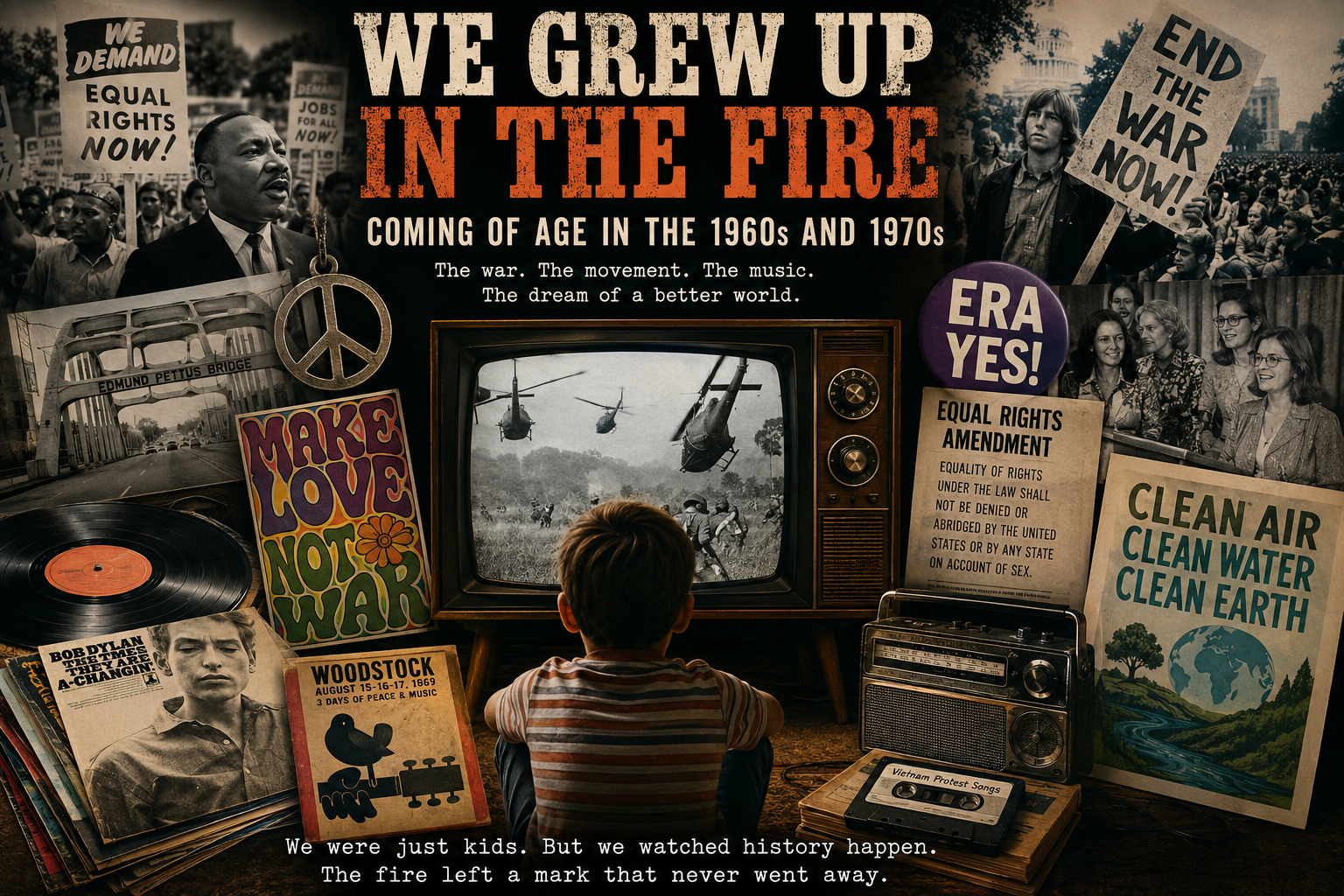
There are generations that get to grow up quietly. They come of age in periods of relative calm, watch the world from a comfortable distance and build their sense of self against a backdrop of ordinary life unfolding at a manageable pace. We were not that generation. The kids who grew up in the 1960s and 1970s came of age inside a convulsion. The country was arguing about everything simultaneously, at full volume, with genuine stakes and genuine fury, and there was no way to be young during that time without absorbing all of it whether you wanted to or not. Looking back from here, what strikes me most is not how much chaos there was. It is how much of it turned out to matter, and how different the things that mattered look from sixty years of distance than they did from the kitchen table of a house in the middle of it all.
The Television in the Living Room
The Vietnam War came into American living rooms every evening at dinner time. That sounds like a figure of speech now but it was a literal fact of daily life for anyone who grew up in the 1960s. Walter Cronkite sat behind his desk and read the casualty figures while the footage played. Body counts. Helicopter shots. Jungle footage that looked nothing like the war movies your father watched on the same television set on Sunday afternoons. There was no internet to filter it, no algorithm deciding what you were emotionally prepared to see. The war just arrived with the six o'clock news and sat at the table with you while you ate. My generation learned what war looked like not from history books but from live footage, and that footage produced an entirely different relationship to military service and national authority than anything a textbook could have manufactured.
The draft was real. You did not have to be particularly politically minded to understand what the draft meant if you were a young man in the late 1960s. It meant that the government could reach into your life with a number and change everything. Boys who graduated high school in 1968 or 1969 were not just making decisions about what to do next. They were navigating a genuine threat that their choices might not be the ones that mattered. Some went. Some went to Canada. Some found college deferments. Some drew high lottery numbers and exhaled. The draft created a relationship to citizenship and obligation and mortality that nothing in the comfortable decades that followed has replicated for the young people who came after us, and that relationship shaped everything about how my generation eventually thought about war, about government and about the limits of institutional authority.
Over 58,000 American service members died in Vietnam between 1955 and 1975, with the heaviest losses concentrated between 1967 and 1969. More than 2.7 million Americans served in the war. The draft reached into communities across every economic and geographic category, though deferments available through college enrollment and other means meant that working-class and minority communities bore a disproportionate share of the combat burden. The war lasted long enough to shape the childhood of anyone born between roughly 1953 and 1963. You could not grow up in that window without the war being part of your formative landscape.
The Civil Rights Movement and What It Felt Like to Watch History
The Civil Rights Movement was also on television. But it produced a different feeling than the war footage, even for a kid watching from a distance. The war footage was frightening in the way that all violence is frightening. The civil rights footage was frightening in a different way, the way that moral confrontation is frightening, because it forced you to understand something about the country you lived in that the country had been carefully avoiding putting on television. Bull Connor's fire hoses. The Edmund Pettus Bridge. The children in Birmingham. George Wallace in the schoolhouse door. These images arrived into the same living rooms as the war footage and they demanded a different kind of reckoning.
For a kid growing up in that era, the Civil Rights Movement was not a historical event happening somewhere else. It was a live argument happening in your country, in your schools, in your neighborhood, in the conversations adults had when they thought you were not paying attention. The question of whether the country was going to live up to its own stated ideals was not rhetorical. It was being contested in real time by real people at genuine personal risk, and watching that contest from childhood, even without fully understanding it, produced a moral seriousness about questions of equality and fairness that stayed with the people who grew up watching it. Whatever else you want to say about that era, the Civil Rights Movement produced genuine moral progress at enormous human cost and it is not possible to have grown up watching it without being permanently changed by what you saw.
The Hippies and What Flower Power Actually Felt Like
The hippies were something else entirely. They were confusing and fascinating and occasionally infuriating in the way that anything is confusing and fascinating and infuriating when you are ten years old and you do not fully understand what the adults around you are arguing about. The Summer of Love was 1967. I was a child. What I knew was that something was happening that was clearly different from anything that had come before it, that it involved a lot of color and a lot of music and a lot of people who had decided that the rules their parents had lived by were not rules they were going to follow, and that this decision made some adults very angry and other adults very excited and that the argument between those two groups was audible everywhere you went.
The flower power aesthetic was genuinely beautiful in the way that all genuine artistic explosions are beautiful. The colors, the graphics, the posters, the album covers, the fashion that rejected everything buttoned-down and conformist about postwar American life, all of it had an energy and a visual freshness that even a kid could feel. San Francisco was producing something the radio was broadcasting and the older kids on your street were absorbing and the whole thing had the feeling of a world being remade from scratch by people who had decided the old one was not worth keeping. Looking back at it honestly now, the idealism was real and the excess was also real. The notion that you could dismantle every social structure simultaneously and replace it all with love and good intentions turned out to be naïve in ways the 1970s made clear pretty quickly. But the cultural energy was genuine and the music it produced was extraordinary.
The flower power aesthetic was genuinely beautiful in the way that all genuine artistic explosions are beautiful. The notion that you could dismantle every social structure and replace it with love and good intentions turned out to be naïve. But a generation that produced that much music while it was being naïve gets some credit for the naïveté.
Rock and Roll as the Language of the Era
The music of the 1960s and 1970s deserves its own conversation because it was not background noise to everything else that was happening. It was the connective tissue. It was how the culture processed the war, the movement, the social upheaval, the generational conflict and the sheer overwhelming speed of change that was reshaping American life faster than most people could absorb it. Bob Dylan told you the times were changing in 1964 and he was not wrong. The Beatles arrived in 1964 and something shifted in the atmosphere. The Rolling Stones played the same bars and the same chords and produced a completely different emotional weather. Jimi Hendrix played the national anthem at Woodstock in 1969 and it sounded like everything the country was going through rendered in guitar feedback.
The radio in the 1960s and early 1970s was the most democratic cultural medium that had ever existed. You did not choose your playlist. You listened to what was on, which meant you heard everything, which meant the music of that era crossed boundaries of taste and style and demographic category in ways that streaming algorithms have since made essentially impossible. A kid in 1968 might hear Marvin Gaye and Creedence Clearwater Revival and Simon and Garfunkel and Sly and the Family Stone in the same hour. The music was integrated before much else was. It was talking to everybody at the same time. And what it was saying, across all those different voices and styles, was that the world was bigger and stranger and more complicated and more beautiful than what the previous generation had been willing to admit.
Woodstock in August 1969 drew an estimated 400,000 people to a farm in upstate New York for three days of music that became the defining cultural event of the counterculture. The lineup ran from Joan Baez to Jimi Hendrix, from Jefferson Airplane to Crosby, Stills, Nash and Young. Altamont followed just four months later, in December 1969, with a security failure that produced a killing on camera and marked the moment the counterculture's sense of its own benevolence took its first serious blow. Both events happened within the same four months, which tells you something about the speed at which the era's idealism and its limits arrived simultaneously.
The ERA and the Argument About Women's Lives
The Equal Rights Amendment was proposed by Congress in 1972 and sent to the states for ratification. It read, in its entirety: equality of rights under the law shall not be denied or abridged by the United States or by any state on account of sex. Twenty-three words. They were contested with a ferocity that is hard to fully convey to anyone who did not live through it. Phyllis Schlafly built an entire political movement, the STOP ERA campaign, around the argument that the amendment would eliminate legal protections for women rather than extend them, that it would force women into military combat and unisex bathrooms and strip them of alimony rights. Gloria Steinem and Betty Friedan and the women's movement made the opposite case with equal passion. The argument happened in living rooms, in churches, in state legislatures and on the covers of magazines, and it was one of the first times that many kids growing up in that era heard adults argue seriously about what it meant to be a woman in America and whether the country's laws reflected a fair answer to that question.
The ERA fell three states short of the 38 needed for ratification by its extended deadline in 1982. But the argument it produced did not end with the deadline. The decade-long fight over the amendment pushed questions about women's employment, women's legal rights, women's roles in institutions and women's autonomy into mainstream political conversation in ways that did not disappear when the ratification effort failed. The women who grew up watching that argument, and the men who grew up alongside them, were not unchanged by it. The culture the ERA debate produced outlasted the amendment itself, which is often how the most important arguments work.
The Counterculture's Real Legacy
Looking back honestly, which is the only way worth looking back, the era produced genuine achievements and genuine wreckage in roughly equal measure. The Civil Rights Movement produced the Civil Rights Act of 1964 and the Voting Rights Act of 1965, two of the most consequential pieces of legislation in American history, passed at the cost of extraordinary suffering by people who had every reason to give up and did not. The women's movement produced changes in employment law, educational access and public life that are now so thoroughly embedded in American institutions that younger generations cannot fully imagine the world they replaced. The environmental movement produced the Clean Air Act of 1970, the Clean Water Act of 1972 and the Environmental Protection Agency. These are real achievements. They changed real lives. They deserve acknowledgment without qualification.
The wreckage was also real. The counterculture's most extreme expressions produced a romanticism about drug use that cost lives and a contempt for institutions that made it harder to build the functional civic infrastructure the 1970s desperately needed. The sexual revolution arrived faster than the social infrastructure required to manage its consequences sustainably. The anti-war movement's entirely justified opposition to Vietnam sometimes tipped into a reflexive anti-military sentiment that made it harder for returning veterans to be received with the dignity they deserved, an injustice that took decades to begin correcting. The idealism was genuine. The belief that you could change everything at once without breaking things you would later need turned out to be wrong, and the 1970s were largely spent discovering exactly which things had been broken.
What It Left in Us
The people who grew up in the 1960s and 1970s carry something that is genuinely difficult to describe to people who did not share the experience. It is not simply nostalgia for a particular era's music or fashion or cultural energy, though those things are real enough. It is a specific orientation toward change, toward authority, toward the relationship between individual conviction and collective action, that was formed by watching a country argue with itself at genuine volume about questions that actually mattered. We learned from watching the Civil Rights Movement that ordinary people could face extraordinary power and move it if they were willing to pay the cost. We learned from watching Vietnam that governments can be wrong and that the people who say so out loud are not automatically traitors. We learned from the women's movement that the categories people had been told were fixed could be renegotiated. We learned from the music that the world was bigger than the neighborhood and more complicated than the textbook and more beautiful than the nightly news made it look.
None of those lessons arrived cleanly. All of them came wrapped in confusion and contradiction and the specific chaos of an era that was moving too fast for anyone to fully understand what was happening while it happened. But the lessons stuck. And the people who carry them are still here, still arguing, still trying to figure out which parts of that fire produced something worth keeping and which parts just burned.
My Bottom Line
It was a genuinely transformative time. I say that without irony and without the kind of reflexive nostalgia that turns complicated history into a highlight reel. The era produced real good: legal equality for Black Americans, expanded rights for women, environmental protection that saved the air and water, a reckoning with a disastrous war that changed how the country thought about military commitments. It also produced real excess: the romanticism about social disintegration, the contempt for the institutional structures that functional societies require, the generational arrogance that assumed you could remake everything at once without losing anything worth keeping. Both of those things happened. Both of them shaped what came after. The country we live in now, for better and for worse, was made in the fire of those two decades. And the people who grew up in that fire, who absorbed it through the television and the radio and the conversations of frightened and excited adults, are still carrying what it made of them.
We were just kids. But we were kids who watched history happen in real time, who heard it on the radio and saw it on the news and felt it in the way adults talked at dinner. That leaves a mark. Sixty years later, the mark is still there.
Why This Matters
It matters because understanding what that era actually was, rather than what nostalgia or revisionism has made of it, is how any generation makes sense of its own inheritance. The young people alive today inherited both what that era built and what it broke. The Civil Rights legislation, the environmental protections, the expanded legal rights for women are real achievements that require maintenance and defense. The cultural contempt for institutions that the counterculture helped seed is also a real inheritance, one that has made it harder to build and sustain the functional civic structures a complex society requires. You cannot adequately defend what was built or honestly reckon with what was broken if you do not understand the era that produced both. That is what this post is: one person's attempt to remember clearly what it felt like to grow up in the fire, before the fire got turned into either a golden age or a cautionary tale by people who were not there.
Disclaimer: The views expressed in this post are the personal opinions and recollections of the author and are offered for educational, commentary and public discourse purposes only. They do not represent the positions of any institution, employer, organization or affiliated entity. Nothing in this post constitutes legal, financial, medical or professional advice of any kind. Historical figures and events referenced are drawn from publicly documented history. Personal recollections reflect the author's own experience and perspective. Readers are encouraged to consult primary sources and form their own conclusions.