
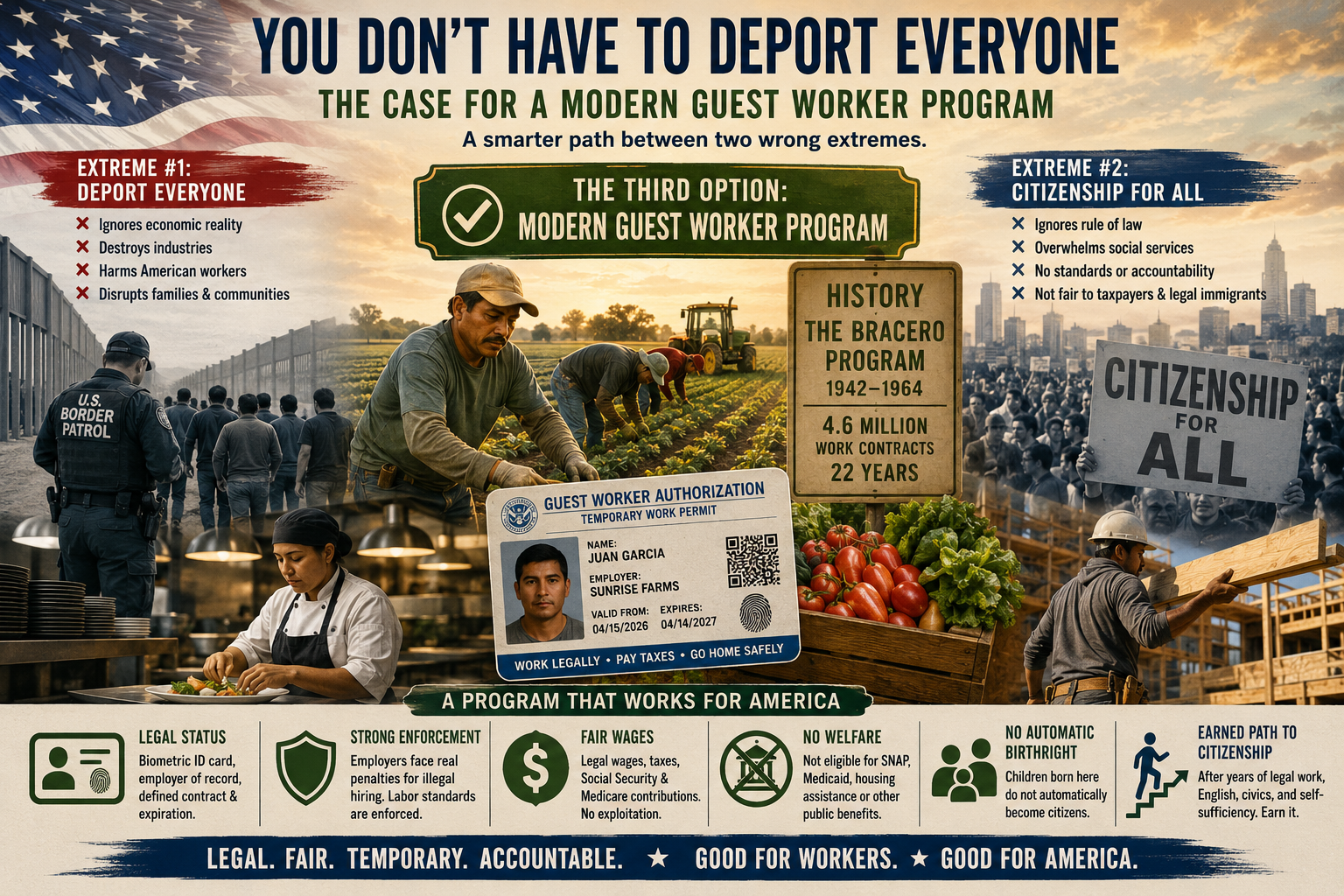
Every time the immigration debate gets loud, the same two camps emerge and plant their flags. On one side: remove everyone who is here illegally, secure the border completely and let the market sort out the labor question later. On the other: provide a path to citizenship for everyone already here, expand legal immigration indefinitely and treat any enforcement as fundamentally hostile to human dignity. Both of those positions have real political constituencies. Neither of them is a serious policy proposal for a country that actually has to function. The deport-all argument ignores the genuine structural role migrant labor plays in agriculture, food processing, hospitality, construction and dozens of other industries where the pipeline of willing American workers has not materialized at current wages. The citizenship-for-all argument ignores the legitimate interest of every taxpaying citizen in an immigration system that serves the country rather than simply absorbing whatever population arrives. There is a third position and it has historical precedent. America ran it for twenty-two years. It was imperfect. A modern version, designed to fix the original's specific failures, could work considerably better.
The "Americans Won't Do That Work" Argument Is Half Right
Let me concede what is true in the argument before dismantling what is wrong with it. The claim that Americans will not pick crops, work restaurant kitchens, clean hotel rooms or swing hammers on construction sites is half right and half wrong in a way that the people making it usually prefer not to specify. Americans absolutely did all of those jobs before the mass illegal immigration wave of the 1990s changed the economics of the labor market. They did them because the jobs paid wages that reflected the actual supply and demand for labor. When an employer can choose between hiring a legal worker at a wage that reflects the market and hiring an undocumented worker at a wage depressed by the availability of that parallel labor supply, the legal worker loses. That is not because Americans are lazy or because they think the work is beneath them. It is because rational economic actors respond to price signals and the price signal in those industries has been systematically distorted for thirty years by a labor market that operates outside the legal system.
What is genuinely true in the argument is that certain industries, particularly agriculture, require a level of seasonal and temporary labor that fluctuates in ways that the permanent domestic workforce cannot efficiently absorb. Fruit and vegetable harvests happen in specific windows. You cannot build a trained permanent American workforce around picking strawberries in California in May and then standing idle in June. The agricultural labor demand is genuinely seasonal, genuinely temporary and genuinely enormous. The question is not whether that demand exists. It does, and it existed for the entire twentieth century. The question is how to meet it legally, fairly and without creating a permanent underclass of people whose labor the economy depends on but whose legal status the system refuses to acknowledge.
According to the Department of Agriculture, approximately 73 percent of U.S. crop farmworkers were foreign-born as of the most recent National Agricultural Workers Survey, with the majority undocumented. The hospitality industry employs an estimated one in ten undocumented workers. Construction, as documented by the Center for Immigration Studies, employs roughly 13 percent of the undocumented workforce. These are not marginal economic roles. They are load-bearing parts of the food, shelter and service infrastructure that every American uses every day. You cannot remove that labor overnight without consequences for the supply chains, the cost of food and the pace of construction that affect every income level. That does not mean the status quo is acceptable. It means any replacement system has to account for the labor reality, not pretend it does not exist.
What the Bracero Program Actually Was
Between 1942 and 1964, the United States government operated the Mexican Farm Labor Program, known as the Bracero Program from the Spanish word for manual laborer. The program was established by bilateral agreement with Mexico on August 4, 1942, originally to address labor shortages created when American workers entered military service during World War II. Over its twenty-two-year life, the program issued 4.6 million contracts to Mexican workers, making it the largest contract labor program in American history. Workers came on short-term contracts, primarily for agricultural labor, with guaranteed minimum wages, transportation back to Mexico upon contract expiration and basic guarantees of humane treatment including adequate shelter and food. They did not receive citizenship. Their children born in Mexico remained Mexican citizens. They were not eligible for American social welfare programs. They came, they worked, they went home.
The program's historical record is honest about its failures as well as its function. Agricultural corporations frequently violated the wage guarantees because enforcement was weak and workers had limited recourse. Employers colluded to suppress wages for all agricultural workers, using braceros as a ceiling on what American farmworkers could demand. Workers were used as strikebreakers at operations like the DiGiorgio Fruit Corporation in 1947, where government officials escorted braceros to fields vacated by striking domestic workers. The program ended in 1964 partly due to pressure from labor and civil rights organizations who documented these abuses. The historical lesson is not that the guest worker concept failed. It is that a guest worker program without genuine enforcement of its own labor standards produces exploitation. A modern version has to solve that problem or it reproduces the same outcome.
The Bracero Program ran for twenty-two years, issued 4.6 million work contracts, and workers came and went without citizenship claims, social welfare eligibility or anchor baby provisions. It worked as a labor mechanism. It failed as a labor protection system. The fix is not to abandon the mechanism. It is to build the enforcement that was missing.
Why Structural Embeddedness Changes the Argument
The concept that makes the deport-all position unworkable at national scale is not sentiment. It is structural embeddedness, a term from economic sociology most associated with the work of Mark Granovetter, whose 1985 paper in the American Journal of Sociology established the theoretical framework for understanding how economic actors become integrated into networks, institutions and relationships in ways that make simple extraction enormously disruptive. Applied to immigration, structural embeddedness means that after decades of operating in an economy, undocumented workers are not sitting at the margins waiting to be removed. They have been woven into the production processes, cost structures, seasonal staffing systems and supply chains of the industries they work in. Removing them is not like removing a component from a machine. It is more like removing a load-bearing element from a building that was designed around its presence.
Agricultural operations in California's Central Valley, Florida's citrus groves and the vegetable fields of Texas have built their entire production models around a seasonal migrant labor force that arrives, harvests and departs on predictable cycles. The food processing plants in the Midwest have structured their staffing and their production lines around a workforce that the domestic labor market has not replaced at any point in thirty years of trying. The framing crews and roofing companies and drywall contractors who built the housing developments of the 2000s and 2010s built their businesses, their schedules and their bids around labor cost structures that include this workforce. Disrupting all of that simultaneously and abruptly does not produce a clean market correction and a smooth transition to American workers at higher wages. It produces supply chain failures, harvest losses, construction slowdowns and price spikes in food and housing while the market attempts to reorganize over a period of years, not weeks.
Sociologist Takeyuki Tsuda's landmark study of Japanese-Brazilian immigrant workers in Japan, published in the Journal of Asian Studies in 1999, documented how what began as a temporary labor program became permanent as workers built social networks, employer relationships and community ties that made return migration increasingly difficult over time. The same dynamic operated in the Bracero Program's aftermath: after the program ended in 1964, undocumented immigration to the United States increased rather than decreased, because the labor demand that had been served legally through the program continued and workers who had built relationships with American employers found informal channels to maintain those relationships outside the legal system. Embeddedness, once established, does not dissolve when the legal mechanism that created it is removed. It finds alternative pathways.
The structural embeddedness literature also documents something the deportation-first argument consistently underestimates: when embedded workers are removed without a managed replacement system, employers do not automatically pivot to domestic workers. They mechanize where they can, they consolidate operations, they exit labor-intensive production entirely or they source from foreign suppliers who are not subject to American labor costs. The net result for American workers is not always higher wages and more jobs. It is sometimes fewer jobs in restructured industries that no longer require the labor the enforcement action was designed to redirect. The Mississippi chicken plant example, where wages rose and local workers were hired after ICE enforcement, is a genuine data point. It is also a single-industry event in a contained location with specific characteristics that do not automatically replicate at national scale across fourteen industries simultaneously.
Here is what structural embeddedness means for your argument specifically. The deport-all position treats embeddedness as if it does not exist, assumes you can remove eleven million people from an economy and the economy continues functioning while the market corrects. Embeddedness says that assumption is wrong in ways that matter to the American workers and consumers the policy is supposed to help. The citizenship-for-all position treats embeddedness as a permanent justification for the status quo, using it to argue that because people are here and integrated, their presence must be formalized as citizenship. That argument treats the outcome of a policy failure as an entitlement. Your guest worker framework takes embeddedness seriously without treating it as either an insurmountable obstacle or a blank check. It says: these workers are already structurally embedded in our economy, the honest policy response is to bring that embedded economic reality into the legal system with documented status, enforced wages, defined terms and genuine accountability on both sides rather than either pretending the embeddedness does not exist or converting it into permanent citizenship by default. The biometric ID card is the mechanism for converting embedded but illegal economic relationships into embedded but legal ones. That is what a serious policy response to structural embeddedness actually looks like.
What a Modern Guest Worker Program Should Look Like
The design of a functional modern guest worker program is not complicated in principle, though it is genuinely difficult in political practice because it requires both sides to give up something. The right has to accept that a legal guest worker program is not amnesty and is not open borders. It is a managed system that brings labor into the legal economy, taxes it, regulates it and tracks it. The left has to accept that a guest worker program is not a citizenship pipeline and is not a welfare entitlement. It is a labor contract with defined terms, genuine obligations and genuine limits.
The core elements of a workable system are these. Workers receive a biometric identity card that establishes their legal presence, their employer of record, their contract terms and their expiration date. The card is not a pathway to citizenship by itself. It is a work authorization with a time limit. Employers who hire guest workers without valid cards face meaningful penalties, not the nominal fines that currently make illegal hiring cheaper than legal hiring. Guest workers pay into Social Security and Medicare at the same rate as any other worker, because that is fair to both the workers and the system, but they collect benefits only under the terms of bilateral agreements with their home countries rather than as individual American entitlements. They are not eligible for SNAP, Medicaid, housing assistance or other means-tested welfare programs. Their children born on American soil during a temporary work authorization are not automatically citizens, which requires either a statutory fix or a constitutional amendment, but which is the correct policy outcome since the purpose of the program is temporary labor, not permanent population transfer.
A guest worker who has worked legally in the United States under the program for a defined period, say five or ten years of documented employment, compliance with all program requirements and no criminal record, should have a pathway to apply for legal permanent residency and eventually citizenship. The conditions should be real and enforced: demonstrated English proficiency, passage of a civics examination, documented economic self-sufficiency and no use of means-tested welfare programs during the qualifying period. This is not a gift. It is an earned status available to people who have demonstrated over years that they want to be Americans in the full sense, not simply residents of a country that offers better economic conditions than their country of origin. The distinction between a guest worker program that offers a genuinely earned citizenship pathway and an amnesty program that offers citizenship as the automatic outcome of being here long enough is not semantic. It is the entire difference between a system that incentivizes compliance and one that incentivizes endurance.
The Wages Question Is Inseparable From the Labor Question
The reason many Americans genuinely will not do agricultural, restaurant, hotel and construction work at current wages is not laziness or cultural contempt for physical labor. It is that current wages in those industries are set by a labor market that includes a large undocumented workforce operating without the full set of legal protections and costs that legal employment carries. A restaurant owner who pays undocumented kitchen workers off the books at below minimum wage has a lower cost structure than the restaurant owner who complies fully with labor law. The compliant owner is either unable to compete on price or unable to attract American workers at the wage the non-compliant market has established as the sector norm.
A guest worker program that requires legal registration, documented wages, Social Security contributions and genuine enforcement of labor standards raises the cost floor for the entire industry. That higher floor produces higher wages for everyone in the industry, including the American workers who currently cannot compete at the depressed wages that illegal labor has produced. It also produces higher prices for consumers, because labor costs are embedded in the price of every tomato and every hotel room and every framed wall. That is honest and worth saying plainly: a fair labor market costs more than an unfair one. The question is whether Americans are willing to pay the true cost of the food and services they consume rather than shifting that cost onto a vulnerable workforce that has no legal recourse when it is underpaid. In my view they should be. That is what a functioning labor market with enforceable standards actually looks like.
The Birthright Citizenship Problem
The anchor baby issue, to use the term that accurately describes the policy problem if not the human reality behind it, is the single most direct incentive structure that turns temporary labor migration into permanent population settlement. A guest worker who gives birth on American soil under the current legal interpretation of the 14th Amendment produces a child who is an American citizen by birth, which then creates a legal tie to the country that complicates the temporary nature of the worker's presence enormously. This is not a theoretical concern. It is the documented mechanism by which temporary labor programs produce permanent immigrant communities, because the rational response to having an American citizen child is to remain in the country where that child has rights, even if your own legal status remains temporary or undocumented.
As I noted in a separate post on this site, the Supreme Court ruled 6-3 on June 30, 2026 to uphold birthright citizenship as constitutionally required. Justice Kavanaugh's concurrence explicitly noted that Congress has the authority to legislate on this question even if executive action is insufficient. A guest worker program should be accompanied by legislation establishing that children born to foreign nationals on temporary work authorization do not acquire citizenship at birth. Whether that requires a statutory fix or a constitutional amendment is a legal question that Congress and the courts will have to work through. That it is the correct policy for a temporary labor program is not a close question. A program designed to create temporary labor relationships should not contain a structural incentive that converts those relationships into permanent ones.
My Bottom Line
The immigration debate in America is trapped between two positions that are each wrong in different ways and correct in different ways. Mass deportation of everyone who is here illegally ignores both the genuine labor market role that migrant workers play and the logistical reality of removing eleven million people from a country where many have lived for decades and built families. Blanket citizenship and social welfare eligibility for everyone who arrived illegally ignores the legitimate interest of American citizens in an immigration system that serves national interests and the rule of law. A modern guest worker program, built on the historical precedent of the Bracero Program but with genuine labor protections, genuine wage enforcement, biometric documentation, no automatic birthright citizenship, no welfare eligibility and a real but earned pathway to citizenship for those who commit to the full assimilation project, is a better answer than either extreme. It treats migrant workers as human beings deserving of legal protection and fair wages. It treats American workers as deserving of a labor market that is not artificially depressed by the absence of legal standards. It treats the taxpaying public as deserving of an immigration system that serves the country rather than simply absorbing whatever population manages to arrive. That is a workable position. It requires both sides to accept less than they want. That is also what serious policy usually requires.
America ran a guest worker program for twenty-two years that moved millions of people across the border legally, temporarily and without citizenship claims. The concept is not radical. It is historical. The modern version just needs the enforcement mechanisms the original lacked. That is an engineering problem, not a philosophical one.
Why This Matters
It matters because the labor markets in agriculture, food processing, hospitality and construction are not going to function without migrant labor at any foreseeable wage level, and pretending otherwise is a fantasy that serves neither American workers nor the workers who currently fill those roles without legal protection. It also matters because the current system, in which millions of workers are economically necessary but legally invisible, is the worst of all possible arrangements: it exploits the workers, undercuts the American workers who would compete at fair wages, costs the treasury tax revenue from off-books employment and generates the political toxicity that makes rational immigration reform nearly impossible. A guest worker program with genuine enforcement, fair wages, documented status and no automatic citizenship pathway converts an exploitative informal system into a managed legal one. It is better for everyone in the transaction except the employers who currently profit from the absence of rules. Those employers are not the constituency the policy should be designed to protect.
References
- Granovetter, M. (1985). Economic action and social structure: The problem of embeddedness. American Journal of Sociology, 91 (3), 481-510. [Foundational theoretical framework for structural embeddedness.]
- Tsuda, T. (1999). The permanence of "temporary" migration: The structural embeddedness of Japanese-Brazilian immigrant workers in Japan. Journal of Asian Studies, 58 (3), 687-722. [Documents how embedded labor relationships persist after legal mechanisms end.]
- Bracero History Archive. (2009). About the Bracero Program. braceroarchive.org. [4.6 million contracts, 1942-1964, largest U.S. contract labor program.]
- Britannica. (2024). Bracero Program. britannica.com. [Guaranteed minimum wage, free housing, healthcare, transportation back to Mexico.]
- Texas State Historical Association. (2024). Bracero Program. tshaonline.org. [4.5 million braceros entered, program details, post-program undocumented immigration increase.]
- Immigration History. (2024). Bracero Agreement 1942-1964. immigrationhistory.org. [Employer abuses, strikebreaking at DiGiorgio, program failures.]
- U.S. Department of Agriculture. (2024). National Agricultural Workers Survey. dol.gov. [73% of crop farmworkers foreign-born.]
- Center for Immigration Studies. (2023). Illegal immigration and the construction industry. cis.org.
- Pew Research Center. (2021). Facts on unauthorized immigrants in the U.S. pewresearch.org.
- Supreme Court of the United States. (2026, June 30). Trump v. Barbara, No. 24-940. Kavanaugh, J., concurring. [Congressional authority to legislate on birthright citizenship.]
Disclaimer: The views expressed in this post are the personal opinions of the author and are offered for educational, commentary and public discourse purposes only. They do not represent the positions of any institution, employer, organization or affiliated entity. Nothing in this post constitutes legal, financial, medical or professional advice of any kind. References to historical programs, labor statistics, court decisions and immigration data are based on publicly available sources cited above. Commentary on immigration and labor policy reflects the author's independent analysis and is protected expression of opinion. Readers are encouraged to consult primary sources and form their own conclusions.