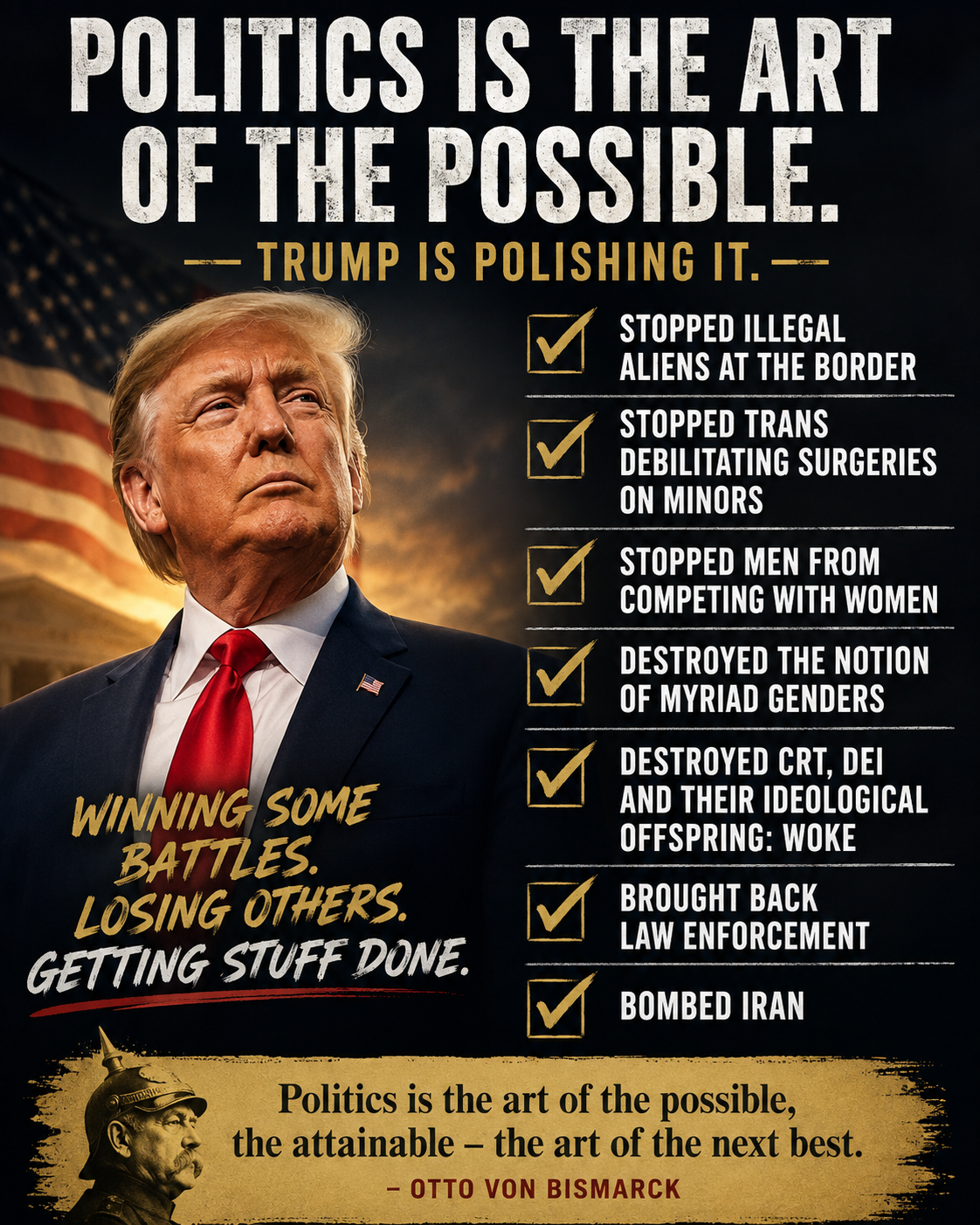
Otto von Bismarck is credited with one of the most enduring observations ever made about government: politics is the art of the possible. That sentence is worth remembering when evaluating Donald Trump. Trump's supporters sometimes talk as though he can simply order the country to become what they want it to become. His opponents sometimes talk as though every executive action represents the end of democracy. Neither view reflects how American government actually works. A president operates inside a constitutional system containing Congress, federal courts, state governments, bureaucracies, elections, interest groups, corporations, universities, the media and more than 330 million people who frequently disagree with one another.
The real question therefore isn't whether Trump has gotten everything he wanted. He hasn't. The more interesting question is whether he has figured out how to get a remarkable amount of what he wants within the limits of what is politically possible. Increasingly, I think the answer is yes.
The Border: Perhaps the Clearest Example
Start with illegal immigration. Trump didn't repeal immigration law, abolish asylum or somehow make illegal immigration mathematically impossible. He changed incentives. His administration ended the previous use of CBP One appointments for inadmissible migrants, terminated categorical parole programs, increased detention and removal efforts and redirected federal resources toward enforcement. People responded to the incentives.
According to Customs and Border Protection data, Border Patrol apprehensions along the southwest border fell from 56,520 in October 2024 to 8,350 in February 2025. By July, they had fallen to 4,596.
That doesn't mean nobody crosses illegally. It means the enormous migration flows Americans had been told were nearly impossible for a president to control were, in fact, enormously responsive to policy. Trump didn't solve every immigration problem. He demonstrated that enforcement matters. That is the art of the possible.
Gender Medicine for Children
Trump also moved aggressively against medical gender transition procedures involving minors. His January 28, 2025 executive order directed federal agencies to oppose the use of federal resources supporting certain puberty blockers, cross-sex hormones and surgical interventions for people under 19.
The president cannot walk into every hospital in America and personally dictate medical practice. States have their own laws, courts intervene, medical organizations disagree, parents have rights, and federal statutes impose additional limitations. But presidents control enormous amounts of federal policy, regulation and funding, and Trump used those levers. Whatever terminology one prefers in this deeply contentious debate, there is no question about the direction of federal policy: the administration moved decisively away from federal support for medical gender transition involving minors. Again, politics is the art of the possible.
Women's Sports
Trump followed the same approach with women's athletics. On February 5, 2025, he issued an executive order directing federal agencies to interpret Title IX around biological sex in athletic competition and to take enforcement action against federally funded educational institutions that disregard that interpretation.
Did Trump personally rewrite every athletic association's rulebook? No. Could he use federal authority to change the incentives facing schools and universities? Absolutely. For years Americans were told that allowing biological males who identified as transgender to compete in women's sports represented some inevitable progression that opponents simply needed to accept. Trump essentially said no, and because the federal government possesses enormous influence through Title IX enforcement and education funding, that no mattered.
Two Sexes Became Federal Policy Again
Trump also confronted one of the stranger developments of the previous decade: the government's institutional acceptance of an expanding collection of gender identities. His January 20, 2025 executive order established federal policy recognizing male and female as the two sexes and directed agencies to use sex rather than gender identity in federal policies and forms.
Did that eliminate every discussion about gender identity? Of course not, nor should presidents possess that sort of control over private thought. What Trump did was considerably more important constitutionally: he changed government policy. People remain perfectly free to identify however they choose, argue about gender, write books about it, teach theories about it where legally permissible and attempt to persuade everyone else. But the federal government no longer has to adopt every theory as official doctrine. That's an important distinction.
DEI, CRT and the Retreat of "Woke" Institutionalism
The same thing occurred with DEI. Trump issued orders ending federal DEI programs and preferences and directed agencies away from race- and sex-based government programs that his administration regarded as discriminatory. He also targeted what his administration described as radical ideological instruction in K-12 education, including certain applications of critical race theory and gender ideology.
Did Trump destroy CRT? No president could, since ideas don't disappear because presidents issue executive orders. Did he destroy DEI? Not literally. Private companies, universities, nonprofits and state governments remain capable of adopting policies permitted by law. But he substantially changed the environment in which these ideas operate, and that may prove more consequential.
For roughly two decades, Americans watched an ideological ecosystem grow around concepts such as equity, intersectionality, implicit bias, gender identity, anti-racism and DEI. Eventually that ecosystem produced what became colloquially known as "woke" politics. Trump didn't make those ideas illegal. He did something politically smarter: he stopped allowing the federal government to automatically legitimize and subsidize many of them. That is a very different thing from censorship. It is government changing sides in an argument.
Law Enforcement Came Back Into Favor
Trump's approach to policing illustrates the same philosophy. During the aftermath of George Floyd's death, America had an important and legitimate discussion about police misconduct. But legitimate reform eventually became entangled with slogans such as "defund the police," hostility toward law enforcement and policies that many Americans believed made policing more difficult. Trump went sharply in the opposite direction.
In April 2025, he ordered his administration to increase support for law enforcement, develop policies protecting officers and direct federal resources toward aggressive enforcement against criminals. He didn't eliminate police misconduct, and he didn't magically end crime, and supporting police should never mean giving officers permission to violate constitutional rights. What changed was the government's posture.
Police once again heard something from Washington that shouldn't have been controversial: we expect you to enforce the law, and the federal government will support you when you do so lawfully.
And Then There Was Iran
Perhaps nowhere was Trump's version of political possibility more dramatic than Iran. For years, American presidents debated how to prevent Iran from obtaining a nuclear weapon without becoming trapped in another Middle Eastern war. Then, in June 2025, Trump ordered Operation Midnight Hammer, striking three Iranian nuclear facilities, including Fordow. The Pentagon confirmed that U.S. forces carried out strikes against Fordow, Natanz and Isfahan.
Whether one believes that operation was strategically brilliant or dangerously escalatory, the action demolished one assumption that had dominated Washington: that attacking Iran's hardened nuclear infrastructure was practically unthinkable. Trump thought otherwise. He took an enormous military risk while attempting to keep the operation limited rather than committing the United States to another massive ground war. That was political possibility expressed through military power.
Winning Some, Losing Some
This is where Trump's admirers occasionally make a mistake. They measure him against perfection. Trump hasn't won every fight. Courts have blocked or narrowed some administration policies, Congress hasn't given him everything he wants, and some campaign promises have proven more difficult than advertised. Economic policy produces tradeoffs. Tariffs create winners and losers. Immigration enforcement creates difficult legal and humanitarian questions. Foreign policy produces consequences that cannot always be predicted. And Trump himself sometimes creates unnecessary political problems through rhetoric that overwhelms the underlying policy.
But none of that contradicts the argument. It proves it.
Politics is the art of the possible, not the art of the perfect.
You win something, you lose something. You get seventy percent of what you wanted, discover that another twenty percent requires Congress, watch five percent get killed by a judge, and accept that the remaining five percent wasn't such a good idea in the first place. Then you move to the next fight.
Trump Understands Something His Critics Often Don't
Trump has never been particularly ideological in the traditional sense. He is transactional, and that frustrates ideological conservatives almost as much as it frustrates progressives. He will negotiate. He will retreat. He will threaten something enormous and accept something considerably smaller. He will abandon a position when he concludes it is politically impossible. Then, when he finds an opening, he will push harder than conventional politicians believed possible. That isn't philosophical consistency. It is political pragmatism. And perhaps that explains Trump better than almost anything else.
The Honest Counterargument
A fair version of this piece has to include the strongest objection to it, and it's a real one. Critics don't see these as ordinary political trade-offs. They see specific, tangible harm: families navigating medical decisions for transgender children losing access to care their own doctors recommended, immigrants and asylum seekers facing harsher enforcement with fewer legal off-ramps, longstanding diversity programs dismantled without much public accounting of what, if anything, replaces them. "The art of the possible" is a framework for describing how power gets exercised. It is not, by itself, a moral defense of any particular exercise of it. A president can be highly effective at using the levers available to him and still be using them toward ends a substantial share of the country believes are wrong. Both of those claims, that Trump has been unusually effective within the constraints of the system, and that some of what he has done with that effectiveness is genuinely harmful in the eyes of many Americans, can be true at the same time.
Changing the Direction of the Ship
America is enormous. Its federal government alone employs millions of people and spends trillions of dollars, and its universities, corporations, courts, states, cities, media organizations and cultural institutions possess enormous independent power. Nobody becomes president and simply turns the ship around. The ship has too much mass, too much inertia and too many captains.
Trump can't erase progressive ideology, eliminate illegal immigration, eliminate crime, settle every argument over race, force Americans to agree about gender, permanently prevent Iran from threatening its neighbors, or accomplish everything he promised during a campaign. But perhaps that is the wrong standard. Look instead at direction. Illegal border crossings collapsed. Federal DEI policy was reversed. Federal gender policy returned to biological sex. Federal policy shifted against medical gender transition involving minors. The federal government moved to protect female athletic categories based on sex. Federal policy moved aggressively toward supporting law enforcement. And when Trump concluded Iran's nuclear facilities represented an unacceptable threat, American bombers went after them.
Those are not imaginary victories, nor are they total victories. They are political victories, and there is a difference.
Trump wins some fights. He loses others. Sometimes he compromises, and sometimes the courts, Congress or reality simply stop him. And sometimes he pushes against what Washington insists cannot be done and discovers that it can.
That isn't omnipotence. It isn't dictatorship. It isn't perfection. It is something much older and considerably more mundane. Politics. And Donald Trump, whatever else one thinks of him, appears to understand Bismarck's lesson exceptionally well: politics is the art of the possible. Trump isn't getting everything. He is getting what he can. Then he moves on to the next battle.
References
- U.S. Customs and Border Protection. Southwest Land Border Encounters. cbp.gov. [Border Patrol apprehensions falling from 56,520 in October 2024 to 8,350 in February 2025, and to 4,596 by July 2025.]
- The White House. (2025, January 20). Executive Order, Defending Women From Gender Ideology Extremism and Restoring Biological Truth to the Federal Government.
- The White House. (2025, January 28). Executive Order, Protecting Children From Chemical and Surgical Mutilation.
- The White House. (2025, February 5). Executive Order, Keeping Men Out of Women's Sports.
- The White House. (2025, April 28). Executive Order, Strengthening and Unleashing America's Law Enforcement to Pursue Criminals and Protect Innocent Citizens.
- U.S. Department of Defense. (2025, June). Statement confirming Operation Midnight Hammer strikes on the Fordow, Natanz and Isfahan nuclear facilities.
Disclaimer: This article reflects the author's personal opinions and political analysis, offered for commentary and public discourse purposes only. It does not represent the positions of any institution, employer, organization or affiliated entity with which the author may be associated in any capacity. Political commentary is protected opinion under the First Amendment. Readers are encouraged to consult primary sources and form their own conclusions.