
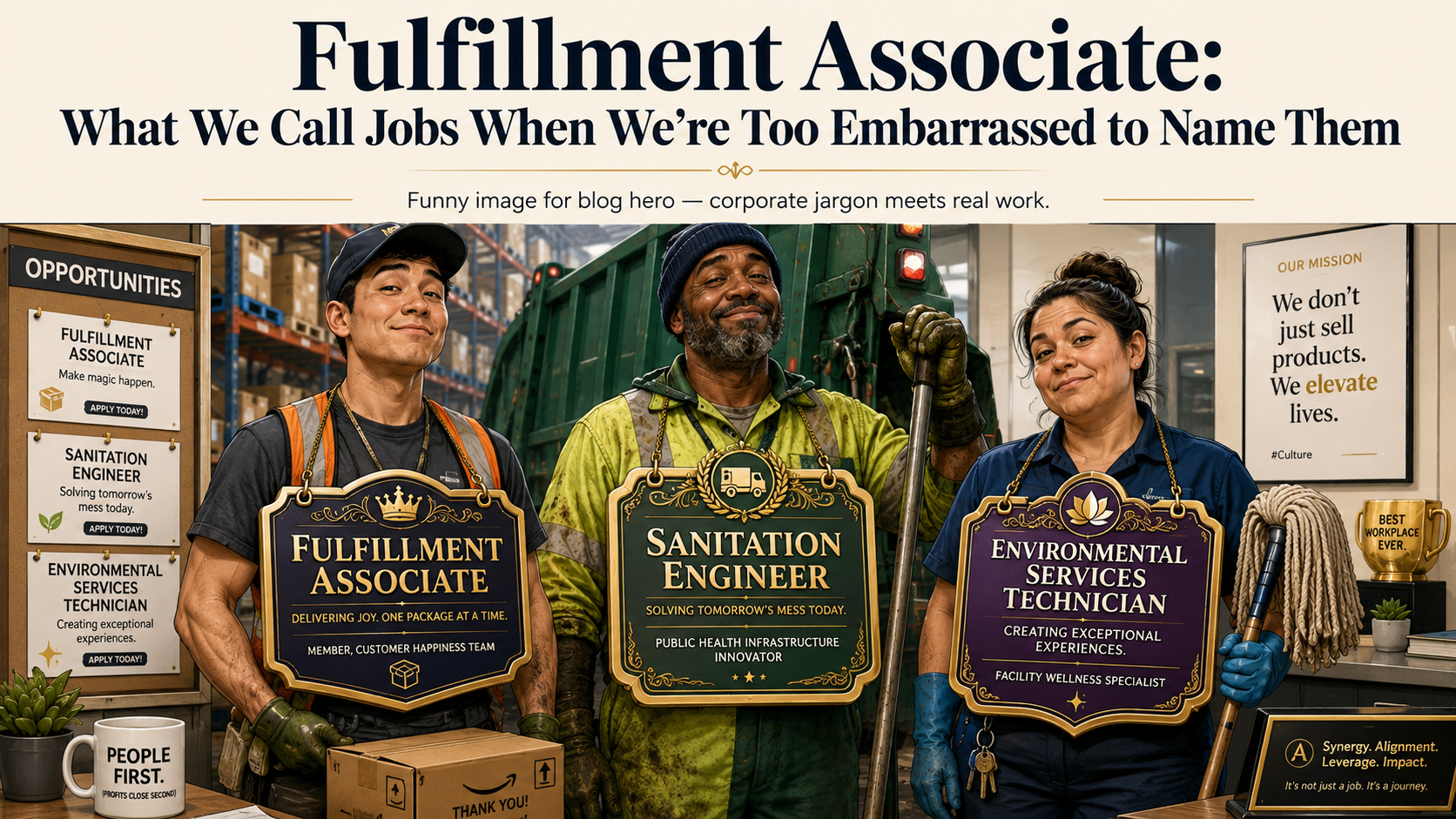
I learned a new word today: fulfillment associate. I had to look it up. It turns out a fulfillment associate is a person who works in a warehouse, picking items off shelves and packing boxes so your online order shows up on your porch two days later. That's it. That's the job. A good, honest, physically demanding job that deserves real respect. What struck me wasn't the job. It was the word. Somewhere between the loading dock and the job posting, "warehouse worker" became "fulfillment associate," and I couldn't stop thinking about it for the rest of the day.
This isn't new. I remember, years ago, hearing someone called a "sanitation engineer" and being genuinely confused for a second, because I thought they meant an actual engineer, someone with a degree who designs water treatment systems. They meant the garbage man. A perfectly good, physically brutal, essential job got handed a title that sounds like it belongs on a business card at a firm with a parking garage and a receptionist named Carol.
We do this constantly now, and once you start noticing it, you can't stop.
A Field Guide to Jobs We Renamed So We Wouldn't Have to Look at Them
- Fulfillment Associate
- Translation: warehouse worker. Picks boxes off shelves, packs them, ships them. Fulfills your Amazon order. Fulfills nothing else that the title implies.
- Sanitation Engineer
- Translation: garbage man. Does not hold an engineering degree. Does hold your trash cans, at six in the morning, in the rain, so the rest of us never have to think about where the garbage goes.
- Environmental Services Technician
- Translation: janitor, often specifically in a hospital. Cleans floors that genuinely need to be clean for people's safety, which is one of the more important jobs in the building, and gets a title that sounds like it involves a lab coat and a clipboard.
- Guest Experience Associate
- Translation: hotel front desk clerk, or the person cleaning your room. The "experience" in question is checking in. It is not a theme park.
- Customer Experience Specialist
- Translation: the person on the phone who has to listen to you yell about your cable bill, calmly, for an hourly wage, for eight hours a day.
- Brand Ambassador
- Translation: the person in the grocery store handing out cubes of cheese on toothpicks.
- Chief Happiness Officer
- Translation: someone in HR. This is a real title at real companies. Nobody's actual happiness has ever improved because their HR department got a fancier business card.
- Growth Hacker
- Translation: marketing person. Nothing is being hacked. Nothing is growing any faster because the word "hacker" is now on someone's LinkedIn.
I Dug Ditches. Nobody Called Me an Engineer, and It Wouldn't Have Helped.
Before any of that, I dug ditches. One of my first jobs was as a plumbing apprentice, which sounds like it might involve pipes, fittings and a useful trade, and it does, eventually. Mostly, in the beginning, it involves a shovel. You dig the trench so the pipe can go in it. That is the job. It is hot, it is repetitive, your back hurts by ten in the morning, and nobody, thank God, ever tried to call me a subterranean infrastructure access engineer. If they had, I would have laughed at them, and then I would have kept digging, because the hole still needed to be six feet long and two feet deep whether or not anyone dressed it up with a fancier name.
A fancy title has never once made a shovel lighter, a warehouse shift shorter, or a hospital floor easier to mop. The work is exactly as hard the day after the title changes as it was the day before. All that changes is what it says on the name tag.
Why This Matters
None of this is really about the words themselves. It's about what the words are covering for. We live in a culture that has gotten very good at renaming discomfort instead of addressing it. Pay a warehouse worker more, and you've actually improved the job. Call her a fulfillment associate, and you've improved nothing except how the job posting reads. It costs nothing to inflate a title. It costs quite a lot to inflate a paycheck, improve working conditions, or simply say out loud that hard, unglamorous work deserves genuine respect rather than a rebrand.
Nobody calls an electrician a "residential energy distribution technician." Nobody renames a surgeon. The trades and professions that already carry real, earned respect don't need linguistic help. It's disproportionately the jobs our culture has quietly decided are lower status, warehouse work, cleaning, garbage collection, entry-level retail and service work, that get the fanciest new names. That's not a compliment to the work. It's an admission that the honest name didn't feel good enough on its own, so we covered it with a nicer one instead of asking why we felt that way in the first place.
Avoiding reality does not change reality. A ditch is still a ditch, whether you call it a ditch or a subterranean access corridor. Somebody still has to dig it.
My Bottom Line
I don't think anyone doing these jobs is actually fooled by the titles. The fulfillment associate knows she's working in a warehouse. The sanitation engineer knows he's collecting trash. The people doing the work are rarely the ones confused about what the work is. The confusion, if there is any, belongs to the rest of us, the people writing the job postings, running the HR departments, and deciding that the honest name for hard work needed a makeover instead of a raise.
Call the job what it is. Then pay the person doing it what the work is actually worth. That would do a great deal more for anyone's dignity than a new line on a business card ever has.
Disclaimer: This piece reflects the author's personal opinions and observations, offered in good spirits for commentary purposes. It is not a criticism of any individual who holds one of the job titles mentioned, nor of the honest, essential work those titles describe. It does not represent the positions of any institution, employer, organization or affiliated entity with which the author may be associated in any capacity.