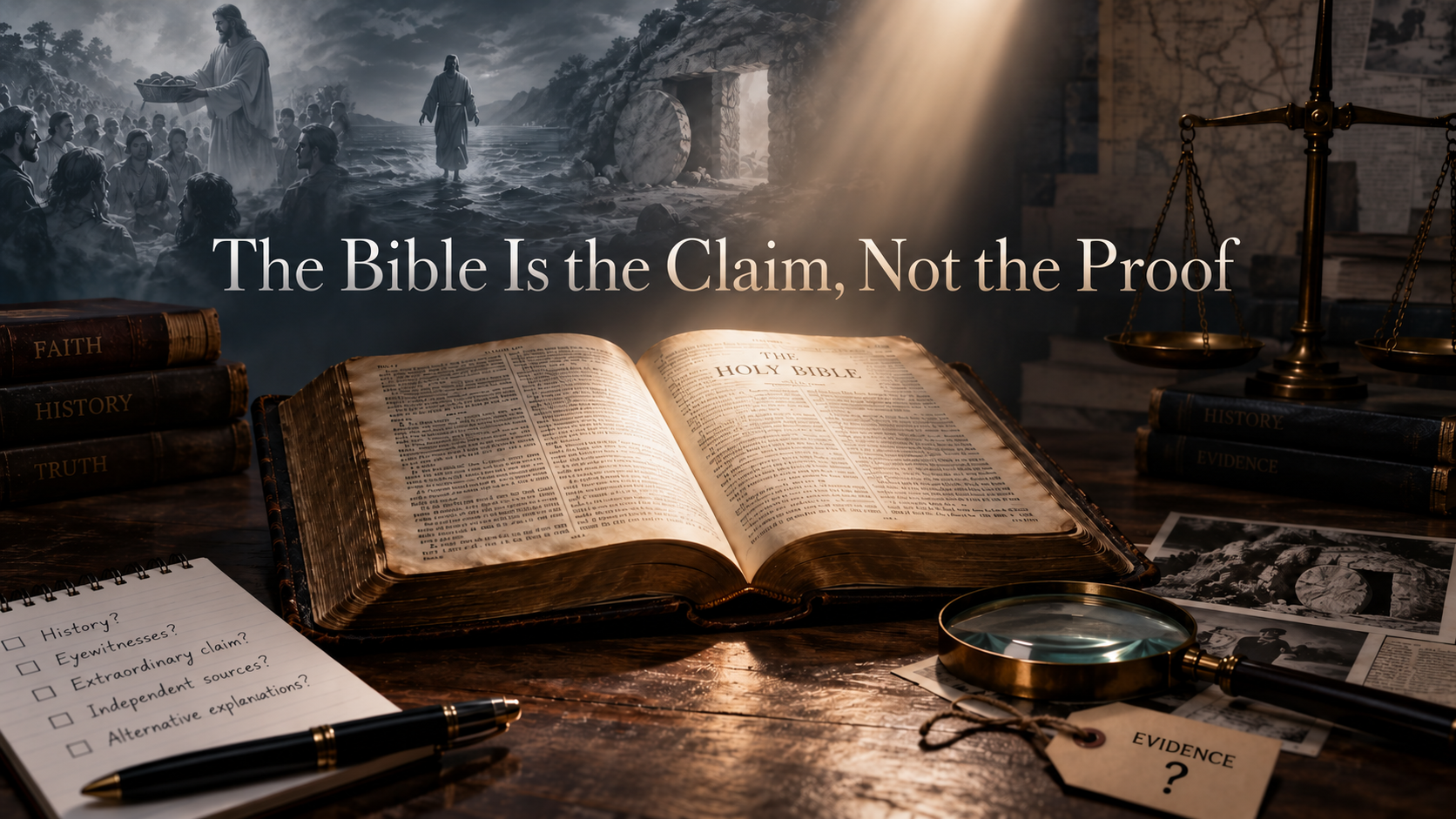
There is a fundamental disconnect in most conversations between Christians and skeptics about the Bible. A Christian says Jesus was the Son of God. Why? Because the Bible says so. How do we know the Bible is telling the truth? Because it is the Word of God. How do we know it is the Word of God? Because the Bible says it is. And around we go.
That is not evidence. That is circular reasoning.
The Bible can be studied as an ancient collection of historical, theological and literary documents. It tells us what Jews and early Christians believed, what stories circulated among them and how those beliefs developed over time. But there is an enormous difference between saying the Bible is evidence of early Christian belief and saying the Bible is independent proof that the supernatural events it describes actually happened.
It is not. And that distinction seems almost impossible for some Christians to accept.
The Bible Is the Assertion
Suppose I write a book tomorrow claiming I walked across Cherry Creek Reservoir without sinking. The book says I did it. Page 47 gives a detailed description. Page 103 mentions it again. Another chapter says several people saw me do it. Four chapters tell four slightly different versions.
Have I proven that I walked on water? Of course not. I have created a document that claims I walked on water.
The document itself becomes something historians can examine. When was it written? Who wrote it? Where did the information come from? Are the accounts independent of each other? Did any contemporary witness mention the event? Does anything outside my book corroborate what I said?
That is how historical investigation works. Christianity does not get an exemption.
When the Gospel of John says Jesus raised Lazarus from the dead, the Gospel is the source of the claim. It cannot also serve as independent confirmation that the claim happened. When Matthew says graves opened and dead people walked into Jerusalem after Jesus died, Matthew is making an extraordinary assertion. When the Gospels say Jesus fed thousands with a few loaves and fishes, walked on water, healed the blind, controlled storms and rose from the dead, those are claims that require evidence.
The fact that Christians eventually collected these documents into something called the Bible does not transform the assertions into proof. A claim does not become evidence for itself because later generations declared the book containing it sacred.
The Burden of Proof Is Not on the Skeptic
This is another place where these conversations go off the rails. The Christian makes the extraordinary claim: Jesus was dead for several days and physically returned to life. Then the skeptic gets asked, "Can you prove he didn't?"
No. And I do not have to. That is not how the burden of proof works.
If I claim there is an invisible dragon living in my attic, you are not obligated to search every square inch of my house and prove there isn't one. I made the assertion. The burden belongs to me.
If someone claims Jesus was resurrected, that person bears the burden of demonstrating a resurrection occurred. If someone claims God inspired a particular collection of ancient books, that person must establish divine authorship. The skeptic does not have to disprove Christianity any more than the Christian has to disprove Zeus, Odin, Vishnu or Osiris. The person making the claim carries the burden.
That principle does not disappear when the subject becomes Christianity.
Four Gospels Are Not Necessarily Four Independent Witnesses
A common argument holds that the New Testament contains several accounts of Jesus and therefore multiple independent witnesses. That is misleading.
Matthew, Mark and Luke are called the Synoptic Gospels precisely because they share enormous amounts of material, language, structure and sequence. The majority scholarly position remains that Mark was written first, generally around 65 to 75 CE, and that Matthew and Luke came later and used Mark or traditions closely connected to it. Matthew and Luke are commonly dated to roughly 80 to 95 CE.
That matters. If three newspapers print essentially the same story because two copied from the first, we do not have three independent sources. We have one tradition reproduced by three publications.
None of the four canonical Gospels identifies its author within the narrative the way a modern eyewitness would sign a statement. The traditional names were attached to the works by early Christian tradition, and the surviving texts were produced decades after the period in which Jesus is generally believed to have lived. That does not make the Gospels worthless. It means they need to be treated like other ancient documents instead of receiving evidentiary privileges because they eventually became scripture.
Where Are the Contemporary Independent Witnesses?
This matters more once we consider the scale of what the Gospels claim happened. Jesus was not a quiet philosopher teaching a handful of students. According to the narratives, thousands followed him. He fed enormous crowds through miracle. He healed disease. He restored sight. He walked on water. He raised Lazarus after four days dead. At his death, Matthew describes darkness, an earthquake, the temple curtain tearing and tombs opening, followed by dead saints entering Jerusalem. Then Jesus himself rises from the dead.
If we are discussing these events historically rather than devotionally, the obvious question is where the contemporary independent evidence is. We do not have it. That does not prove Jesus never existed. Most historians accept that a historical Jesus did. But it creates a very different question from the one Christian apologetics usually asks. There is an enormous difference between evidence that an itinerant Jewish preacher named Jesus existed and evidence that this preacher suspended the laws of nature. Those are not remotely equivalent propositions.
Philo: A Contemporary Who Says Nothing About Jesus
Philo of Alexandria lived roughly from the late first century BCE until around 50 CE, squarely within the traditional period of Jesus's life. He was not ignorant of Judean affairs. He wrote about Judaism, politics and contemporary events. He even discusses Pontius Pilate, the Roman governor central to the Gospel crucifixion story.
Yet Philo says nothing about Jesus. A Cambridge treatment of Philo notes that while he describes Pilate's behavior and administration, he makes no mention of the trial or crucifixion of Jesus. A recent Oxford treatment states there is no evidence in Philo's surviving works of direct contact with Christians.
Silence alone does not prove Jesus did not exist. Writers omit things for countless reasons. But silence becomes more interesting when the claims themselves get larger. An obscure Jewish preacher escaping Philo's attention is perfectly plausible. A man publicly feeding thousands through supernatural multiplication, raising the dead and generating spectacular public miracles is a different proposition. The greater the alleged public event, the more reasonable it becomes to ask why independent contemporary evidence is absent.
Josephus: Decades Later and Complicated
The Jewish historian Josephus is frequently presented by Christian apologists as powerful independent confirmation of Jesus. It is considerably more complicated than that.
Josephus wrote his Jewish Antiquities around 93 or 94 CE, roughly six decades after Jesus's traditional death. One famous passage, the Testimonium Flavianum, describes Jesus, but its wording has been debated for generations because it contains language that reads as strikingly Christian. Scholars disagree about how much of the passage is original to Josephus and how much was altered by later Christian scribes. The controversy remains active in modern scholarship.
Josephus also contains a less controversial reference to James as the brother of Jesus, "who was called Christ." That is historically interesting. But notice what it does not establish. Josephus does not independently report watching Jesus feed 5,000 people. He does not attest Jesus walking on water. He does not verify Lazarus being raised. He does not document the empty tomb or confirm the resurrection. At most, Josephus supports the historical case that Jesus existed and that a movement associated with him developed. That is a long way from proving Christianity's supernatural claims.
Tacitus: Useful, but Nearly a Century Too Late for the Miracles
The Roman historian Tacitus wrote his Annals in the early second century. Discussing Nero's persecution of Christians after the fire of Rome, he says that "Christus," from whom Christians derived their name, had been executed during the reign of Tiberius under Pontius Pilate. That is useful historical evidence.
But look at what it actually establishes. By the early second century, Romans knew Christians existed and understood their movement traced itself to a figure called Christus who had been executed under Pilate. Tacitus was writing roughly eighty years after Jesus's traditional death. He does not say he investigated Roman records and can confirm Jesus walked on water. He does not verify Lazarus. He does not confirm the feeding of thousands or the resurrection. He confirms the existence of Christians and reports the origin story associated with their movement. Those are very different things.
Pliny: Evidence for Christians, Not Jesus's Miracles
Around 112 CE, Pliny the Younger wrote to Emperor Trajan asking how Christians should be handled. His letter tells us Christians gathered, sang hymns to Christ "as to a god" and practiced a developing religious tradition. This is important evidence for Christianity. It is not independent evidence for the miracles attributed to Jesus.
Pliny tells us what Christians believed and how they worshiped roughly eighty years after Jesus's traditional death. A person's belief in an event is evidence the person believes it. It is not automatically evidence the event occurred. Millions of people believing something does not turn belief into historical verification.
The Famous "Three Sources"
This leaves us with three major non-Christian sources routinely invoked in discussions about Jesus: Josephus, Tacitus and Pliny. There are other possible references, including a famously ambiguous statement in Suetonius about someone called "Chrestus," but its connection to Jesus is uncertain.
The point is not that ancient writers never mention Christianity. They do. The point is when they mention it and what they actually confirm. Josephus writes decades after Jesus. Tacitus writes later still. Pliny writes in the early second century. None was a contemporary eyewitness to Jesus's ministry. None independently verifies the feeding miracles, Jesus walking on water, Lazarus returning from the dead or the resurrection. They demonstrate that Christianity existed and that Christians believed particular things about their founder. That is not the same proposition as proof.
What About Paul?
A knowledgeable Christian may respond that Paul's letters predate the Gospels. That is true and should be acknowledged. Paul's authentic letters are the earliest surviving Christian writings. First Corinthians is commonly dated to roughly 53 or 54 CE. In 1 Corinthians 15, Paul repeats an earlier Christian tradition saying Jesus died, was buried, was raised and appeared to Peter, the Twelve, more than 500 people, James and others. Scholars generally recognize this tradition predates Paul's letter and may be considerably earlier. That is important historical evidence for how early resurrection belief developed.
But Paul is still not independent contemporary confirmation of the resurrection itself. Paul never knew or saw Jesus during Jesus's lifetime. He was not an eyewitness to Jesus's ministry, miracles, crucifixion or resurrection. His claimed encounter with Jesus came only after Jesus's death and was described as a revelatory experience of the risen Christ. He did not accompany Jesus through Galilee. He does not claim to have watched Jesus feed 5,000 people. He does not describe witnessing Jesus walk on water or Lazarus emerge from his tomb.
Paul provides strong evidence that belief in Jesus's resurrection appeared very early. He does not provide independent empirical proof that a dead body resumed biological life. Evidence that people believed something happened is not identical to evidence that the thing happened.
The Resurrection Accounts Do Not Even Tell One Seamless Story
Christians often speak of "the resurrection account" as though the New Testament presents one coherent narrative. It does not. The resurrection stories differ on who went to the tomb, how many heavenly figures were present, what the women did afterward, who first encountered Jesus and where the later appearances occurred. Even Christian scholarship acknowledges discrepancies among the Easter narratives.
Apologists have spent centuries trying to harmonize these accounts. Perhaps some differences can be reconciled. Reconciliation is not the same thing as agreement. If four witnesses entered a courtroom and gave materially different descriptions of an extraordinary event, we would examine those differences carefully. We would not declare contradictions irrelevant because we wanted the underlying claim to be true. The Bible deserves the same scrutiny.
Lazarus Presents an Even Simpler Problem
According to John 11, Lazarus had been dead for four days. Jesus arrives. The tomb is opened. Jesus calls him out. A dead man walks out alive. If true, this would be one of the most extraordinary events in recorded human history.
Yet Lazarus appears in none of the Synoptic Gospels. Mark does not tell us. Matthew does not tell us. Luke does not tell us. Paul does not tell us. Josephus does not tell us. Philo does not tell us. Tacitus does not tell us. Only John contains the story.
That does not mathematically prove the story false. But it does not give us independent historical verification that it happened either. John makes the claim. John cannot simultaneously serve as an independent witness corroborating John.
The Same Problem Runs Throughout the Bible
This evidentiary problem is not confined to the New Testament. The Bible contains stories written for theological purposes, traditions passed down across generations, legendary material, poetry, symbolism, political history, mythology, law codes, prophecy, moral teaching and competing theological perspectives accumulated across centuries. Many biblical events lack independent contemporary attestation. Many biblical narratives contain internal tensions or contradictions. Different books sometimes give different numbers, attribute actions to different people or offer different theological explanations for the same supposed history.
None of this means the Bible has no historical value. That would be equally foolish. Ancient texts do not have to be perfect to be historically valuable. But historical value does not make every sentence factual. Homer is historically valuable. The Epic of Gilgamesh is historically valuable. Egyptian religious texts, the Quran and Roman mythology are historically valuable. Nobody concludes from that fact that Athena sprang from Zeus's head, Utnapishtim literally survived a divinely ordered worldwide flood or Muhammad literally traveled through the heavens on a supernatural night journey. Historical documents tell us enormously important things about the civilizations that produced them. They do not receive automatic supernatural credibility.
Christianity Must Play by the Same Rules
This is what I find frustrating about Christian apologetics. Christianity frequently demands an evidentiary standard for every other religion that it refuses to apply to itself.
Ask a Christian why he does not believe Joseph Smith's account of golden plates and angels. Evidence matters. Ask why he does not believe Muhammad received the Quran directly from Gabriel. Evidence matters. Ask why he rejects Hindu miracle stories or regards the Greek gods as mythology. Evidence matters. Then ask why Jesus rose from the dead. Suddenly, "the Bible says so."
Either supernatural claims require evidence or they do not. Either testimony must be examined critically or it should not. Either contradictions matter or they do not. Either independent corroboration strengthens historical claims or it does not. Christianity does not become exempt because it is culturally familiar.
This Does Not Mean Jesus Never Existed
I am not arguing here that Jesus never existed. The existence of a historical Jesus and the divinity of Jesus are separate questions. There is enough material for most historians to conclude that a Jewish religious teacher named Jesus existed, attracted followers and was probably crucified under Pontius Pilate. Fine. None of that requires a miracle. Roman authorities crucified people. Jewish teachers existed. Religious movements formed. Followers mythologized leaders. Those are ordinary historical propositions.
Now change the claim. Jesus was God incarnate. Jesus controlled nature. Jesus multiplied matter. Jesus cured incurable disease instantaneously. Jesus walked on water. Jesus restored a decomposing corpse to life. Jesus himself returned from the dead. Now we have entered an entirely different evidentiary universe, and the evidence must rise with the magnitude of the claim. It does not.
Faith Is Not Evidence
There is nothing logically inconsistent about a Christian finally saying, "I believe it because I have faith." Fair enough. Faith is faith. But then call it faith. Do not call it historical proof. Do not tell skeptics the resurrection has been proven. Do not claim four independent eyewitnesses when the literary history of the Gospels is far more complicated. Do not cite Tacitus and pretend he witnessed Jesus. Do not cite Pliny as though he independently investigated an empty tomb. Do not cite Josephus without acknowledging the textual controversy surrounding the famous Jesus passage. And most importantly, do not demand that skeptics disprove the supernatural. That is not our burden.
Why This Matters
This matters beyond an argument about religion. The Bible continues to influence American politics, law, education, reproductive policy, sexuality, science education and the relationship between church and state. People have every right to believe the Bible is divinely inspired. They have every right to believe Jesus walked on water, that Lazarus walked out of a tomb, that Jesus physically rose from the dead. But when those beliefs move from the church into public policy, the rest of us have every right to ask the simplest question imaginable. What is the evidence?
"The Bible says so" is not enough. The Bible is the source making the assertion. It cannot also be the independent proof of the assertion. The Christian claiming a miracle bears the burden of demonstrating the miracle. The skeptic is not required to disprove it.
After nearly two thousand years, the central supernatural claims of Christianity remain precisely what they began as: claims of faith preserved in Christian texts. Historically important. Culturally transformative. Profoundly influential. Not independently demonstrated facts.
That distinction should not be controversial. It is simply what intellectual consistency requires.
- Bockmuehl, Markus, ed. (2001). The Cambridge Companion to Jesus. Cambridge University Press. [On Philo's treatment of Pilate]
- Hansen, Chrissy. (2025). A Negative Testimonium?: A Response to Fernando Bermejo-Rubio. New Testament Studies. [On the Testimonium Flavianum controversy]
- Josephus, Flavius. Antiquities of the Jews. Book 18 & 20. [Testimonium Flavianum and the James reference]
- Philo of Alexandria. Legatio ad Gaium. [Contemporary account of Pilate with no mention of Jesus]
- Pliny the Younger. Letters, Book 10. [Correspondence with Trajan on Christian practice]
- Tacitus. Annals, Book 15. [Reference to "Christus" and Pilate]
- Whealey, Alice. The Testimonium Flavianum in Syriac and Arabic. New Testament Studies. [Textual history of the Josephus passage]