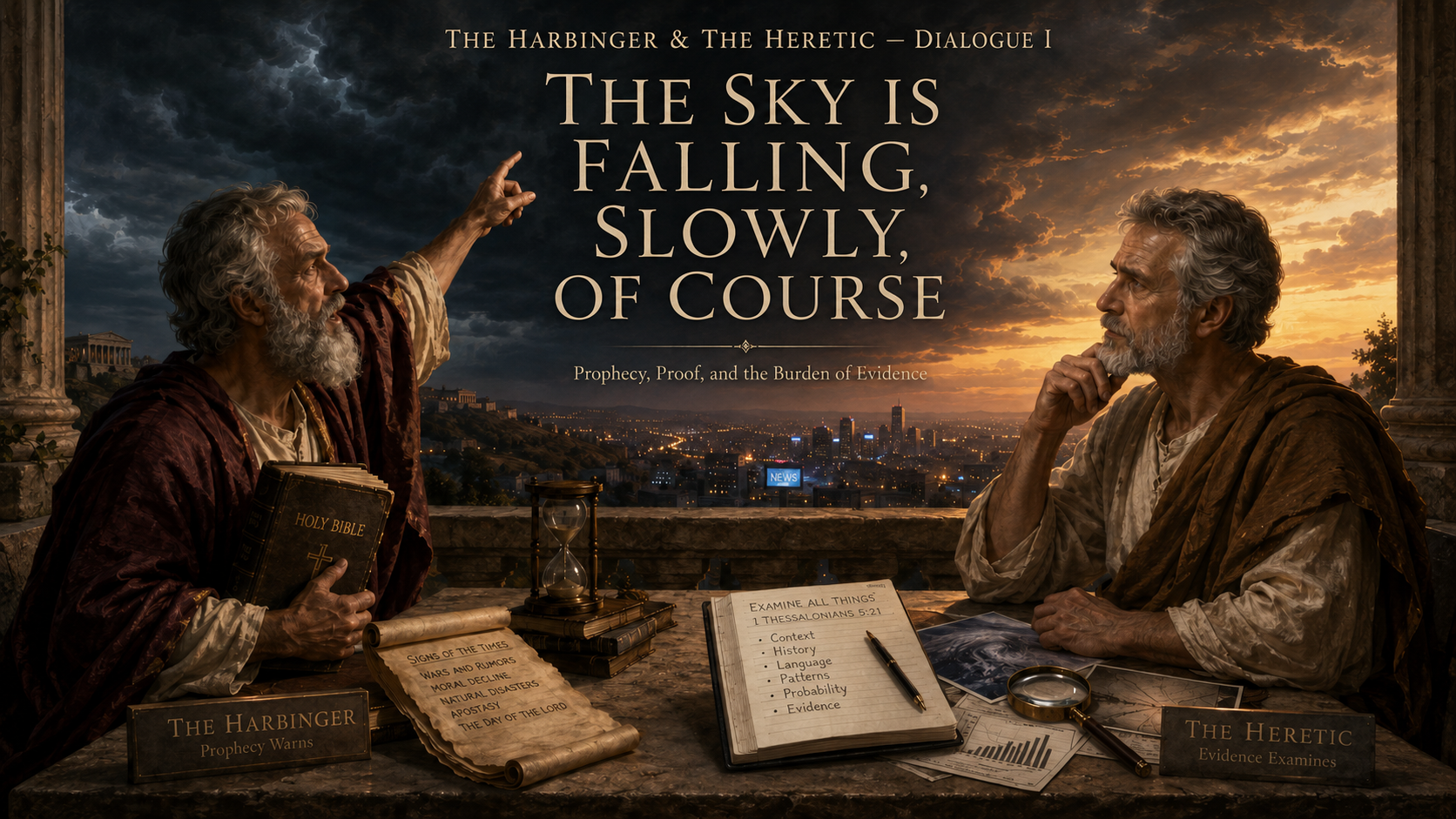
Two old friends sit beneath a fading evening sky. One believes in God and sees prophecy unfolding in nearly every headline. The other does not believe in God, or in anything supernatural, and believes that faith does not relieve anyone of the obligation to prove what he claims.
My friend, you are blind to what is happening. Everything I have warned you about is coming to pass right under your nose.
Everything?
Absolutely everything. The moral decline, political corruption, wars, lawlessness, attacks on Christianity, the destruction of the family. All of it. The Bible predicted this.
Then perhaps you can help me see it. What, specifically, did you predict?
I have been telling you for decades that this country, and the world, is on a trajectory toward disaster.
But "trajectory toward disaster" is not a specific prediction. Every generation has believed that the world was deteriorating. What did you predict would happen, and when did you predict it?
There you go again, pretending I predicted some overnight catastrophe. Those are your words, not mine. I have always said it would happen slowly, inch by inch.
Then let us be clear. You are not predicting a sudden catastrophe. You are predicting a slow decline with no established timetable.
Precisely. Like the frog in slowly boiling water.
That comparison sounds persuasive, but it creates a problem. If the decline is slow, indefinite and without measurable milestones, how could your prediction ever be proven wrong?
It cannot be wrong because it is already happening.
That is the claim. I am asking for the proof.
Just look around you!
Looking around is not a method of verification. Two people can see the same events and interpret them differently. You may see an unmistakable march toward biblical catastrophe. Another person may see a troubled but resilient civilization experiencing the same political, cultural and moral conflicts that have appeared throughout history. Which interpretation is correct cannot be settled by declaring that your opponent is blind.
You do not want to believe. That is your problem.
No, my friend. That answer avoids the question. You have turned my request for evidence into a defect in my character. If I agree with you, I understand the Bible. If I disagree, I am spiritually blind. If events become worse, you were right. If conditions improve, the improvement is temporary and catastrophe remains on the horizon. Under those rules, your belief can never be questioned, tested or disproven.
Biblical truth does not need to be tested by human intellect.
Biblical truth and your interpretation of current events are not necessarily the same thing.
Are you questioning Scripture?
I am questioning you.
There is no difference when I am telling you what Scripture plainly says.
There is an enormous difference. Scripture may be divinely inspired, but neither you nor I possess divine infallibility when interpreting it. Christians have disagreed about prophecy for two thousand years. They have disagreed about Revelation, Daniel, the Antichrist, the millennium, the tribulation, the "last days," and whether particular prophecies describe ancient Rome, future events, spiritual realities or some combination of the three. Questioning a man's interpretation is not the same as questioning God.
But surely you can see the signs.
Which signs, specifically?
Wars and rumors of wars. Pestilence. Earthquakes. Lawlessness. People becoming lovers of themselves. Good being called evil and evil being called good.
Those are serious passages, and they deserve serious consideration. But wars, disease, natural disasters, lawlessness, vanity, political corruption and moral confusion are not unique to our generation. The Black Death killed an enormous portion of Europe. Two world wars slaughtered millions. Christians endured persecution under Rome. Nations collapsed. Cities burned. Empires rose and fell. Slavery, famine, genocide, religious warfare and political tyranny have scarred nearly every century. Do today's events fulfill biblical prophecy in some unique way, or do they resemble the recurring tragedies of human history?
Today it is happening worldwide.
Many previous catastrophes were also international. Modern communications allow us to witness nearly every tragedy as it occurs. A person carrying a smartphone can see more suffering before breakfast than his ancestors encountered in a lifetime. That may make the world feel uniquely catastrophic even when certain conditions, such as life expectancy, childhood survival, literacy and protection from violence, have improved greatly over the longer course of history. The existence of terrible events does not, by itself, prove a particular prophetic interpretation.
You want to explain away everything with your precious science and reason, but science cannot even explain how the universe began, or why there is something rather than nothing. Some things can only be explained by God.
That gaps remain in human knowledge is true, and some of them may always remain. But a gap in what we currently understand is not evidence for whatever someone proposes to fill it. For most of human history, people did not understand lightning, disease or the movement of the stars, and nearly every one of those mysteries was confidently attributed to a god at the time. Almost all of them were eventually explained by something other than a deity. "We do not yet know" is an honest position. "Therefore my god did it" does not follow from it. It only feels like it does, because certainty is more comfortable than an open question.
You always hide behind your intellect.
Reason is not a hiding place. It is one of the tools God gave us to separate truth from error. If a preacher predicts that an event will occur on a certain date and it does not occur, we recognize the prediction as false. But if he predicts a vague, gradual decline without a deadline, then every disturbing headline becomes evidence in his favor. Nothing can count against him. That is not prophecy being verified. It is a belief being protected from examination.
You think I am predicting that the sky will fall overnight.
No. I understand your argument perfectly. You are saying the sky is falling slowly. I am saying that the word slowly does not eliminate the need to prove that the sky is actually falling.
You cannot persuade someone who refuses to be persuaded. I am finished casting pearls before swine.
Calling me swine does not answer my question either.
Then what would satisfy you?
Something specific enough to evaluate. Tell me exactly what you predicted. Show me when you made the prediction. Identify the biblical passage you believe supports it. Explain the passage in its historical and theological context. Identify the present event that fulfills it. Then explain why today's event is uniquely prophetic rather than another example of something humanity has experienced repeatedly. Finally, tell me what evidence would convince you that your interpretation might be mistaken.
Why must I tell you what would prove me wrong?
Because if the answer is nothing, then we are no longer discussing an evidence-based claim. We are discussing an unchangeable conviction. You are free to hold that conviction. But you cannot reasonably demand that I accept it as proven.
Faith does not require proof.
Personal faith may reach beyond what can be demonstrated empirically. But once you make factual claims about history, politics, society and current events, those claims can and should be examined.
Personal faith may reach beyond what can be demonstrated empirically. But once you make factual claims about history, politics, society and current events, those claims can and should be examined. Saying, "I believe Christ will return," is a profession of faith. Saying, "This particular election, war, disease, cultural movement or government policy proves that biblical prophecy is being fulfilled right now," is an interpretive claim. That claim requires an argument.
You simply do not want to believe.
I do not believe in your God, or in any god, and that is not the same thing as refusing to believe anything at all. I believe the physical world is real and knowable. I believe evidence and reason are the best tools we have for separating what is true from what merely feels true. I believe the Bible is a significant historical and literary document worth serious study, whatever one concludes about its origin. What I do not believe is that one person must accept another person's certainty simply because it is delivered with force. Certainty is not evidence. Repetition is not evidence. Anger is not evidence. Insulting the person asking questions is certainly not evidence.
So you believe everything is fine?
Not at all. That is another false choice. I can recognize political corruption without believing the apocalypse is underway. I can oppose moral decline without claiming every social change fulfills Revelation. I can worry about war, debt, crime, government power, ideological extremism and the weakening of institutions without announcing that civilization is inevitably approaching oblivion. Concern is rational. Vigilance is prudent. Catastrophizing requires considerably more proof.
But what if I am right?
Then truth will withstand honest questions. If your interpretation is correct, evidence and careful examination will strengthen it. You should not need to silence questions by calling the questioner blind, ignorant, naive, prideful or unwilling to believe. Those accusations are not the language of persuasion. They are a way of making disagreement morally or spiritually impermissible.
Perhaps you will understand when it is too late.
Perhaps. Human beings can certainly miss dangers. But we can also spend our lives expecting disasters that never arrive. Fear has persuaded many generations that they were witnessing the final collapse. That is precisely why predictions must be specific and interpretations must be examined.
Then you will not listen to my warnings?
I will listen. But listening does not mean surrendering my judgment. Bring me facts, not merely conclusions. Bring me specific predictions, not memories reshaped after the events. Bring me Scripture in context, not isolated verses attached to the evening news. Explain what would prove your interpretation wrong. Most importantly, speak to me as a friend and fellow believer, not as a spiritually superior man casting pearls before someone he has declared to be swine.
And if I cannot do that?
Then you may still have a deeply held belief, but you do not yet have a proven argument.
The two friends fall silent. Above them, the evening sky remains where it has always been. It is darker than it was an hour earlier, but darkness at sunset is not evidence that the sun will never rise again.
Faith Should Not Fear Examination
There is nothing wrong with Christians studying prophecy or viewing current events through a biblical lens. The problem begins when an interpretation is declared unquestionably true and every request for evidence is dismissed as ignorance, arrogance or unbelief.
A prediction that has no deadline, no measurable conditions and no possibility of being proven wrong is not much of a prediction. "The catastrophe is coming slowly" can be repeated for fifty years, and every unsettling development can be presented as confirmation. The person making the claim carries the burden of supporting it.
What was predicted? When was it predicted? What happened? How closely did the event match the prediction? What biblical passage applies? Why does it apply uniquely to the present rather than to similar events throughout history? What evidence could show that the interpretation is mistaken? Those are not attacks on Christianity. They are reasonable questions.
Faith and reason are not mortal enemies. Asking for proof is not the same as refusing to believe, and questioning a friend's interpretation of prophecy is not the same as rejecting the Bible. The sky may indeed be changing. Storm clouds may be gathering. There may be genuine reasons for concern. But whether the warning is sudden or slow and steady, inch by inch, the same principle remains.
Saying the sky is falling, slowly, of course, still requires proof that the sky is actually falling.
References
- Roser, M., Ortiz-Ospina, E. & Ritchie, H. Life Expectancy. Our World in Data. ourworldindata.org. [Long-run improvements in life expectancy, child mortality and literacy.]
Disclaimer: This piece is a fictional dialogue written to illustrate a broader argument about how prophetic and end-times claims are tested and discussed. It does not dispute the validity of Christian faith, Scripture or personal belief in biblical prophecy. It argues only that specific interpretive claims about current events fulfilling prophecy deserve the same scrutiny as any other factual claim. The views expressed are the personal opinions of the author for educational, commentary and public discourse purposes only and do not represent the positions of any institution, employer, organization or affiliated entity with which the author may be associated in any capacity. Religious commentary is protected opinion under the First Amendment.