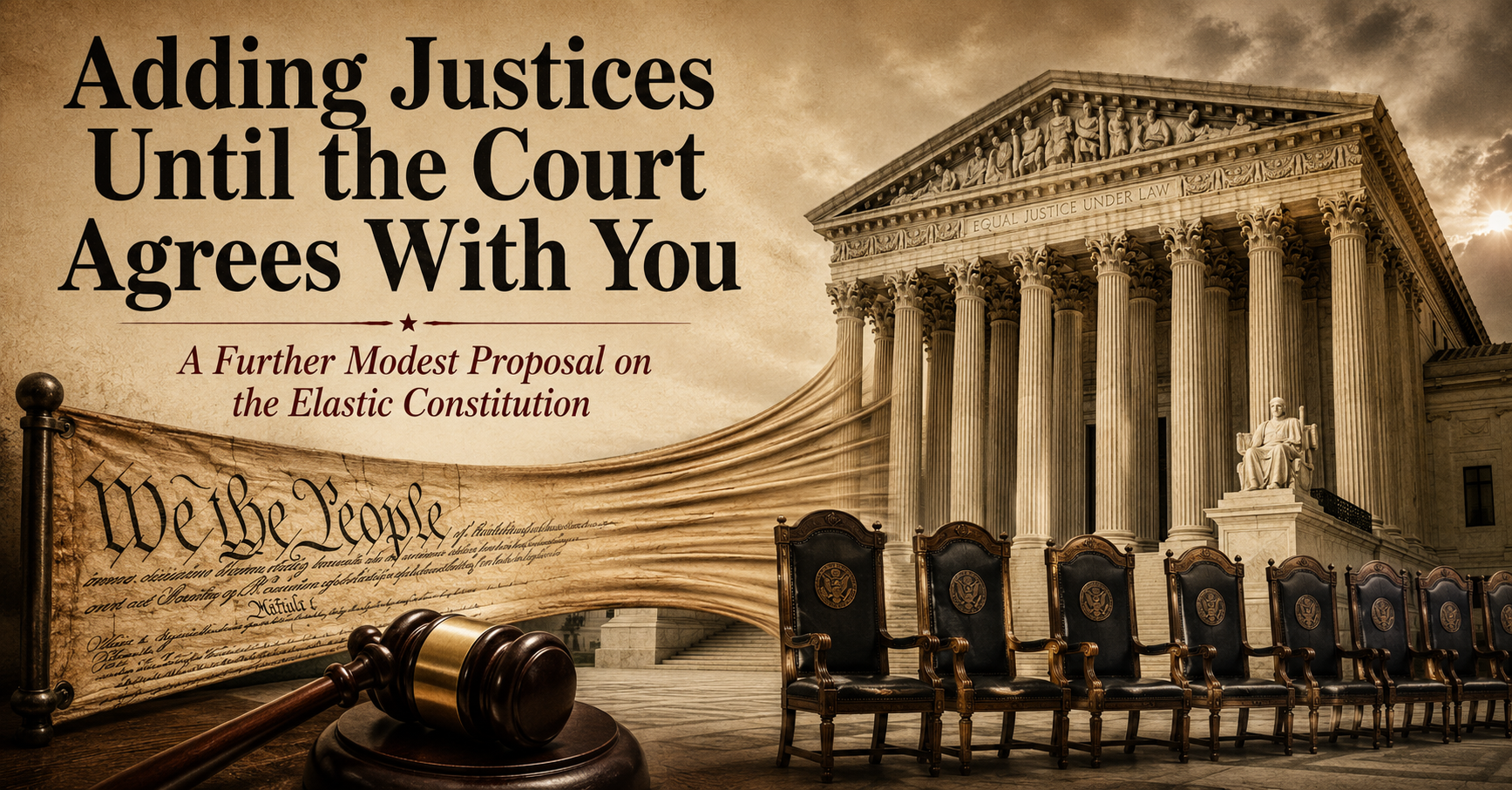
It is a truth universally acknowledged among the progressive wing of the Democratic Party that when the Supreme Court of the United States issues a ruling one finds disagreeable, the appropriate response is not to amend the Constitution through the cumbersome process the founders prescribed, nor to elect different legislators to pass different laws, nor even to accept with graceful civic dignity the possibility that one's preferred policy position may not be constitutionally mandated. The appropriate response, it has been discovered, is to add more justices to the Court until the ratio of agreeable to disagreeable opinions shifts in the desired direction. This innovation, which the Framers somehow failed to include in the document despite their considerable foresight, has the considerable advantage of requiring only a simple congressional majority rather than the three-fourths supermajority that Article V inconveniently demands for actual constitutional amendments. One marvels that it took two and a half centuries to discover that the Constitution can be effectively amended by adding personnel to the institution charged with interpreting it.
A Brief History of the Elastic Clause, Elastically Applied
The discovery that the phrase "general Welfare" in Article I, Section 8 means whatever Congress currently wishes it to mean was made, in its modern commercial form, during the administration of Franklin Delano Roosevelt, a president of considerable determination and some impatience with the existing constitutional order. Having been informed by the Supreme Court on multiple occasions between 1934 and 1936 that his New Deal programs exceeded the federal government's enumerated powers, Roosevelt conceived an admirably direct solution. Rather than amend the Constitution, which requires convincing thirty-eight states and therefore a great deal of patience, he proposed in 1937 to simply add one new justice to the Court for every sitting justice over the age of seventy, up to a maximum of fifteen total, which would by the purest coincidence have allowed him to immediately appoint six justices personally sympathetic to his programs.
Roosevelt described this plan as a measure to improve the efficiency of a Court burdened by elderly jurists of diminished capacity. The nation's editorial boards, legal scholars, members of his own party and even his Vice President described it somewhat differently. Senate Majority Leader Joseph Robinson, who was supposed to shepherd the plan through Congress, is reported to have worked himself to a fatal heart attack in the effort before the bill could be brought to a vote. The Court, demonstrating the institutional self-preservation instinct for which it has since become celebrated, began in that same year to uphold New Deal legislation it had been striking down, in what historians with a gift for phrase-making have called the switch in time that saved nine. Roosevelt did not get his bill. He got something better: a Court that had learned that sufficiently credible presidential displeasure produces doctrinal flexibility.
Roosevelt's official message to Congress on February 5, 1937 described the proposal as addressing the problem of overworked federal courts and justices of "aged or infirm" capacity who were unable to keep pace with their caseloads. Chief Justice Charles Evans Hughes responded with a letter to the Senate Judiciary Committee demonstrating, with the meticulous patience of a man who had been insulted by someone who thought he wouldn't notice, that the Court was fully current on its docket, that adding justices would actually slow its work, and that the description of the sitting justices as decrepit was not supported by the evidence of their recent output. The Senate Judiciary Committee rejected the bill 10-8 in what was described as a "scathing" report. Roosevelt lost the battle and won the constitutional war. The modern welfare state was born from a threat that never became law.
Hamilton Did Not Mean What You Think Hamilton Means
The defenders of the elastic general welfare clause are fond of invoking Alexander Hamilton as their authority, citing his Report on Manufactures of 1791 as proof that even the founders recognized the general welfare clause as an independent and broad grant of spending authority. This citation is accurate as far as it goes, which is not very far in the direction its invokers wish to travel. Hamilton's Report on Manufactures argued that Congress could appropriate money for national purposes beyond the strict list of enumerated powers. The purposes Hamilton had in mind were roads, harbors, canals and the development of domestic manufacturing capacity, which in 1791 constituted the actual physical and productive infrastructure of a young nation attempting to become economically independent of European suppliers. Hamilton was arguing for what we would now call infrastructure spending and industrial policy. He was not, by any stretch of the interpretive imagination he actually possessed, arguing for permanent individual income transfers from working citizens to non-working citizens as a general exercise of federal compassion.
The distinction Hamilton drew was between spending that was general and national in its benefit versus spending that was particular and local. A canal connecting the Ohio River to the Atlantic seaboard benefits every merchant, farmer and manufacturer who uses it. A cash payment to a specific individual benefits that individual, and the argument that the aggregate of millions of such payments constitutes a national general benefit is the kind of reasoning that Madison, Hamilton's co-author of the Federalist Papers, specifically warned would render the entire concept of limited enumerated powers meaningless. Madison tried to have the general welfare clause removed from the Constitution entirely because he foresaw that it would be stretched. Hamilton, whose view of federal power was the most expansive among the founders, would nonetheless have found the modern welfare state's invocation of his name for purposes he never endorsed to be, at minimum, a considerable liberty with his legacy.
Hamilton argued for canals. He is now cited as constitutional authority for a trillion-dollar annual transfer payment system. One imagines he would have thoughts about this, and that they would be expressed at some length and with considerable force.
The Modern Rediscovery of an Excellent Idea
Having established that the general welfare clause means whatever Congress says it means, the progressive wing of American politics has in recent decades rediscovered Roosevelt's complementary insight: that the Supreme Court means whatever its current composition says it means, and that its current composition is therefore a matter of some political urgency. In April 2021, Senators Edward Markey of Massachusetts and Elizabeth Warren of Massachusetts, along with Representatives Jerry Nadler of New York, Hank Johnson of Georgia and Mondaire Jones of New York, introduced the Judiciary Act of 2021, a two-page document proposing to expand the Supreme Court from nine to thirteen justices. They held this announcement on the steps of the Supreme Court building itself, which has the considerable advantage of ensuring that the justices inside could hear them if the windows were open.
Representative Nadler, displaying the rhetorical ingenuity for which the House Judiciary Committee has become known, explained at the press conference that the proposal should not be described as court-packing. "We are not packing the Supreme Court," Nadler said. "We are unpacking it." The linguistic innovation here is breathtaking in its ambition. One packs a court when one adds justices to achieve a desired political outcome. One unpacks a court when one adds justices to achieve a desired political outcome but prefers a different word for it. The distinction is subtle but Nadler appeared to find it meaningful, and one respects the effort that presumably went into it.
The Judiciary Act of 2021 was introduced April 15, 2021. House Speaker Nancy Pelosi announced the same day that she had no plans to bring it to the floor for a vote. Senate Majority Leader Dick Durbin said he had just heard about it and was not ready to endorse it. President Biden, described as "not a fan" of court-packing, established a 36-member bipartisan commission to study the idea instead. The commission studied it. The bill was reintroduced as the Judiciary Act of 2023 by Senators Markey, Warren and Tina Smith, along with Representatives Nadler, Johnson, Cori Bush and Adam Schiff, demonstrating that the experience of the first bill had not diminished enthusiasm for the concept. It was not brought to the floor in 2023 either. The measure's principal achievement to date has been to establish that the number of co-sponsors willing to introduce a bill that will not be voted on can be maintained and even expanded across multiple congressional sessions.
The Logical Endpoint of an Excellent Principle
I confess that I find the underlying logic of the modern court-packing proposal to be of considerable intellectual interest, and I propose to follow it to its natural conclusion as a service to the citizens who have not yet done so. If the appropriate response to a Supreme Court that issues unwelcome rulings is to add justices until the rulings become welcome, then the appropriate response to a Court enlarged by a Democratic administration is, when a Republican administration next takes power, to add further justices until the ratio is restored to the desired configuration. This process, which could in theory continue indefinitely, would produce a Supreme Court of considerable size after several rounds of reciprocal enlargement. By the fifth or sixth iteration, we would have achieved something approaching a legislature, with the advantage that its members are appointed for life and are not subject to the inconvenience of elections, which impose on legislators the awkward requirement of periodically consulting the citizenry whose lives they govern.
The objection will be raised that this is precisely what happened with the Senate's treatment of judicial nominations under McConnell, with the nuclear option for confirmations, and with Trump's three appointments, and that the Democrats are simply responding in kind. To this objection I say: precisely. Every constitutional norm violated in response to a previous constitutional norm violation produces a republic with fewer constitutional norms, a trajectory that, extended through several more administrations of mutual escalation, produces a document of increasingly ceremonial significance. The founders were aware of this dynamic. It is one of the reasons they built amendment procedures so deliberately difficult that they cannot be circumvented by adding personnel to the institution in charge of interpreting the document. They assumed that the citizens of the republic would understand this. They were optimistic people.
What Madison Would Say, and Why Nobody Is Saying It
James Madison would observe, with the patience of a man who has heard this argument before because he specifically anticipated it and wrote about it, that a constitution whose meaning is determined by the composition of the court interpreting it rather than by its text is not a constitution in any meaningful sense. It is a set of aspirational suggestions subject to revision by whoever controls the appointment process at the relevant moment. Madison's great fear, expressed in the Federalist Papers and in his later writings, was not that the government would fail to act but that it would act without constitutional restraint, acquiring powers through interpretation and precedent that the document's authors never authorized, each expansion becoming the baseline for the next. The general welfare clause stretching from roads and canals to a trillion-dollar transfer payment system, and the court expanding to accommodate whatever the current political majority requires, is the process Madison described and feared. He was right to fear it. He was not, however, in a position to prevent it from the vantage point of 1787, which is approximately where the people who were supposed to prevent it have been operating from ever since.
My Bottom Line, Again Without Excessive Irony
Franklin Roosevelt threatened the Supreme Court into compliance in 1937 and got the constitutional revolution he wanted without passing the bill that would have produced it. The modern Democratic Party has introduced versions of the same bill in 2021 and 2023, without the threat carrying sufficient force to produce either the compliance or the legislation. What both episodes share is the underlying premise that a Supreme Court issuing rulings you disagree with is a court that has gone wrong and must be corrected, and that the mechanism of correction is political rather than constitutional. That premise is the rot. A court that can be corrected by adding members whenever its rulings displease the current majority is not an independent branch of government. It is a committee of the legislature with better furniture. The founders built the Court to be inconvenient on purpose. A court that never inconveniences anyone in power is not doing its job. The politicians who find it most inconvenient are usually the ones who most need to be inconvenienced, which is not a coincidence and is, in fact, the entire point.
Roosevelt threatened the Court into submission in 1937. The modern left has been introducing the same bill ever since, wondering why the threat is not working as well the second time. The answer is that the Court has read the history. The question is whether the Congress introducing the bill has.
Why This Matters Without the Irony
It matters because the two propositions, that the general welfare clause means whatever Congress says it means, and that the Court can be enlarged whenever its rulings are inconvenient, are not separate innovations. They are the same innovation applied to different branches of the same problem. If the Constitution's text is infinitely elastic and the institution charged with enforcing its limits can be restructured whenever it attempts to enforce them, then the Constitution is not a constraint on government power. It is a decoration on government power, which is an entirely different thing and which the founders were quite specifically trying to avoid building. The republic they designed has limits. The people who find those limits most inconvenient are reliably the ones who most need to be limited. That was the design. It was a good one. It deserves more defenders than it currently has.
Disclaimer: This post employs satirical form in the tradition of Jonathan Swift's 1729 essay "A Modest Proposal" and may be read as a companion to the author's earlier modest proposal on welfare. The views expressed are the personal opinions of the author offered for educational, commentary and public discourse purposes only. They do not represent the positions of any institution, employer or affiliated entity. Nothing in this post constitutes legal, financial, medical or professional advice. References to public figures reflect their documented public statements and legislative actions only. Political and constitutional commentary reflects the author's independent analysis and is protected expression of opinion. Readers are encouraged to consult primary sources and form their own conclusions.