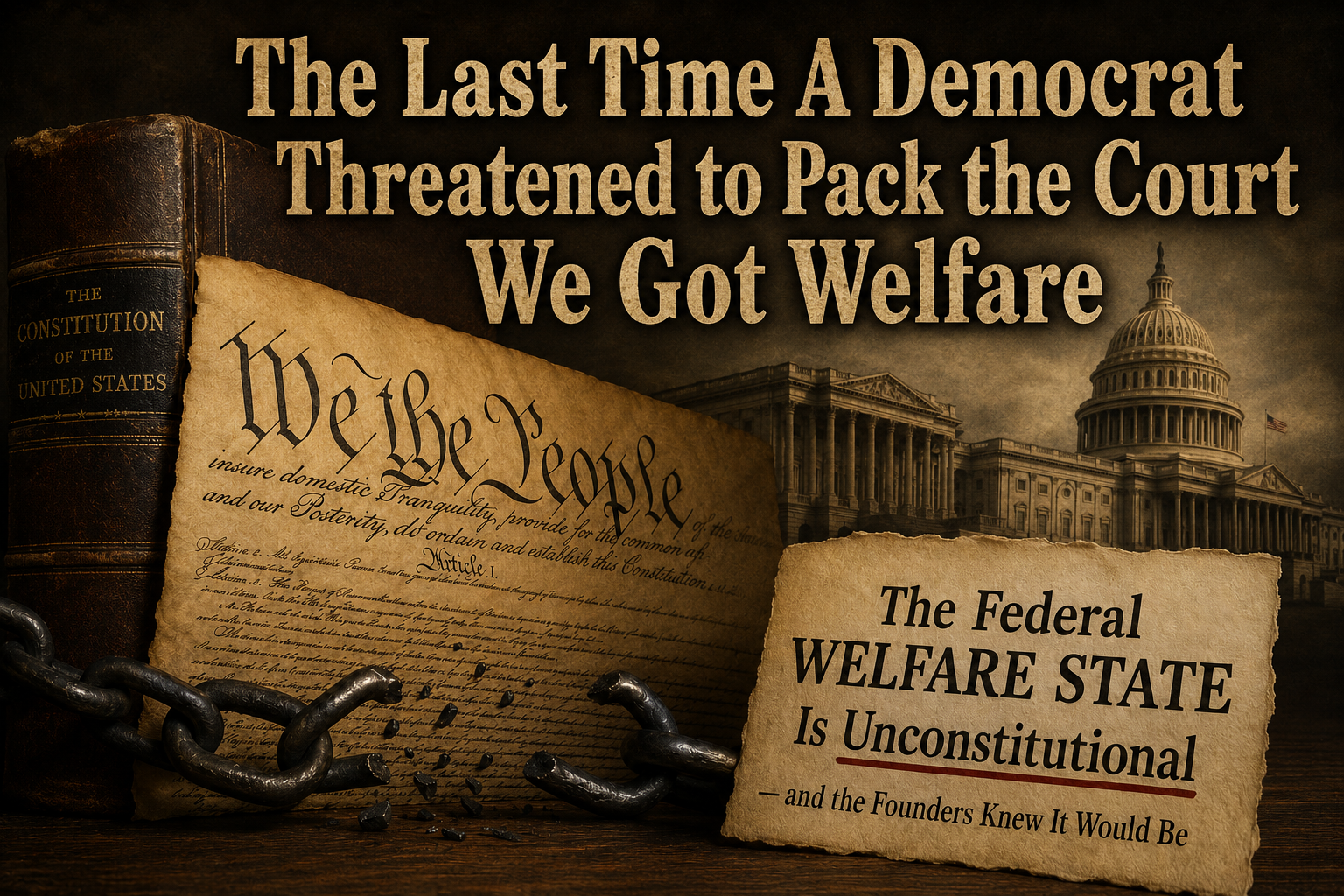
If you walked into the Constitutional Convention in Philadelphia in 1787 and proposed a federal system that would take trillions of dollars from productive workers by force and redistribute it to millions of individuals living on permanent government subsistence, the founders would not have debated the idea. They would have thrown you out. The concept was so far outside the governing philosophy they were building that it would not have been recognizable as a constitutional proposal at all. The men who wrote the document were intimately familiar with what happens when government accumulates unlimited power to provide for the welfare of its citizens. They had read their Montesquieu. They had read their Locke. They had watched European monarchies build exactly that kind of dependency. They designed the Constitution specifically to prevent it from being replicated on American soil. What the modern federal welfare state has become is not an extension of the founders' vision. It is the thing they were building against.
What the General Welfare Clause Actually Says
The text at issue is Article I, Section 8 of the Constitution: "The Congress shall have Power to lay and collect Taxes, Duties, Imposts and Excises, to pay the Debts and provide for the common Defence and general Welfare of the United States." Those six words, "general Welfare of the United States," have been stretched by a century of progressive jurisprudence into authorization for nearly unlimited federal spending on nearly any purpose Congress can describe as beneficial to somebody. That interpretation would have appalled every man who wrote the document, including Alexander Hamilton, who is routinely cited as the one founder who interpreted the clause most broadly.
Here is what the modern welfare state's defenders leave out about Hamilton. Even Hamilton, in Federalist 83, wrote that "the specification of particulars evidently excludes all pretension to a general legislative authority, because an affirmative grant of special powers would be absurd as well as useless if a general authority was intended." In plain English: listing 18 specific powers in Article I, Section 8 would be pointless if the general welfare clause already authorized everything. The enumerated powers would be meaningless surplusage. Hamilton was the most expansive reader of federal power among the founders, and even he did not read "general welfare" as meaning whatever Congress decided was good for someone. Hamilton's Report on Manufactures went somewhat further, arguing that Congress could appropriate money for national purposes beyond the strict enumerated list, but even there he was talking about national infrastructure and manufacturing capacity, not permanent income transfers to individuals.
Modern defenders of the welfare state frequently invoke Hamilton as their constitutional authority, citing his broader reading of the general welfare clause. What they omit is that Hamilton was talking about roads, harbors, canals and manufacturing capacity, projects that benefit the entire national economy. The Heritage Foundation's constitutional analysis notes that even Hamilton recognized the general welfare clause was not unlimited: "It is therefore incumbent upon Members of Congress to consider, once again, the limits of their spending power and recognize, as even Hamilton did, that it is not unlimited." Invoking Hamilton to justify SNAP, TANF and federal housing subsidies is the kind of historical misreading that would have made Hamilton himself object strenuously.
Madison's Warning: He Tried to Remove the Clause Entirely
James Madison, the primary architect of the Constitution, was so alarmed by Hamilton's later expansive reading of the general welfare clause that he advocated for a constitutional amendment to eliminate the phrase entirely. That fact alone tells you everything you need to know about what the founders understood it to mean. Madison spent the last decades of his life trying to prevent the clause from becoming what it eventually became. In a letter to Edmund Pendleton in 1792, Madison wrote: "If Congress can do whatever in their discretion can be done by money, and will promote the General Welfare, the Government is no longer a limited one, possessing enumerated powers, but an indefinite one." In Federalist 41 he was equally clear: "For what purpose could the enumeration of particular powers be inserted, if these and all others were meant to be included in the preceding general power?"
Madison's view was that the general welfare clause was a preamble to the enumerated powers, not an independent grant of authority beyond them. The clause described the purpose for which the 18 listed powers could be exercised. It did not create a nineteenth power to spend on anything Congress chose to call welfare. He was so certain of this interpretation and so alarmed by Hamilton's alternative reading that he described his attempts to contain the clause as trying to render it "harmless." The word harmless. In a letter to Henry Lee, he asked: "What think you of Hamilton's commentary on the terms 'general welfare'? The federal government has been pronounced the creature of unlimited discretion." He did not think that was a good development. He was right that it was not.
Madison tried to amend the general welfare clause out of the Constitution because he knew what it would eventually be used to justify. He called his efforts to contain it making the clause "harmless." What the modern welfare state has become is exactly the harm he was trying to prevent.
The Bonus Bill Veto: The Founders' Explicit Answer
If there were any doubt about how the founding generation understood the limits of federal spending power, the Bonus Bill of 1817 removes it. Congress passed a bill that would have used the bonus paid by the Second Bank of the United States to fund a national system of roads and canals. It was an infrastructure bill by any reasonable description. President James Madison vetoed it. His veto message is one of the most important and least read constitutional documents in American history. Madison wrote that he could not reconcile the bill with the Constitution because it assumed a power not expressly granted and not deducible from any granted power or from several powers combined. He then added that if such a power existed, "it must be found in a different enumeration, or, more probably, in an amendment to the Constitution."
Read that carefully. Madison vetoed federal funding for roads and canals because he did not believe the Constitution authorized it without a constitutional amendment. Roads and canals. Infrastructure. The physical networks that would move goods and people across the young republic. If Madison believed federal infrastructure spending required a constitutional amendment, what would he have said about federal programs providing food, housing, healthcare, cash assistance and childcare to tens of millions of individuals on a permanent basis? The answer is not complicated. He would have said it was not merely unconstitutional. He would have said it was incomprehensible as a federal function.
The New Deal: When the Line Was Erased
The constitutional case for limiting federal welfare spending did not simply yield to superior legal reasoning. It yielded to political pressure applied to a terrified Supreme Court. Franklin Roosevelt, frustrated by a Court that had struck down large portions of his New Deal legislation as unconstitutional, threatened in 1937 to pack the Court by adding up to six new justices who would uphold his programs. The threat worked. In what historians have called the switch in time that saved nine, the Court abruptly reversed course in cases including West Coast Hotel v. Parrish (1937) and began upholding New Deal legislation it had previously been striking down.
The 1936 case United States v. Butler had actually struck down the original Agricultural Adjustment Act, with Justice Roberts writing that Congress's taxing and spending power was limited to the specific enumerated powers. The Court's subsequent reversal, driven by political intimidation rather than constitutional reasoning, is the moment when the modern welfare state's constitutional foundation was laid. That foundation is not a product of honest legal interpretation. It is a product of a president threatening to destroy judicial independence if the courts did not give him what he wanted. The Constitution did not change in 1937. The Court's willingness to enforce it did.
Before 1937, the Supreme Court repeatedly struck down federal programs that exceeded the enumerated powers. In United States v. Butler (1936), the Court struck down the Agricultural Adjustment Act's processing tax as an unconstitutional attempt to regulate agriculture, a power reserved to the states. After Roosevelt's court-packing threat, the Court began upholding New Deal legislation in cases like Helvering v. Davis (1937), which upheld Social Security, with language so expansive that it effectively gave Congress unlimited discretion to define "general welfare." Constitutional scholar Robert Epstein has described this shift as a "constitutional revolution" achieved through political coercion rather than legal argument. The founders' Constitution did not authorize the welfare state. The post-1937 Court decided to allow it anyway.
What the Founders Would Say About Dependency as Policy
The founding generation understood poverty as a genuine human problem and addressed it through private charity, church organizations, community mutual aid and state and local government. What they explicitly rejected was a federal system that extracted wealth from producers and transferred it permanently to non-producers, because they understood from direct observation what that system produces. Benjamin Franklin, writing about the English Poor Laws in a 1766 essay titled "On the Price of Corn and Management of the Poor," observed that making relief easy to obtain destroys the incentive to work, drives up the cost of labor for employers, and produces a dependent class that grows year by year. He wrote that the best way to help the poor was to make them uncomfortable enough in their poverty that they would exert themselves to escape it. That is not a cruel sentiment in its original context. It is an accurate empirical observation about what incentives produce.
Franklin's observation has been validated repeatedly by modern economic research. The work of economists Charles Murray, whose 1984 book Losing Ground documented the perverse incentive structures built into the Great Society programs, and the National Bureau of Economic Research's studies of welfare's effects on labor force participation, family formation and intergenerational poverty, support the founders' intuition that transferring money to able-bodied individuals without behavioral requirements produces more dependency rather than less. Murray documented that out-of-wedlock birth rates, poverty rates and crime rates in poor communities all worsened after the Great Society programs were implemented and expanded, exactly the opposite of their stated goals. The founders did not have Murray's data. They had two millennia of European history showing what happens when governments make poverty comfortable.
You Would Have Starved Waiting for Federal Help in 1789
This is the plain historical truth that modern defenders of the welfare state refuse to reckon with. If you were poor in 1789, the federal government would not have helped you. Not because Congress was cruel or indifferent. Because it was not considered a federal function. You would have been the responsibility of your family, your neighbors, your church, your local community, the county poor farm if your state had one, or private charitable organizations. The federal government's job was to defend the borders, coin money, regulate commerce between the states, deliver the mail and build post roads. That was essentially the list. Feeding, housing and providing healthcare to individuals in need was not on it. It was not a failure of imagination. It was a deliberate choice about what kind of government they were building.
The people who invoke the founders' wisdom on the Second Amendment or the First Amendment or the separation of powers are often the same people who dismiss the founders' explicit views on the limits of federal spending power as outdated and irrelevant. The selective originalism is revealing. When the founders say something that supports your position, they were wise and prescient. When they say something that challenges it, they were products of their time who could not have anticipated modern complexity. The honest position is to acknowledge what they actually believed and argue openly for why the Constitution should be interpreted differently today, not to pretend that Hamilton was secretly in favor of a multitrillion-dollar federal transfer payment system.
My Bottom Line
The federal welfare state as it exists today is not what the founders built or what they would have recognized as constitutional. The general welfare clause was understood by its authors, including Hamilton, to authorize spending in service of the enumerated powers, not to create an unlimited general spending power for any purpose Congress declared beneficial. Madison tried to remove the clause from the Constitution because he was afraid of what it would eventually be used to justify. He was right to be afraid. The Bonus Bill veto demonstrates that even infrastructure spending was considered to require a constitutional amendment by the man who wrote the document. The modern welfare state was not authorized by the founders' Constitution. It was authorized by a Supreme Court that caved to political intimidation in 1937 and has been rationalizing that capitulation ever since.
None of this is an argument that poverty is not real, that people do not suffer, or that the challenges facing low-income Americans are not genuine. They are. The argument is about what level of government is constitutionally empowered to respond and through what mechanisms. The founders believed those responses belonged at the state and local level, in private communities and in voluntary charitable institutions, where accountability is closer, incentives are cleaner and the constitutional structure is respected. That argument deserves to be made honestly, with the historical record in hand, not suppressed because the political class has decided that rethinking the New Deal's constitutional foundation is too uncomfortable to contemplate.
You would have starved waiting for federal food stamps in 1789. Not because the founders were heartless. Because they understood what unlimited federal welfare power eventually produces. Two hundred and fifty years of American history is turning out to prove them right.
Why This Matters
It matters because the constitutional question shapes everything that follows. If the general welfare clause means what the post-1937 Court said it means, then federal spending on virtually anything is constitutional and the only limits are political. If it means what Madison and the historical record say it means, then an enormous portion of the federal budget is operating outside the constitutional authority Congress was granted, and the political argument about how much to spend on welfare programs is secondary to the structural argument about which level of government should be making that decision at all. Restoring that structural argument to American political discourse is not nostalgia for a simpler era. It is fidelity to a constitutional design that dispersed power specifically because concentrated power, even well-intentioned power, tends toward the outcomes that dispersed power was designed to prevent.
References
- Hamilton, A. (1788). Federalist No. 83. "This specification of particulars evidently excludes all pretension to a general legislative authority."
- Hamilton, A. (1791). Report on Manufactures. University of Chicago Press, Founders' Constitution, Article I, Section 8, Clause 1, Document 21.
- Madison, J. (1788). Federalist No. 41. "For what purpose could the enumeration of particular powers be inserted, if these and all others were meant to be included in the preceding general power?"
- Madison, J. (1792). Letter to Edmund Pendleton. "If Congress can do whatever in their discretion can be done by money, and will promote the General Welfare, the Government is no longer a limited one."
- Madison, J. (1817). Veto message on the Bonus Bill. 14th Congress, 2nd Session.
- Franklin, B. (1766). On the price of corn and management of the poor. London Chronicle.
- United States v. Butler, 297 U.S. 1 (1936).
- Helvering v. Davis, 301 U.S. 619 (1937).
- Heritage Foundation. (2023). Enough is enough: Why general welfare limits spending. heritage.org.
- Murray, C. (1984). Losing ground: American social policy 1950-1980. Basic Books.
- Epstein, R. (2014). The classical liberal constitution. Harvard University Press.
Disclaimer: The views expressed in this post are the personal opinions of the author and are offered for educational, commentary and public discourse purposes only. They do not represent the positions of any institution, employer, organization or affiliated entity. Nothing in this post constitutes legal, financial, medical or professional advice of any kind. References to constitutional history, Supreme Court decisions and historical figures are based on publicly available sources cited above. Commentary on constitutional and political subjects reflects the author's independent analysis and is protected expression of opinion. Readers are encouraged to consult primary sources and form their own conclusions.