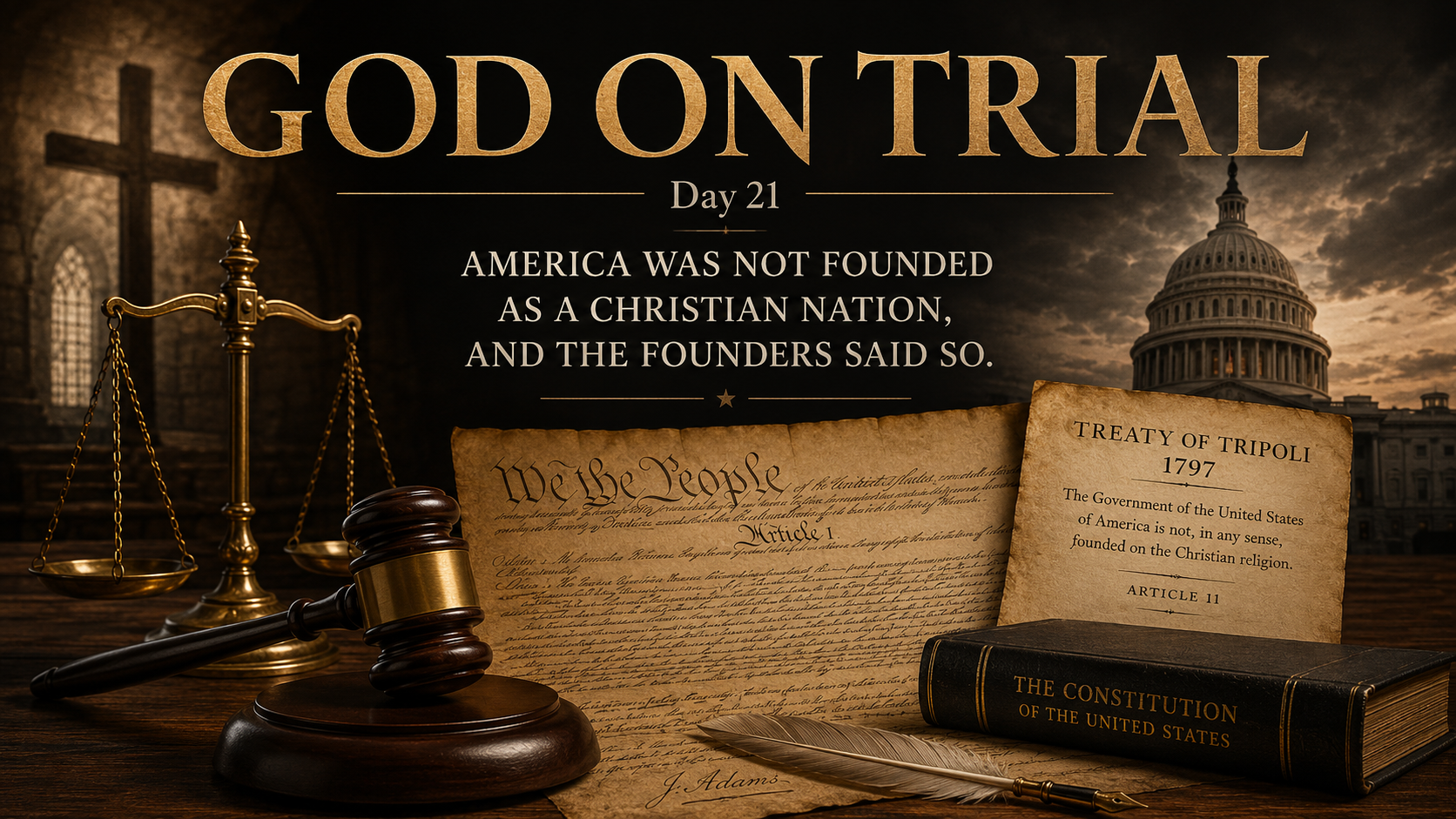
On a Saturday in May 2026, House Speaker Mike Johnson stood on the National Mall and offered a prayer casting the United States as a Christian nation. The event was called "Rededicate 250," organized around the approaching 250th anniversary of the Declaration of Independence. The prayer was not an unusual private act of personal faith. It was a Speaker of the House, the third in line to the presidency, conducting a public religious ceremony on federal land, claiming on behalf of the entire country a founding identity that the founding documents themselves do not support and that the founders themselves explicitly rejected. This is Christian nationalism operating at full throttle in the most visible civic space in America, and it is not being met with the outrage it deserves, because the movement has become so normalized and so loud about its own persecution that the rest of the country has grown exhausted by the argument. This day is for naming the argument plainly and following the historical record to where it actually leads, which is not where Mike Johnson's prayer tried to take it.
The Document That Ends the Debate
Christian nationalists cite the founders constantly. They cite Washington's prayer proclamations. They cite the phrase "endowed by their Creator" in the Declaration of Independence. They cite early state constitutions with religious test oaths. They cite the 1892 Supreme Court decision in Church of the Holy Trinity, in which Justice Brewer declared the United States a Christian nation. These citations are selective, and several of them are misleading in important ways. But Christian nationalists almost never cite the Treaty of Tripoli, and the reason is obvious. The Treaty of Tripoli ends the debate they are trying to have.
The treaty was negotiated beginning under George Washington, signed by President John Adams in 1797 and ratified unanimously by a United States Senate that was still half-filled with men who had signed the Constitution. Article 11 of the treaty contains the following explicit statement, included specifically to reassure a Muslim nation that American foreign policy would not be conducted on religious grounds: the Government of the United States of America is not, in any sense, founded on the Christian religion. Not a subordinate clause. Not a qualifier buried in diplomatic language. A direct, plain declarative sentence, written into a ratified treaty by the founders themselves, at a moment when they were telling the world what kind of country they had built. Nearly every Christian nationalist who argues that the United States was founded as a Christian nation is unaware of this document, or aware of it and hoping you are not.
The 1797 Treaty of Tripoli, ratified unanimously by the Senate and signed by John Adams, stated in Article 11: "The Government of the United States of America is not, in any sense, founded on the Christian religion." It was written to assure the Bey of Tripoli that American foreign policy would not be driven by religious hostility to Islam. The Senate that ratified it included men who had written and ratified the Constitution. Princeton historian Kevin Kruse has noted that despite the founders' clearly secular intent in the founding documents, later generations of Americans began asserting a Christian founding the founders themselves never claimed. The Treaty of Tripoli is the clearest single piece of documentary evidence against that later assertion, which is why Christian nationalists consistently omit it from their historical arguments.
What Madison Actually Said
James Madison is the founder most frequently invoked by Christian nationalists as a defender of religious public life. He is also the founder who wrote the most sustained and specific argument against exactly what Christian nationalism is doing today. In 1785, two years before the Constitutional Convention, Madison wrote the Memorial and Remonstrance Against Religious Assessments in response to a Virginia bill that would have used public tax money to support Christian teachers. His argument was not merely that the bill was bad policy. It was that religion and government corrupt each other when mixed, and that the corruption runs in both directions. Government corrupts religion by giving it state power it was never meant to wield. Religion corrupts government by attaching civic authority to theological claims that cannot be evaluated by the rational methods civic authority requires.
Madison wrote explicitly that experience witnesseth that ecclesiastical establishments, instead of maintaining the purity and efficacy of religion, have had a contrary operation. He saw established churches across Europe and across the American colonies producing not genuine faith but coerced conformity, social pressure, political manipulation and persecution of dissenters. His solution was not to drive religion from public life. It was to draw a clear, structural line between the two domains so that each could flourish in its proper sphere without corrupting the other. The establishment clause that Madison shepherded into the First Amendment was not a concession to irreligion. It was the most sophisticated possible protection for religion against the one thing historically most likely to destroy it: political power.
What Jefferson Actually Said
Jefferson's famous letter to the Danbury Baptists in 1802, which introduced the wall of separation metaphor into American political discourse, is routinely described by Christian nationalists as an obscure private letter with no constitutional significance. Both claims are false. The letter was written to the Danbury Baptist Association in Connecticut, a religious minority group facing real harassment from the Congregationalist establishment that dominated Connecticut's state government. The Baptists had written to Jefferson expressing concern that religious liberty in their state was treated as a privilege granted by government rather than a natural right that existed prior to government. Jefferson's response was a formal statement of federal constitutional principle, not a casual note. The wall of separation he described was not a wall to keep religion out of public life. It was a wall to keep government out of religion's domain, protecting the Danbury Baptists from the majority religious establishment that was making their lives difficult.
When Christian nationalists claim that the separation of church and state is a modern liberal invention with no constitutional basis, they are arguing against the explicitly stated intentions of the author of the Declaration of Independence, written in a formal presidential communication, in response to a petition from a Baptist congregation that was being persecuted by a religious majority. Jefferson was protecting religious minorities from exactly what Christian nationalism now proposes: the use of majority religious preference to shape civic life in ways that coerce everyone else.
Every Christian nationalist who dismisses church-state separation as a modern liberal invention is arguing against the explicitly stated intentions of the founders they invoke constantly. Madison built the wall. Jefferson named it. Adams ratified a treaty declaring the government not founded on Christianity. These were not secret opinions. They were public documents.
The Constitution Does Not Mention God or Jesus
The most straightforward refutation of the Christian nation claim is sitting in the text of the founding document itself. The Constitution of the United States does not mention God. It does not mention Jesus. It does not mention the Bible, Christianity, scripture, the church or any religious tradition whatsoever. The only two references to religion in the original Constitution are both restrictive: the prohibition on religious test oaths for federal office in Article VI, and the First Amendment's establishment clause prohibiting Congress from making any law respecting an establishment of religion. Both are limitations on government's relationship with religion, not affirmations of it. The founders had the text. They made their choices. The absence of God from that text was not an oversight. It was the deliberate decision of men who understood exactly what state religion produced in the countries they had studied and in the colonies they had lived in, and who chose to build something structurally different.
Christian nationalist historians sometimes point to "in the Year of Our Lord" in the Constitution's dating clause as evidence of Christian founding. The phrase is a standard dating convention of the era with no more theological significance than writing A.D. on a check. They point to the Declaration's "endowed by their Creator" language, which is genuine but refers to a Creator in the broadly deistic sense that Jefferson, who rejected the divinity of Jesus and edited the miracles out of the New Testament, consistently used. They point to early state constitutions with Christian requirements, ignoring that most of those requirements were eliminated in the decades following the founding as the Second Great Awakening produced a wave of genuine voluntarist religious revival that had no need of state coercion to sustain it.
Nearly All Serious Historians Agree on This
The Christian nation claim is not a contested historical question among professional historians. Americans United for Separation of Church and State summarizes the consensus plainly: most, nearly all, serious historians agree that America was not founded as a Christian nation in any meaningful legal, philosophical or constitutional sense. Princeton historian Kevin Kruse has documented in detail how the corporate-funded religious campaigns of the mid-twentieth century, not the founding era, produced the widespread popular belief in a Christian founding. It was Eisenhower-era additions, not Jefferson-era documents, that put "under God" in the Pledge of Allegiance and "In God We Trust" on currency. The historical claim that America has always been a Christian nation is, in Kruse's framing, an invention of the 1950s promoted through organized campaigns, not a description of the 1780s. Christian nationalists are not recovering a lost historical truth. They are defending a relatively recent political mythology against the evidence that contradicts it.
The phrase "under God" was added to the Pledge of Allegiance in 1954, during the Eisenhower administration, at the height of Cold War anti-Communist anxiety. "In God We Trust" became the national motto in 1956, replacing "E Pluribus Unum," the original motto chosen by the founders. The National Prayer Breakfast was established in 1953. These additions were deliberate Cold War political choices to contrast American religious identity with Soviet atheism, not recoveries of founding-era practices that had been abandoned. Christian nationalists who treat these mid-twentieth-century additions as evidence of a Christian founding are confusing a Cold War political campaign with the founding generation's actual documented intentions.
The Victimhood Claim That Does Not Hold Up
The most strategically effective move in the Christian nationalist playbook is the victimhood claim. When anyone insists that religion must stay in its lane, that government may not enforce theological positions, that public schools may not conduct officially sponsored Christian worship or mandate scriptural displays, the response is immediate and loud. Christians are under attack. Faith is being driven from the public square. Religious people are being silenced. The secular state is persecuting believers. This framing has been so aggressively promoted and so uncritically amplified that millions of Americans have accepted it as description when it is actually strategy.
The actual request being made by those who insist on church-state separation is modest to the point of being obvious. Practice your faith. Build your churches. Preach your theology. Raise your children in your tradition. Vote your values. Run for office. Make your arguments in the public square through persuasion. All of that is protected without qualification by the First Amendment and should be. What is not protected is using the machinery of government to impose those values on people who do not share them, funding religious instruction with public tax money, mandating scriptural displays in public school classrooms, writing theological positions into civil law and then claiming persecution when the people those laws govern object to being governed by someone else's scripture. The Christians are not being persecuted. They are being declined when they request special authority. Those are not the same thing.
Religion Does Not Need State Power to Thrive
One of the most revealing facts about the American religious experience is that the United States, with its strict constitutional separation of church and state, has historically been among the most religiously active nations in the developed world, far more so than European countries with established state churches. Tocqueville noted this in the 1830s and traced it directly to voluntarism, the fact that American religious participation was free, self-motivated and therefore genuine rather than coerced. When religion does not need government support to survive, the faith that remains is authentic. When religion does need government support, what remains is often not faith at all but cultural conformity maintained by social pressure and legal compulsion.
Madison understood this. He wrote that fifteen centuries of Christian establishment in Europe had produced pride, indolence and the degradation of religion itself. The American experiment in voluntarist religion, protected by a secular state rather than sponsored by one, produced more genuine religious participation than the established churches of Europe ever achieved. Christian nationalists who demand state support for their faith are not fighting for Christianity. They are fighting for a version of institutional Christianity that has historically harmed Christianity wherever it has captured state power. The founders knew this from history. They designed accordingly. Their design has worked for 235 years. The effort to dismantle it in the name of the founders who built it is one of the most audacious historical reversals in American political life.
My Bottom Line
The United States was not founded as a Christian nation. The Treaty of Tripoli says so. The Constitution says so through its silences and its two religion clauses. Madison's Memorial and Remonstrance says so. Jefferson's letter to the Danbury Baptists says so. The entire structure of the founding documents says so through their grounding in Enlightenment reason, natural rights philosophy and the explicitly secular principle that governments derive their just powers from the consent of the governed rather than from divine mandate. The Christian nation claim is a myth developed primarily in the twentieth century for political purposes, contradicted by the documentary record of the founding era and rejected by nearly every serious historian who has studied the question. Christian nationalists who invoke the founders to support this claim are invoking people who wrote the refutation of it into law and into treaty. They deserve to be told so, directly, with the documents in hand, without apology and without any further deference to a victimhood performance that has been running for decades without serious pushback.
Wanting religion to stay in its lane is not persecution. It is the founding principle. The founders built the lane. Madison named it. Jefferson walled it. Adams put it in a treaty. The Christian nation myth requires ignoring all of that. It should be ignored no longer.
Why This Matters
It matters because the Christian nation myth is not a harmless historical disagreement. It is the foundation on which an entire political program is being built. The argument that America was always a Christian nation is the argument that church-state separation is a corruption of the founding rather than its central design feature. Remove that argument and the legal and philosophical justification for mandating Ten Commandments displays in public schools, writing theological positions about marriage and reproduction into civil law, conducting official government prayer services on federal land and scoring legislators by their faithfulness to scripture collapses entirely. Christian nationalists know this, which is why the historical claim matters so much to them and why the historical refutation of it matters so much to everyone else. The founders did not build this republic on scripture. They built it on reason, liberty and the consent of citizens who were not required to share any faith as a precondition of full membership. Defending that founding against the people who are misrepresenting it is not hostility to religion. It is fidelity to the actual republic the founders actually built.
References
- Treaty of Tripoli, Article 11. (1797). Ratified unanimously by the U.S. Senate; signed by President John Adams.
- Madison, J. (1785). Memorial and Remonstrance Against Religious Assessments.
- Jefferson, T. (1802). Letter to the Danbury Baptist Association.
- U.S. Constitution. (1787). Article VI, Clause 3; First Amendment.
- Kruse, K. M. (2015). One nation under God: How corporate America invented Christian America. Basic Books.
- Fea, J. (2011). Was America founded as a Christian nation? Westminster John Knox Press.
- Seidel, A. L. (2019). The founding myth: Why Christian nationalism is un-American. Sterling.
- Americans United for Separation of Church and State. (2026). Statement on the Christian nationalist rewriting of American founding history. au.org.
- ARC Magazine. (2025, October). The Christian nationalist rewriting of American history. arcmag.org.
- MS NOW. (2026, July 1). America's founders could have designed a Christian nation. They wisely decided not to.
Disclaimer: The views expressed in this post are the personal opinions of the author and are offered for educational, commentary and public discourse purposes only. They do not represent the positions of any institution, employer, organization or affiliated entity. Nothing in this post constitutes legal, financial, medical or professional advice of any kind. This post engages critically with specific political movements, public officials' public statements and historical claims and does not make claims about any individual's private faith or sincere religious belief. References to public figures reflect their public statements and public actions only. Commentary on religious, political and constitutional subjects reflects the author's independent analysis and is protected expression of opinion. Readers are encouraged to consult primary sources and form their own conclusions.