Turn on the television, open a fundraising email or sit through a sermon reworked into a political rally, and you will hear some version of the same message: the country cannot survive without being saved. Saved from godless secularists. Saved from Christian nationalists. Saved from socialists. Saved from fascists. Saved from the other party, which is one election away from ending the republic as we know it. Strip away the specific villain of the week and the structure underneath is identical, and it is worth naming plainly, because the people spreading it are the actual source of the panic the rest of this piece is written to correct.
Two groups profit most from this framing, and they borrow from each other's playbook constantly. The first is a strain of religious rhetoric that has fused national politics with spiritual warfare, casting policy disputes as battles against literal evil and treating electoral defeat as evidence that the nation has fallen out of God's favor and needs collective repentance to be spared judgment. The second is a strain of partisan rhetoric, present on the left and the right in roughly equal measure, that casts the opposing party not as fellow citizens with different priorities but as an existential threat that must be defeated to save democracy, the Constitution or the country itself.
Both narratives share the same structure. Identify an enemy. Declare the stakes apocalyptic. Position yourself, your candidate, your church or your donation link as the last line of defense standing between the country and collapse. Ask for money, attention, votes or obedience in exchange for salvation from a catastrophe that, on inspection, keeps failing to arrive on schedule.
Fear retains attention better than reassurance. Apocalyptic framing raises more money than sober analysis. A movement that convinces its own supporters the country will not survive the next election has built itself a permanent excuse for any tactic and a permanent audience that cannot afford to look away.
This is not a both-sides platitude offered to avoid taking a position. It is an observation about a shared business model, and naming it does not require pretending every concern raised inside that rhetoric is fake. Some of the underlying issues are real. The packaging around them, the constant insistence that the nation is one election, one court ruling or one sermon away from needing rescue, is the part that deserves to be called what it is. Garbage, dressed up as urgency.
The Real Concerns Underneath the Noise
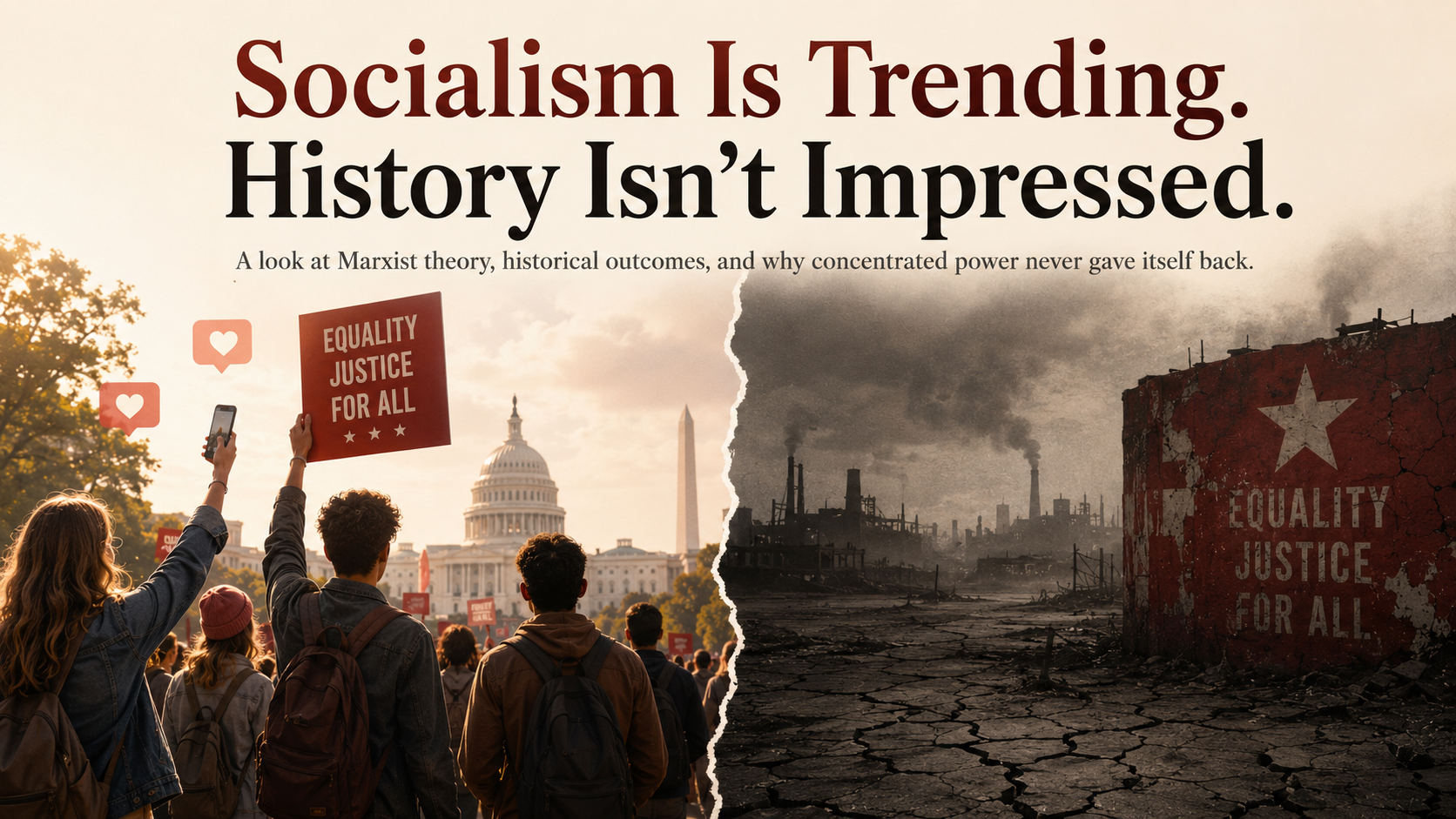
There is no shortage of serious issues to worry about in America. Socialism is no longer a word confined to dusty political theory books. Illegal immigration places real pressure on communities, public services, wages, housing and the rule of law. Political extremism has become louder, angrier and increasingly comfortable treating fellow Americans as enemies. Both parties warn that the other side is one election away from destroying the country. Every political faction seems convinced that another faction is about to seize permanent control.
These concerns should not be dismissed. A nation can lose its freedom, prosperity and social cohesion if its citizens become complacent. Bad policies have consequences. Borders matter. Elections matter. The Constitution matters. Economic systems matter. Culture matters. Anyone who says none of these things can ever be threatened is ignoring history.
But history teaches another lesson too. Not every threat becomes a catastrophe, not every movement succeeds and not every election is the final battle for the soul of the nation. America is extraordinarily difficult to remake overnight. That is not because our politicians are unusually wise or trustworthy. It is because the country is simply too large, too complex, too decentralized and too stubborn to be transformed as easily as the doomsayers, religious or partisan, claim.
Why America Is Hard to Remake Overnight
The United States has a massive, interdependent economy involving hundreds of millions of people, millions of businesses, fifty state governments, thousands of counties and cities, countless contracts, vast private-property interests and deeply established financial institutions. Turning that system into a socialist economy would require far more than electing a few politicians who use socialist language. It would require dismantling or radically altering institutions upon which nearly every American, including the advocates of socialism, depends.
Likewise, one faction cannot easily take over the country merely by winning an election. The president does not govern alone. Congress is divided into two chambers. Courts can restrain executive and legislative action. States possess their own constitutional powers. Elections recur. Federal agencies are bound by law and procedure. Private organizations, businesses, media outlets, religious institutions, civic groups and millions of individual citizens all exert influence outside Washington. Alexander Hamilton and James Madison built this by design, arguing in Federalist No. 51 that ambition must be made to counteract ambition, with each branch of government given the constitutional means and personal motive to resist encroachment by the others.
None of these safeguards is perfect. Every institution can be abused, weakened or corrupted. Yet the sheer number of competing interests creates enormous resistance to permanent control by any one group. What frustrates us as government gridlock can also protect us from sudden political domination.
The Constitution Was Built to Resist Being Rewritten
The Constitution adds another layer of inertia. It can be amended, but deliberately so. Under Article V, an amendment must clear a two-thirds vote in both chambers of Congress, or a convention called by two-thirds of state legislatures, and then ratification by three-fourths of the states, a bar so high that only twenty-seven amendments have succeeded in well over two centuries. Americans may argue about constitutional meaning, and courts may reinterpret provisions over time, but completely rewriting the structure of the republic is not something a temporary congressional majority, one preacher or one president can casually accomplish.
Culture Resists Being Marched in One Direction
Culture is even harder to command. Americans do not agree on much, but they remain deeply attached to personal choice, private ownership, local control, free expression and the right to tell authority to go to hell. That instinct crosses party lines, even when people apply it inconsistently. A population this diverse, argumentative, armed with competing media and spread across a continent is not easily marched in a single ideological direction, no matter which pulpit or podium is doing the marching.
Decline Doesn't Happen by Vote. It Happens by Accumulation.
This does not mean decline is impossible. Countries rarely collapse because everyone wakes up one morning and votes to destroy them. Decline usually occurs through accumulation: debt that grows year after year, laws that are selectively enforced, institutions that lose public trust, borders that become meaningless, speech that becomes dangerous and citizens who stop defending principles because doing so is inconvenient.
That is why concern is necessary. Panic, however, is not.
The Chicken Little Problem
Too many political commentators, and no shortage of pulpits, make their living by declaring that the sky is falling. Every bill is the end of freedom. Every election is the last free election. Every protest is the beginning of civil war. Every policy mistake proves that dictatorship, or judgment, is weeks away. The outrage may attract clicks, donations, viewers, followers and offering plates, but eventually it creates the Chicken Little problem.
When everything is an emergency, nothing is.
The people who predict national collapse every six months eventually resemble the boy who cried wolf. Even when a genuine danger appears, much of the public stops listening. Constant exaggeration does not strengthen a political or religious cause. It destroys its credibility. It also exhausts ordinary citizens, who cannot remain in a permanent state of fear and anger. Pew Research has tracked this exhaustion directly, finding that large majorities of Americans report feeling worn out by the sheer volume of political news, a fatigue that sets in regardless of party.
What Real Vigilance Looks Like
We should be able to say that illegal immigration is a serious national problem without claiming it guarantees the immediate end of the United States. We should be able to oppose socialist policies without pretending America will become the Soviet Union after the next budget bill. We should confront political extremism without assuming every foolish activist represents half the country, and we should criticize presidents, governors, judges and members of Congress without treating each one as the final villain in the American story.
Perspective is not complacency. It is discipline.
The healthier position lies between denial and hysteria. Pay attention. Vote. Speak plainly. Defend the Constitution. Demand secure borders and equal enforcement of the law. Challenge destructive economic ideas. Resist political violence and authoritarian behavior regardless of which side, or which pulpit, engages in it. But also recognize the strength and inertia built into the American system.
The United States has survived a civil war, depressions, world wars, assassinations, riots, corruption, terrorism, pandemics and political movements far more dangerous than most of what trends on social media today. Survival was never automatic, and it came at tremendous cost. Nevertheless, the country endured because its institutions, economy, culture and people were more resilient than the pessimists, religious or secular, ever expected.
Our problems are real. Some are severe. They deserve attention rather than ridicule. But worry should lead to sober action, not theatrical predictions of unavoidable doom.
The wolf may occasionally appear. That is precisely why we should stop shouting that it is already at the door every time a branch moves in the woods.
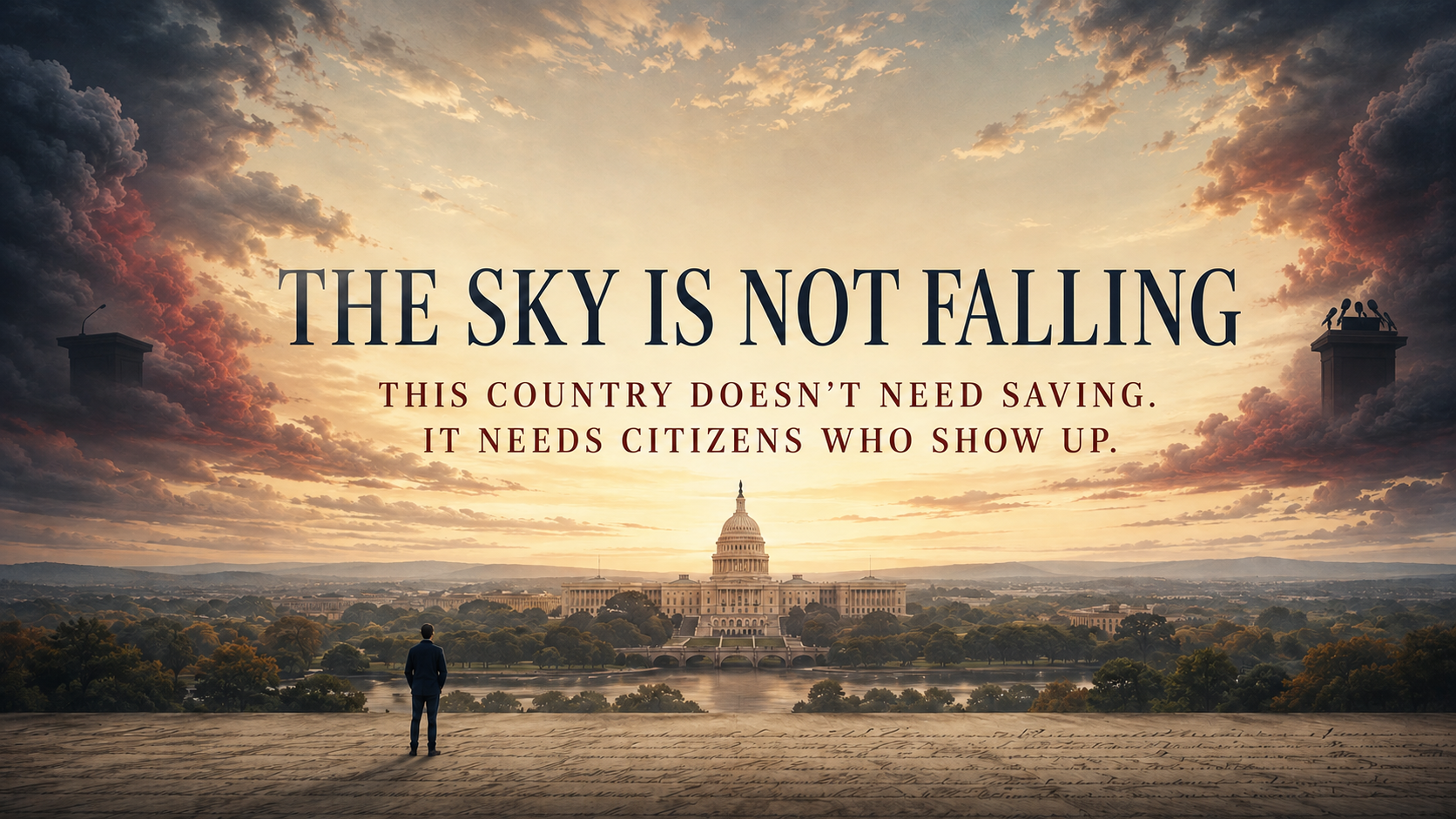
This Country Doesn't Need Saving. It Needs Citizens Who Show Up.
This is where the religious and partisan salvation narratives collide directly with the actual text of the founding documents, and lose. This nation does not need saving, not by God, not by any god, not by any religion, not by whichever party currently claims it alone can prevent the apocalypse. The Constitution's own first words settle the question of where this system's authority comes from. "We the People of the United States, in Order to form a more perfect Union... do ordain and establish this Constitution for the United States of America." Not a monarch. Not a church. Not a deity. Us.
The Declaration of Independence, a separate document written for a separate purpose, does invoke "the Laws of Nature and of Nature's God" and "their Creator" as philosophical grounding for certain unalienable rights, and that language reflects the founding generation's worldview honestly. But it is the Constitution, not the Declaration, that actually creates the government, distributes its powers and binds its officers, and the Constitution deliberately contains no invocation of God anywhere in its operative text. Article VI is explicit on the point: no religious test shall ever be required as a qualification for any office or public trust under the United States. The 1797 Treaty of Tripoli, negotiated under Washington and ratified unanimously by the Senate under Adams, stated the matter even more plainly, declaring that the government of the United States "is not, in any sense, founded on the Christian religion."
None of that erases the cultural inheritance this country carries. The nation's civic habits and moral vocabulary were shaped over centuries by a largely Christian tradition, and that history is real. But culture and legal authority are two different questions. The Constitution's authority does not derive from any deity, and it does not derive from either political party. It derives from the people who ordained it and the people who continue to consent to be governed by it.
The Constitution is a human document, ordained by human beings, amendable by human beings and defended, when it is defended at all, by human beings willing to show up, vote, serve on juries, run for office, sit through hearings, write laws and occasionally risk their lives for it. No deity signed it. No political party owns it. No preacher and no pundit is entitled to tell you the republic dies without their particular brand of salvation. If the republic survives, that will be because citizens did their job, not because heaven or a party platform intervened on the country's behalf.
This country doesn't need saving. It needs citizens who show up.
That is not an argument against faith. Plenty of Americans draw personal strength, morality and hope from religious belief, and that remains entirely their own business under the same Constitution that protects it. It is an argument against outsourcing responsibility to whoever is currently selling salvation, spiritual or political. A country that waits passively to be rescued, by God, by a strongman or by whichever party wins in November, is a country that has already stopped governing itself. The Founders did not write a document asking Providence, or a party, to keep the republic alive. They wrote a document asking us to.
Why This Matters
A free society depends on citizens who can recognize danger without becoming addicted to fear, and without handing that fear over to whoever profits from stoking it. Constant political and religious panic makes people easier to manipulate, less willing to compromise and more likely to accept extreme measures in the name of defeating an allegedly existential enemy. America needs vigilance, but it also needs proportion, and it needs citizens who can tell the difference between a genuine warning and a fundraising pitch dressed up as one. We can take socialism, illegal immigration, political extremism and institutional overreach seriously while remembering that this country is far more durable, and far harder to capture, than the doomsayers, in the pulpit or on the ballot, would have us believe.
References
- Hamilton, A. or Madison, J. (1788). Federalist No. 51. [On the separation of powers and institutional checks: "ambition must be made to counteract ambition."]
- National Archives. The Constitution of the United States: A Transcription. archives.gov. [Preamble language; Article V amendment process; Article VI, Clause 3 on the prohibition of religious tests for public office.]
- National Archives. The Declaration of Independence: A Transcription. archives.gov. [Invocation of "Nature's God" and "their Creator," distinct from the Constitution's operative text.]
- National Archives. Treaty of Tripoli (1797). archives.gov. [Article 11 language on the U.S. government's secular founding.]
- Pew Research Center. Americans' Views of Government and Political News Fatigue. pewresearch.org.
- Gallup. Socialism and Capitalism Attitudes in the U.S. gallup.com. [Polling trends on socialism's growing favorability, particularly among younger Americans.]
- Congressional Budget Office. The Fiscal and Economic Effects of Immigration. cbo.gov.
Disclaimer: This article reflects the author's personal opinions and is intended for commentary and public discourse only. It does not endorse political violence, unlawful conduct or hostility toward any individual or group, and its criticism of apocalyptic rhetoric applies equally across religious and political lines rather than targeting any single faith, denomination or party. It does not represent the positions of any institution, employer, organization or affiliated entity with which the author may be associated in any capacity. Political and religious commentary is protected opinion under the First Amendment. Readers are encouraged to consult primary sources and form their own conclusions.