Invoking the Fifth does not prove guilt. It does prove that Fauci chose legal self-protection over public explanation. After everything Americans were ordered, pressured and shamed into doing in the name of his expertise, they deserved more than that.
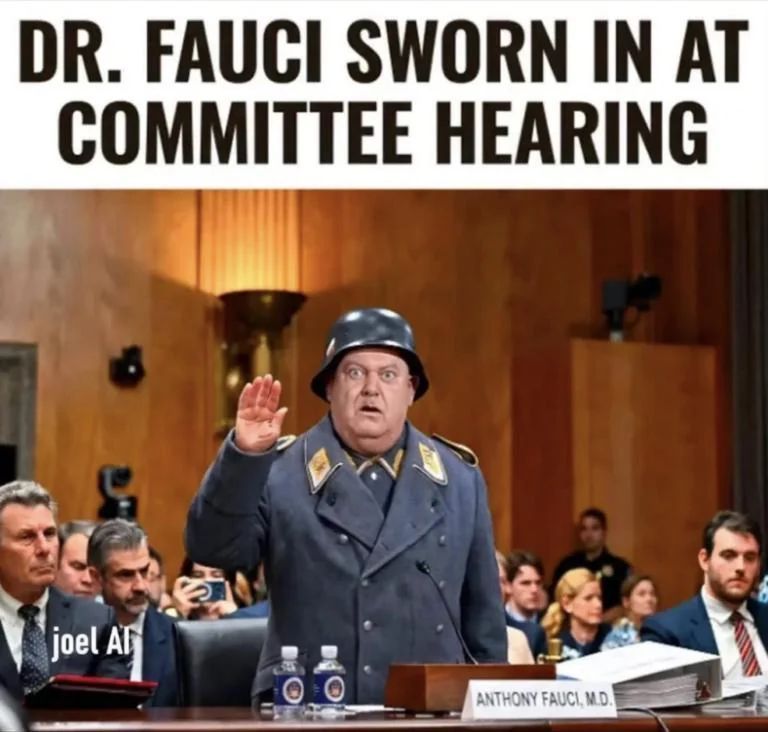
Dr. Anthony Fauci had another opportunity to address the American people. He could have explained what he knew about COVID-19's origins, why scientists privately considered possibilities that were publicly dismissed, what role his advice played in shutdowns and school closures and whether the government's funding and oversight of risky virus research were adequate. He could have admitted mistakes. Every official involved in a crisis of that magnitude made some. Instead, when Fauci appeared under subpoena before the Senate Homeland Security and Governmental Affairs Committee on July 29, 2026, he invoked the Fifth Amendment more than 100 times. He said he believed Senator Rand Paul was trying to trap him into a statement that could lead to prosecution and that he was following his attorney's advice. Fauci had the constitutional right to remain silent. I would never argue otherwise. Having the right to refuse does not make the refusal admirable. It does not restore public trust. It does not clear the record. It does not help Americans understand what happened during one of the most disruptive periods in modern history. It looks even worse when placed beside a newly released diary that sometimes appears less concerned with scientific uncertainty than with celebrity interviews, magazine profiles, Hollywood praise, bobbleheads and the extraordinary experience of being Dr. Anthony Fauci.
A Diary Full of Fauci
Senator Paul released more than 1,000 pages of Fauci's pandemic-era journal before the hearing. The material covers government meetings, scientific discussions, conflicts within the Trump administration and Fauci's rapidly expanding public profile. A personal diary is naturally going to contain personal observations. It is understandable that Fauci would record the surreal experience of becoming internationally famous almost overnight. The accumulation is still bizarre.
In May 2020, Fauci wrote that the explosion of his national and international fame was almost unimaginable. He described himself as perhaps the most discussed person in America and one of the world's most recognizable people. The diary tracks Brad Pitt portraying him on Saturday Night Live, a Billy Crystal spoof, an email from Barbra Streisand, praise from author Sally Quinn and a conversation with Julia Roberts in which she reportedly called him her hero. Fauci preserved images of masks, portraits, murals and bobbleheads bearing his likeness. Some entries show discomfort, but he documented the attention in remarkable detail regardless. This was happening while families were losing businesses, children were sitting at home, patients were dying without relatives beside them and millions of Americans were being told that extraordinary restrictions were necessary because experts like Fauci understood the danger better than they did. Against that background, pages devoted to celebrities being thrilled to meet him do not read well.
The diary does not prove every accusation critics have leveled at Fauci. His January 2020 entry described the Wuhan market as an amplifier rather than the original source of the outbreak, language he used nearly identically in public statements weeks later. That particular entry does not show him secretly contradicting his public position. The diaries do show scientists considering a laboratory origin early in the pandemic, which deserves scrutiny given that the lab-leak possibility was later treated in some circles as a disreputable conspiracy theory. Private scientific uncertainty during an unfolding crisis is not by itself proof of a criminal conspiracy. What the diary establishes is something more limited but still troubling: the public image of a reluctant, purely scientific adviser does not fully match the private record of a powerful official who tracked his own celebrity closely, knew he influenced major decisions and later resisted accepting responsibility for the consequences of that influence.
When Public Health Became a Personality Cult
Fauci did not create his celebrity status alone. Much of the national media transformed him from a government scientist into a cultural symbol. His face appeared on merchandise. He received flattering profiles and entertainment coverage. Criticizing him was increasingly treated not as disagreement with a government official but as hostility toward science itself. That was unhealthy. Science is a method. It is not a person and it is certainly not a government employee, regardless of how impressive his resume may be. Scientific claims must remain open to challenge, correction and replacement. A healthy scientific culture says: here is the evidence, here are its limitations and here is what we still do not know. A personality cult says: trust the expert. Once Fauci became the embodiment of the science, questioning him became politically and socially dangerous. That made genuine scientific debate harder because challenges to policy were often interpreted as attacks on medicine, intelligence or basic human decency.
Science is a method. It is not a person. Once Fauci became the embodiment of the science, questioning him became socially dangerous. That is not how science is supposed to work. That is how religions work.
He Had Influence Even When He Lacked Legal Authority
Fauci's defenders often make a technically correct but incomplete argument: Fauci did not possess the legal authority to close a school, restaurant, church or business. That is true. Governors, mayors, school boards and other officials issued those orders. Legal authority is not the same as influence. According to his diary, Fauci spoke with New York City Mayor Bill de Blasio in March 2020 and persuaded him to close city schools. He recorded a similar conversation with an official working for California Governor Gavin Newsom who intended to close schools and restaurants. CBS reported that Fauci's words carried substantial weight with the officials who held the actual power to impose restrictions. Yet in an October 2022 ABC interview, when asked about prolonged school closures, Fauci resisted accepting responsibility and said he had nothing to do with closing schools. He correctly noted that he was not the head of a school board. That response avoided the more important question of influence.
That discrepancy is exactly what Fauci should have addressed at the Senate hearing. Did he recommend the initial closures? Did he believe they continued too long? Did local officials overextend his advice? Did he later minimize his role because the consequences had become politically unpopular? Those are answerable questions that require no screaming, no insults and no criminal accusations. They require an honest distinction between issuing an order and using scientific authority to persuade someone else to issue it. Fauci could have said: yes, I advised temporary closures based on the information available in March 2020, and some jurisdictions kept schools closed longer than I supported. That would at least be an answer. "I had nothing to do with it" sounds like something else.
The Fifth Amendment Is Not Proof of Guilt
The Fifth Amendment protects people from being compelled to provide testimony that may incriminate them. It is one of the most important constitutional protections that exists and it applies to popular and unpopular people alike. Its purpose is not limited to protecting the innocent. It prevents government from forcing a person to help construct a criminal case against himself. Fauci's invocation of the Fifth does not legally prove that he committed a crime. That point matters. Conservatives who defend constitutional rights cannot decide that the Fifth Amendment is evidence of guilt when the person invoking it is someone they dislike.
Fauci also had a legitimate reason for caution. President Biden's January 2025 pardon covered federal offenses Fauci might have committed between January 1, 2014 and the date of the pardon in connection with his government service. It could not pardon false testimony or conduct occurring at the 2026 hearing. Any new answer could potentially become the basis of a fresh false-statement or perjury allegation. From a criminal-defense perspective, remaining silent was arguably prudent. From a public-accountability perspective, it was regrettable. Fauci was not a private citizen dragged into a random dispute. He was one of the most influential public officials during a national emergency. Americans were instructed to follow policies that affected their employment, education, medical care, worship, travel and family relationships. The public deserved something more than a prepared statement followed by 100-plus invocations of the Fifth.
The senators questioning Fauci did not all distinguish themselves. Some questions were hostile, mocking or theatrical. Senator Josh Hawley reportedly asked Fauci what kind of tie he was wearing. Another senator used profanity. Fauci's attorney was removed from the hearing after repeatedly attempting to speak without recognition. That behavior made the proceeding look more like political entertainment than serious oversight and handed Fauci an argument that the hearing was designed to humiliate rather than uncover facts. Democratic senators described it as politically motivated. More than 150 scientists signed a letter defending Fauci and rejecting accusations made against him. Congressional theatrics do not erase legitimate questions. There is room to believe that Rand Paul has pursued Fauci personally and aggressively while also believing Fauci has avoided accountability. Both can be true. The hearing should have focused on documents, dates, recommendations, definitions and apparent inconsistencies. Instead, both sides helped produce another political spectacle.
Public Service Requires More Than Legal Survival
Fauci's response appears designed to survive a legal proceeding. That is not the same as serving the public. Public officials routinely hide behind carefully limited statements. I did not issue the order. I did not directly approve the payment. I do not recall that particular conversation. That was not the technical definition I was using. My attorney has advised me not to answer. Each statement may be defensible in isolation while still concealing the larger truth. Coming clean does not necessarily mean confessing to a crime. It means explaining what happened without retreating into semantics.
Fauci could have acknowledged that his scientific opinions carried extraordinary political power. He could have admitted that the media's treatment of him became excessive. He could have explained why his diary spent so much time recording celebrity attention during a national emergency. He could have identified recommendations he would change in hindsight. He could have distinguished between defensible early emergency measures and policies that continued after the evidence changed. He could have said he was wrong. Instead, Americans watched the man once presented as the authoritative voice of science refuse to answer even as senators read from a diary in which he had been remarkably willing to talk to himself.
My Bottom Line
Anthony Fauci had the right to invoke the Fifth Amendment. He also had a responsibility to the American public that extended beyond doing whatever his criminal-defense attorney considered safest. The diary's preoccupation with fame is strange, unseemly and revealing. It suggests that Fauci understood he had become more than an adviser. He was a celebrity, a political symbol and a source of authority whose words could shape government action across the country. That makes his later attempts to minimize his influence difficult to accept. The Senate hearing could have been an opportunity to correct the record. Senators indulged in theatrics instead and Fauci sheltered behind a constitutional protection that, while entirely legitimate, left the country no closer to the truth.
Americans are not stupid. They can see when someone spends 1,000 pages of diary documenting how famous they are and then refuses to answer how they used that fame. One of those things is a choice. So is the other.
Why This Matters
Another pandemic will eventually occur. When it does, public health officials will again ask Americans to trust their advice, accept uncertainty and possibly make real sacrifices. That trust cannot be ordered into existence. It must be earned through transparency, humility and accountability. Officials cannot demand unquestioning obedience during a crisis, minimize their influence when policies go badly and then refuse to answer questions after the internal record becomes public. The lesson of the Fauci diary is not that every expert is corrupt or every pandemic policy was unnecessary. The lesson is that no expert should become bigger than the evidence, no government scientist should be treated as the human embodiment of science and no public servant who exercised national influence should expect invoking the Fifth to settle the public's legitimate questions.
References
- Associated Press. (2026, July 29). Fauci repeatedly invokes the Fifth Amendment in a contentious Senate committee hearing. apnews.com.
- Associated Press. (2026, July). Takeaways from Anthony Fauci's COVID-era diaries. apnews.com.
- CBS News. (2026, July). Fauci diaries, released by Sen. Rand Paul, touch on COVID origins and tense relationship with Trump. cbsnews.com.
- U.S. Senate Committee on Homeland Security and Governmental Affairs. (2026, July 29). Testimony of Anthony Fauci.
- ABC News. (2022, October 16). This Week transcript 10-16-22. abcnews.go.com. [Fauci statement on school closures.]
- U.S. Department of Justice, Office of the Pardon Attorney. Pardons granted by President Joseph Biden. justice.gov.
- Congressional Research Service. General protections against self-incrimination: Doctrine and practice. Constitution Annotated. constitution.congress.gov.
Disclaimer: The views expressed in this post are the personal opinions of the author and are offered for educational, commentary and public discourse purposes only. They do not represent the positions of any institution, employer, organization or affiliated entity with which the author may be associated in any capacity, whether academic, professional or commercial. Nothing in this post constitutes legal, financial, medical or professional advice of any kind. Invoking the Fifth Amendment is a constitutional right and does not establish criminal guilt. All factual claims are drawn from publicly documented sources cited above. Allegations concerning Dr. Fauci, COVID-19's origins and federally supported research remain disputed unless established through competent evidence or a court proceeding. Commentary reflects the author's independent analysis and is protected expression of opinion under the First Amendment. Readers are encouraged to consult primary sources and form their own conclusions.