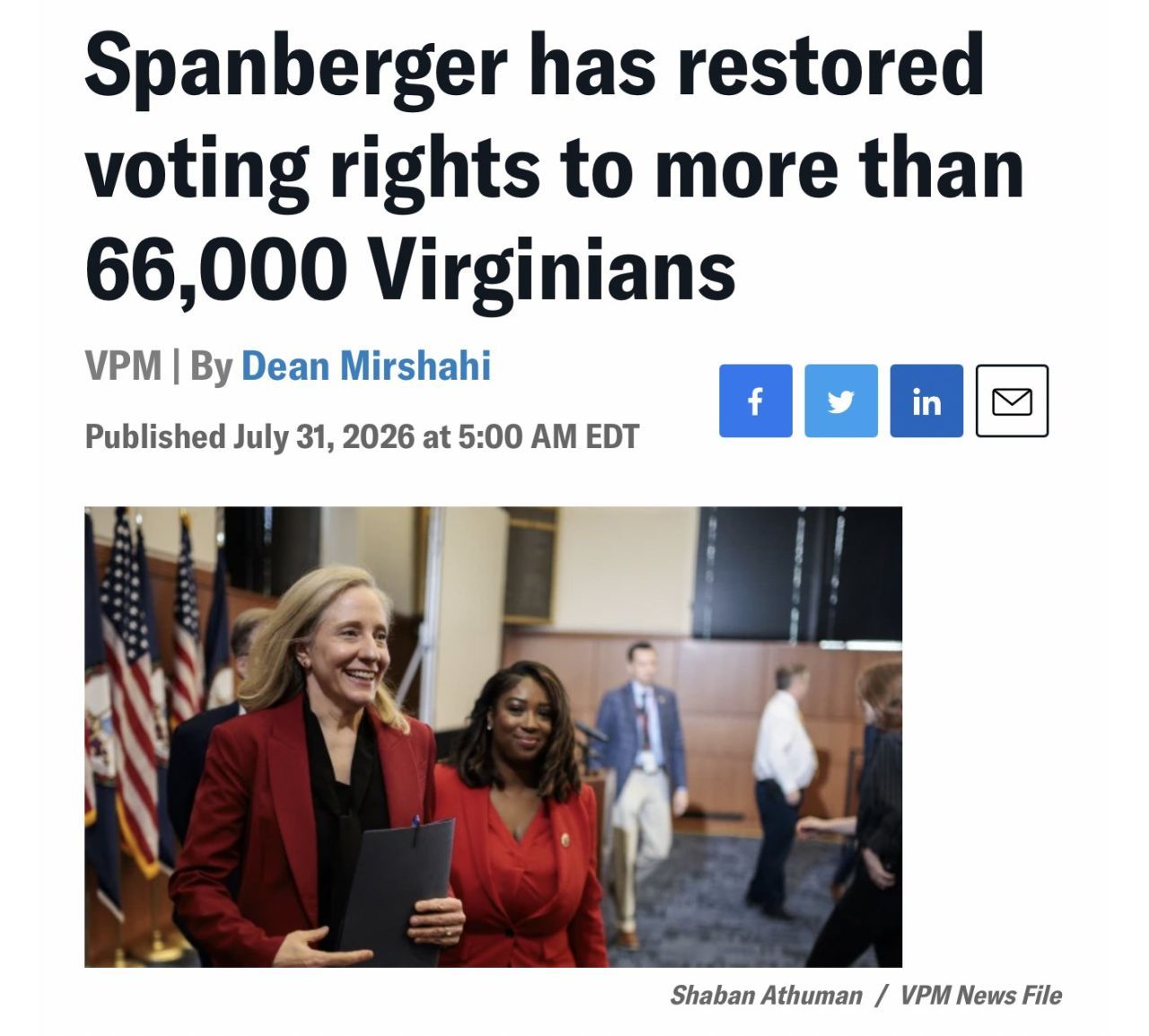
A social media post celebrating a governor for restoring rights is not automatically wrong. It is not automatically complete. The number is accurate. The framing around it deserves scrutiny.
A social media post is celebrating Virginia Governor Abigail Spanberger for restoring voting rights to more than 66,000 people convicted of felonies. It portrays the action as correcting former Governor Glenn Youngkin's supposed effort to deny Virginians their fundamental rights. The number itself appears accurate. On July 31, 2026, Spanberger's office announced that her administration had restored civil rights to 66,085 formerly incarcerated Virginians since she took office in January. Those restored rights include voting, serving on a jury, running for public office and becoming a notary public. Firearm rights are not restored by the governor through this process. That is what happened. What needs examining is the suggestion that Youngkin arbitrarily stole rights from innocent citizens and Spanberger heroically returned something that could never legally have been taken away. That is not an honest description of Virginia law, American history or the governor's constitutional authority.
These Rights Were Lost Because of Felony Convictions
Virginia's Constitution states that a person convicted of a felony is not qualified to vote unless that person's civil rights are restored by the governor or another appropriate authority. That restriction was not invented by Youngkin. It was already part of Virginia's constitutional system when he entered office. A felony conviction in Virginia results in the loss of several civil rights: the right to vote, serve on a jury, run for office and become a notary. The right to possess a firearm is also affected, though a governor cannot restore firearm rights through the ordinary civil-rights restoration process. Youngkin did not personally strip these individuals of their rights. Their felony convictions triggered the loss of those rights under Virginia law. The governor's role was deciding whether and when to restore them.
Youngkin chose a more restrictive, individual review system. Spanberger chose a faster and much broader restoration system. Youngkin restored rights to fewer than 10,000 people during his four-year term. Spanberger restored rights to 66,085 people in slightly more than six months. People are free to prefer Spanberger's policy. They are also free to prefer Youngkin's. Calling Youngkin's approach an effort to deny Virginians their fundamental rights turns a legitimate policy disagreement into a moral accusation. Those are different things and the difference matters.
Article II, Section 1 of the Virginia Constitution disqualifies people convicted of felonies from voting unless their civil rights are restored by the governor or other appropriate authority. The Virginia Department of Elections confirms that a felony conviction results in loss of the right to vote, serve on a jury, run for public office and become a notary. These are not new Republican restrictions. They are provisions of Virginia's constitutional framework that predate both Youngkin and Spanberger. The governor's role under that framework is discretionary restoration, not the original deprivation.
What "Served Their Time" Actually Means Here
Spanberger repeatedly described these Virginians as having "served their time." That phrase creates the impression that everyone had completed prison, parole, probation, restitution, fines and every other court-ordered obligation before having their rights restored. That is not what Virginia's current restoration standard requires. Under the Spanberger administration's published policy, a person is eligible to apply for restoration after being released from incarceration. The person does not necessarily have to complete probation or parole. The administration also removed a Youngkin-era application question asking whether fines, fees and restitution had been paid.
That does not automatically make the policy wrong. It does make "served their time" an incomplete description. A person can be out of prison while still serving a criminal sentence under supervision. A person can also owe restitution to a victim or remain subject to other court-ordered obligations. The honest statement would be that Spanberger restored rights to more than 66,000 formerly incarcerated people who were no longer in prison. That is materially different from claiming that every person had finished every part of the sentence. The distinction matters to the victims of the crimes involved, who may still be owed restitution. It also matters to the public evaluating whether the policy is being described accurately.
Out of prison is not the same as having completed a sentence. A person can be released from incarceration while still on parole, still on probation and still owing restitution to a victim. "Served their time" is a phrase designed to foreclose that question rather than answer it.
A Federal Court Had Already Changed Virginia's Rules
The viral post also omits a major legal development that occurred before Spanberger announced the 66,085 restorations. In January 2026, a federal court ruled that the federal Virginia Readmission Act of 1870 prevents Virginia from disenfranchising people for every modern felony. Under the ruling, voting rights can be removed only when the offense corresponds to a felony recognized under common law in 1870. Virginia's Department of Elections now states that people convicted of felonies that do not correspond to those historic common-law offenses may be eligible to register without receiving a restoration order from the governor at all. Those convicted of an applicable common-law felony still require gubernatorial restoration.
This raises questions the governor's announcement did not answer. It provided no breakdown of the offenses committed by the 66,085 people. It did not explain how many remained legally disenfranchised under the narrowed 2026 standard. It did not explain how many might already have been eligible to register because of the federal ruling without any action from Spanberger's office. The restoration figure is also not the same as 66,085 newly registered voters. People whose rights are restored must still complete voter registration requirements before voting. The number may be correct. The number alone does not tell the complete story and the press release appears to have been written with that in mind.
Felony Disenfranchisement Is Not a New Republican Invention
The claim embedded in this narrative, that felony disenfranchisement is simply a shameful relic of the Jim Crow past being weaponized by modern Republicans, is historically incomplete. There is no question that some states used criminal laws and disenfranchisement provisions in racially discriminatory ways during and after Reconstruction. That history should not be ignored or excused. It is also not the whole history. Research published in Studies in American Political Development traces American criminal disenfranchisement policies through the colonial period and early republic. Kentucky included felony disenfranchisement language in its 1792 constitution. Vermont followed with restrictions involving bribery and corruption. Ohio's 1802 constitution authorized disenfranchisement for bribery, perjury and other infamous crimes. Additional states adopted similar provisions in the early nineteenth century, predating the Civil War, Reconstruction and Jim Crow by decades.
The Fourteenth Amendment itself recognizes the possibility of denying voting rights for participation in rebellion or other crime. In Richardson v. Ramirez in 1974, the United States Supreme Court relied on that language when upholding state authority to disenfranchise people convicted of felonies. That does not mean every disenfranchisement law is wise, fairly administered or immune from constitutional challenge. A law enacted or enforced for purposeful racial discrimination can still be unconstitutional. It does mean that felony disenfranchisement is not some fringe idea created by Glenn Youngkin or modern Virginia conservatives. It has existed throughout most of American history and is expressly recognized within the constitutional structure. Pretending otherwise is not history. It is advocacy dressed as history.
In Richardson v. Ramirez, 418 U.S. 24 (1974), the United States Supreme Court held that the Fourteenth Amendment's Section 2, which references the abridgment of voting rights for "participation in rebellion, or other crime," implicitly permits states to disenfranchise people convicted of felonies without violating the equal protection clause. The Court did not hold that such disenfranchisement was required or that discriminatory applications were protected. It held that the practice was constitutionally permissible within the framework the amendment itself established. That case remains controlling authority on the constitutional question.
Voting Is Fundamental. It Has Never Been Unconditional.
Voting is one of the most important rights of American citizenship. Calling it foundational is reasonable. Calling it absolute is not. Citizens must meet age, residency, registration and citizenship requirements. States can restrict voting by people who have been judicially declared unable to understand the act of voting. Criminal convictions can result in restrictions that courts have long recognized as constitutionally permissible. Convicted felons frequently lose more than physical freedom. Depending on the jurisdiction and the offense, they can lose firearm rights, jury eligibility, eligibility for public office, certain professional licenses and other civil privileges. The serious question is not whether these consequences exist. They clearly do. The serious question is when those rights should be restored.
Should restoration occur automatically upon release from prison? Should it occur after probation and parole are completed? Should restitution to victims be paid first? Should violent offenses be treated differently from nonviolent offenses? Should repeat offenders receive the same treatment as first-time offenders? Should the governor consider each case individually? Those are legitimate policy questions and reasonable people land in different places on them. Spanberger's press release largely avoids them by treating broad immediate restoration as an unquestionable moral good and individual case review as an attempt to deny rights. A press release is not obligated to be a policy analysis. Treating a press release as one is the audience's mistake to avoid.
Virginia Voters Will Decide What Comes Next
Virginia voters are scheduled to consider a constitutional amendment on November 3, 2026. The proposed amendment would generally remove restoration from the governor's discretion and automatically return political rights upon release from incarceration. It would not require completion of probation, parole or the entire criminal sentence before voting rights return. That is a substantial change in public policy and it deserves honest debate from both sides. Supporters should explain why release from prison is the appropriate trigger for automatic restoration and why probation, parole, restitution and the nature of the offense should not require further consideration before rights are returned. Opponents should acknowledge that people can complete their obligations, rebuild their lives and become responsible members of society, and that permanent or indefinitely withheld restoration is not obviously the right answer for every offense. Neither side should pretend that a felony conviction has traditionally carried no civil consequences. The voters considering this amendment deserve better than that.
My Bottom Line
The claim that Spanberger restored rights to 66,085 Virginians is accurate. The rest is political packaging. These individuals lost their rights because they were convicted of felonies under a Virginia constitutional provision that existed before Youngkin became governor. Youngkin used a slower case-by-case restoration process. Spanberger replaced it with a streamlined system that proactively identified people for restoration. Many of the recipients were released from incarceration, but that does not necessarily mean they completed probation, parole, restitution or every other portion of their sentences. The announcement also ignores the January 2026 federal ruling that had already made some people with felony convictions eligible to register without any gubernatorial restoration order. Felony disenfranchisement is not a new Republican scheme. It has roots in the colonial period and early republic, appears in the text of the Fourteenth Amendment and has been upheld as constitutionally permissible by the Supreme Court. Spanberger made a policy choice within her constitutional authority. Virginians are entitled to question whether she made the right one, and they should do so with accurate information rather than the version her press office preferred.
Yes, elections have consequences. One of those consequences is that the losing side does not get to define the factual record. The restoration number is real. The claim that Youngkin stole fundamental rights from innocent people is not. Those are different things and the people sharing the post should know the difference.
Why This Matters
This debate is larger than one governor or one social media post. A free society depends on both individual rights and personal accountability. Rights restoration can be appropriate, particularly for people who have completed their obligations and demonstrated rehabilitation. It should not be transformed into a political numbers game or an election-season voter registration campaign without meaningful standards and public transparency. At a minimum, Virginians deserve to know what crimes were involved, whether sentences were fully completed, whether restitution to victims remains unpaid and how the 2026 federal ruling affected the announced total. Restoring civil rights is a serious exercise of governmental power. It deserves more than a slogan, a victory lap and a carefully framed social media post. The voters being asked to make this policy permanent in November deserve the full picture.
References
- Office of the Governor of Virginia. (2026, July 31). Governor Spanberger restores voting rights for more than 66,000 Virginians. governor.virginia.gov.
- Virginia Department of Elections. Felony convictions and voter eligibility. elections.virginia.gov.
- Constitution of Virginia, Article II, Section 1. [Disqualification of convicted felons from voting unless rights restored.]
- Virginia Restoration of Rights. Restoration of rights process. restore.virginia.gov.
- Virginia Department of Elections. Proposed constitutional amendment, Question 3, November 3, 2026. elections.virginia.gov.
- VPM News. (2026, July 31). Spanberger has restored voting rights to more than 66,000 Virginians. vpm.org.
- Schroedel, J. et al. Revisiting the origins of felony disenfranchisement in the United States. Studies in American Political Development. Cambridge University Press. [Documents colonial-era and early republic origins of felony disenfranchisement.]
- Richardson v. Ramirez, 418 U.S. 24 (1974). [Supreme Court upholds state authority to disenfranchise convicted felons under Fourteenth Amendment.]
Disclaimer: The views expressed in this post are the personal opinions of the author and are offered for educational, commentary and public discourse purposes only. They do not represent the positions of any institution, employer, organization or affiliated entity with which the author may be associated in any capacity, whether academic, professional or commercial. Nothing in this post constitutes legal, financial, medical or professional advice of any kind. All factual claims are drawn from publicly documented sources cited above. Commentary on voting rights, Virginia law and political policy reflects the author's independent analysis and is protected expression of opinion under the First Amendment. Readers are encouraged to consult primary sources and form their own conclusions.