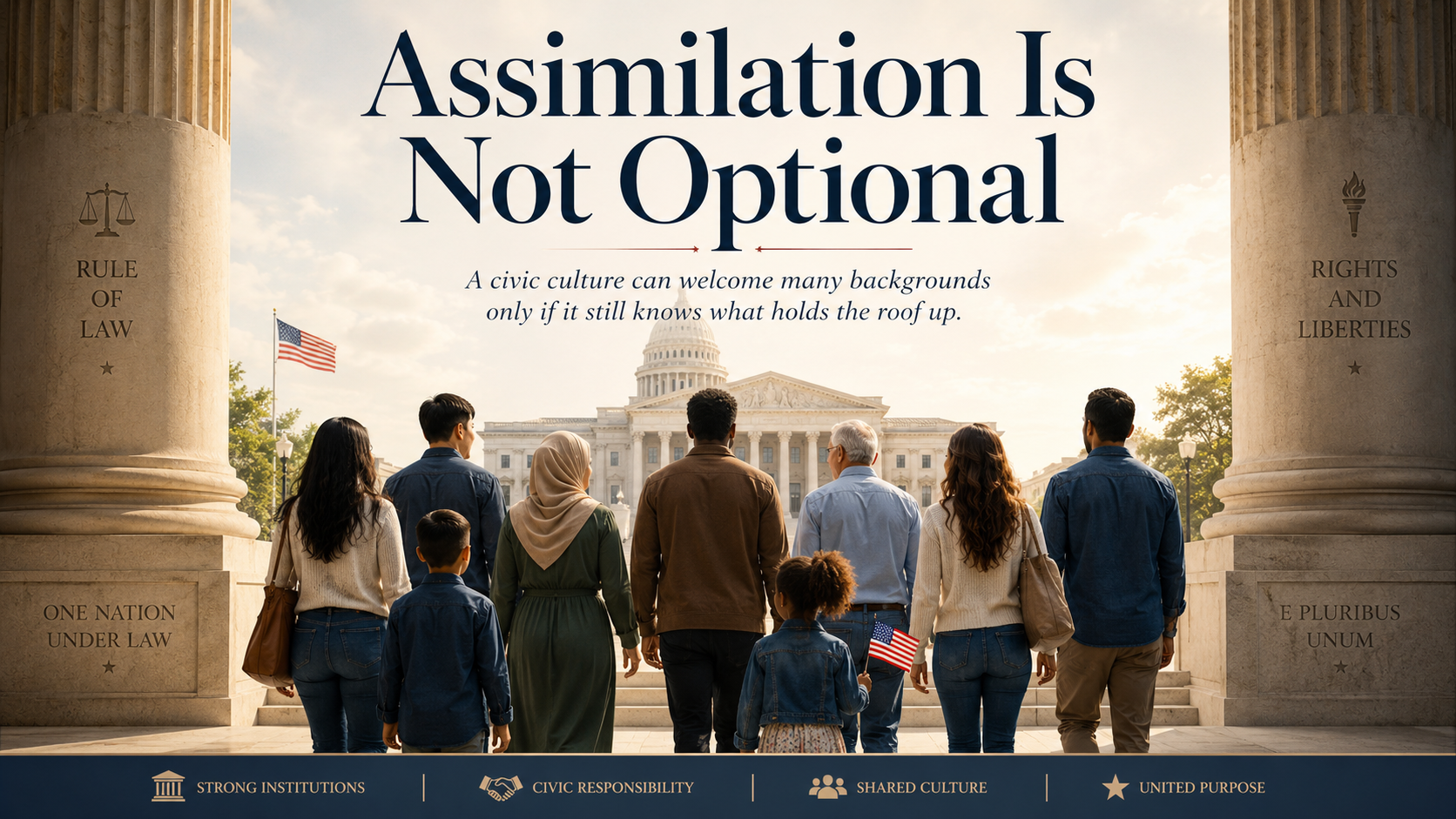
America is, and has always been, a nation built on religious freedom. Nobody who moves here is required to attend a church, believe in God or adopt any faith at all, and that protection is not up for negotiation. But religious freedom is not the same question as cultural origin, and conflating the two has cost this country the ability to have an honest conversation about assimilation. The freedom to worship any religion or none at all was itself produced by a particular culture, with a particular history and a particular set of institutions. That culture did not arrive from nowhere. It grew out of a Christian moral and legal inheritance, carried by English common law, Protestant dissent and Enlightenment philosophy, and it is the reason the freedom exists at all. Immigrants do not need to convert to anything. They do need to understand what they are joining, and why it works.
That distinction gets lost constantly, usually on purpose. Say that American culture has Christian roots and someone will accuse you of wanting a theocracy. That is not the argument. The argument is closer to the opposite. A country that forgets the source of its own freedoms is a country that stops knowing how to defend them, and stops being able to explain to newcomers why those freedoms are worth defending in the first place.
What Actually Built the System
Start with the obvious. The United States did not invent the rule of law, private property, individual rights or representative government out of thin air in 1776. Those institutions arrived already loaded with centuries of prior development, most of it English, most of that development shaped by a specifically Protestant and common law tradition. The idea that government exists to serve the individual, not the other way around, that contracts should be enforced, that no one is above the law, that conscience deserves protection from the state, these were not universal assumptions. They were the product of a particular civilization's long argument with itself, an argument fought largely inside a Christian moral framework even when the combatants disagreed about theology.
Alexis de Tocqueville noticed this on his famous tour of the young republic in the 1830s. He did not find American democracy sustained primarily by its laws. He found it sustained by habits, associations, churches, voluntary institutions and a shared moral vocabulary that made self-government possible without constant coercion. Max Weber later argued that the particular ethic of discipline, thrift and vocation running through Protestant Christianity helped produce the economic culture that made industrial capitalism function. Neither man was writing theology. Both were describing how culture, not just law, does the load-bearing work in a functioning republic.
This is not an argument that America was founded as an explicit Christian theocracy, that the Founders were uniformly devout, or that non-Christian and secular Americans have contributed less to the country. Many of the Founders were Deists or held unorthodox religious views, and the First Amendment's establishment clause exists precisely because the founding generation wanted government kept out of religion. The argument here is narrower. The moral, legal and cultural inheritance that produced American institutions is traceable to a specific civilizational source, and understanding that source matters for anyone joining the country today, regardless of what they personally believe.
Freedom of Religion Is a Product of the Culture, Not a Replacement for It
Here is where the argument gets uncomfortable for people who want to shut it down quickly. The right to worship any religion, or none, in the United States is itself a Christian-culture product. It emerged from centuries of intra-Christian conflict, Protestant dissenters fleeing persecution, colonists who had personally experienced state-enforced religion and wanted no part of repeating it. The First Amendment was not handed down by a neutral committee representing every world religion equally. It was written by men shaped by a specific tradition who concluded, largely for religious and moral reasons of their own, that government coercion of conscience was wrong.
Religious liberty is not evidence that Christianity was irrelevant to the American founding. It is one of Christianity's own arguments, won by people arguing inside that tradition, then extended to everyone else.
That is a meaningfully different claim than "America is a Christian nation" in the theocratic sense, and it deserves to be stated precisely instead of caricatured. Nobody needs to believe in God to benefit from a legal system built by people who did. Nobody needs to attend church to benefit from a work ethic and civic culture shaped by people who did. But understanding where the system came from is different from being required to practice the religion that produced it.
What Assimilation Actually Asks For
Assimilation, properly understood, has never meant conversion. It means understanding and accepting the operating system of the country you have chosen to join. That includes the language, the rule of law, the presumption of individual rights, due process, equal treatment under law regardless of tribe or religion, and yes, the cultural inheritance, heavily Christian in origin, that produced the expectation that these things are owed to every person rather than granted as a favor by whoever holds power.
Every successful wave of American immigration understood this instinctively, even when it wasn't stated this bluntly. Irish Catholics, Italian Catholics, Eastern European Jews, and later immigrants from Latin America and Asia arrived practicing their own faiths, cooking their own food and speaking their own languages at home, while learning English, sending their children to American schools, and adopting the civic assumptions of the country they had joined. Political scientist Samuel Huntington argued in his 2004 book Who Are We? that this pattern, cultural retention alongside civic assimilation into what he called the country's Anglo-Protestant cultural core, was precisely what made large-scale American immigration sustainable for two centuries. His thesis was controversial. It was also, on the historical record of successful assimilation versus failed assimilation, difficult to dismiss.
What Happens When Assimilation Is Treated as Optional
The alternative to assimilation is not diversity. Diversity of background has always coexisted with assimilation in the American model. The alternative to assimilation is parallel society, groups that live inside the country's borders while operating under a different set of legal, cultural or moral assumptions than the ones the country's institutions were built to protect. That is not a hypothetical. European countries that embraced multiculturalism as an explicit alternative to assimilation, rather than as a complement to it, have spent the past two decades publicly relitigating whether that experiment succeeded, particularly around questions of parallel legal expectations, radicalization and civic trust between communities.
America does not have to repeat that experiment to learn from it. A nation that stops asking newcomers to understand and accept its actual operating system, out of fear that asking is somehow bigoted, is a nation quietly consenting to its own fragmentation. Rights that are not understood as universal, rather than tribal or religious in origin, stop being defended as universal. Institutions that nobody is asked to understand eventually have nobody left who knows how to protect them.
You cannot indefinitely defend an inheritance that fewer and fewer people are asked to understand. Eventually there is no one left who remembers what it was for.
The Honest Counterargument
A fair version of this piece has to include the strongest objection to it, and the objection is real. Many serious historians dispute the "Christian nation" framing entirely, pointing to the explicitly secular language of the Constitution itself, the Deism of Jefferson and Franklin, and the Treaty of Tripoli's 1797 statement that the United States government "is not, in any sense, founded on the Christian religion." Other scholars argue that crediting American success to Christian culture specifically, rather than to Enlightenment liberalism, English legal tradition, geography, natural resources, or plain historical timing, is an oversimplification of causes that were interwoven and cannot be cleanly separated. These are legitimate objections, not fringe ones, and anyone making the cultural argument owes readers that acknowledgment rather than pretending consensus exists where it does not.
Where I land is narrower than "Christian nation" and broader than "religion is irrelevant." The specific moral vocabulary, legal habits and civic assumptions that built functioning American institutions have an identifiable and heavily Christian cultural lineage, alongside Enlightenment and common law influences that ran through and were shaped by that same civilization. You do not have to be religious to inherit that vocabulary. You do have to understand it to participate in defending it, and a country that stops teaching it, to immigrants and to its own native-born citizens alike, is a country whose institutions will not survive the people forgetting why they exist.
My Bottom Line
Nobody should be asked to convert. Nobody should be asked to abandon their language at home, their food, their holidays or their private faith. That was never the American bargain and it should not become one now. What should be asked, of every immigrant and frankly of every native-born citizen who has stopped learning it, is an honest understanding of where American rights and institutions actually came from, why they are not universal defaults that every culture and system of government independently arrives at, and why they require active understanding to survive.
Rights are not self-executing. Someone has to understand them well enough to defend them. A country that stops asking anyone to do that work is a country that is quietly deciding it no longer needs its own inheritance.
Why This Matters
This is not an argument for excluding anyone based on religion, and it should never be used as one. A Hindu, a Muslim, a Buddhist, an atheist or anyone else can understand and defend the American system of individual rights and rule of law as fully as anyone born into a Christian household, and many already do, often more fluently than citizens who have never had to think about what they were born into. The argument is that the system they are defending has an identifiable cultural origin, and pretending otherwise, out of a well-meant but mistaken idea that acknowledging that origin is exclusionary, leaves the country without the vocabulary to explain itself to the next generation, immigrant or native-born. A house does not need everyone living in it to have built it. It does need everyone living in it to understand what is holding the roof up, or eventually nobody will notice when it starts to fall.
References
- de Tocqueville, A. (1835/1840). Democracy in America.
- Weber, M. (1905). The Protestant Ethic and the Spirit of Capitalism.
- Huntington, S. P. (2004). Who Are We? The Challenges to America's National Identity. Simon & Schuster.
- National Archives. Treaty of Tripoli (1797). archives.gov. [Article 11 language on the U.S. government's secular founding.]
- National Constitution Center. The First Amendment: Establishment and Free Exercise Clauses. constitutioncenter.org.
- Fonte, J. (2011). Sovereignty or Submission: Will Americans Rule Themselves or Be Ruled by Others? Encounter Books. [On civic assimilation.]
Disclaimer: This article argues that American institutions have an identifiable and significantly Christian cultural lineage, and that civic assimilation, not religious conversion, is essential to sustaining those institutions. It does not argue that any religion should be favored or disfavored by government, that non-Christian or secular Americans contribute less to the country, or that the founding was an explicit theocratic project. Serious historians dispute aspects of the cultural argument made here, and that disagreement is acknowledged directly in the piece rather than elsewhere. The views expressed are the personal opinions of the author for educational, commentary and public discourse purposes only and do not represent the positions of any institution, employer, organization or affiliated entity with which the author may be associated in any capacity. Political and religious commentary is protected opinion under the First Amendment. All factual claims are drawn from publicly documented cited sources. Readers are encouraged to consult primary sources and form their own conclusions.